How to Make Your First $10k Building an AI Company Brain

I am going to show you how to make your first $10k building an AI company brain.
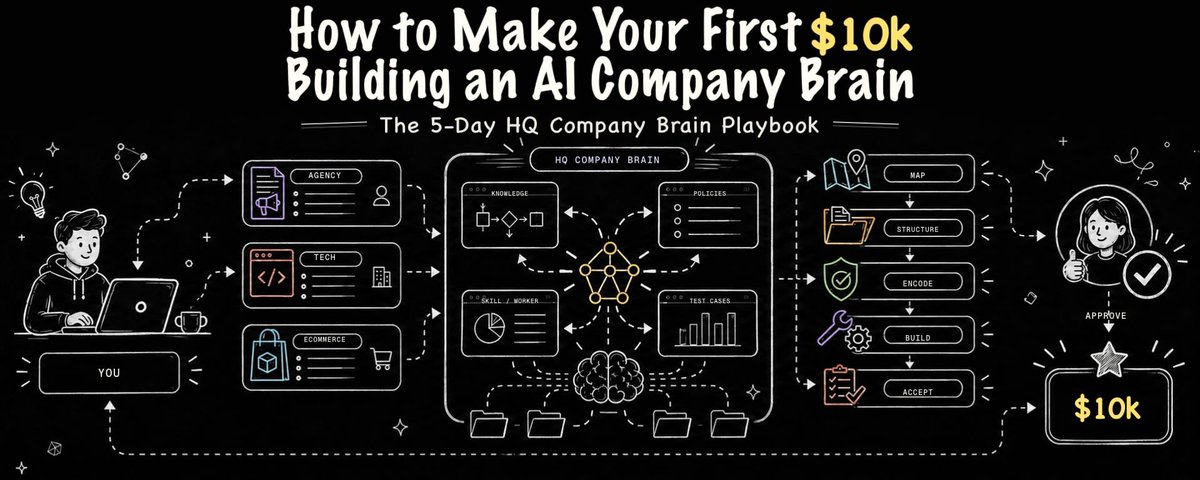
You do not need to build an AI product, become a developer, or call yourself an AI consultant.
Instead, you just need to find one company whose knowledge is scattered across documents, calls, chats, and people's heads. Then turn one repeated workflow into a system its entire team can use.
Charge $10k. Deliver it in 5 days.
We will use HQ to build the system.
The customer is buying a company brain that holds its knowledge, rules, and workflows in one shared context layer, so every person and agent starts from the same place.
In this article:
1, The exact $10k offer
By the end, you will have the offer, scripts, HQ prompts, and checklists required to sell the sprint and deliver it.
Let's build the offer.
1. Sell the repeated problem, not the AI system
Most companies already use AI.
The problem is that every useful session starts with another briefing.
An agency pastes the client's positioning into Claude again. An ecommerce marketer searches for the approved product claims.
A product team explains why last month's launch decision changed. The same context gets rebuilt by different people in different tools.
That repeated explanation is the opportunity.
You are going to take one workflow that depends on scattered company knowledge and give it a permanent home.
For an agency, that could be turning client calls into an approved creative brief.
For an ecommerce brand, it could be turning reviews, product facts, and prior campaigns into a weekly campaign brief.
For a tech company, it could be turning customer calls and product decisions into launch material the team can trust.
The first project should be painfully narrow.
Do not promise to automate the company. Do not map every department. Do not ask for access to every tool.
Sell the first workflow the company never has to explain twice.
2. Package the work as a $10,000 sprint
Open-ended consulting is hard to buy and even harder for a beginner to deliver.
A fixed sprint gives both sides a finish line.
Here is the offer:
The $10,000 Company Brain Sprint
In 5 working days, I will turn one repeated company workflow into a shared AI system your team can run again.
You receive:
Investment: $10,000. Half to begin, half when the acceptance checklist passes.
The 5-day clock starts when the client names one workflow owner and gives you the agreed source material.
Keep the exclusions just as clear.
The sprint does not include custom software, a company-wide migration, deep integrations, or an agent taking external actions without approval.
Private files stay inside the client's HQ. Credentials must come through a client-controlled access path, never a document or chat message.
That boundary protects your margin and makes the offer believable.
The price fits the right workflow. Five team hours each week becomes 260 hours a year. At a blended $100 an hour, the repeated work already costs $26,000 before delays, corrections, or missed opportunities.
This is why the prospect matters. A $10k sprint belongs inside a company where the workflow touches client delivery, campaign output, sales, product launches, or another result with visible value.

3. Target companies with visible context loss
Do not choose prospects by company size alone.
Choose them by the amount of repeated knowledge work.
The best early buyers tend to be agencies, ecommerce brands, tech companies, recruiting firms, professional-services teams, and media businesses.
They usually show the same signals:
several people touch the same deliverable;
the work depends on calls, documents, examples, and unwritten judgment;
someone keeps correcting the same mistakes;
the team already pays for AI tools;
the final output is easy for a human to review; and
one person owns the result and can approve the project.
Use this scorecard before contacting anyone. Give each answer 0, 1, or 2 points.
Prospect scorecard
How often does the workflow happen?
How many people touch it?
How scattered is the required context?
How often is work corrected or rebuilt?
How expensive is delay or poor quality?
How quickly can the owner judge a good output?
A prospect scoring 9 or more out of 12 is worth a demo.
You can find these companies without a lead database.
Look through your own network first. Agency owners, creative strategists, ecommerce marketers, product leads, and operators already tell you where briefing and handoffs break.
Then look for public evidence:
agencies publishing a steady stream of client work;
ecommerce brands running many campaigns across several products;
tech companies shipping frequent launches and release notes;
job posts mentioning documentation, handoffs, quality control, or knowledge management;
founders complaining that AI still needs too much context; and
teams hiring several people to produce the same type of deliverable.
Read their case studies, job posts, help docs, founder interviews, and public team content. You are looking for work that repeats and knowledge that appears scattered.
A company asking for "an AI strategy" is weak. An agency lead who says every brief requires an hour of hunting through calls and old campaigns is strong.
You need a repeated job, a visible owner, and a clear before and after.
4. Pick the first workflow to build in HQ
A good first HQ workflow is frequent, valuable, context-heavy, and easy to review.
It should need company knowledge, a few durable rules, and a repeatable sequence HQ can package as a shared skill or worker.
Good examples:
client call to approved creative brief;
customer research to campaign brief;
sales call to proposal draft;
product decision to launch brief;
candidate intake to interview pack;
weekly company activity to leadership update.
Each one fits the same HQ shape:
knowledge → policies → skill or worker → human review
Bad examples:
automate our whole agency;
connect every company tool;
replace the operations team;
build an autonomous sales department;
clean up every document we have ever created.
Use one question to cut the scope:
Can the client give me 3 real inputs and judge 3 real outputs by Friday?
If the answer is no, the workflow is too wide or too vague.
The output also needs a contract. Define what it contains, which sources it may use, which rules it must follow, who reviews it, and where the agent must stop.
That turns "make better briefs" into something you can deliver and prove.

5. Build a small HQ demo that earns the conversation
Install HQ for yourself before contacting anyone. Go to hqforwork.com, download the HQ app, and complete the setup.
Build your first case study inside your own HQ. You will learn the system once, create a real artifact to show, and avoid figuring out the product during a client project.
Choose 20 qualified companies. Build a small HQ demo for the strongest few.
Create a clean HQ sandbox for the prospect. You only need four pieces:
A short company map
Three to five public sources
One policy the output must follow
One skill or worker that produces the deliverable
Use only public information: the website, product pages, public case studies, job posts, interviews, help docs, and social content.
Run the workflow once and save the result. The prospect should see how HQ finds the context, applies the rule, and produces the same type of deliverable their team already creates.
For an agency, turn a public client case study into a creative brief.
For an ecommerce brand, turn product pages and reviews into a campaign angle brief.
For a tech company, turn public product docs and release notes into a launch brief.
The demo should take less than 15 minutes to present. It can take longer to prepare.
Show four things:
The context the system found
The rule it followed
The deliverable it produced
What would improve with the company's private knowledge
Do not build the complete system for free. Build enough to make the missing layer obvious.
6. Use outreach that names the workflow
The message should sound like you noticed a problem, not like you bought an AI-consulting template.
Warm introduction
Hey [name], this made me think of what you said about [specific pain]. I have been building company brains in HQ that keep the context and rules for repeated workflows.
I mocked up a small version for [company] using public material. Happy to show you next time we chat if it would be useful.
Direct message
Hey [name], I was looking through [specific company material] and noticed your team produces a lot of [deliverable].
I built a small HQ demo that pulls the public context into one company brain and turns it into [output]. I can send you the short screen recording if this is something your team spends time briefing.
Cold email
Subject: I built this for [company]
Hi [name],
I spent some time looking through [specific sources] and built a small HQ demo for [company]. It pulls that material into one company brain, then uses it to create [specific deliverable].
I made it because teams producing [output] usually lose time briefing AI with the same context and corrections. I recorded a short walkthrough using public information only. Happy to send it over if useful.
[your name]
The goal of outreach is the walkthrough, not the sale.
On the call, show the output first. Then ask how the team creates it today.
7. Discovery should define the build
If the prospect likes the demo, move directly into discovery.
You need answers to these questions:
Workflow
What starts this job?
What must exist when it is finished?
How often does it happen, and who touches it?
Context
Which documents, calls, examples, and systems contain the required information?
When 2 sources conflict, which one wins?
What knowledge currently lives only in someone's head?
Judgment
What separates an acceptable output from a strong one?
Which mistakes does the team keep correcting?
Which claims, actions, or decisions require approval?
Proof
Can you give me 3 real past inputs and their accepted outputs?
Who gives final approval on Friday?
What must be true for the sprint to count as complete?
End the call by reading the contract back:
I will build one [workflow] using these [sources]. It will produce [output], follow [rules], and stop before [approval boundary].
We will test it on 3 real examples. The sprint is $10,000, with $5,000 to start and $5,000 after the acceptance checklist passes.
Then keep the next step simple:
This feels like a good fit for the 5-day sprint. I can start on [date]. If you want to move ahead, I will send a short scope and the first $5,000 invoice.
Now both sides know what is being bought.
8. Build the company brain in HQ
HQ gives the client one shared context and capability layer across tools like Claude Code, Codex, and Cursor.
Instead of leaving the company's knowledge inside one AI chat, you store the sources, rules, and reusable workflow in a system the team owns.
Go to hqforwork.com, install the HQ app, and complete the guided setup. Open the new HQ workspace in the AI tool you already use.
Then create the client's company space and keep the first build small:
Client HQ structure
Knowledge: company map, source guide, and accepted examples
Policies: source priority, approval boundaries, and output standard
Skill: the reusable client workflow
Workers: any specialist roles the workflow needs
Projects: the live work and current state
The company map explains what the company does, who the workflow serves, who owns it, what matters now, and where the trusted sources live.
The policies preserve the judgment the agent would otherwise lose between sessions.
The skill or worker carries the repeatable procedure.
Use this build prompt after adding the approved sources:
Build one reusable HQ workflow for [company].
Outcome
Turn [input] into [output].
Allowed sources
[List the approved company sources.]
Source priority
[List which source wins when information conflicts.]
Required rules
[List the company's quality, claim, voice, and approval rules.]
Procedure
Verification
Test the workflow against the 3 supplied examples. Compare each result with the accepted output. Record every miss and fix the source map, policy, or workflow that caused it.
Done when
The workflow passes the client acceptance checklist and is ready for team handoff.
Do not solve every bad result by making the prompt longer.
If the agent misses a fact, fix the knowledge. If it chooses the wrong document, fix the source priority. If it repeats a bad judgment, fix the policy. If it skips a step, fix the workflow.
The deliverable is the system around the output.

9. Deliver it in 5 days
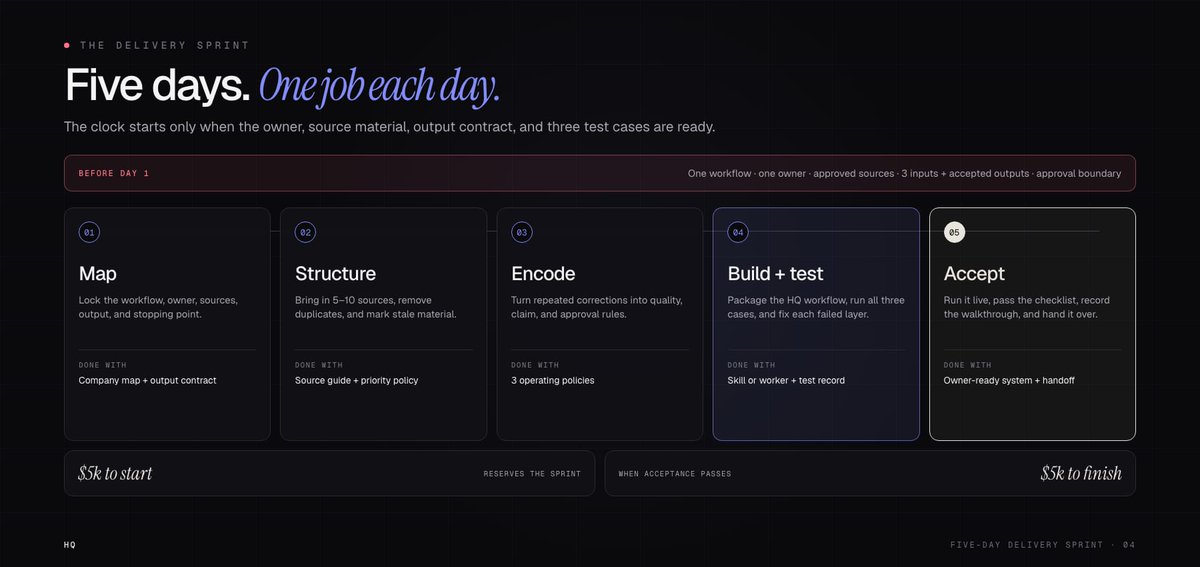
The sprint should move quickly because every day has one job.
Day 1: Map
Confirm the workflow, owner, sources, output contract, approval boundary, and 3 test cases. Create the company map.
Day 2: Structure
Bring in the 5 to 10 approved sources. Remove duplicates, label stale material, and write the source-priority policy.
Day 3: Encode judgment
Turn repeated corrections into 3 short policies: what the output must do, what it must never do, and where a person must approve.
Day 4: Build and test
Package the workflow as an HQ skill or worker. Run the 3 test cases. Fix the layer that caused each miss, then run the same case again.
Day 5: Accept and hand over
Run the workflow live with the owner. Complete the checklist, record the walkthrough, show the team how to update the knowledge, and collect the remaining $5,000.
Use this acceptance checklist:
Company Brain Sprint acceptance
The company map names the workflow, owner, sources, and current priority.
The system uses only approved client sources.
Conflicting or missing information is flagged.
The 3 operating policies are applied correctly.
The workflow produces the agreed format.
All 3 test cases meet the owner's standard or have documented exceptions.
The agent stops at the agreed approval boundary.
The owner can run the workflow without you.
The team knows how to correct and update the system.
Finish with a simple handoff:
What we built: [workflow and outcome]
Where the knowledge lives: [HQ paths]
How to run it: [command or instruction]
What requires approval: [boundary]
How to improve it: [where sources, policies, and examples are updated]
Open items: [anything outside the sprint]
That is a finished $10,000 implementation, not a folder dump.
10. Let the first workflow sell the second
Do not force a retainer into the first conversation.
Deliver the sprint. Watch the team use it. The next offer should come from the next repeated problem they can now see.
There are 3 clean extensions:
Another workflow sprint for $10,000
Monthly knowledge maintenance and workflow testing
A larger team rollout with more sources, policies, and workers
The first sprint gives you more than the first payment.
It gives you a demo you are allowed to discuss, an acceptance checklist, a delivery process, a testimonial to request, and a clearer niche.
Your second agency build should be easier than your first because the company map, discovery questions, policies, test process, and handoff already exist.
That is the real business opportunity.
You are not selling random AI hours. You are installing a small system, proving it against real work, then improving the same delivery process each time.
The first 10 actions from zero
Pick one buyer type: agency, ecommerce brand, tech company, or another context-heavy team.
Pick one recurring workflow they already spend time briefing and correcting.
Write the fixed $10,000 offer and exclusions.
Find 20 companies showing the right qualification signals.
Build a small public-information demo for the strongest prospect.
Send the workflow-specific outreach message.
Run discovery and collect 3 real test cases.
Take $5,000, install HQ, and deliver the sprint in 5 days.
Pass the acceptance checklist, record the handoff, and collect the final $5,000.
Ask for a testimonial, then sell the next workflow.
Start with one company and one workflow.
The company does not need another AI strategy deck. It needs one piece of work that gets better every time the team runs it.
Build that first.
Your first client should not be the first time you use HQ.
Go to hqforwork.com, download the app, and build the first version for yourself. Add your own knowledge, turn one repeated workflow into a skill, and run it until the result is worth showing.
That becomes your case study, your demo, and the system you can sell for $10k.
Build your own company brain first. Then go build one for someone else.
If you want to test HQ with your own team, go to https://www.hqforwork.com/r/karla
Bookmark and follow me @karlarboledas for more content.
Thanks for reading :)