What if everything goes right for AI? Learnings from the Aluminium trade.

There are countless takes telling us why the AI buildout will result in a bubble that will collapse under its own weight. Some argue we are already in it, and that the subsequent meltdown will be comparable to the early 2000s.

Most supply crunches end in gluts within ~3-5 years, and they destroy significant economic value in the process.
This is the core argument, and it is hard to fault. The list is too long to ignore. Some examples include: (1) the telecom dark fibre crunch & glut (2000-2002) which saw Corning, Lucent and Nortel all go down 99%+, or (2) the US Railroads (1890s) resulted in 25% of US mileage ending in receivership.
There is a notable exception, however: Aluminium (1850s-1950s). Not because it avoided a glut. It got there eventually, but it took over a hundred years. And it has a number of commonalities with AI Tokens.
So what if everything goes right?
In 1852, aluminium cost more than gold
In fact, twice as much: $1,200/kg for aluminium vs. $600/kg for gold. Napoleon III reportedly served his best guests on aluminium plates. He gave everyone else the gold ones. And the cap of the Washington Monument (100 ounces of aluminium), was one of the most expensive metal objects in America.
Interestingly, aluminium was never rare. It is the most abundant metal in earth's crust. However, back then, it was impossibly expensive to separate.
The number of use cases for aluminium was limited by its price.
Then the price fell >99.9%
Both Hall and Héroult independently figured out electrolytic smelting in 1886. Bayer solved the ore side in 1889. By 1954, US production was 1.3 million tonnes at ~$0.48/kg.
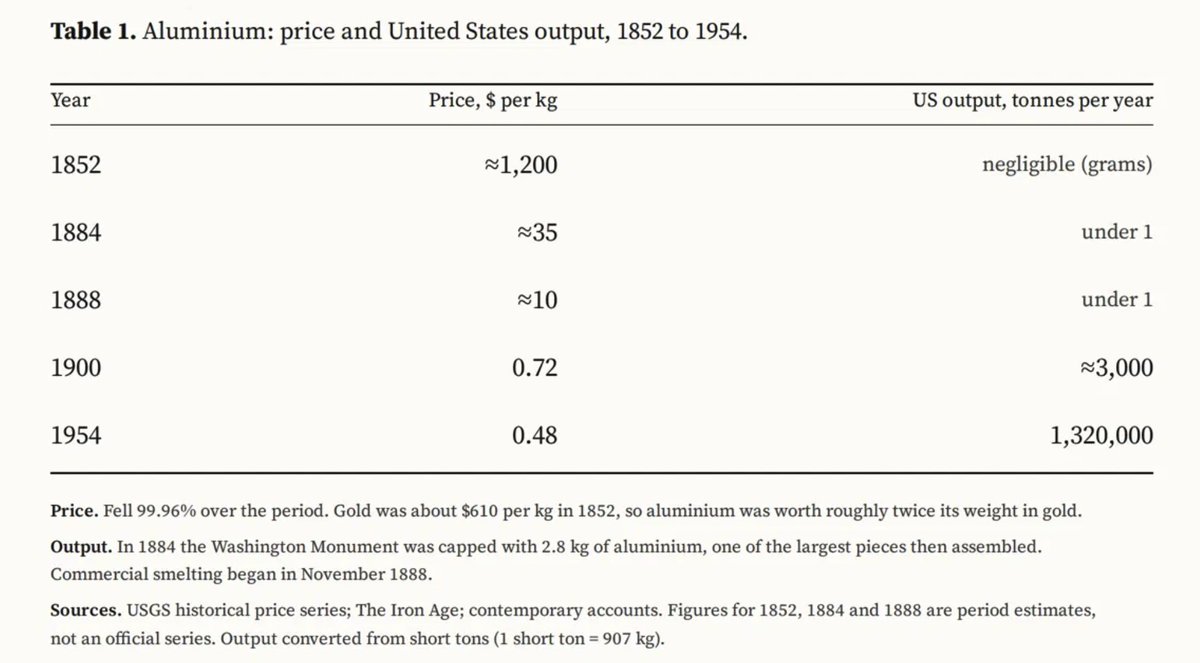
Everyone looking at that table today would call it a glut. It is the single greatest price collapse in industrial history. But it built one of the largest materials markets on earth, and the value of the trade went from ~$500k in 1895 to $640m p.a. in 1954.
But price never collapsed into the same market. Each drop opened a new one. So the total market grew exponentially
Nobody sold more jewellery. Each price step killed the old category and created one that consumed orders of magnitude more metal.

AI Tokens are getting down the identical cost staircase. But 10x faster:

Aluminium took 100 years to go down >1,000x in cost. AI Tokens will likely do it in <10 years. And the rung that truly matters is the one where humans stop being the binding constraint.
Most gluts arrive when demand hits a human-scale ceiling. Cookware is bounded by the number of kitchens. Cans are bounded by how many drinks a person drinks. Cars by how many households exist. Once the ceiling is hit, any capacity built above it becomes a glut: it cannot be absorbed at any price.
Aircraft enabled aluminium to keep going for a while, as it stopped being something a person handled, and became an input to a machine. But planes carry passengers, so the ceiling was still human. It was just one link further out. And aluminium, *after over one hundred years of growth* - ended up a glut in the end.
So aluminium never found an unbounded market. It found a sequence of higher ceilings. This meant over 100 years during which the price went down by >1,000x, while the market size also increased by >1,000x.
AI Tokens *could be* an unbounded market
AI Chat is the low ceiling. It is bounded by human reading speed, multiplied by the number of humans. And we are "close" to it. Over 1 billion users engage with platforms like ChatGPT or Claude every month.
Reasoning and agents are the first rung where the consumer may not be a human at all. Nobody reads the reasoning tokens. And perhaps, soon, agents will be run by agents - thereby removing the cap altogether.

With agentic AI, the constraint may entirely stop being humans. It could become the combination of (1) cost and (2) utility. And both sides of this equation are getting better, fast: (1) the cost side is falling 2-5x/year per the above table, and (2) as models continue to improve (the intelligence), token utility increases.
Aluminium needed both too. Cheap metal was useless until duralumin made it structural in 1909. Price alone would never have built an aeroplane.
At the infrastructure layer: one producer (Alcoa) captured nearly all the value. That is worth studying in the context of AI (Nvidia)
Alcoa held a monopoly for over fifty years. This was not due to the Hall patent (it expired in 1906). Rather, Alcoa had (1) the process: two decades of hard-won operating know-how from its furnaces and its people, (2) the ore: it owned ~90% of America's economical bauxite reserves by 1909, and (3) power: it owned the hydroelectric sites. It took a 1945 antitrust ruling to break Alcoa.

Today, Nvidia has some similarities to Alcoa - but also some core differentiation.
So for the ones still keeping score: one moat owned, one moat rented, one moat absent. Alcoa had all three.
The application layer will win anyways
The producer did extremely well out of this. Alcoa held its monopoly for 57 years, and it took a federal antitrust case in 1945 to break it.
But compare what the metal was worth against what it made possible: the DC-3 was the aeroplane (the application) that made commercial air travel a viable business model. It weighed about 7.5 tonnes empty, almost all of it aluminium, just a few thousand dollars of metal at the price above... While Douglas sold the aircraft for ~$100,000.
Run the same sum on the drinks can: it was a fraction of a cent of aluminium wrapped around something Coca-Cola sold for a nickel.
So who wins? The owner of the category that could not exist at the old price. Nobody selling aluminium jewellery in 1852 became Douglas. The value went to whoever found the new use, never to whoever had been selling the old one cheaper.
Which is the answer to the question I opened with. Everything going right does not mean the price holds. It means the opposite. The price collapses, the technology works, and the money moves layer by layer for over a century. Those were never competing outcomes in aluminium. They were the same one.
At 20VC, we are investing across the stack - from enablers of mass enterprise adoption and cost curve regression (👋 Fireworks AI), to databases best placed for agents (👋 Clickhouse), to Energy (👋 Fuse Energy and Rivan Industries), to future application AI winners, such as Solve Intelligence and Fonio AI. If you feel we should be in touch, hit me up!
