How to build a $2M video production pipeline

i'm giving you 7 free skills and the exact pipeline directors are using to produce AI films with millions of dollars in budget in higgsfield... the whole system revealed step-by-step, with the skill that runs each stage ready to install today

Seedance 2.5 at 1080p (only on higgsfield) now means you can one shot full 30sec ads/creatives/trailers without any upscaling... this is awesome

here's what's inside:
to get access to all the skills, join here: https://t.me/tgmachina i'll be posting them shortly
and if you want to go deeper on turning AI video into actual revenue, the training and the weekly systems for that live in the real time AI ops community at weeklyaiops.com
the engine: seedance 2.5 at 1080p and the CLI
everything in this article runs through one platform: higgsfield
two reasons, and both are structural: the whole surface is built for agentic use, so your agent can drive every generation end to end, and Seedance 2.5 at 1080p only on higgsfieldruns on it
the whole workflow runs on one video model, deliberately
one model means one prompt grammar, one set of quirks, one consistency behavior to learn... the image models only build the reference sheets that feed it
that video model today is Seedance 2.5
it one-shots a 30 second clip with the dialogue lip-synced and the sound effects generated in the same pass, and it carries a reference budget big enough to hold your cast, your location, a key prop, a camera move, a voice, and the ambience inside one generation
the pipeline's iteration rule gives a failing shot 10 to 15 attempts before you're allowed to blame the wording
the CLI is the agentic door:
three commands and every model becomes callable from Claude Code or whatever harness you run, which means an agent can hold the whole pipeline... what generates, in what order, with which model, while you direct
and if 2.5 gets replaced next quarter, nothing below changes... treat the model table as a snapshot, because the stages and the gates are the part you keep
here's a quick example of what you could produce with this pipeline:
the actor doesn't remember how he looked yesterday
that sentence is the entire reason this pipeline exists
a video model has no memory between generations, so if a character's appearance isn't described exhaustively in every single prompt, neighbouring shots hand him a different face, a different jacket, a different age
on a 10 second clip nobody notices... across 90 minutes it kills the film, because the audience reads a continuity break faster than any other flaw
the model has no memory, so the pipeline is the memory
half the stages you're about to see exist only to remember things on the model's behalf... what the hero wears, how far the door sits from the window, which palette owns the scene
and the memory runs on four rules you never break:
break the first rule and you remake half your material once the look drifts
the rest of this piece is those four rules stretched into a working studio
the 11 stages
classic pre-production is casting, location scouting, and a prop shop
here it runs in reverse: you fix digital references instead, and the tighter you close the early stages, the cheaper every generation after them gets

the stages run in sequence at scene level, with one exception: while scene N generates, the editor is already assembling scene N-1 and the director team is shotlisting N+1
that overlap exists because a reshoot here costs minutes, not a shooting day
the editor watches an assembly, orders a missing cutaway, and has it the same afternoon... which means editing stops being post-production and starts actively shaping what gets made
but none of it starts until the gates say so
a stage exits through a written checklist, and the hardest gate sits in front of generation: every character, variant, location, and prop in a scene needs a registry row marked locked before a single film frame renders
the most expensive rule in the pipeline, and the most rewarding
now the stages themselves
each one below closes with the skill i built to run it, and all 7 are waiting in the telegram
stage 1: the breakdown
before anyone writes a prompt, the script becomes shot cards
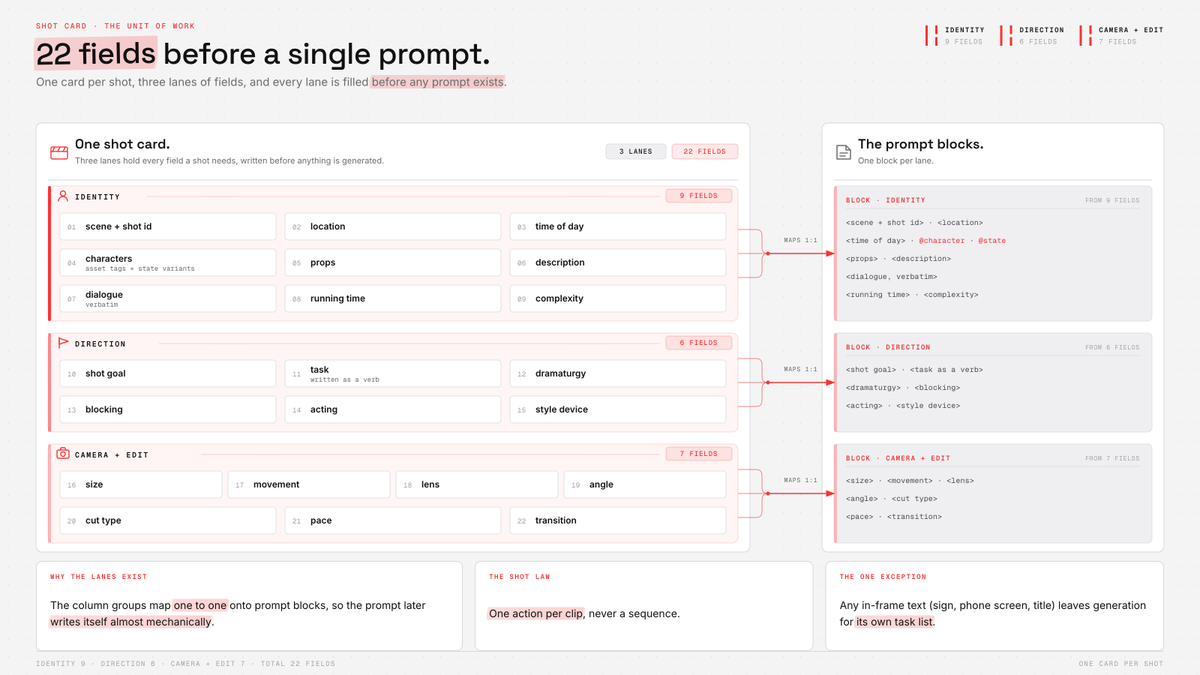
each shot gets a card of 22 fields in three lanes:
22 fields sounds like bureaucracy until you see what it buys: the prompt later writes itself almost mechanically, because the column groups map one to one onto prompt blocks
two rules ride along
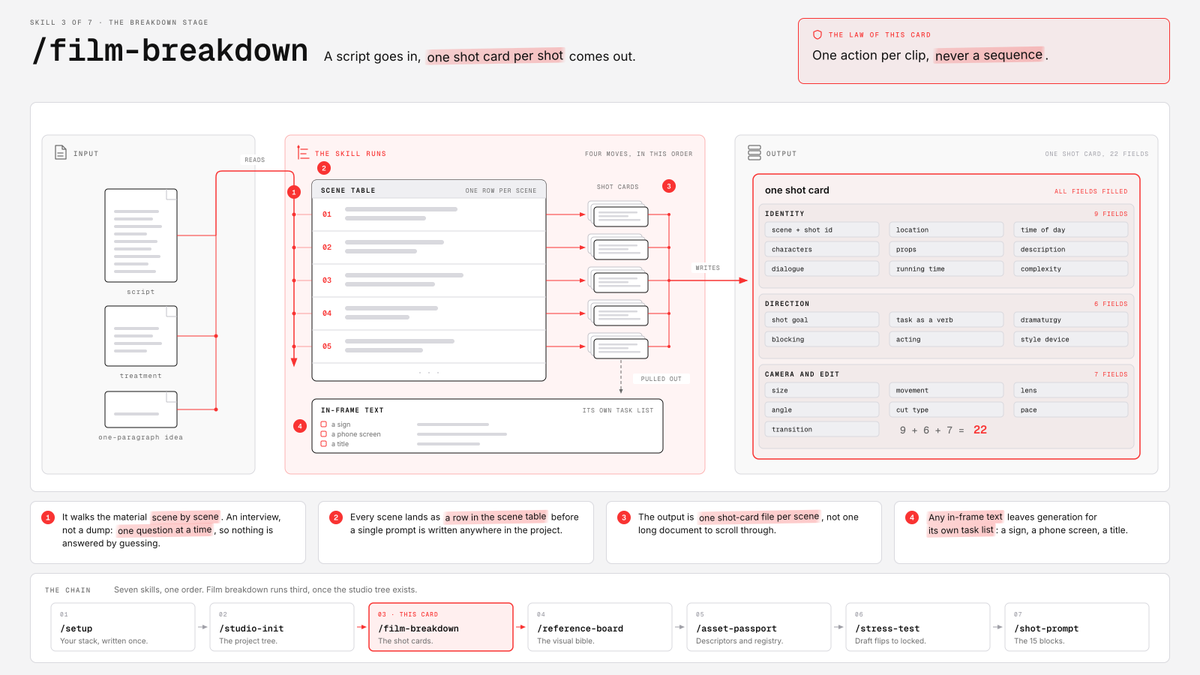
every clip carries one action, never a sequence of them
and any text that must appear inside the frame... a sign, a phone screen, a title... leaves the generation entirely and goes onto its own task list, because video models write text badly and titles belong to the edit
the skill: /film-breakdown takes a script, a treatment, or a one-paragraph idea and walks it scene by scene, one question at a time, writing the scene table and one shot-card file per scene as it goes
every shot leaves with all 22 fields filled, and any in-frame text is already pulled onto its own task list before you ever prompt
but a perfect card still describes a man no two models will draw the same way... that problem has its own two stages
stages 2 and 3: references and the lock
a reference here is a spec
"a tired father in a worn jacket" produces a different man in every model and every head
an actual image of him settles the question, which is why the rule runs one direction only: find the existing image first, then describe it... never imagine a description and hunt for proof
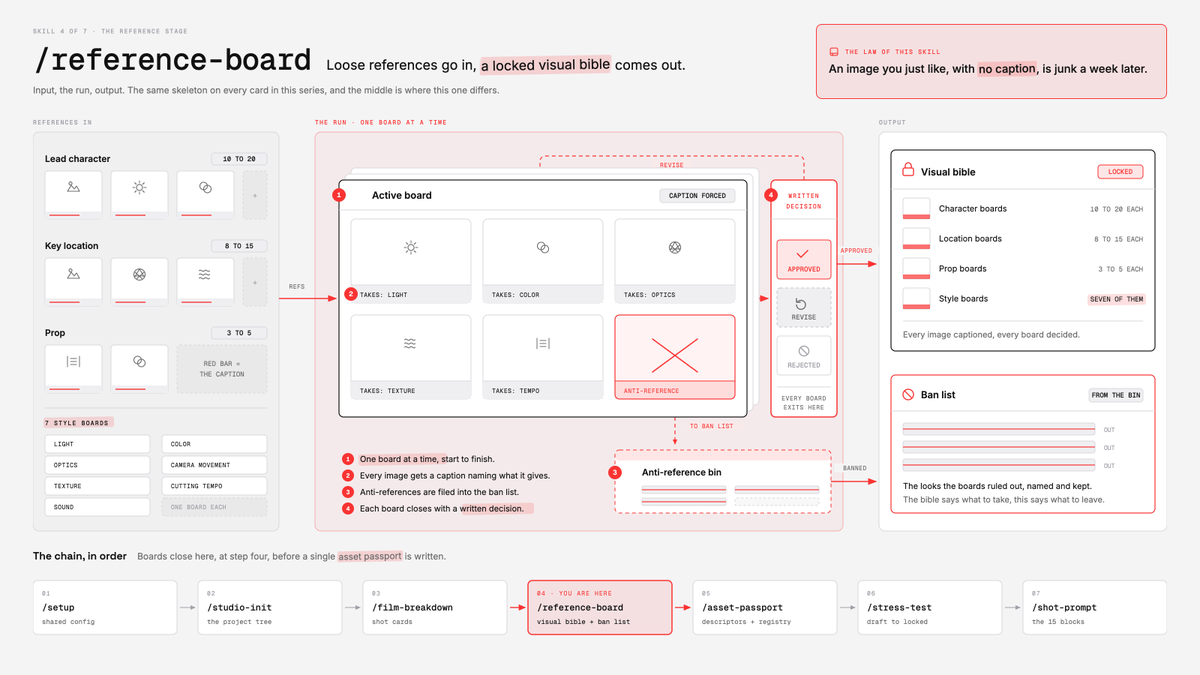
the working counts: 10 to 20 images for a lead character, 8 to 15 per key location, 3 to 5 per prop, plus separate boards for light, color, optics, camera movement, texture, cutting tempo, and sound
those ranges are counted from working productions, not guessed, which is why i'm not rounding them
every image gets a caption naming exactly what is taken from it
an image you just like, with no caption, is junk a week later
and the images marked "like this... not allowed" become the ban list, which saves you more generations than the references do
the fastest way to fill the style boards is to extract from real cinema instead of imagining: feed stills from films that already carry your feeling to a vision model, have it name the lens, the light direction, the palette, the grain, and lock the output as one paragraph that gets pasted into every prompt of the project
then comes the lock, and the lock is written
every board ends in a fixed decision... approved, revise, or rejected... recorded on the board itself
a style that was approved verbally means the director and the prompt engineer are holding two different films, and they find out a month in
the skill: /reference-board runs the interview one board at a time... you supply the references, it forces a caption on every image, files every anti-reference into the ban list, and closes each board with the written decision, approved, revise, or rejected
nothing gets called locked without that decision on the board
stage 4: the passport
here's where consistency gets manufactured
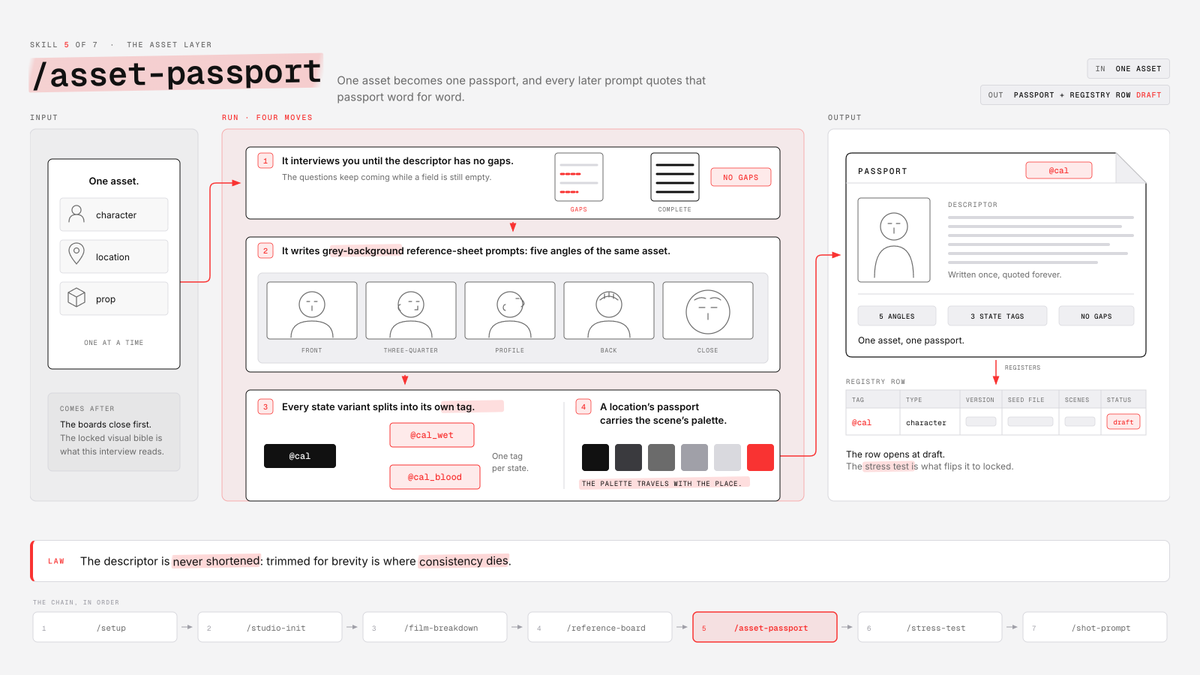
watch what happens to one character: he gets an exhaustive text descriptor, and a sheet of reference images generated on a neutral grey background... front, three-quarter, profile, back, close portrait
that pair, descriptor plus references, travels into every prompt he appears in, word for word, file for file
that's his passport, and a production holds one per character, location, and prop
wet clothes are a different passport
so is blood... @cal, @cal_wet, and @cal_blood are three separate assets with three separate tags, because a variant described inline is a variant the model will forget
two details make passports hold:
and the reference images themselves get built by hand first, in an image model, before any video prompt exists
lock them and never regenerate them... if the motion looks wrong later you fix the motion prompt, because a new image undoes every piece of consistency work stacked on the old one
every passport lands as a row in one living registry: tag, type, version, seed file, scenes, status
a passport at this point is still a draft, because a passport built on one lucky image is a false victory
the skill: /asset-passport builds one asset at a time... it interviews you until the descriptor has no gaps, writes the grey-background reference-sheet prompts for your image model, splits every state variant into its own tagged asset, and files the registry row at draft
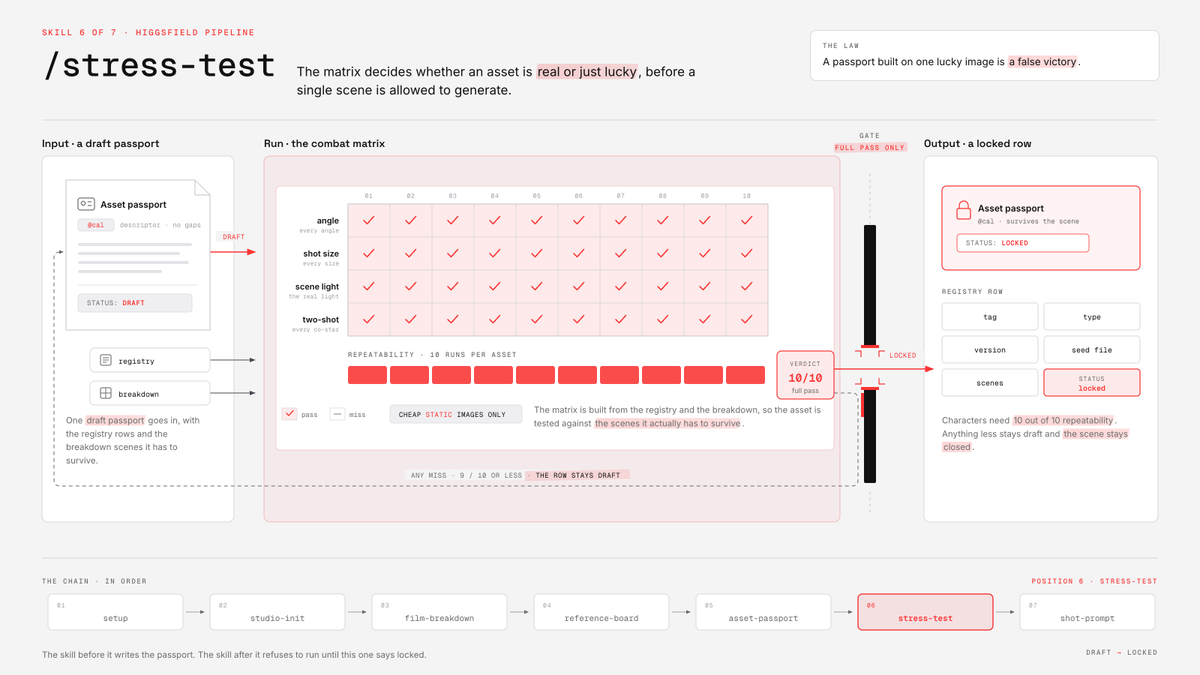
stage 5: the stress test
before any asset is trusted, it generates under combat conditions: different angles and shot sizes, the lighting of its actual scenes, and standing next to every asset it will share a frame with... because a character who holds up alone often breaks the moment he shares a frame
the tests are cheap static images, run before a single expensive video generation
characters have to hit 10 out of 10 repeatability
which is correct
anything below that keeps the registry row at draft, and the scene it blocks either waits or consciously moves to the next production block
generation for a scene starts when every row it touches says locked, and not an hour earlier
the skill: /stress-test reads your registry and breakdown, builds the combat matrix... angles, shot sizes, the real scene light, a two-shot beside every co-star... hands you the test prompts, and flips the row to locked only on a full pass
no full pass, no lock, and the scene stays closed
with the registry green, the production finally starts rendering... and every shot of it comes from the same fifteen blocks
stage 6: the prompt
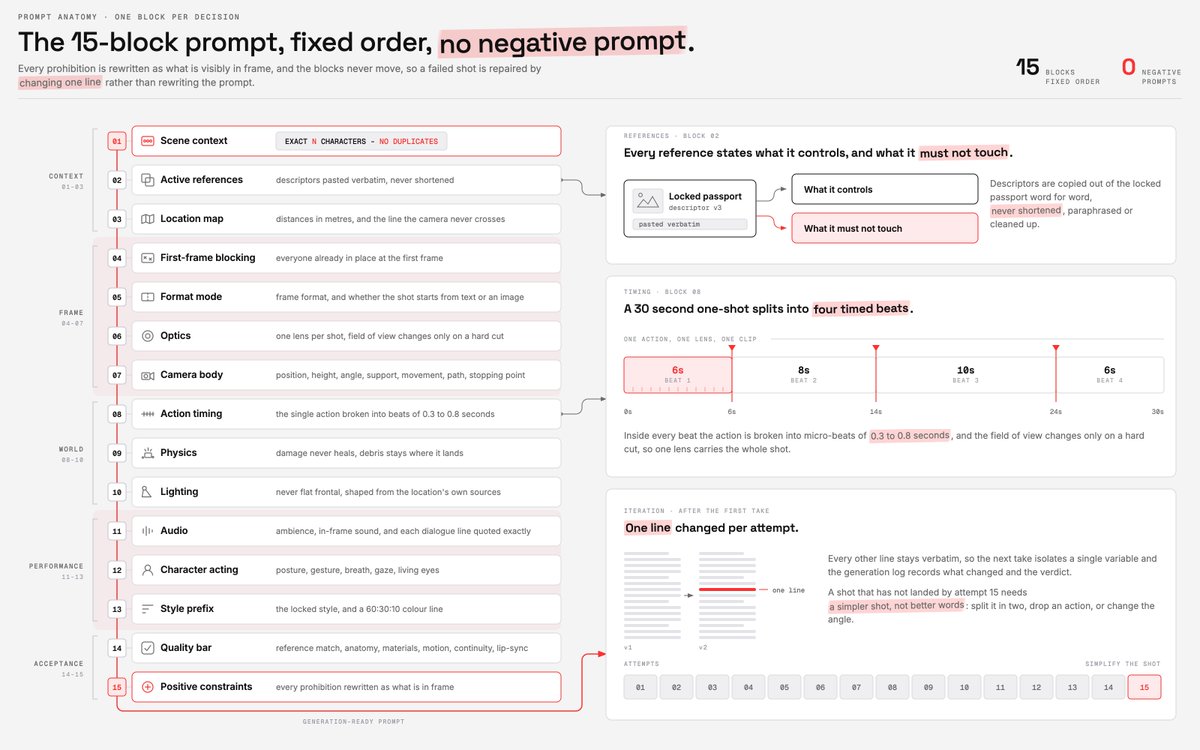
every shot prompt is the same 15 blocks in the same fixed order
no negative prompt anywhere... every prohibition is rewritten as what IS in the frame
this is what the generation stage runs on, because once the blocks are locked the render itself is mechanical
the blocks worth stealing on their own:
for a 30 second one-shot the prompt splits into four timed beats... 0-6 sets the scene, 6-14 builds, 14-24 turns, 24-30 resolves... with the full detail set written per beat, timestamps included
references get the same discipline: every attached image, clip, or audio file states what it controls and what it must not touch
"@video 1 defines motion and pacing" is half a role... the other half is "do not take identity, clothing, or scene from it", and that second line is what stops one reference leaking into a shot it was never meant to shape
motion gets its own grammar: every prompt names the camera move and pairs it with an event that happens during the clip
then it says no frozen figures, outright
a dolly past a standing figure is a still image that drifts
the same dolly while the sail tears loose is a film
then the iteration rule
an edit changes one line and keeps everything else verbatim, every attempt gets logged with what changed and the verdict, and a shot that hasn't landed by attempt 15 doesn't need better words... it needs a simpler shot: split it in two, drop an action, change the angle
a finished take is accepted by checklist... matches the references, no artifacts, camera as ordered, lip-sync holds, cuts with its neighbours... and only accepted takes get final names in the selects folder
that acceptance is the last yes a shot ever needs, because the editor never touches raw generations
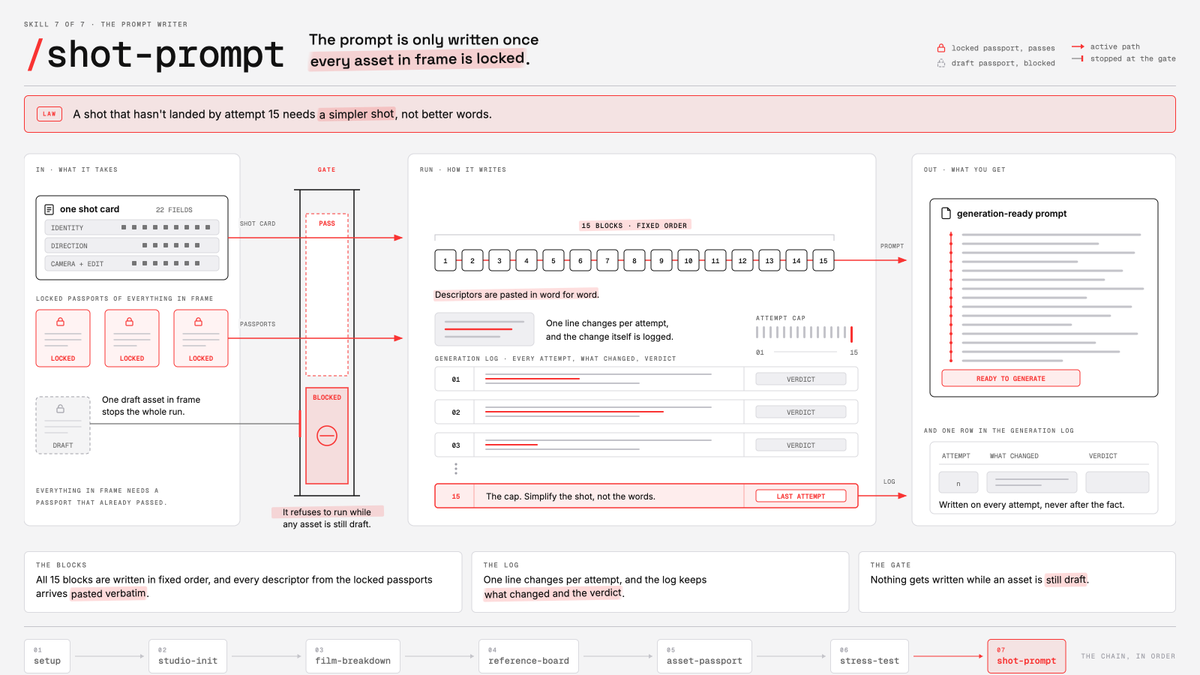
the skill: /shot-prompt takes one shot card plus the locked passports of everything in frame, and it refuses to write a generation-ready prompt while any of those assets is still draft
then it writes the 15 blocks with every descriptor pasted verbatim and keeps the generation log with you... one line changed per attempt, simplify the shot at 15
the studio is a file tree
there's no production office in this pipeline
there's a directory
one more law: a reference file is never renamed
a new version is a new file, because renaming breaks every prompt that points at the old one
the skill: /studio-init asks one question, the project name, then scaffolds the whole tree, seeds the breakdown, the bible, the registry, and the generation log as ready templates, and writes the three folder laws into the project so every agent that touches it inherits them

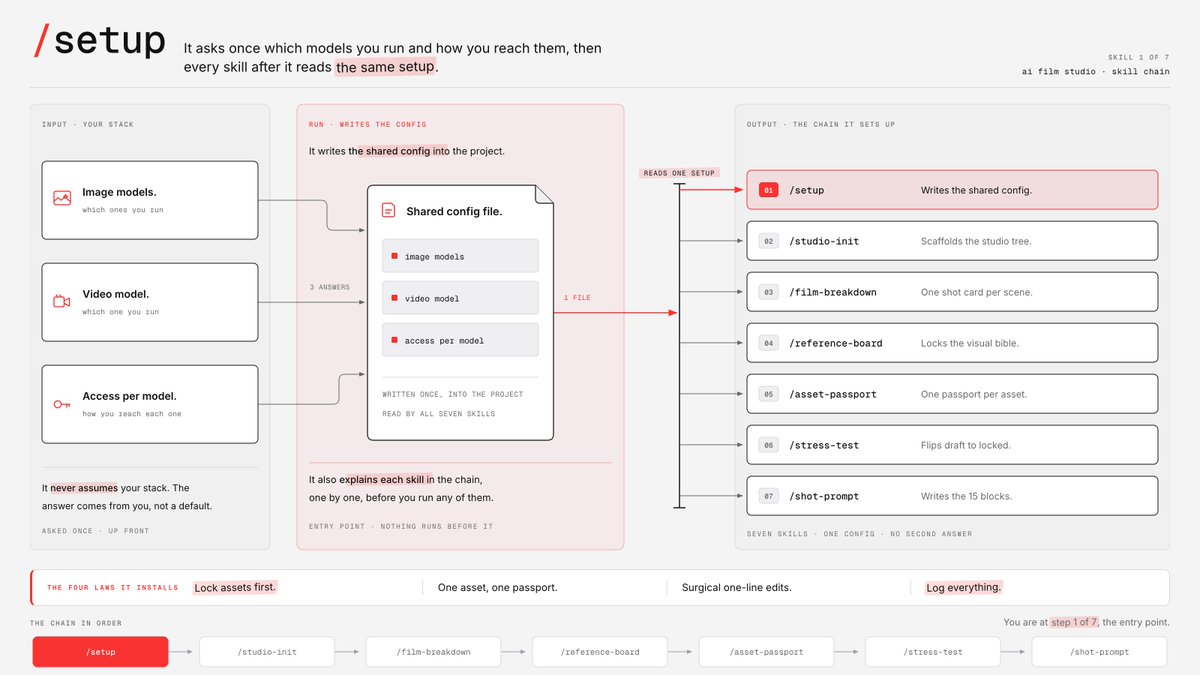
and the seventh skill is the front door: /setup asks what image and video models you work with, how you access each one, and never assumes a stack... it writes the shared config into your project so every other skill reads the same setup, then hands you the chain in order: setup, studio-init, film-breakdown, reference-board, asset-passport, stress-test, shot-prompt
all 7 are in the telegram: https://t.me/tgmachina
stages 7 to 11: what stays human
edit, cleanup, color, sound, and master are the five stages no skill runs
the pipeline generates picture and scratch audio, and it stops there on purpose
finishing is human work
the edit trims the first and last half second of nearly every generation, because clips drift at their edges
and it cuts harder than feels natural, because generated shots lean into slow entries... the standing instruction is to cut more aggressively than you think you should
generated sound is scaffolding: the lip-synced lines set the timing, then a sound post team cleans that same voice instead of re-recording it, rebuilds the effects, and mixes to platform loudness
color goes to a colorist whose first job is unifying neighbouring shots, since every location's passport already delivered a built-in grade to refine
and the masters ship like any studio's: a DCP, the standard cinema delivery package, for festivals, a ProRes file, the high-quality archival format, for the vault, plus platform encodes and subtitles
the archive keeps more than the finished film
it keeps the means of production... every final prompt, the generation log, the registry, the locked passports... because the sequel starts from everything the last production learned
the playbook block
the whole pipeline, compressed to the block worth saving:
skip the locks and half your material gets made twice
models will swap out from under this system... the method itself expects its model table to age in months
the sequence and the gates are the part that doesn't
thank you higgsfield for sponsoring this article
the 7 skills drop in my telegram shortly: https://t.me/tgmachina


