There Are Only 4 Ways to Make Money. Everything Else Is a Story.

You are using one of them right now. Probably the worst one. And nobody has ever told you that the other three exist because the people who use them do not write blog posts. They are too busy compounding.

Let me ruin a few things you believe about money.
That "passive income" stream you keep hearing about on podcasts? It is one of these four, with a marketing name. That "side hustle" your coworker started? Same four. That hedge fund making 40% a year? Same four, just running all of them at once.
The entire global economy, every dollar that has ever moved from one person to another, runs on four mechanisms. Not twelve. Not "multiple streams of revenue." Four. They have been the same four since Florence in 1400, and the fact that nobody taught you this in school is not an accident. It is a design choice that keeps you on the wrong one.

Here is each one. Pay attention to which one you are stuck on.
WAY 1: LABOR
You trade time for money. This is where 95% of people stay forever.
You wake up. You commute. You sit in a chair or stand on a floor for 8 hours. Someone deposits money into your account on the 15th and the 30th. You do it again tomorrow.
That is labor. It is the most common way to make money on earth and the one with the hardest ceiling.
A barista at $15 per hour maxes out at $30,000. An accountant at $50 per hour maxes out at $100,000. A software engineer at $200 per hour maxes out at $400,000. A neurosurgeon at $300 per hour maxes out at $600,000.
Do you see the pattern? The rate changes. The ceiling does not. It is always the same constraint: 2,000 billable hours in a year. Nobody gets 2,001.
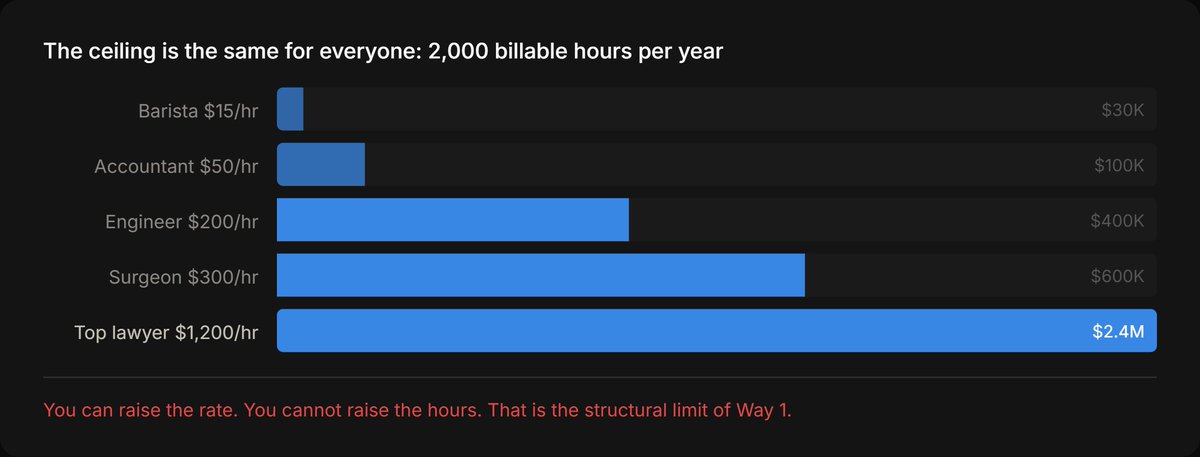
Here is the part that should bother you. If you are reading this article, you are almost certainly on Way 1. That means your entire financial life is bounded by a number you cannot change. You can negotiate a higher salary. You can switch jobs. You can learn a new skill that pays more per hour. But you are still moving within a cage, and the cage is 8,760 hours per year.
And here is the part that should bother you more: the people who are not on Way 1 do not work less. They work differently. They plugged into a different engine. And the gap between you and them is not talent, not luck, not a rich family. It is that they understood what you are about to understand.
Labor has one thing the other three do not: certainty. You show up, you get paid. Every other way of making money trades that certainty for the removal of the ceiling. That trade is the most important financial decision of your life.
Now stop and do something before you keep reading.
Pull up your last paycheck right now. Look at the number. Ask yourself: "could this number exist if I disappeared tomorrow?" If the answer is no, you are running one engine and it is labor. That is your starting point. Hold it in your head as we go through the other three.
WAY 2: CAPITAL
Your money earns money while you sleep. But you need money first, and that is the trap nobody talks about.
Capital is simple to describe and brutal to execute. You take money you already earned through labor, put it into something that grows, and leave it there long enough for compounding to do the work.
The problem is obvious. You need money to make money. And that first pile has to come from Way 1. Which means the transition from labor to capital requires something deeply unpleasant: spending less than you earn, consistently, for years, while everyone around you is buying things that feel like they matter.
This is why most people never make the transition. Not because they do not understand investing. Because they cannot tolerate the gap between what they earn and what they spend.
Here is what that gap does over time:
Compounding does not reward the smartest investor. It rewards the most consistent saver. The person who put $500 into an index fund every single month for 30 years and never stopped will beat the person who waited for "the right time" almost every time.

Now the honest part. The chart above looks clean and inevitable. It is not. In year 7, your invested $100,000 has grown to $195,000 and you feel smart. Then the market drops 35% and you are looking at $127,000. Less than you started with. Every instinct in your body screams to sell and stop the bleeding.
If you sell, the chart above never happens. You lock in the loss and go back to Way 1 forever.
If you hold, you feel physically sick for about 18 months. Then the line resumes.
That is the real cost of capital. Not knowledge. Not skill. Stomach. You need the stomach to watch your money shrink and do nothing about it. Most people do not have it, and there is no shame in that. But it means capital is not for everyone, and anyone who tells you it is painless is selling something.
Here is what to do tonight. Check whether you have an automated investment set up. Not "I plan to invest." An actual recurring transfer that moves money from your checking account to an index fund on the first of every month, without you touching it. If you do not have it, set it up tonight. The amount does not matter. $100 is fine. $50 is fine. The automation is the point, because automation removes the decision you will otherwise fail to make 300 months in a row.
WAY 3: ARBITRAGE
You find something that is priced wrong and you fix it before anyone else does.
This is the way of making money nobody teaches you because it does not look like a "job" and it does not fit on a resume. But it is how every fortune that was built fast was built.
Arbitrage, at its core: something is worth more in one place than another. You move it from the cheap place to the expensive one. The difference is yours.
The pure version is dead. Algorithms close price gaps in milliseconds now. But the applied version is everywhere, and you are surrounded by it right now.
Notice the pattern. None of these people are working harder. They are seeing a gap that other people do not see and closing it.
Arbitrage does not reward the hardest worker. It rewards the person who sees the gap first. And every gap closes the moment enough people see it.
That is the catch. Drop shipping was a gold mine in 2016 because the gap between AliExpress prices and Shopify prices was invisible to most people. By 2020, everyone had a course about it. The gap closed. The arbitrage died.
This means every arbitrage you find has an expiration date. You cannot build a career on one gap. You need the skill of finding gaps, not the gap itself.
Here is what to do this week. Think about one thing you know how to do that other people regularly pay someone else to do badly. One skill where the gap between your ability and the market average is wide. Now ask yourself: "what would it look like to sell that gap directly, outside of my salary?" You do not have to do it. But thinking about it is the first step toward seeing Way 3.
WAY 4: INSURANCE
You get paid to absorb risk that other people cannot sleep with.
This is the least visible of the four engines and the one that builds the biggest fortunes when run correctly.
Insurance is any transaction where you take on uncertainty that someone else does not want, and they pay you a premium for the relief. The mechanism is simple: fear in, money out.
The obvious version is a car insurance company. You pay $150 a month because the thought of a $40,000 accident bill is unbearable. The company collects $150 from millions of drivers and knows that most will never file a claim. The difference between premiums collected and claims paid is profit.
But insurance is hiding inside things you see every day and never recognized:
In every case, one side pays to remove uncertainty. The other side profits from absorbing it. If you are always on the paying side, you are subsidizing someone else's engine.
The danger of insurance is that it works perfectly until it does not. Premiums trickle in for years. You feel invincible. Then the tail event hits. A hurricane. A pandemic. A market crash. And the payout is 100x the premium you collected. The insurance seller must be right 99 out of 100 times. The one time they are wrong can erase everything.
Here is what to notice starting tomorrow. Count how many times in one week you pay someone else to absorb your risk. Insurance premiums. Warranties. Subscription fees. Fixed-price contracts. Expedited shipping (paying to remove the risk of waiting). Once you start counting, you will realize you are funding other people's Way 4 all day long. That is fine if it is a conscious trade. It is expensive if it is invisible.
THE DECOMPOSITION: TAKE ANYTHING APART
Now the framework becomes a weapon. Once you can see the four engines, you can decompose any company, any job, any income stream in seconds.
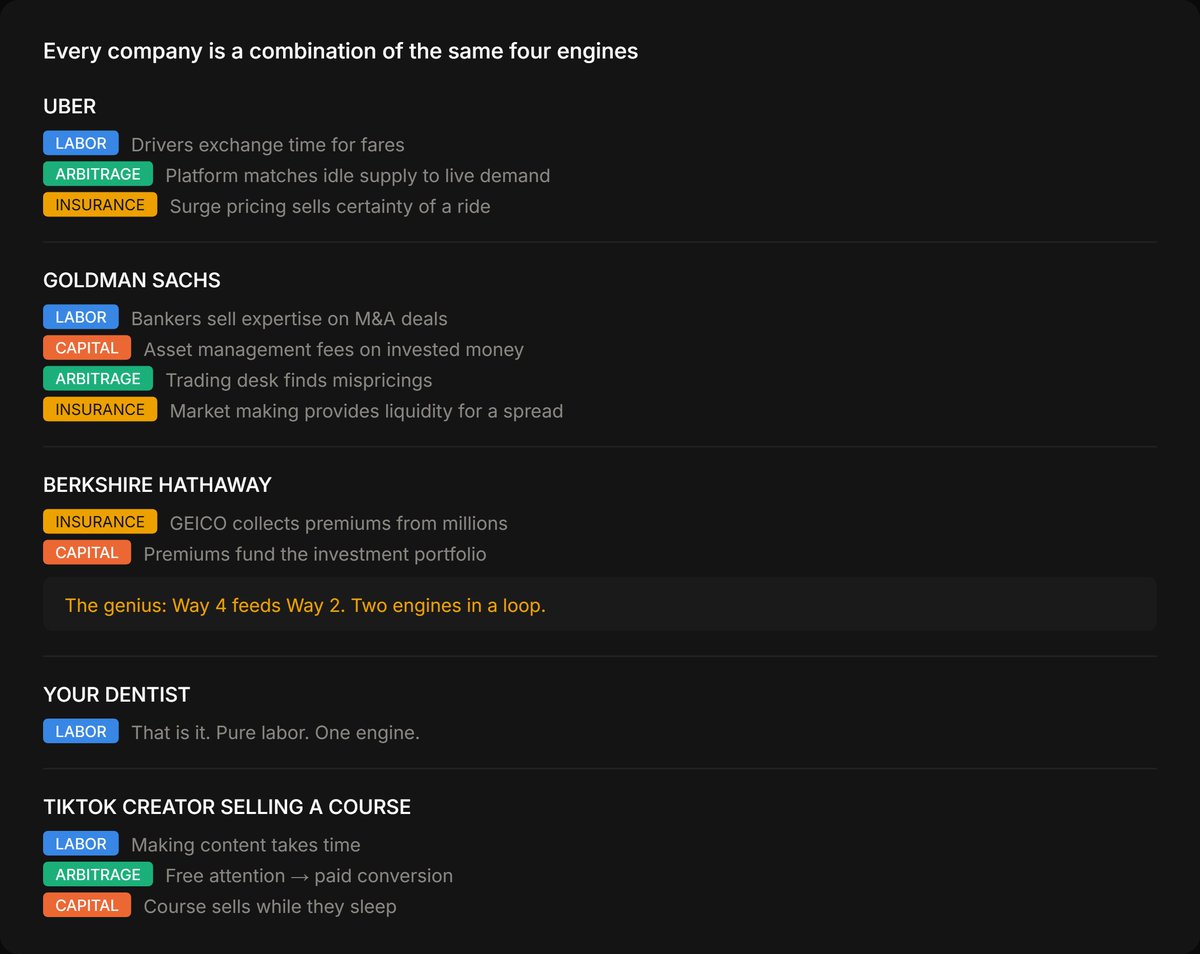
Look at Berkshire Hathaway. Warren Buffett is not a genius stock picker. He is a genius engine designer. GEICO collects insurance premiums. Those premiums are money that Buffett invests before claims arrive. The insurance business funds the capital business. Way 4 feeds Way 2 in a self-reinforcing loop. That single loop, run for fifty years, built a $900 billion company.
Now look at your dentist. One engine. Labor. If she stops showing up, the income stops. She makes good money, but she is on a treadmill and the treadmill does not compound.
The TikTok creator runs three engines out of four. Content creation is labor (it takes time). The free audience becoming paid customers is arbitrage (attention gap). The course selling at 3am while they sleep is capital (an asset producing returns). Three engines from a bedroom.
Here is what to do right now. Write down every source of income you have. Next to each one, write which engine it runs on. If every line says "labor," that is not a judgment. That is a diagnosis. And a diagnosis is the first step toward a different prescription.
THE AUDIT THAT CHANGES EVERYTHING
Three questions. Answer them honestly and your financial plan becomes immediately clearer than whatever your financial advisor has been telling you.
Question 1: How many engines are you running?
One engine is fragile. You lose the job, you lose everything. There is no backup. There is no compounding. There is nothing working while you sleep. Most people spend their entire career here and call it a plan.
Two engines is stable. You have a salary and you invest. Or you freelance and run a small product. One can absorb a hit while the other keeps running.
Three or four is antifragile. The engines feed each other. Labor income funds capital. Capital returns fund experiments. Experiments find arbitrage opportunities. This is how every wealthy person you have ever studied actually operates.
Question 2: Are any of your engines feeding each other?
This is the question that separates the merely comfortable from the genuinely free. Parallel engines are good. Connected engines are exponential.
Question 3: What would it take to turn on a second engine?
Not "what would it take to double my income." That is a Way 1 question and it keeps you on the treadmill. The real question is: "what would it take to make money while I am not working?"
For most people the answer is embarrassingly simple.
THE CLOSE

Every business book you have ever read is a rearrangement of these four things. Drop shipping is arbitrage. SaaS is labor converted into capital. Options trading is insurance. A hedge fund is all four running at once.
The stories on top are not worthless. But the stories are not the mechanism. The mechanism is always one of four.
Here is what I want you to do before you close this tab.
Take 60 seconds. Write down every way money enters your life. Next to each one, tag it: labor, capital, arbitrage, or insurance. Count the tags.
If you see one tag, you now know the problem. If you see two, you know the next step. If you see three, you are ahead of 99% of people who will ever read this article and you already know it.
Four ways. Everything else is a story. And now that you see the engines, you cannot unsee them.
The question for tonight is not "how do I make more money." It is "which engine am I missing, and what is the smallest thing I could do this week to turn it on?"
Four ways. Everything else is a story told on top.
You will forget most of this article within a week. That is fine. But you will not forget the framework. Next time someone pitches you an "opportunity," you will catch yourself asking: which engine is this? Next time you look at your paycheck, you will see the tag next to it.
That is the point. Not to memorize. To see differently.
Save this for the moment you need it. That moment is closer than you think.
I am writing the next one now: why the most dangerous number in your financial life is not your debt, your salary, or your net worth. It is your savings rate, and almost nobody measures it correctly. Follow so you do not miss it.