50+ Polymarket Bots, Each Making $100K+/Month.Inside the Algorithms Used in "BTC Up/Down 5m" Markets

Markets like "BTC Up or Down 5m" look almost too simple.

There are only two outcomes. Five minutes later, one settles at 100¢ and the other at 0
But a high-performing Polymarket bot sees a completely different problem. It is not simply asking:
“Will Bitcoin go Up or Down?”
Subscribe to my Tg channel ✍️ https://t.me/+VDXq5wkZ2AIxMDBi
At the same time, the system may be calculating:
> the current probability of Up and Down
> whether Polymarket has fully reacted to the latest BTC move
> how much liquidity can actually be filled
> the real average price of the planned position
> how much exposure is already sitting on each side
> how the next fill will change total risk
That means the bot can completely reshape a position in a few seconds while a manual trader is still watching the Bitcoin chart
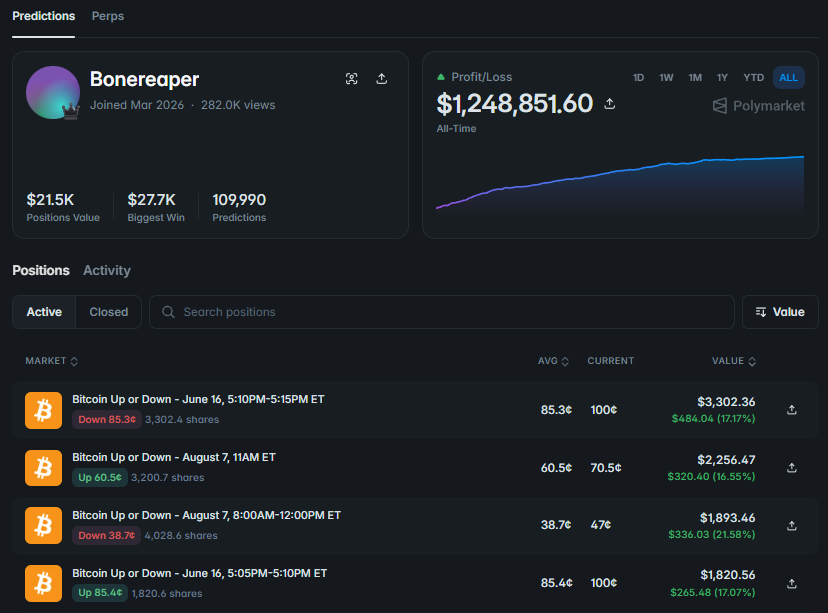
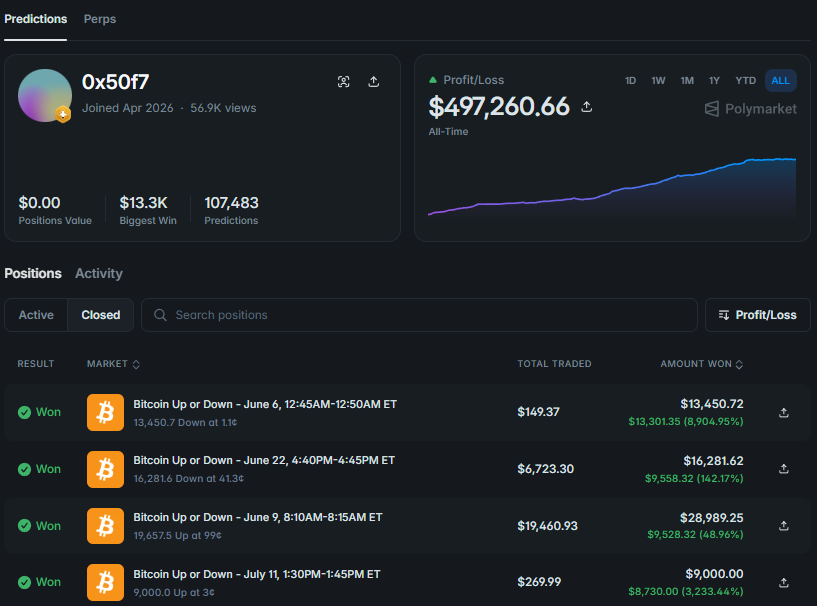
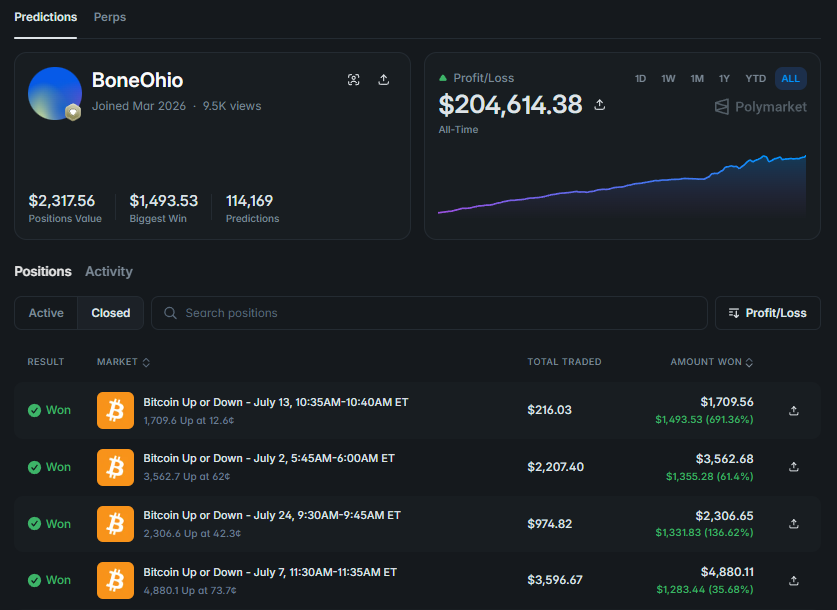
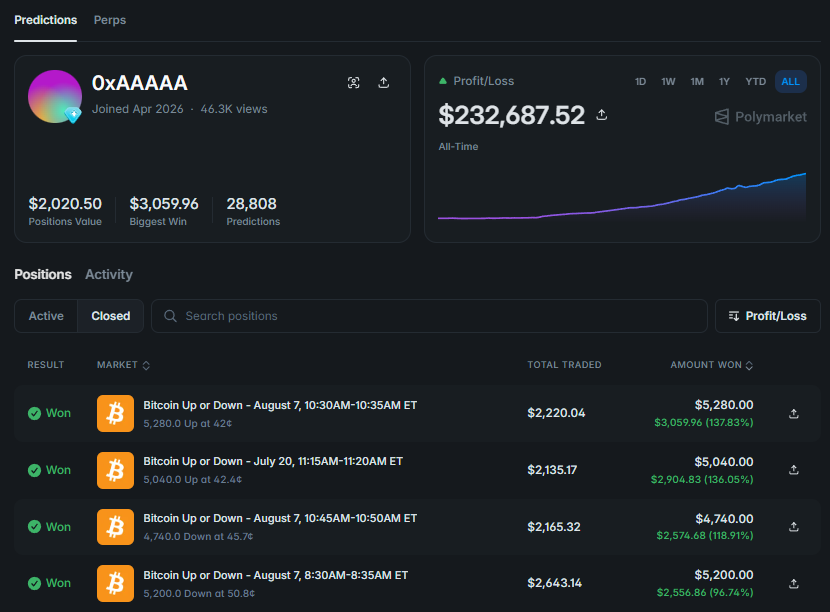
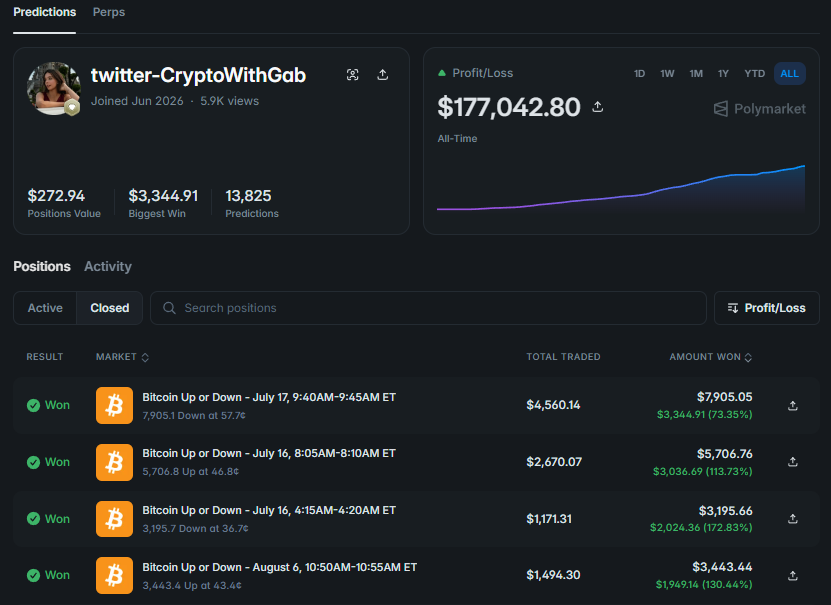
After reviewing more than 50 high-performing Polymarket bots, I found that most of them are not built around one perfect directional forecast
Their edge usually comes from a combination of pricing, position structure, execution, liquidity, and risk control
Here is how the system works.
1. The bot first calculates what the contract should be worth
Imagine BTC suddenly moves above the opening price of an active BTC Up or Down 5m market.
The move is already visible on an external exchange.
But some sell orders for Up on Polymarket may have been placed before that move happened.
If those orders are still resting in the book, the contract can briefly remain available at a price that no longer matches the latest market state.
That temporary mismatch is what the bot is looking for.
To estimate it, the system may track:
> the distance between BTC and the market’s opening price
> the speed of the latest Bitcoin move
> short-term volatility
> seconds remaining before expiry
> bid and ask levels
> available size at several price levels
> the current prices of Up and Down
> average entry prices already held
> unhedged inventory
> resting limit orders
> related BTC Up or Down 5m and BTC Up or Down 15m markets
Instead of treating the current Polymarket price as fair value, the bot creates its own estimate.
Suppose Up is trading at 42¢.
A new BTC move arrives and the model recalculates the probability of Up at roughly 54%.
From the bot’s perspective, the important question is no longer whether Bitcoin looks bullish.
The question becomes:
“Can I still buy a 54¢ outcome for significantly less than 54¢?”
One simple way to update that probability is to adjust the previous odds using the strength of the new signal.
def revise_probability(
    previous_probability,
    signal_multiplier
):
    prior_odds = (
        previous_probability
        / (1 - previous_probability)
    )

    adjusted_odds = (
        prior_odds
        * signal_multiplier
    )

    updated_probability = (
        adjusted_odds
        / (1 + adjusted_odds)
    )

    return updated_probability


fair_probability = revise_probability(
    previous_probability=0.42,
    signal_multiplier=1.62
)

print(
    f"Updated probability: "
    f"{fair_probability:.2%}"
)
There is one major problem, however.
A sharp BTC move may simultaneously create:
higher trading volume
stronger bid imbalance
aggressive market buys
a move in ETH
a move in SOL
That may look like five separate confirmations.
In reality, all five can be consequences of the same original Bitcoin move.
If the model treats them as independent evidence, it will overestimate the probability.
So a strong system must measure not only how powerful a signal looks, but also how much genuinely new information it adds.
2. A correct fair value can still produce a bad trade
Suppose the bot values Up at 55¢. The best available sell order is 46¢.
At first glance: 55¢ − 46¢ = 9¢ of edge
But that does not mean the bot can capture the full 9¢.
The first 80 shares may be available at 46¢. The next 200 may cost 48¢. The next 400 may already be sitting at 50¢.
So the relevant number is not the best ask.
It is the average price required to build the full position. The system also needs to include:
> fees
> spread
> slippage
> partial fills
> worse prices at larger size
> uncertainty in the model itself
A simplified version is:
Tradable Edge = Fair Value − Expected Average Entry − Trading Costs − Safety Margin
def calculate_trade_edge(
    fair_value,
    average_entry,
    execution_costs,
    safety_margin
):
    price_advantage = (
        fair_value
        - average_entry
    )

    usable_edge = (
        price_advantage
        - execution_costs
        - safety_margin
    )

    return usable_edge


edge = calculate_trade_edge(
    fair_value=0.55,
    average_entry=0.49,
    execution_costs=0.012,
    safety_margin=0.008
)

print(
    f"Tradable edge: "
    f"{edge:.2%}"
)
This is where many strategies that look amazing on a chart fall apart in live trading.
A mispricing can exist in historical data. It can exist at the top of the order book. It can even exist for 50 shares.
But if the bot wants to trade 5,000 shares, that same opportunity may disappear completely. So there is a major difference between:
finding an edge and being able to execute enough size before the edge disappears.
3. Some of the best opportunities appear between related markets
A bot does not need to search for mispricing inside one contract only.
The same Bitcoin move can affect several markets at once:
> BTC Up or Down 5m
> the next BTC Up or Down 5m window
> BTC Up or Down 15m
> related ETH and SOL short-term markets
But those contracts do not always update at the same speed.
For example, imagine BTC moves sharply higher.
The current BTC Up or Down 5m market quickly reprices Up from 50¢ to 68¢. At the same time, BTC Up or Down 15m is still trading around 54¢. That does not automatically mean the 15-minute contract is cheap.
The two markets have different opening prices and different amounts of time remaining. Instead, the bot estimates fair value for each market separately.
For example:
BTC Up or Down 5m market price: 68¢
model value: 66¢ BTC Up or Down 15m market price: 54¢
model value: 61¢
Now the picture is very different.
The first market is already slightly expensive relative to the model. The second is still trading far below its estimated value.
The bot can therefore compare each contract’s deviation from its own fair value rather than simply comparing their raw prices.
One way to normalize the relationship is:
Relative Score = (Current Gap − Typical Gap) / Historical Gap Volatility
A large deviation does not automatically create a trade. But it tells the system that one part of the connected market structure has moved unusually far away from the rest.
A human may watch one contract. A bot can monitor an entire network of related probabilities at the same time.
4. Five ways bots turn a pricing edge into a position
Finding an underpriced outcome is only the first step. The next question is:
How should the position actually be built?
Across high-performing Polymarket bots, several recurring structures appear.
1️⃣ Dynamic Position Rotation

Suppose the model initially sees an edge in Up. The bot starts buying Up.
Then BTC loses momentum, moves back toward the opening level, and the estimated probability of Up falls.
The bot does not need to stay committed to its original view.
It can:
> stop adding Up
> reduce part of the existing Up position
> begin accumulating Down
> rotate again if the market changes once more
The first entry is not the final decision. The position keeps changing together with the model. The main danger is noise.
If BTC keeps moving back and forth, the bot may repeatedly switch between Up and Down and gradually lose its original edge through spread, slippage, and poor fills.
2️⃣ Temporal Arbitrage
The simplest binary arbitrage happens when: Up + Down < $1
For example:
Up = 45¢
Down = 48¢
Total cost = 93¢
One of the two contracts will eventually settle at $1. But some bots build this structure without buying both outcomes at the same moment.
Imagine BTC moves higher and Down falls to 27¢. The bot buys Down. Later Bitcoin reverses toward the opening level. Now Up can be accumulated around 49¢.
The final pair becomes:
Down = 27¢
Up = 49¢
total cost = 76¢
Those two prices may never have existed together in the order book. The bot created the arbitrage from two different market states.
But there is a catch.
Until the second outcome has been acquired, the position is not really arbitrage. After buying Down, Bitcoin may continue moving higher until expiry. In that case, cheap Up never appears and the bot is left holding a directional Down position.
More conservative systems solve this by building pairs in smaller pieces:
50 Down
then 50 Up
then another block
This limits the amount of inventory left exposed while waiting for the other side.
3️⃣ Hedged Directional Position
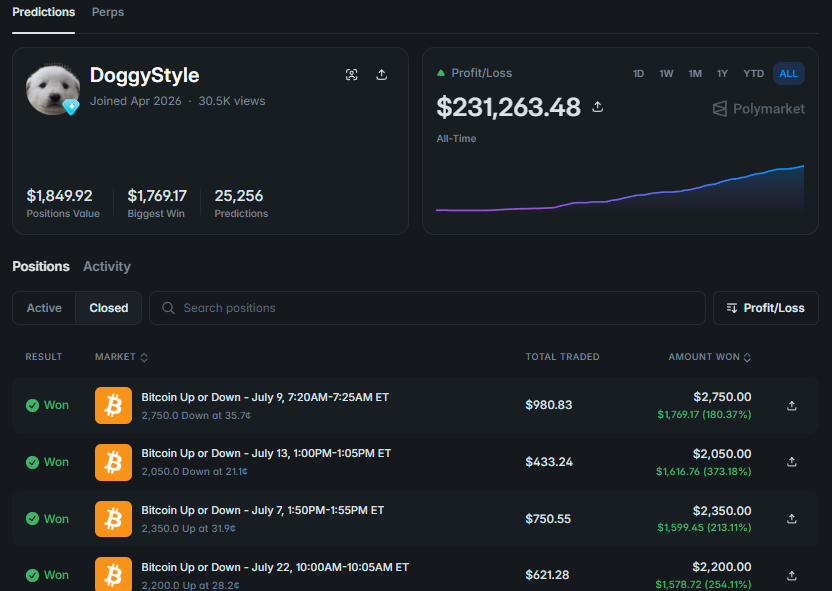
Other bots do not try to make Up and Down quantities perfectly equal.
Imagine the position is:
260 Up
235 Down
235 contracts on each side form the paired portion. The remaining 25 Up create the directional bias.
So most of the position is protected, while the bot still keeps additional exposure to the outcome its model prefers.
The structure can be summarized as:
Directional Exposure = Up Quantity − Down Quantity
def split_position(
    up_quantity,
    down_quantity
):
    matched_quantity = min(
        up_quantity,
        down_quantity
    )

    directional_exposure = (
        up_quantity
        - down_quantity
    )

    return {
        "matched_quantity": matched_quantity,
        "directional_exposure": directional_exposure
    }


position = split_position(
    up_quantity=260,
    down_quantity=235
)

print(
    f"Matched quantity: "
    f"{position['matched_quantity']}"
)

print(
    f"Directional exposure: "
    f"{position['directional_exposure']}"
)
If the signal becomes stronger, the bot can increase the imbalance.
If confidence falls, it can add more Down and reduce directional risk.
But holding both outcomes does not automatically make the position efficient.
Suppose the average prices are:
Up = 55¢
Down = 49¢
A complete pair costs $1.04.
That pair can still return only $1 after resolution. So the supposedly protected part of the position already carries a 4¢ deficit.
The extra directional contracts must first recover that deficit before the full position moves into positive PnL.
4️⃣ Multi-Market Inventory Management
Some bots do not think in terms of:
one market = one trade
They manage capital across several markets at the same time:
BTC Up or Down 5m
BTC Up or Down 15m
ETH Up or Down 5m
SOL Up or Down 15m
neighboring market windows
In this structure, the bot manages an inventory rather than a collection of isolated bets.
Suppose it accumulated Down earlier and the contract has now risen to 98¢. The bot has two choices. It can wait for settlement at $1.
Or it can sell part of that inventory at 98¢, release capital immediately, and move it into another market where a new edge has appeared.
Sometimes the system may also buy a very small amount of the opposite outcome at 1–2¢.
If nothing unusual happens, that protection costs very little. If BTC suddenly crosses the boundary near the end of the market, the cheap opposite position can offset part of the loss.
For this type of bot, the important question is not whether one entry was good.
It is:
How efficiently is the entire inventory using edge?
Near-Resolution Capture
Another group of bots operates almost entirely near the end of the market.
When the result appears close to certain, the likely winning outcome may still trade below $1.
For example:
entry = 98.7¢
settlement = $1
gross return = 1.3¢
The return on each trade is small.
So the strategy depends on high turnover and large volume.
But the risk distribution is extremely asymmetric.
A bot can capture 1¢ again and again, then lose almost the entire contract value on one incorrect trade.
That can happen because of:
a final-second BTC move
the wrong resolution price feed
an incorrect opening price
misunderstanding the settlement rules
failing to cancel a limit order in time
This is why an extremely high win rate does not automatically mean the strategy is safe.
The size of the rare losses matters much more.
5. The biggest problem often starts after the first fill
Suppose the bot finds what looks like perfect arbitrage.
Up + Down = 94¢
It submits two orders. The Up order fills. The Down order fills only partially. Then the market moves and the remaining Down becomes too expensive. The arbitrage is gone.
But the bot is now holding an open Up position. The pricing model was not necessarily wrong. The failure happened during execution.
The system now has to decide:
how long it should wait for the second leg
how much worse a price it can accept
how much imbalance is safe
whether to remain passive with limit orders
when it should cross the spread
whether closing the first leg at a small loss is now the better decision
One way to manage this is to make the working quote depend on inventory.
A simplified structure is:
Working Price = Fair Value − Inventory Penalty
And:
Inventory Penalty = q × λ × σ² × τ
where:
q = current position imbalance
λ = risk sensitivity
σ = volatility
τ = time remaining
If the bot already holds too much Up, it becomes less willing to keep buying more Up.
At the same time, acquiring Down becomes more valuable because it reduces the imbalance.
This sounds simple, but it is one of the biggest differences between a real execution system and a bot that simply keeps buying whenever its directional signal remains positive.
6. The final filter is position size
Even a strong edge does not justify putting the entire capital into one market.
The model can be correct and the trade can still fail because:
liquidity disappears
one leg never fills
the API becomes delayed
an external data feed updates late
the real average entry becomes worse than expected
several correlated positions open at the same time
That is why sizing is treated as a separate decision.
One approach is to use only a fraction of the full Kelly allocation.
def fractional_kelly(
    win_probability,
    entry_price,
    fraction=0.20
):
    loss_probability = (
        1 - win_probability
    )

    net_odds = (
        1 - entry_price
    ) / entry_price

    full_kelly = (
        net_odds * win_probability
        - loss_probability
    ) / net_odds

    fractional_allocation = (
        full_kelly
        * fraction
    )

    return max(
        fractional_allocation,
        0
    )


allocation = fractional_kelly(
    win_probability=0.60,
    entry_price=0.49,
    fraction=0.20
)

print(
    f"Capital allocation: "
    f"{allocation:.2%}"
)
But mathematical sizing alone is still not enough.
A production bot normally needs hard limits such as:
maximum capital per market
maximum unhedged inventory
maximum exposure to BTC, ETH, or SOL
daily loss limit
correlated-position limit
automatic kill switch when market data becomes unreliable
Correlation is especially important.
A position in BTC Up or Down 5m and another position in BTC Up or Down 15m are technically two different markets.
But if both contain large Up exposure, they may effectively be the same bet on Bitcoin.
The same problem appears when BTC, ETH, and SOL all move together during a broad crypto move.
What high-performing Polymarket bots actually have in common
There is no single strategy shared by every high-performing bot.
Some continuously rotate between Up and Down.
Others buy both outcomes at different moments and gradually turn directional exposure into arbitrage.
Some maintain a large paired position with a smaller directional imbalance.
Others manage inventory across several Polymarket markets at once.
And some barely trade until the final seconds before resolution.
But underneath these different strategies, the same process keeps appearing:
receive fresh data
calculate an independent probability
compare it with the real executable price
choose the right position structure
build the position without dangerous imbalance
limit the amount of capital at risk
repeat the process at scale
That is the real advantage of these systems.
They do not need to know exactly where Bitcoin will be five minutes from now. They only need to answer two questions faster than most traders:
What should Up and Down be worth right now?
and
Can I build the position before that opportunity disappears?
Join my Tg channel ✍️:https://t.me/+VDXq5wkZ2AIxMDBi
Follow me ✌️:https://x.com/Dan1ro0