founder content is a system [full playbook]

At my last company (@boardyai), I wrote 100+ posts, generated 20M+ impressions, and helped bring 12k+ inboundapplications for our enterprise offering in 4 months.
During that time, studying founder content became my full-time obsession.
After studying thousands of posts, I kept seeing the same 3 people showing up on my feed: @levelsio, @marclou, and @zach_yadegari.
These guys have mastered the repeatable post. You've seen their posts even if you don't follow them. Between the three of them, those posts have driven over $50 million in outcomes.
What you probably never noticed is that the posts repeat. Same 6 structures, new inputs, over and over for years.
By the end of this article you'll see them everywhere, and you'll know how to write every one.

Structure
This playbook has three parts:
1 - Raw material
Before getting into the formats themselves, there is a step most people skip that will decide whether any of this works.
Whenever someone copies a viral post and it flops, the natural conclusion is that the format didn't work. In almost every case I've studied, the format was fine and the problem was that the person had nothing of their own to put inside it.
The founders in this article are pulling from a deep inventory of numbers, stories, and things they've built, and that inventory is what makes the same 6 structures feel fresh every time they use them.
So before you write anything, you need to take stock of what you actually have. Most founders have far more material than they realize, and it tends to fall into three categories.
i - Your numbers
Every number you're sitting on can become a post. This includes revenue, users, downloads, days since launch, cold emails sent, and even rejections collected.
The most common mistake I see is founders assuming their numbers are too small to share.
What makes a number perform has very little to do with its size and everything to do with the context around it.
A post that says "$180 MRR" doesn't give the reader much, but a post that says you reached $180 MRR after nine months of building on nights and weekends tells a story people want to follow.
If you look at Zach's early Cal AI posts, they worked for the same reason his $1M post worked, because the interesting part was never the number itself but the gap between the number ($1M) and the person behind it (high schooler).
Go through your business and write down every number you have, even the ones that you're embarrassed about. You will be pulling from this list constantly in part two.
ii - Your scars
Your failures are some of the most valuable material you own. The products that never made any money, the job you hated, and the launch that got 12 downloads all belong on this list.
Most founders hide these stories, which is exactly why they perform so well. Failure content is the least supplied content on this app and the most trusted, because readers know that nobody exaggerates to make themselves look worse.
Some of Marc Lou's most shared posts are honest rundowns of every product he built that went nowhere, and what makes that format special is that it works at any follower count. You could publish your version of it tomorrow.
iii - Your build log
Whatever you're working on right now is also material. The feature you shipped this week, the bug that spent your entire weekend, and the decision you're currently stuck on are all posts waiting to be written.
The best example of this is @levelsio, whose entire account is essentially a public build log.
When he coded a flight simulator in public, the process of building it was the content, and those posts were performing before the product had a single user.
This is worth internalizing because it means you don't need results to start posting. Progress on its own is watchable, and documenting it honestly is enough.
Before moving on to part two, put together your list across all three categories.
I would aim for at least ten items on your list. This will be the fuel for the engine that I'm about to show you.
2 - The 6 formats
Now that you have your inventory, this section covers the structures that turn it into posts.
For every format, I'll show you a real example, and explain why it works.
i - The build log
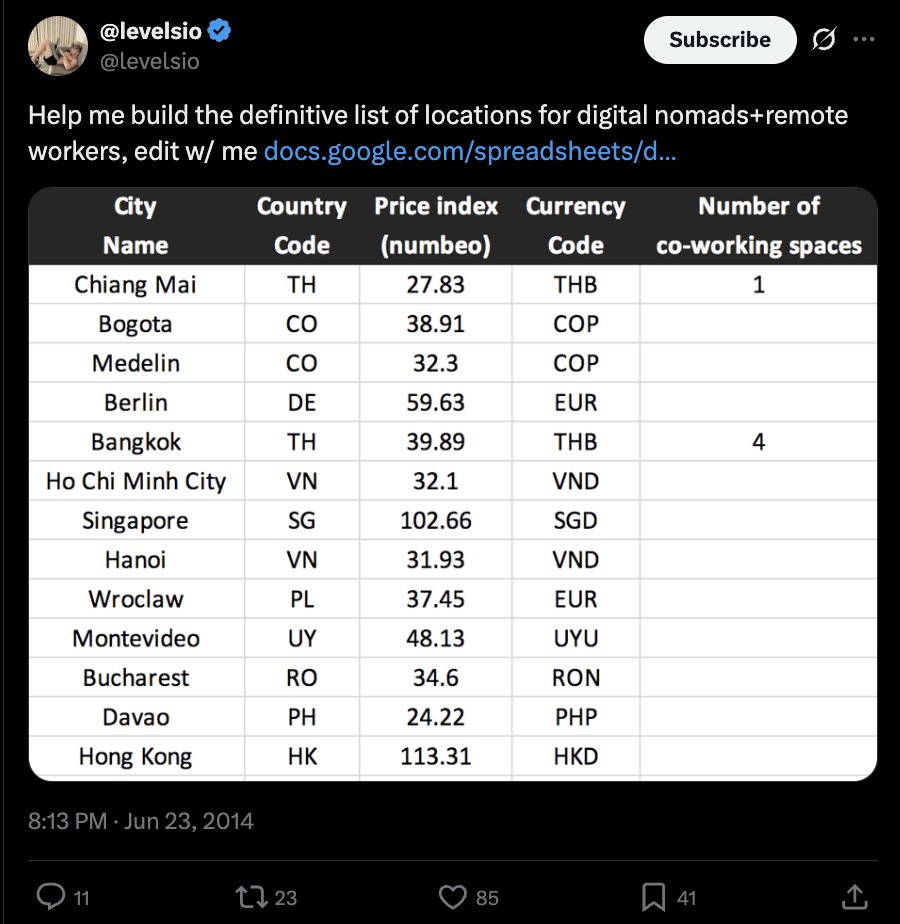
The entry price here is zero. If you're working on something, you can run this format today.
This post from June 2014 is the exact moment Nomad List started.
Look at the engagement before you look at anything else. By every metric you'd normally care about, this post looks like a failure. 85 likes is nothing to write home about, and most people would have deleted it and moved on to a new idea.
The product didn't even exist yet. What levelsio posted was a Google spreadsheet and an invitation to help him fill it in, and strangers did, adding cities and columns until the spreadsheet outgrew itself.
Within a month, it became a website that hit #1 on both Product Hunt and Hacker News. Today, that project is now Nomads.com, which still does $15K a month a decade later and is the project that made his name.
This is the part most people get wrong about build logs. You aren't posting for impressions, you're posting for the handful of people who actually care about what you're building.
This format is repeatable because people invest in unfinished things.
People get attached to things they watched being made, the same way you root harder for a team you've followed all season.
Post the process and people will stick around to see how it ends. The ones who stick around will become your earliest users.
ii - The documented failure
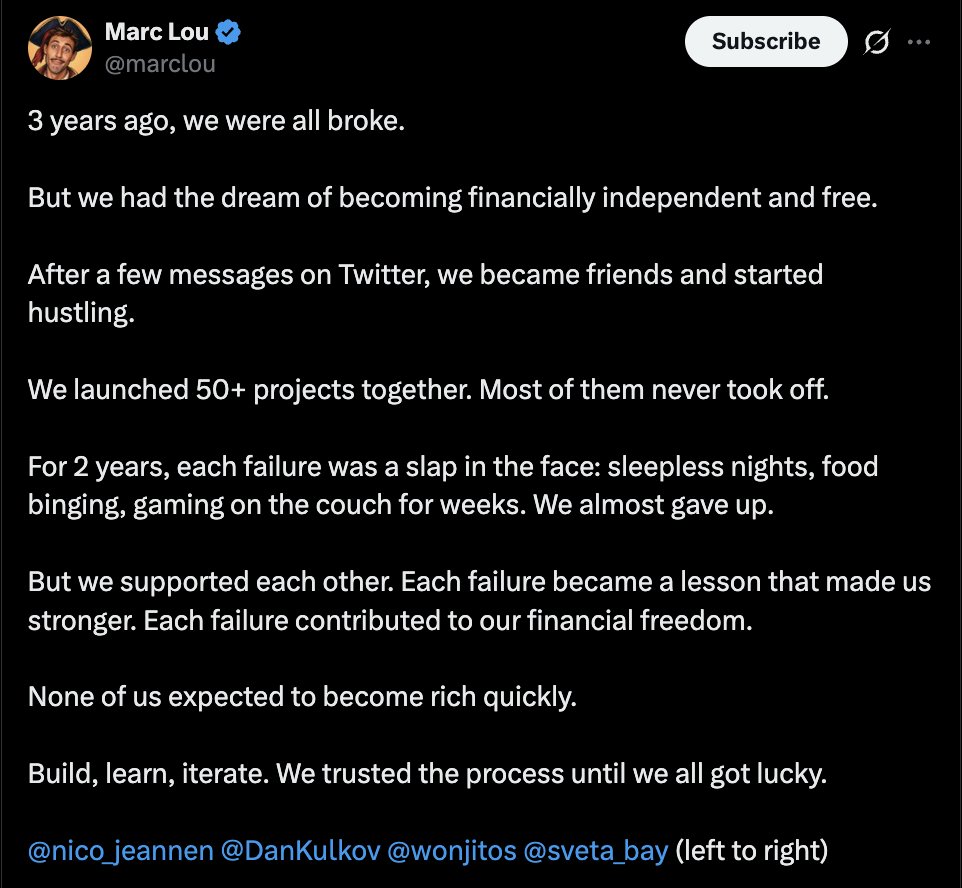

If the build log has the lowest entry price, this one has the highest emotional price. All you need is a story that stings a little to tell.
Every founder has at least one.
If you look closely at how Marc wrote this, almost the entire post is about the losing years. The success only shows up in the last line, and he doesn't even explain what worked. There's just a photo of him and his friends in a pool.
Failure content is massively undersupplied on X. Somehow everyone you see on this app is winning, posting launch announcements, revenue screenshots, and making 10k+ a month.
Be specific about the embarrassing details. This is what makes the story feel true. "Food binging and gaming on the couch for weeks" does WAY more of the heavy lifting than "it was a hard time."
iii - The value post
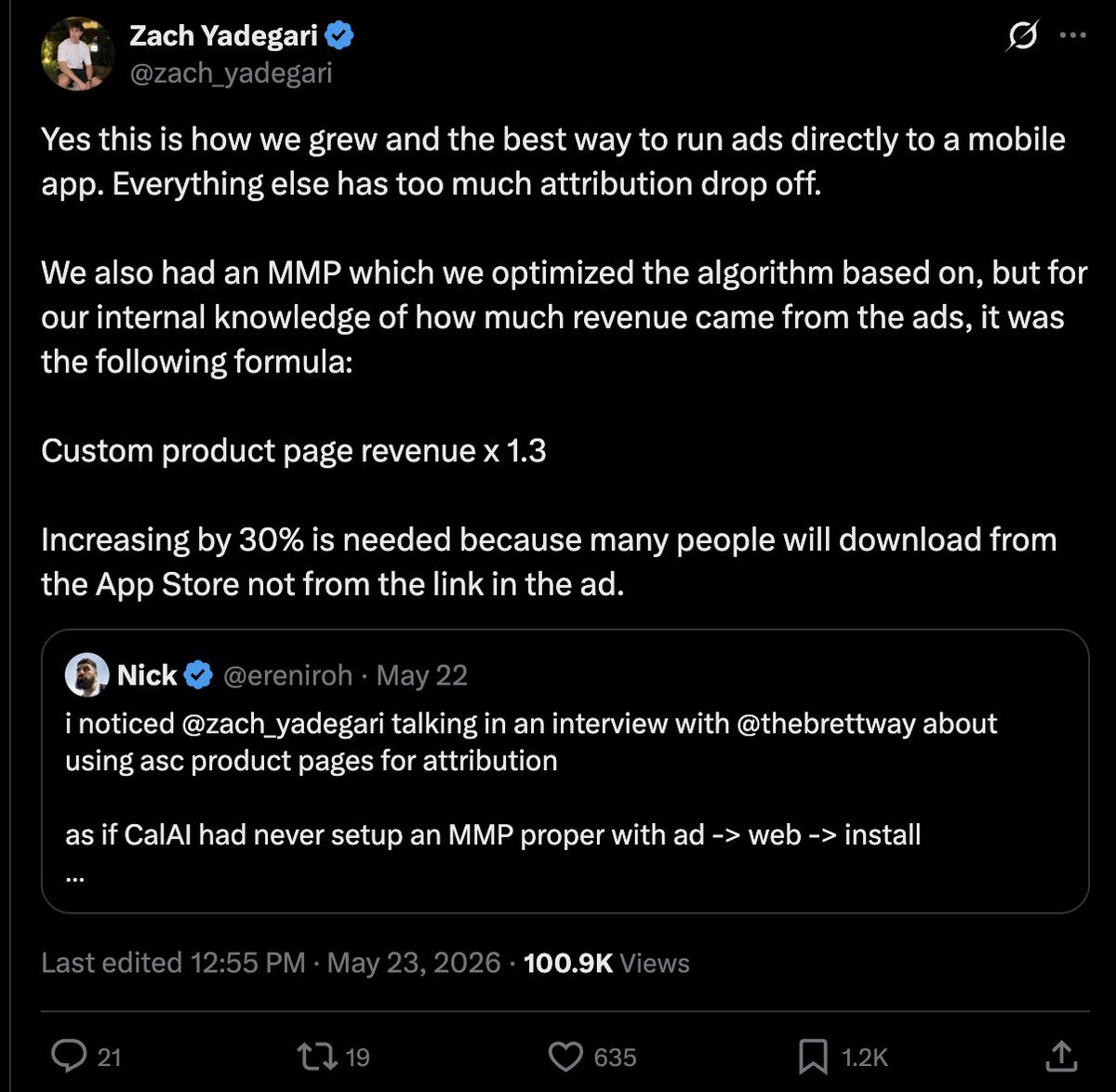
The entry price here is experience, and having done the thing recently enough to remember the steps.
A value post is exactly what it sounds like, teaching your reader how to do something you've already done.
This one from Zach is a good example to study because of how he structures each step. Notice that he never just gives the instruction.
He says to start with HTML/CSS/JS, and then immediately explains that it's because those are the easiest to launch something public with.
Every step in the post follows that same pattern, and it matters because advice without reasoning is just a list, and lists don't build trust in the person writing them.
Value posts are also the biggest bookmark farmers of the six formats. Nobody bookmarks your opinion, but everyone bookmarks instructions they'll need later, and bookmarks are one of the strongest signals that the algorithm rewards.
When you write yours, pick something you figured out in the last few months, while the details are still fresh. The more specific the topic, the better it performs. "How I got my first 10 customers with cold DMs" will always beat "how to get customers," because it's more convincing.
iv - The receipt

The entry price here is a win you can screenshot, and it doesn't have to be revenue. Your first paying customer, an unprompted DM from a happy user, a spike in your downloads chart. Anything you can show instead of describe.
levelsio has been posting these dashboards for a decade, and the first thing to notice is how little he writes around them. Usually one line, sometimes nothing at all. That restraint is the format. The feed is full of people describing how well things are going, and a screenshot cuts through all of it because a claim can be written by anyone, but a dashboard had to be earned.
He takes it further than anyone else on this app. Open his profile and look at his bio, where every product is listed with its monthly revenue right next to it. His entire account is set up so that a stranger landing on it believes him within five seconds.
The real power of this format shows up with repetition. One screenshot is a flex, and people scroll past flexes. But when you post the same dashboard every month, it becomes a series, and people start following just to see the next number. The receipt you post today is setting up the one you post in March.
v - The contrast hook

The entry price here is a gap between who you are and what you did, and you have one even if you can't see it yet.
Look how little is actually in this post. A revenue number, and a fact about school. He doesn't explain how he did it, and he doesn't celebrate. Two facts, side by side, and the reader is left to resolve them on their own.
You might think this post did well simply because $1M is a big number. It isn't that.
Founders announce $1M on this app every single day and nobody stops scrolling.
The school detail is what made it go viral, because a founder crossing $1M is a regular Tuesday on this app...but a kid hitting it between AP classes is a story you tell someone else, and posts that people share are posts that travel.
So when you write yours, stop looking for the impressive half and start looking for the gap in the story.
vi - The milestone chapter

This is the most expensive format on the list, because the entry price is a story that people are already following.
Milestones are easy to confuse with receipts, so here's the difference. A receipt proves a win to strangers who have never seen your account before. A milestone connects that win to everything you've posted leading up to it.
If you look closely at Marc's post, you'll notice he embedded the original tweet from December 2022, back when he was asking a tiny audience to support his launch. This is what makes the post work. He never has to convince you that the journey happened, because the artifact from the beginning is sitting inside the post and anyone can tap into it.
This is the part I would steal. Quoting your own old tweet turns your timeline into proof that nobody can fake, and if you've been posting for even six months, you already have the raw material sitting in your history.
One thing to keep in mind is that this is the only format on the list you can't run today. A milestone with no story behind it is just a number, so the only way to unlock this format is to have been posting consistently. Run the other five from wherever you are, and this one will arrive on its own.
3 - Wring the towel
At this point you have your raw material and the six formats to run it through. The last part is getting everything out of the posts that work, because most people find a winner, use it once, and move on to the next idea.
i - Repost your winners
One of the most underrated things you can do is repost something that already did well a few months ago.
Only a fraction of your followers saw the original post, anyone who followed you after has never seen it, and the people who did see it have mostly forgotten. levelsio has been posting the same dashboards and the same takes for a decade, and I've never once seen someone reply that he already said this in 2019.
The reality is that you will get bored of your content long before your audience does. So if a post performed above your baseline, rewrite the hook, update the numbers, and run it again in a month or two.
ii - Quote tweet your winners
Whenever one of your posts starts picking up steam, you should quote tweet it with some added context. The views on your quote get counted toward the original post, which means you're stacking impressions onto something the algorithm is already distributing.
This also works long after the post has died down. Quoting an old winner with an update gives your newer followers the backstory in one tap, and you already saw the ceiling of this move in format six, where Marc built his milestone post by quoting his own tweet from two years earlier.
iii - One outlier is never one post
When a post massively outperforms everything around it, the worst thing you can do is celebrate and move on. An outlier is information. Something in that post resonated, and your job is to figure out what it was and run it back.
Let's say your failure story pops. That same material can come back as a contrast hook, as a milestone chapter once things turn around, and as a build log for whatever you do next. Launches work the same way, because a launch was never one post to begin with.
The announcement, the updated numbers, and the lessons are three separate posts sitting inside one event.
Closing notes
Everything in this article is stealable. The formats are sitting in front of you, the examples are linked, and by the end of this, you should have a raw material list of everything about you.
But I want to be straight with you about what happens next. Your first posts will not look like the screenshots in this article.
For context, Marc took 8 months to reach 1,000 followers. The founders you just studied were tweeting in the void for longer than anyone remembers, and the reason you know their names is because they KEPT posting through it.
So start with the two formats that make the most sense for you. If you're building something, start the build log. If you have a scar, write the failure post.
And if you'd rather have these formats written for you, in your voice, from your own material, you NEED to use @stanleybystan. He's an AI Head of Content for X, LinkedIn, and Instagram. Free to try here: x.getstanley.ai/r/anson