"At a time when the American public is expressing unprecedented...

Ben Freeman@BenFreemanDC
36 views
May 29, 2026
~2 min read
Advertisement
1
"At a time when the American public is expressing unprecedented levels of distrust in the Israeli government, Congress just proposed tying the U.S. to the Israeli military more than ever before."
Here's the story: 🧵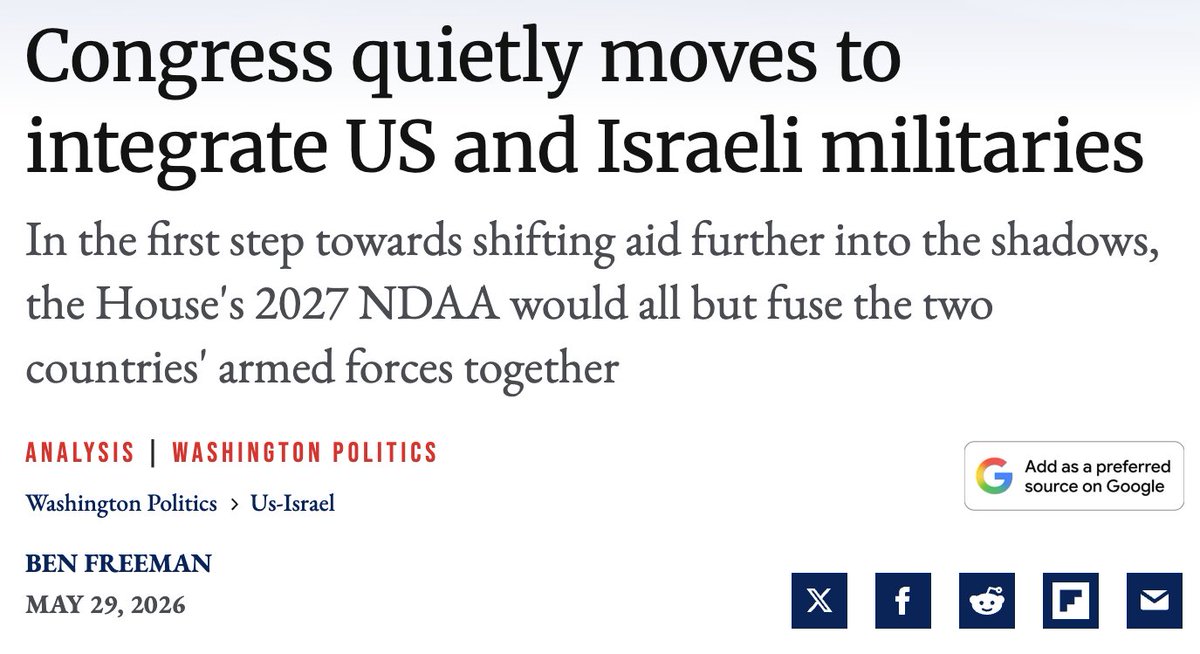
Here's the story: 🧵
2
Buried in the House’s 2027 NDAA is Section 224: the “United States-Israel Defense Technology Cooperation Initiative," which would dramatically expand U.S.-Israel military cooperation far beyond the current aid model.
3
We’re talking bilateral R&D, weapons co-production & deep defense-tech integration. It also names emerging technologies like AI, quantum, autonomous systems, directed energy, cyber, biotech, and more. In other words: the battlefields of the future.
4
One of the most alarming phrases in the bill: “network integration” and “data fusion.”
Put plainly, the U.S. military’s data could soon be the Israeli military’s data.
That is not normal defense cooperation. That is something much deeper.
Put plainly, the U.S. military’s data could soon be the Israeli military’s data.
That is not normal defense cooperation. That is something much deeper.
5
The U.S. already gives Israel extraordinary military support.
Israel has received more than $200 billion in inflation-adjusted U.S. military assistance since 1948.
But Section 224 would mark a shift from aid to integration.
Israel has received more than $200 billion in inflation-adjusted U.S. military assistance since 1948.
But Section 224 would mark a shift from aid to integration.
6
That shift matters A LOT.
Traditional military aid is at least somewhat visible and politically accountable.
But moving the relationship into defense acquisition, co-production, and joint tech development risks pushing it further into the shadows.
Traditional military aid is at least somewhat visible and politically accountable.
But moving the relationship into defense acquisition, co-production, and joint tech development risks pushing it further into the shadows.
7
It would also create powerful new political incentives inside the U.S.
If Israeli defense firms expand co-production facilities here, they can claim to create jobs in congressional districts — and gain more allies in Congress.
That’s how military-industrial influence grows.
If Israeli defense firms expand co-production facilities here, they can claim to create jobs in congressional districts — and gain more allies in Congress.
That’s how military-industrial influence grows.
8
We’ve already seen Israeli defense production footprints in places like Mississippi and Arkansas.
Section 224 could turbocharge that model — making the Israeli military-industrial base even more embedded in U.S. politics.
Section 224 could turbocharge that model — making the Israeli military-industrial base even more embedded in U.S. politics.
9
All of this is happening while the American public is increasingly skeptical of unconditional support for Israel.
A recent poll found just 16% of Americans support continuing to supply Israel with weapons without new restrictions.
A recent poll found just 16% of Americans support continuing to supply Israel with weapons without new restrictions.
10
That disconnect is striking:
The public is asking for more restraint and accountability with Israel.
Congress is proposing deeper, less transparent military integration.
That’s not democracy. That’s the military-industrial complex doing what it does best.
The public is asking for more restraint and accountability with Israel.
Congress is proposing deeper, less transparent military integration.
That’s not democracy. That’s the military-industrial complex doing what it does best.
11
And the timing could not be worse.
Israel has repeatedly used U.S. weapons in Gaza in ways that human rights groups and journalists have linked to violations of international humanitarian law.
This is not the moment to deepen integration with Israel’s military.
Israel has repeatedly used U.S. weapons in Gaza in ways that human rights groups and journalists have linked to violations of international humanitarian law.
This is not the moment to deepen integration with Israel’s military.
12
Members of Congress concerned about U.S. interests, regional stability, and democratic accountability should act now.
The first step is simple:
Reject Section 224 from the NDAA.
Stop the U.S.-Israel military-industrial merger before it starts.
The first step is simple:
Reject Section 224 from the NDAA.
Stop the U.S.-Israel military-industrial merger before it starts.
13
For all the details, check out my article in @RStatecraft responsiblestatecraft.org/israel-us-mili…
