The average startup pays $8,000-15,000/month for a team of 3-4...

The average startup pays $8,000-15,000/month for a team of 3-4 developers.
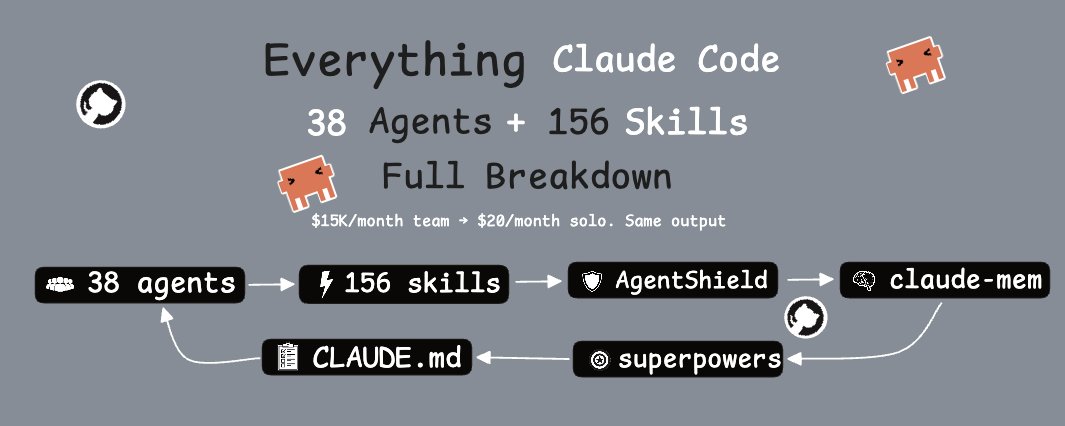
One guy won the Anthropic hackathon by building a full product in 8 hours solo with Claude Code. Prize - $15,000.
Then he opened his repository and everyone understood how he did it. 153,000+ stars on GitHub. The fastest growing dev tool repo in history.
Everything Claude Code turns Claude into a full engineering team: 38 specialized agents, 156 skills, 72 commands, a security scanner with 1,282 tests, and a system that learns from every session.
Developers using ECC report 60% cost reduction and 3-5x faster shipping. Here's how it works and how to set it up correctly.
Part 1 - What's inside (and what you actually need)
Install:
```python
# Option A — plugin (recommended)
/plugin marketplace add affaan-m/everything-claude-code
/plugin install everything-claude-code@everything-claude-code

# Option B — selective install (only what you need)
ecc install --profile developer \
  --with lang:typescript \
  --with agent:security-reviewer \
  --without skill:continuous-learning
```
Option B is the right move. You don't need all 156 skills. Pick your language, pick your agents, skip the rest.

38 agents - not chatbots, specialists
Each agent has one job and does it well:
```plaintext
planner             → breaks down task into steps, delegates to other agents
security-reviewer   → scans for vulnerabilities before shipping
typescript-reviewer → catches TS-specific antipatterns
pytorch-build-resolver → fixes PyTorch build issues
code-reviewer       → general code review with 5 parallel checks
debugger            → structured root-cause analysis
```
Coverage: TypeScript, Python, Go, Java, Kotlin, C#, Rust, C++, Perl, Flutter. 12 language ecosystems.
Planner is the key hero in the repo. You give a task - it breaks it down, assigns to specialists, coordinates the result.
In practice: a task that took a junior dev a day - planner + 3 agents do in 20-40 minutes. Without the bugs you spend a week fixing afterward.
156 skills - only load when needed
Skills don't eat your context window constantly. They activate only when relevant:
```plaintext
/plan          → structured task planning
/tdd           → test-driven development workflow
/e2e           → end-to-end testing
/security-scan → AgentShield vulnerability check
/model-route   → pick the right model for the task
/harness-audit → evaluate your current setup
/simplify      → refactor for readability
/loop-start    → autonomous iterative work
```
Plus domain skills: nextjs-turbopack, bun-runtime, pytorch-patterns, documentation-lookup, mcp-server-patterns.
72 commands - one slash instead of a paragraph of prompts
Instead of "please review my code and check for security issues and run tests and...":
```plaintext
/review        # full code review
/security-scan # AgentShield audit
/tdd           # tests first, then implementation
/plan          # break down any task
/quality-gate  # check if ready to ship
```
One slash and done. Savings: ~15-20 minutes of prompt engineering per task. On 10 tasks a day - that's 2.5-3 hours returned to you.
Replaces: Hours of setting up Claude Code from scratch in every project.
Part 2 - AgentShield (the real diamond everyone skips)
Most people skip this part. This is the most important thing in ECC.
Context: in January 2026 12% of skills on one marketplace were malware - 341 out of 2,857 community skills. A CVSS 8.8 CVE exposed 17,500 instances to RCE with one click. The Moltbook breach - 1.5 million API tokens compromised.
AgentShield is a security auditor for your entire Claude Code setup. 1,282 tests, 98% coverage,102 security rules.
```plaintext
# Quick scan — don't even need to install
npx ecc-agentshield scan

# Auto-fix safe issues
npx ecc-agentshield scan --fix

# Deep analysis with three Opus 4.6 agents
npx ecc-agentshield scan --opus --stream
```
What --opus does is wild. Runs three Claude Opus 4.6 agents in a red-team/blue-team/auditor pipeline:
```plaintext
Attacker agent  → looks for exploit chains in your config
Defender agent  → evaluates your defenses
Auditor agent   → synthesizes both into a prioritized risk report
```
What it scans:
```plaintext
CLAUDE.md           → hardcoded secrets, injection vectors
settings.json       → misconfigured permissions
MCP configs         → server risks (25+ known CVEs)
Hooks               → injection analysis
Agents              → prompt injection, privilege escalation
Skills              → supply chain verification
```
Output:
```plaintext
Security Scan Results
─────────────────────
Grade: B+
Critical: 0 | High: 2 | Medium: 5 | Low: 3

❌ HIGH: Hardcoded API key in CLAUDE.md:15
   Fix: Move to environment variable

⚠️ MEDIUM: Overly permissive hook in hooks.json:42
   Fix: Restrict to specific file patterns
```
Can run in CI - every PR that changes an agent config gets automatically audited:
```python
- name: AgentShield Security Scan
  uses: affaan-m/agentshield@v1
  with:
    min-severity: "medium"
    fail-on-findings: "true"
```
One npx ecc-agentshield scan command can save you from leaking API keys worth thousands of dollars. Or from a malware skill draining your code.
Replaces: Hoping your Claude Code setup isn't breaking your security. The cost of the problem AgentShield catches: from $500 (API key leak) to $50,000+ (breach via MCP server).
Part 3 - The system that learns from you
Here's what separates ECC from any other config pack.
Normal Claude Code starts every session from scratch. Doesn't learn from your patterns. You fix the same type of bug 10 times - Claude won't remember.
ECC's continuous learning creates "instincts" - behaviors the agent develops by observing your sessions:
```plaintext
Session 1:  you fix an async error-handling pattern
→ ECC logs this as instinct (confidence: 0.3)

Session 5:  you fix the same pattern differently
→ confidence grows to 0.6

Session 10: stable pattern detected
→ confidence 0.9
→ Claude applies this automatically in new code
```
This isn't model fine-tuning. This is a knowledge layer on top that persists between sessions and improves over time.
Result: after 2-3 weeks of daily use Claude writes code in YOUR style. Not "generic AI assistant" style - exactly how you would write it yourself - but 10x faster.

Replaces: Explaining your patterns to Claude every session. After a month - it's like having a junior who finally learned your conventions.
Part 4 - Three repos that make ECC complete
ECC is powerful on its own. But it has gaps. These three repos close them perfectly.
claude-mem - memory between sessions (38,000+ stars)
github.com/thedotmack/claude-mem
ECC gives agents and skills. But agents don't remember previous sessions. claude-mem fixes this.
```python
/plugin marketplace add thedotmack/claude-mem
/plugin install claude-mem
```
5 lifecycle hooks capture everything. SQLite storage. Web viewer at localhost:37777. Now your ECC agents remember what they learned yesterday.
Superpowers - think before coding (obra)
github.com/obra/superpowers
ECC has 38 agents that write code fast. Without Superpowers they jump into implementation without a plan.
```python
/plugin marketplace add obra/superpowers
/plugin install superpowers
```
Forces structured thinking: TDD mode, brainstorming, root-cause debugging. Agents still write code - but now they think first.
Without Superpowers: agent writes 400 lines -> 3 hours of debugging. With Superpowers: agent plans 10 minutes -> writes 400 lines -> works first try.
CLAUDE.md rules - predictable behavior
Not a repo - a pattern. Add to your CLAUDE.md:
```plaintext
- Always run tests before marking task complete
- Never create files outside the project directory
- Ask before deleting any file
- Explain reasoning before writing code
- If unsure, ask — don't guess
```
All 38 ECC agents read CLAUDE.md. Added rules - all agents follow them. Predictable behavior instead of chaos.
Full setup - 5 minutes
```plaintext
# 1. Install ECC (selectively — for your stack)
/plugin marketplace add affaan-m/everything-claude-code
/plugin install everything-claude-code@everything-claude-code

# 2. Add memory
/plugin marketplace add thedotmack/claude-mem
/plugin install claude-mem

# 3. Add discipline
/plugin marketplace add obra/superpowers
/plugin install superpowers

# 4. Run security scan
npx ecc-agentshield scan --fix

# 5. Add behavior rules to CLAUDE.md

```
What you get:
```plaintext
38 specialized agents      → replaces 3-4 juniors ($8K-15K/month)
156 skills                 → replaces weeks of setup
Security scanner           → catches $500-50K+ problems
Continuous learning        → Claude learns YOUR style in 2-3 weeks
Persistent memory          → stop explaining the same thing daily
Structured thinking        → code works first try
```
One solo founder with ECC + claude-mem + Superpowers ships like a team of 3-4 people. For $20/month instead of $8,000-15,000/month.
You either pay $15K/month for a team. Or install 4 plugins in 5 minutes.
The only thing it costs - the decision to stop doing everything manually.
You build your own life - so choose the right path.
/ If this was useful - follow /
more info in my tg channel: https://t.me/noisyclub01