Okay, I have read this paper and it is horrible. The obvious reply,...

Vincent Geloso@VincentGeloso
27 views
Mar 28, 2026
~5 min read
Advertisement
1
Okay, I have read this paper and it is horrible. The obvious reply, that many economists have made, is that there is no causality in there.
The problem is that I have not seen many replies that cite actual empirical research, so let me plug this in. On five grounds.
x.com/jasonhickel/st…
The problem is that I have not seen many replies that cite actual empirical research, so let me plug this in. On five grounds.
x.com/jasonhickel/st…
2
1) First, there is evidence using synthetic controls that liberalizations boosted growth. The first big one on this front is Billmeier and Nannicini in Restat (2013)
Using synthetic control methods, they find that most episodes of liberalization enhanced growth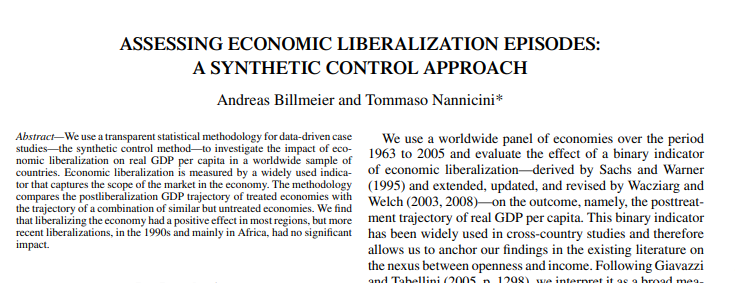
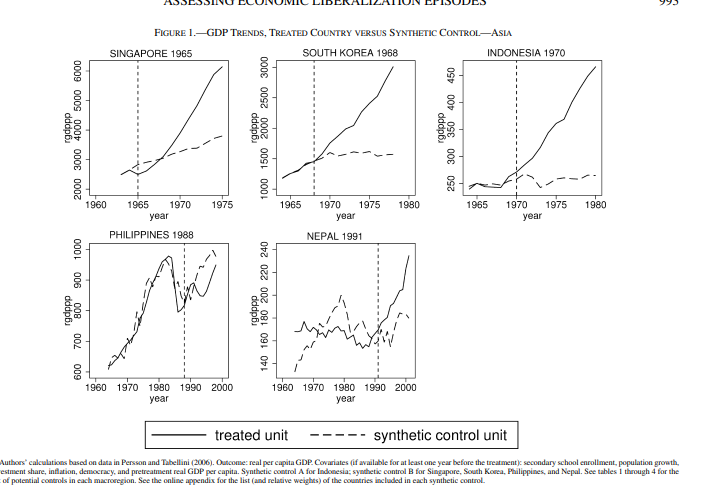
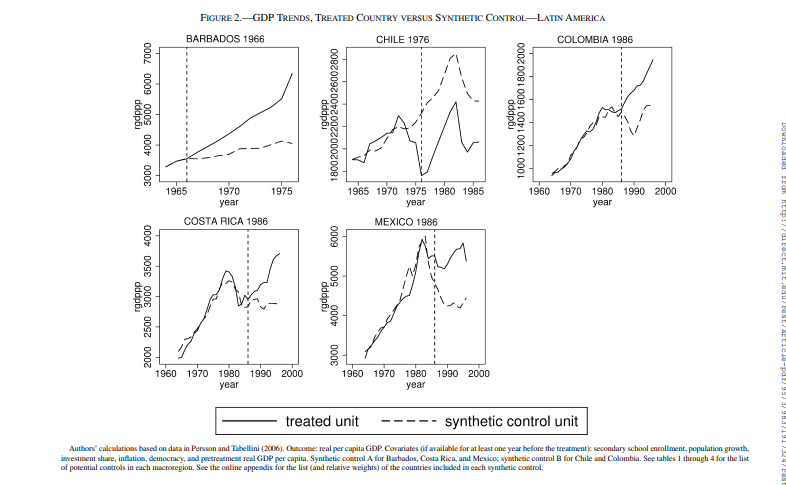
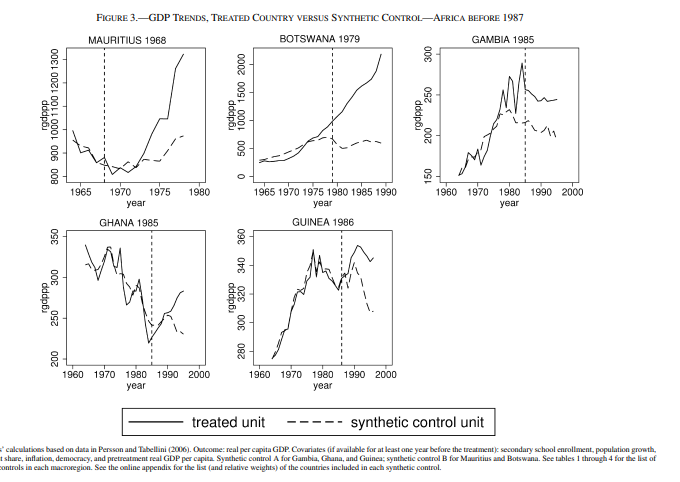
Using synthetic control methods, they find that most episodes of liberalization enhanced growth
3
Improvements on the method combined with replications of Billmeier showed that this holds quite well. For example, take the case of Barbados as one the studied liberalizations in the JBES paper below.
Kaul, A., Klößner, S., Pfeifer, G., & Schieler, M. (2022). Standard synthetic control methods: The case of using all preintervention outcomes together with covariates. Journal of Business & Economic Statistics, 40(3), 1362-1376.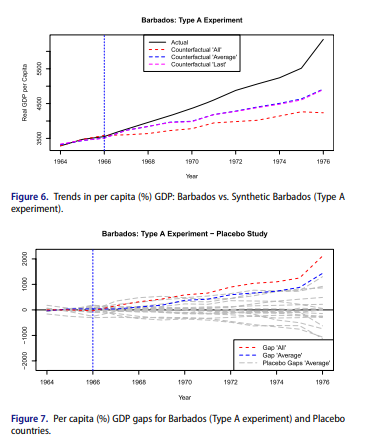
Kaul, A., Klößner, S., Pfeifer, G., & Schieler, M. (2022). Standard synthetic control methods: The case of using all preintervention outcomes together with covariates. Journal of Business & Economic Statistics, 40(3), 1362-1376.
4
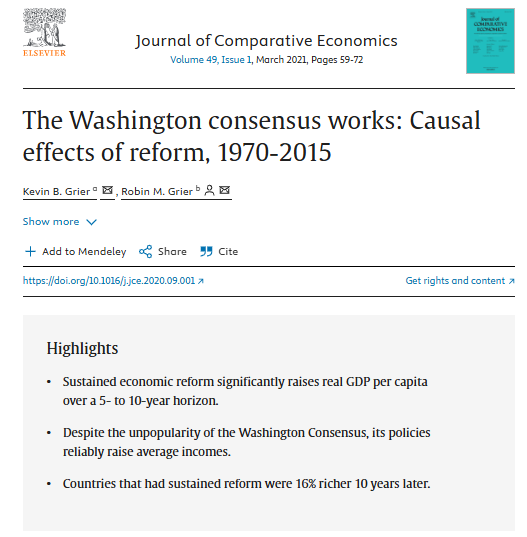
2) There are great papers that use matching methods instead of SCM. These are nicer I think because they look at "big jumps" in economic freedom indexes (available since 1970) and try to match with the closest non-liberalizers. They also avoid issues of "heterogeneous treatment effects" which can foil some DiD estimates. This is what my co-author Kevin Grier and Robin Grier did in this Journal of Comparative Economics article
5
The effect is a big boost to growth that amount to 16% more income on average for liberalizers relative to non-liberalizers within ten years of reform.

6
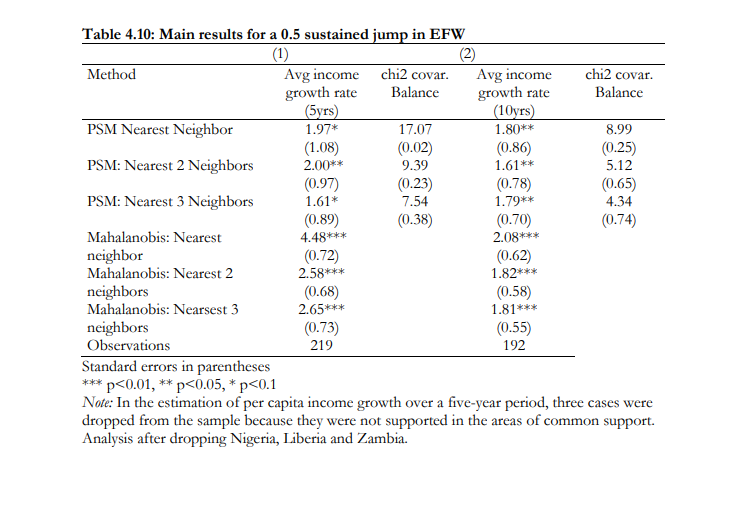
Another co-author of mine, in her dissertation and now in a forthcoming article, concentrated on episodes of liberalizations in Africa. The idea being that reforms were milder there, from a lower levels, with weaker states and the legacy of colonialism. Using the same method, Florence Muhoza finds the same thing -- even small liberalizations boosted growth.
7
3) Justin Callais and a team of researchers that changes according to the paper (one time with the poorly named old guy called Andy Young (he is a buddy, I get to do this) and another time with Niclas Berrgen and Andreas Bergh), he checks the effects of globalization and liberalizations on income distribution.
There are increases in inequality following liberalizations. However, they also find that all income deciles enjoy gains from liberalizations and globalization. In fact, globalization is actually favorable to middle incomes more than top.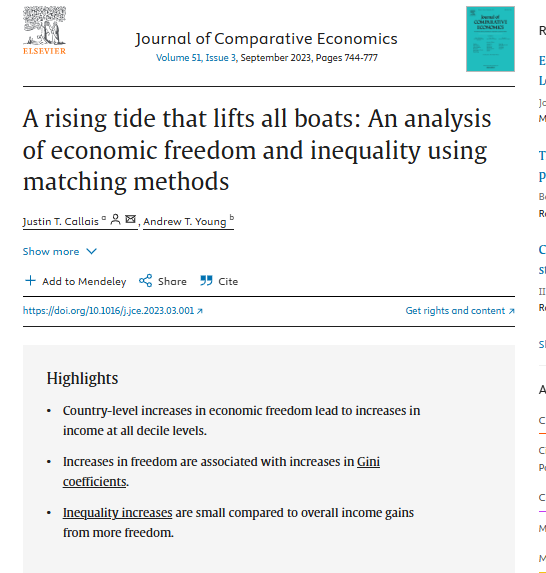

There are increases in inequality following liberalizations. However, they also find that all income deciles enjoy gains from liberalizations and globalization. In fact, globalization is actually favorable to middle incomes more than top.
8
And this is to say nothing of the work showing that economic freedom -- a good indicator of liberalization degrees -- is associated with far lower poverty levels.
See for example: Doran, C., & Stratmann, T. (2020). The relationship between economic freedom and poverty rates: cross-country evidence. Journal of Institutional and Theoretical Economics (JITE)/Zeitschrift für die gesamte Staatswissenschaft, 686-707; Saccone, D., & Migheli, M. (2022). Free to escape? Economic freedoms, growth and poverty traps. Review of Development Economics, 26(3), 1518-1554.
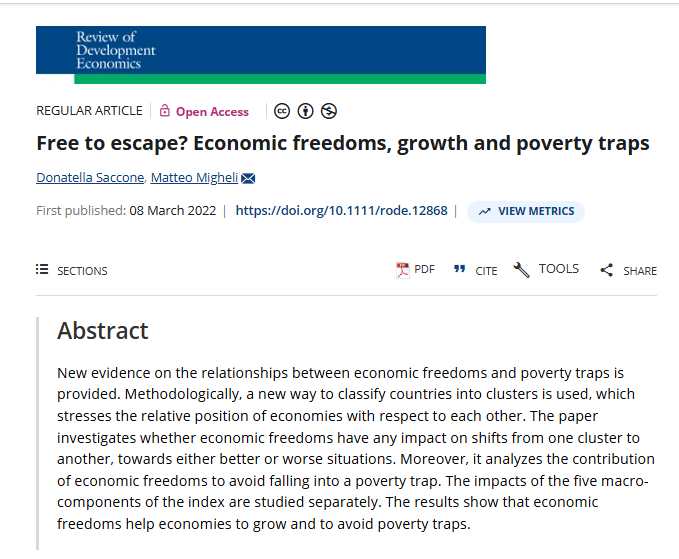
See for example: Doran, C., & Stratmann, T. (2020). The relationship between economic freedom and poverty rates: cross-country evidence. Journal of Institutional and Theoretical Economics (JITE)/Zeitschrift für die gesamte Staatswissenschaft, 686-707; Saccone, D., & Migheli, M. (2022). Free to escape? Economic freedoms, growth and poverty traps. Review of Development Economics, 26(3), 1518-1554.
9
4) Everything said above is an understatement. One of the things I point out in my own work is that because dictatorships lie upward about GDP, you will foil the quality of the matching process and probably get worse results. One of the things I did with Macy Scheck and Sean Alvarez was create a "ratio of errors".
Using nighttime light data, we extracted the "true" GDP estimates in the same way that Luis Martinez did in his JPE paper in 2023. We then replicate the same strategies swapping dependent variables to get an idea of how far off estimators of the effect of economic freedom are.
We find that the true effects of economic freedom on income levels are between 1.1 and 1.62 times greater than commonly estimated. The number for growth is smaller but positive.
To see how much this matters, take the earlier mentioned Grier & Grier estimates of 16% more income ten years after reform. Mix it with the low bound estimated error. So, rather than 16%, the number is actually 17.6%. If you take the upper bound, its closer to 25%. So, the literature misses a lot because it is working -- for no fault of its own -- with the shit numbers that autocrats produce.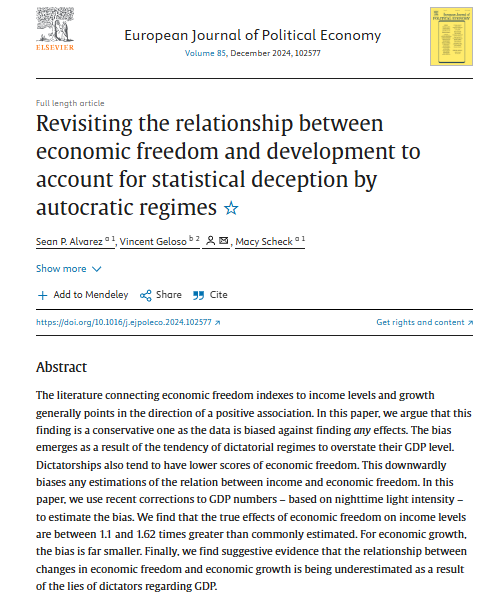
Using nighttime light data, we extracted the "true" GDP estimates in the same way that Luis Martinez did in his JPE paper in 2023. We then replicate the same strategies swapping dependent variables to get an idea of how far off estimators of the effect of economic freedom are.
We find that the true effects of economic freedom on income levels are between 1.1 and 1.62 times greater than commonly estimated. The number for growth is smaller but positive.
To see how much this matters, take the earlier mentioned Grier & Grier estimates of 16% more income ten years after reform. Mix it with the low bound estimated error. So, rather than 16%, the number is actually 17.6%. If you take the upper bound, its closer to 25%. So, the literature misses a lot because it is working -- for no fault of its own -- with the shit numbers that autocrats produce.
10
5) There are cases of failed reforms. But the reason, as Kerianne Lawson and Justin Callais point, is actually totally unrelated to what Hickel et al. mention.
Reason 1: Uneven reforms -- imagine that you reduce tariffs but you fail to secure property rights. Well...then you don't get the full benefits of tariff reductions. You get some of it because the different parts of "economic freedom" are complementary to each other. Its like saying that liberalization needs to be a "package" where a missing ingredient makes the rest less valuable.
Reason 2: Authoritarian regimes -- autocrats who liberalize do not generate much growth (see next message)
Reason 1: Uneven reforms -- imagine that you reduce tariffs but you fail to secure property rights. Well...then you don't get the full benefits of tariff reductions. You get some of it because the different parts of "economic freedom" are complementary to each other. Its like saying that liberalization needs to be a "package" where a missing ingredient makes the rest less valuable.
Reason 2: Authoritarian regimes -- autocrats who liberalize do not generate much growth (see next message)
11
Why do autocrats fail to generate growth when they liberalize? Because autocrats that liberalize can also be autocrats that de-liberalize. On a whim, they can change their minds. Business owners, workers, investors understand that and so they do not act as much as one would expect.
However, with democratization, its different. Democracy acts as a constraint on rulers by allowing the shoe to be on the other foot eventually. It also forces liberalization to be pedagogical and convince people.
Kevin Grier and Robin Grier, in a new article, checked cases of economic liberalization joined with democratic liberalization. In instances of liberalization without democratization, benefits are minimal. With both together, you get the benefits.
So, the disappointing cases of "reforms" have nothing much to do with whether economic liberalization is itself beneficial. It has to do with other factors in political economy -- democracy or if liberalization is well executed.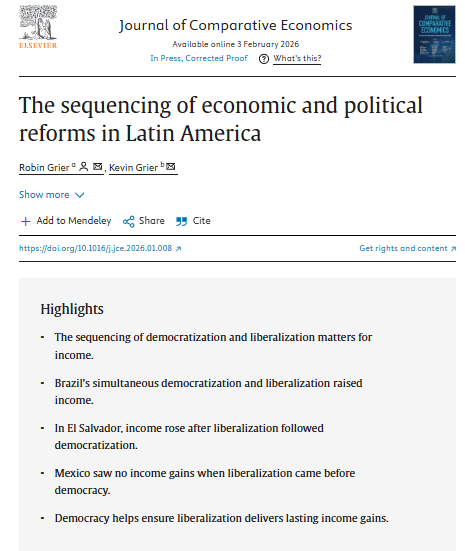
However, with democratization, its different. Democracy acts as a constraint on rulers by allowing the shoe to be on the other foot eventually. It also forces liberalization to be pedagogical and convince people.
Kevin Grier and Robin Grier, in a new article, checked cases of economic liberalization joined with democratic liberalization. In instances of liberalization without democratization, benefits are minimal. With both together, you get the benefits.
So, the disappointing cases of "reforms" have nothing much to do with whether economic liberalization is itself beneficial. It has to do with other factors in political economy -- democracy or if liberalization is well executed.
12
Final: I have dealt with Hickel's work before regarding economic history. It is sloppy as hell. I did the same with the degrowth work he has. It is just wishful thinking with no actual content. This paper offered a mix of both flaws.
13
Addendum: Oh and I add that I am actually not a fan of the World Bank or the IMF. I have been cool towards their existence at best, hostile at worst. I do think that a world without them might be marginally better for people in poor countries. But that is a different discussion that what the Hickel et al. paper does.