What are the effects of large human-capital shocks on innovation?...

Luca Repetto@luca_repetto_c
16 views
Mar 14, 2026
~2 min read
Advertisement
1
What are the effects of large human-capital shocks on innovation?
In a new paper, we study how WWI military deaths across British communities affected local invention over the next decades.
We find that places that lost more young men became persistently less innovative.
(🧵1/11)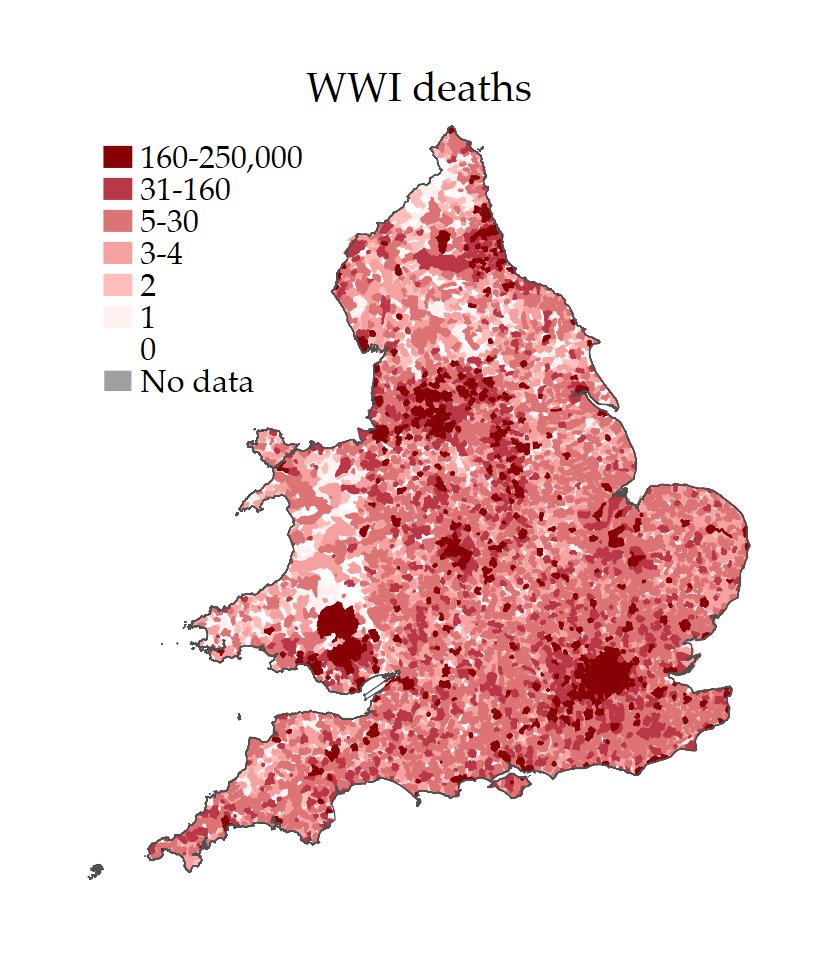
In a new paper, we study how WWI military deaths across British communities affected local invention over the next decades.
We find that places that lost more young men became persistently less innovative.
(🧵1/11)
2
WWI caused a massive loss of young men in Britain: over 750,000 military deaths, heavily concentrated among young cohorts.
Because the war was fought abroad, Britain experienced large human-capital losses without domestic physical destruction.
Because the war was fought abroad, Britain experienced large human-capital losses without domestic physical destruction.
3
This provides a great setting to study a central question in economics:
What happens to innovation when communities lose a large share of their young and skilled population? Do labour shortages spur innovation or does the loss of human capital reduce it?
What happens to innovation when communities lose a large share of their young and skilled population? Do labour shortages spur innovation or does the loss of human capital reduce it?
4
To study this, we build a new dataset linking:
• WWI military records & death records
• the universe of British patents (1895–1979)
• inventor identities and locations
This allows us to track innovation across 10,000+ communities over eight decades.
• WWI military records & death records
• the universe of British patents (1895–1979)
• inventor identities and locations
This allows us to track innovation across 10,000+ communities over eight decades.
5
We compare places with higher vs. lower WWI mortality within the same county.
Main result:
Communities that lost more soldiers became less likely to produce patents in the decades after the war.
Main result:
Communities that lost more soldiers became less likely to produce patents in the decades after the war.
6
Quantitatively, a 10% increase in WWI deaths reduces the probability that a parish produces any patent by about 0.09–0.12 percentage points.
The effects appear during the war and persist for decades.
The effects appear during the war and persist for decades.
7
The effects are even stronger for high-impact inventions.
Exposure to WWI mortality reduces the probability of producing breakthrough patents roughly three times more than the probability of producing any patent.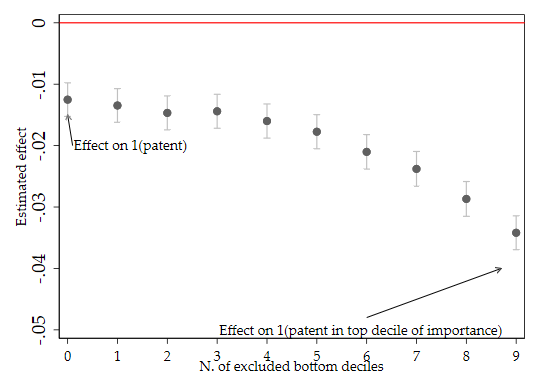
Exposure to WWI mortality reduces the probability of producing breakthrough patents roughly three times more than the probability of producing any patent.
8
Why does innovation fall?
We find two channels:
1️. Existing inventors become less productive
2. Communities produce fewer successful new inventors
Both effects contribute to the long-run decline in innovation.
We find two channels:
1️. Existing inventors become less productive
2. Communities produce fewer successful new inventors
Both effects contribute to the long-run decline in innovation.
9
The productivity decline among inventors is strongest in knowledge-intensive sectors such as electricity, chemistry, physics, and machinery.
These sectors relied heavily on specialised skills and complementary workers.
These sectors relied heavily on specialised skills and complementary workers.
10
Some inventors adapt.
Inventors who relocate to other communities or work with co-authors experience smaller productivity losses, suggesting that networks and local innovation ecosystems help buffer human-capital shocks.
Inventors who relocate to other communities or work with co-authors experience smaller productivity losses, suggesting that networks and local innovation ecosystems help buffer human-capital shocks.
11
Overall, the evidence highlights the importance of local human capital and knowledge networks for innovation.
Paper: tinyurl.com/3avjkdrx - joint work with Jan Bietenbeck, @davidecipu and Ted Pinchbeck
Paper: tinyurl.com/3avjkdrx - joint work with Jan Bietenbeck, @davidecipu and Ted Pinchbeck
