Here's a megathread on the war on Iran that focuses on the deeper...

İyad el-Baghdadi | إياد البغدادي@iyad_elbaghdadi
112 views
Jul 19, 2026
~17 min read
Advertisement
1
Here's a megathread on the war on Iran that focuses on the deeper dynamics, potential trajectories, and likely outcomes.
A lot will change over the next few weeks - this thread is about what won't.
Stay until the end for an announcement & an invitation.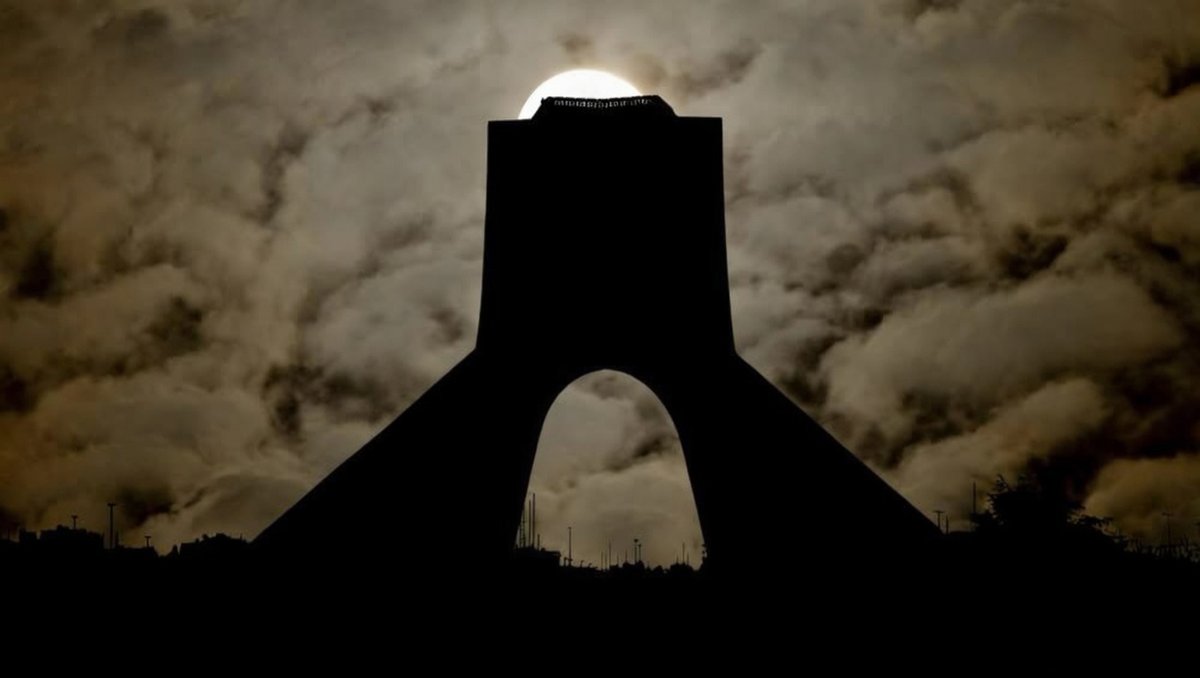
A lot will change over the next few weeks - this thread is about what won't.
Stay until the end for an announcement & an invitation.
2
Most geopolitical analysis is cold and state-centric. Here, we look at the longer arcs and what they mean for the prospects for collective liberation and systems change.
This is geopolitics for liberation.
This is geopolitics for liberation.
3
Let me start by saying that all the main actors here are awful:
- Israel is a genocidal apartheid state
- Trump is an incompetent, corrupt warmonger
- Iran's regime is a brutal, repressive theocracy
God bless and save the people of the region, they're the hope for change.
- Israel is a genocidal apartheid state
- Trump is an incompetent, corrupt warmonger
- Iran's regime is a brutal, repressive theocracy
God bless and save the people of the region, they're the hope for change.
4
This thread is divided into 8 sections, here's the outline. (I could have made this 8 threads, but I wanted to give you everything in one place.)
Please read, comment, and share. I'll be tracking your questions and comments and posting follow-ups, maybe even a live space.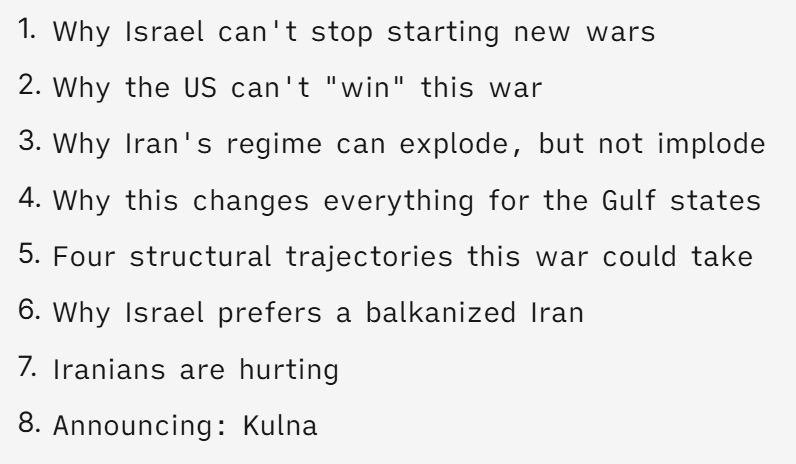
Please read, comment, and share. I'll be tracking your questions and comments and posting follow-ups, maybe even a live space.
5
1. Why Israel can't stop starting new wars
The single deepest driver of this war is a profound shift that happened in Israel after Oct 7.
This shift is both psychological and strategic, but the psychological is driving everything far more than you'd realize.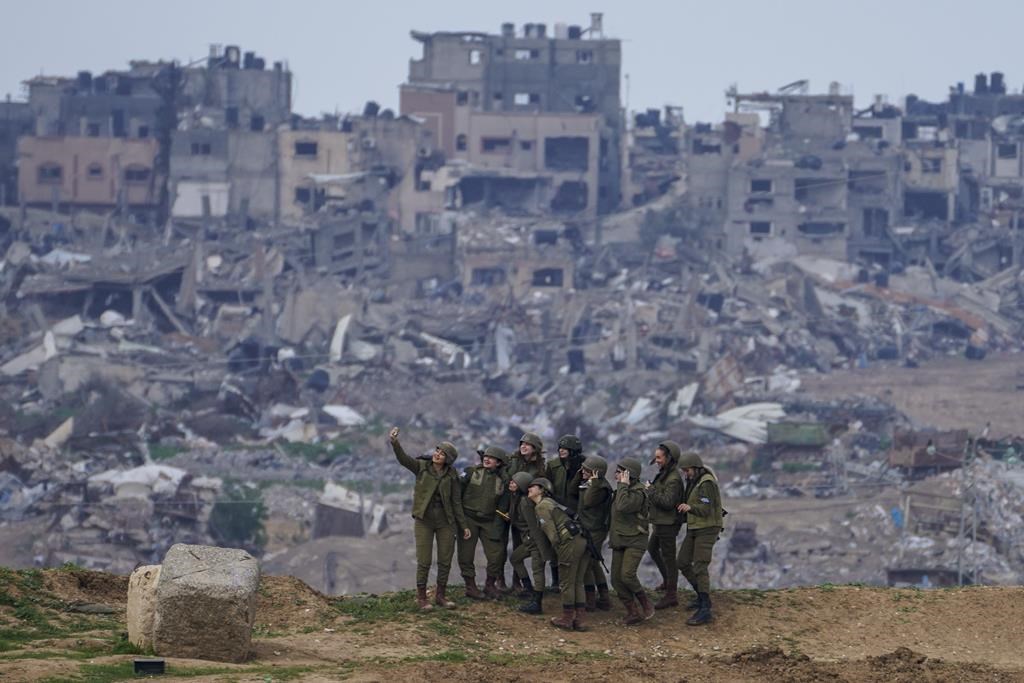
The single deepest driver of this war is a profound shift that happened in Israel after Oct 7.
This shift is both psychological and strategic, but the psychological is driving everything far more than you'd realize.
6
Israel always had a deep, longstanding identity structure that fused post-Holocaust exceptional victimhood with settler-colonial dominator logic.
"Never again be weak, never again be at someone's mercy. The world is a field of danger. We can only be safe if we dominate".
"Never again be weak, never again be at someone's mercy. The world is a field of danger. We can only be safe if we dominate".
7
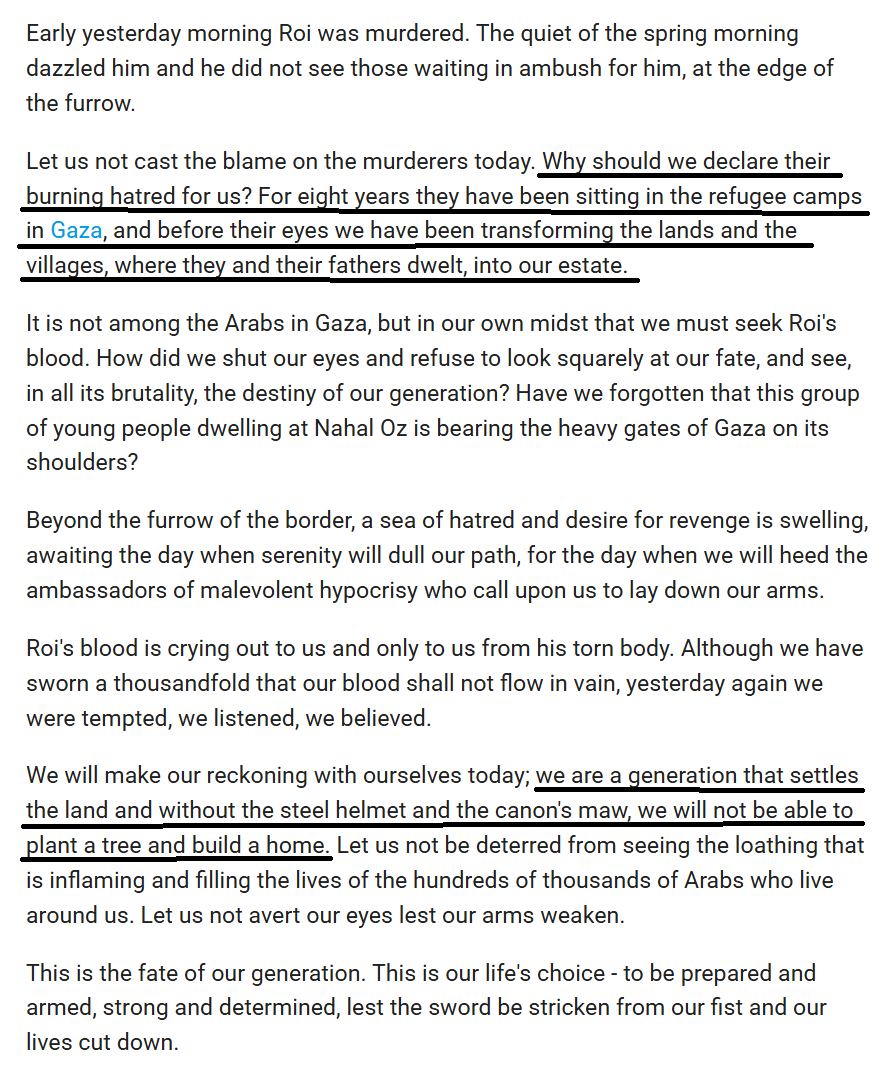
Israel's founders were clear-eyed about what their existence in the region entailed (attached: Ben Gurion & Moshe Dayan in 1956).
After 1973, Israel gained strong Western support and became co-constitutive of the US empire. And this psyche laid dormant for many years.
After 1973, Israel gained strong Western support and became co-constitutive of the US empire. And this psyche laid dormant for many years.
8
The era since Oct 7 decisively returned Israel to its original existential psyche:
- Do not trust, dominate
- Destroy threats before they arise
- Judge capacity and not intent
Hope that dropping enough bombs will make you safe, and live in a mix of jubilation and terror.
- Do not trust, dominate
- Destroy threats before they arise
- Judge capacity and not intent
Hope that dropping enough bombs will make you safe, and live in a mix of jubilation and terror.
9
This is self-fulfilling. Any isolation Israel faces is interpreted as evidence that "they all hate us", and justification for more war.
The more isolated it'll get, the more violent it'll become.
The more violent it becomes, the more isolated it'll get.
There's no off-ramp.
The more isolated it'll get, the more violent it'll become.
The more violent it becomes, the more isolated it'll get.
There's no off-ramp.
10
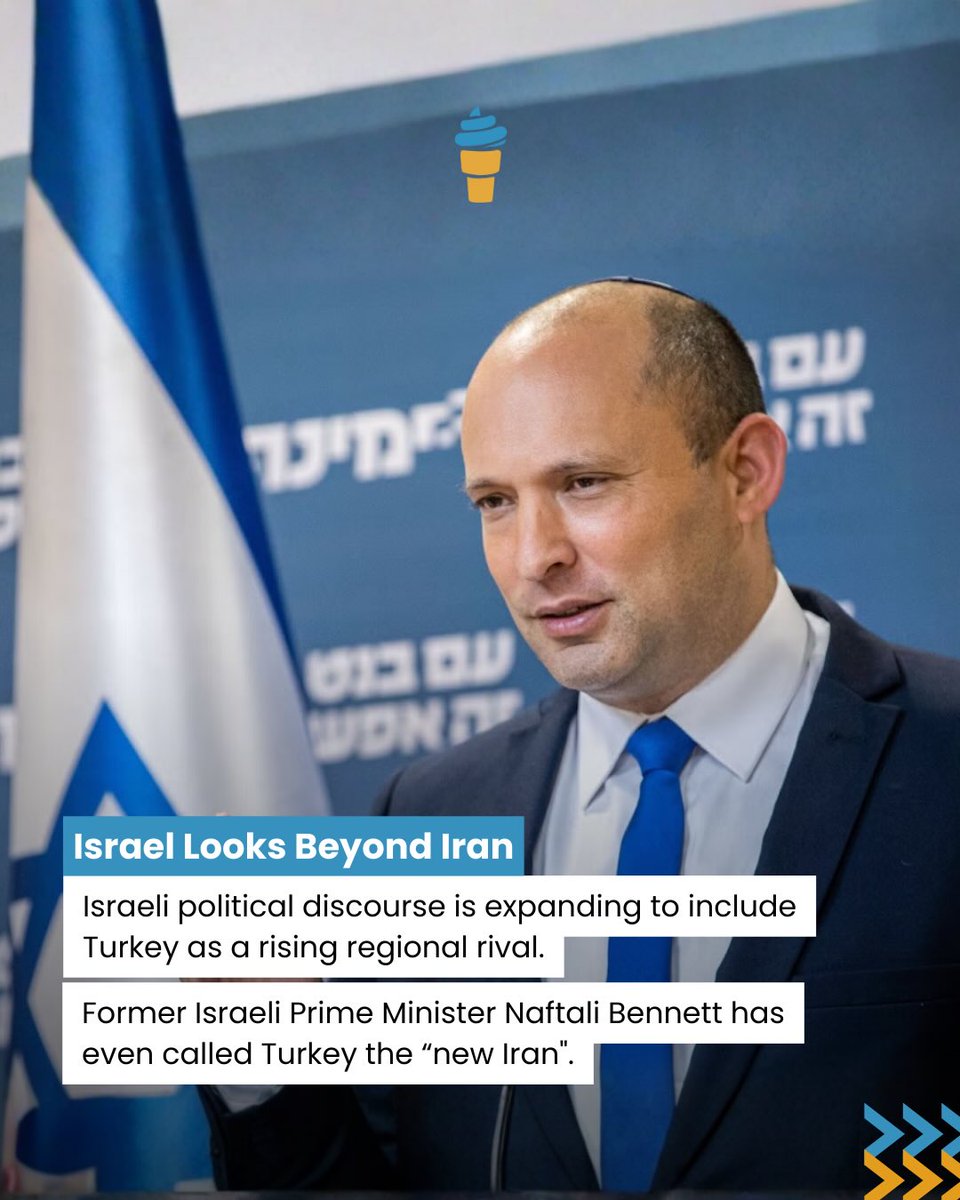
Netanyahu may have started this, but he isn't the deeper cause. He's both a symptom and an accelerator. Nor does this end with him: A successor (be it Bennett, Lapid, or anyone else) would follow the same logic.
This is now structural.
This is now structural.
11
This is why this war feels different. It may appear to be "another round" - but deep down it's the logical end result of a state whose psyche sees perpetual military supremacy as the only viable path to safety.
Everything else now flows downstream from this reality.
Everything else now flows downstream from this reality.
12
The war that began on Oct 7, 2023 is Israel's last war.
Not because Israel's victory (or defeat) is imminent.
Not because after this war, Israel will find peace.
But because Israel will be in a constant state of war from here on, as a very condition of its existence.
Not because Israel's victory (or defeat) is imminent.
Not because after this war, Israel will find peace.
But because Israel will be in a constant state of war from here on, as a very condition of its existence.
13
The US-Israeli war on Iran is Israel's war. And Israel has already signaled the real aim: Leadership decapitation and regime change.
There may be a ceasefire at some point, but Israel will not stop trying to collapse Iran's regime. And the regime rightly sees it as existential.
There may be a ceasefire at some point, but Israel will not stop trying to collapse Iran's regime. And the regime rightly sees it as existential.
14
2. Why the US can't "win" this war
Winning = achieving your goals.
Israel's goal is to maximally degrade the Iranian regime's capabilities and if possible, to collapse the Iranian state.
But what about the US? What does it want? It doesn't seem like anyone in the admin knows.
Winning = achieving your goals.
Israel's goal is to maximally degrade the Iranian regime's capabilities and if possible, to collapse the Iranian state.
But what about the US? What does it want? It doesn't seem like anyone in the admin knows.
15
Is it a war for Iranian freedom, as Trump initially said?
Or is it not a regime change war and "no democracy building exercise", as Hegseth said?
Or is it to get rid of the missiles and navy, as Rubio said?
You can't win a war if you don't know what you want out of it.
Or is it not a regime change war and "no democracy building exercise", as Hegseth said?
Or is it to get rid of the missiles and navy, as Rubio said?
You can't win a war if you don't know what you want out of it.
16
If it's to destroy Iran's missiles and drones, Iran can rebuild. Its production of these is entirely domestic.
If it's for regime change, you need ground troops. The US doesn't have nearly enough troops in the region for this, and no separatist group in Iran is up to the task.
If it's for regime change, you need ground troops. The US doesn't have nearly enough troops in the region for this, and no separatist group in Iran is up to the task.
17
And even if the regime falls, you don't automatically get a democracy (more on this soon).
It seems Trump had envisioned a short war with a highly visible win, something that echoes Venezuela: Take out the top guy, get a ceasefire, declare victory. That clearly didn't work.
It seems Trump had envisioned a short war with a highly visible win, something that echoes Venezuela: Take out the top guy, get a ceasefire, declare victory. That clearly didn't work.
18
When you add the mounting risks, the picture gets far worse.
Starting with the serious systemic shock if the Straits of Hormuz are closed.
The Houthis, who are much less equipped, shut Red Sea shipping by targeting ships with drones and missiles. Imagine what the IRGC can do.
Starting with the serious systemic shock if the Straits of Hormuz are closed.
The Houthis, who are much less equipped, shut Red Sea shipping by targeting ships with drones and missiles. Imagine what the IRGC can do.
19
A quarter of the world's energy, and a large proportion of the world's fertilizers, are shipped through Hormuz.
Long-term closure would trigger a systemic shock and spike global inflation in energy and food. You'll have domino effects reverberating across the world.
Long-term closure would trigger a systemic shock and spike global inflation in energy and food. You'll have domino effects reverberating across the world.
20
Then there's the risk to the Gulf states - if the oil-rich states face collapse, it would trigger a global chain reaction that is impossible to quantify.
It's one thing to achieve your goals at a high cost. It's another to pay a very high cost and still not achieve your goals.
It's one thing to achieve your goals at a high cost. It's another to pay a very high cost and still not achieve your goals.
21
And if the regime "falls" somehow - who inherits the aftermath? Who deals with the chaos? Who receives the refugee waves?
For the US, this is a war with no clear objectives, no upside, and enormous systemic risks - regardless how much they destroy or how many they kill in Iran.
For the US, this is a war with no clear objectives, no upside, and enormous systemic risks - regardless how much they destroy or how many they kill in Iran.
22
What about European countries?
A few are stupid enough to feel they must humiliate themselves and grovel to Trump to keep him on side when it comes to NATO.
Mark Rutte, who once called Trump "daddy", lies out of both sides of his mouth in his attempts to steelman this war.
A few are stupid enough to feel they must humiliate themselves and grovel to Trump to keep him on side when it comes to NATO.
Mark Rutte, who once called Trump "daddy", lies out of both sides of his mouth in his attempts to steelman this war.
23
Yet other European countries realize that:
- This isn't their war
- Degradation of international law is a more serious and lasting a threat to Europe than the Iranian regime ever was
- Getting dragged in can make them a target of Iranian retaliation, including terrorism
- This isn't their war
- Degradation of international law is a more serious and lasting a threat to Europe than the Iranian regime ever was
- Getting dragged in can make them a target of Iranian retaliation, including terrorism
24
The truth is, this war is a godsend for Europe's primary enemy, Putin. Russia is a major exporter of energy.
The rise in energy prices alone can fully fund his war in Ukraine, at a time when systemic stresses were starting to appear in his war machine.
Disaster for Europe.
The rise in energy prices alone can fully fund his war in Ukraine, at a time when systemic stresses were starting to appear in his war machine.
Disaster for Europe.
25
So if this is the picture, why is the US in this war?
Well, because its leadership are low-quality, compromised and beholden to Israel.
This war makes no sense to the US or Europe. This is Israel's war. Netanyahu dog walked Trump into war twice and he'll do it again if he can.
Well, because its leadership are low-quality, compromised and beholden to Israel.
This war makes no sense to the US or Europe. This is Israel's war. Netanyahu dog walked Trump into war twice and he'll do it again if he can.
26
Israel's geopolitical strategy is not aligned with the US's, or the West's; in fact, it is undermining their interests. It'll keep starting wars and dragging them in.
No Western leader dares to say this yet, but Israel is well on its way to becoming a geopolitical liability.
No Western leader dares to say this yet, but Israel is well on its way to becoming a geopolitical liability.
27
Meanwhile, Israel doesn't care about US domestic confusion or Europe's security or global risk. It is singularly focused on max disruption, degradation, and devastation in Iran.
This is Israel's war, and it can still declare victory at the end of it. Everyone else will lose.
This is Israel's war, and it can still declare victory at the end of it. Everyone else will lose.
28
3. Why Iran's regime can explode, but not implode
Iran's regime isn't built around one man's inner circle, like Saddam's Iraq or Assad's Syria.
It is both a regime and a revolutionary religious project. It is ideological, institutional, multilayered, and coup-proofed.
Iran's regime isn't built around one man's inner circle, like Saddam's Iraq or Assad's Syria.
It is both a regime and a revolutionary religious project. It is ideological, institutional, multilayered, and coup-proofed.
29
The religious dimension alone gives it transnational reach. Not all Shias support this regime's ideology - many oppose it on religious grounds. But since its rise, it has definitely managed to grow deep roots across many Shia communities across the world.
30
On paper, the regime looks like a "managed democracy" - with multiple elected bodies constrained by multiple unelected ones, with the Supreme Leader on top.
In reality, however, actual coercive power is in the hands of the Islamic Revolutionary Guards Corps, the IRGC.
In reality, however, actual coercive power is in the hands of the Islamic Revolutionary Guards Corps, the IRGC.
31
The IRGC isn't just an army - it's a parallel military-economic empire tasked with protecting the system. By some estimates, it controls half of Iran's economy.
The IRGC will fight to the bitter end - even if it means turning Iran into a nightmare for any successor regime.
The IRGC will fight to the bitter end - even if it means turning Iran into a nightmare for any successor regime.
32
In the unlikely event of the regime collapsing - or degrading enough that it starts to lose coherence - the IRGC would be effectively in charge. They won't hand over power.
And hand it over to who, anyway? There's no alternative power center in Iran to hand the reins to.
And hand it over to who, anyway? There's no alternative power center in Iran to hand the reins to.
33
In such a scenario, the IRGC's would switch to insurgency mode and decentralized command centers, each cell effectively fighting the war on its own and taking its own decisions. The civilian administration won't be able to rein them. There will be no one person to negotiate with.
34
Israel already set the objectives of this war in existential terms.
And so long the IRGC sees the war in existential terms, it has every incentive to escalate, and no incentive to de-escalate. This is not just a function of their ideology, but of their survival impulse
And so long the IRGC sees the war in existential terms, it has every incentive to escalate, and no incentive to de-escalate. This is not just a function of their ideology, but of their survival impulse
35
In this war we've seen the regime escalate immediately - it's easy to see why once you see that the threat was existential from the start.
But this is also a taste of the IRGC: If the regime falters, the chaos won't stay within Iran. This isn't a regime built to go out quietly.
But this is also a taste of the IRGC: If the regime falters, the chaos won't stay within Iran. This isn't a regime built to go out quietly.
36
4. Why this changes everything for the Gulf states
Nobody in the region wanted this war, least of all the Gulf states that hosted US bases and quietly partnered against Iran for decades.
There have been leaks about MBS pushing for the war, but that's likely Israeli disinfo.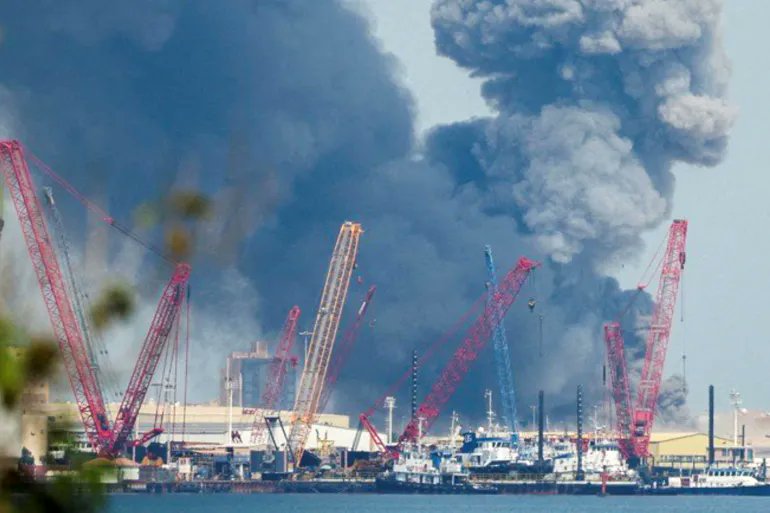
Nobody in the region wanted this war, least of all the Gulf states that hosted US bases and quietly partnered against Iran for decades.
There have been leaks about MBS pushing for the war, but that's likely Israeli disinfo.
37
The IRGC attacked both military & soft targets (airports, oil). Further escalation could see shipping, desalination plants, and even population centers hit. I hope we never get there.
This is "mutually assured destruction" by another name - ensure the pain is shared by all.
This is "mutually assured destruction" by another name - ensure the pain is shared by all.
38
The Gulf states have cried foul, saying their territory wasn't used to attack Iran. But the point is moot: they still have US bases. They're not neutral, they're US allies. But the deeper logic is that in an existential fight, the IRGC will ensure it's existential for everybody.
39
What makes the Gulf states uniquely fragile?
The Gulf states are classical rentier states. A huge proportion of their populations are foreign residents with no path to citizenship.
The UAE, an ally of Israel, was the most targeted country by Iran. Look at its demographics.
The Gulf states are classical rentier states. A huge proportion of their populations are foreign residents with no path to citizenship.
The UAE, an ally of Israel, was the most targeted country by Iran. Look at its demographics.
40
The private sector: fintech, real estate, tourism - all run on foreign labor. These aren't only manual labor - they're professional, investors, families - who settled there thanks to the promise of safety & prosperity in a volatile region. This is how Dubai became a global brand.
41
Missiles hitting Dubai's airports, hotels, and ports shatters that illusion. The entire model depends on an unbreakable promise: Stability.
When that promise is broken, capital flees, talent leaves, real estate devalues, and financial hubs start to look elsewhere.
When that promise is broken, capital flees, talent leaves, real estate devalues, and financial hubs start to look elsewhere.
42
Many non-citizens living in the Gulf are second or third generation. They feel a sense of belonging and will not rush for the exit.
But there are others who came to make money, raise families, and live in luxury, not to live under the constant threat of drones and missiles.
But there are others who came to make money, raise families, and live in luxury, not to live under the constant threat of drones and missiles.
43
The Gulf's armed forces, supported by allies, can shoot down a lot of drones and missiles.
But what was forever a core promise that you can take for granted, now becomes something questioned and contested. This may not cause an immediate mass exodus, but its damage can compound.
But what was forever a core promise that you can take for granted, now becomes something questioned and contested. This may not cause an immediate mass exodus, but its damage can compound.
44
Gulf societies seem to have absorbed the initial shock and panic well - but the real danger is what happens if this draws out into an open ended attrition war.
Past the first few weeks, fatigue can start to set in, and can really stress the social makeup of these countries.
Past the first few weeks, fatigue can start to set in, and can really stress the social makeup of these countries.
45
The IRGC's strategy is deliberate: make the pain so high and shared that another round becomes politically and economically impossible for the Gulf. And the Gulf's pain tolerance is already low.
The alliance with the US was meant to guarantee security, but it made them targets.
The alliance with the US was meant to guarantee security, but it made them targets.
46
The foundation of the petrodollar system was that the Gulf states price their oil in dollars in return for security.
Even in the midst of these events, the US focuses more on protecting Israel.
When the petrodollar system cracks, the entire global system stands to change.
Even in the midst of these events, the US focuses more on protecting Israel.
When the petrodollar system cracks, the entire global system stands to change.
47
5. Four structural trajectories this war could take
I've explained above why I highly doubt this ends with a "victory" or a negotiated end.
The incentives (Israel's perpetual war logic, IRGC's existential war, US mission creep) point to four possible long term paths.
I've explained above why I highly doubt this ends with a "victory" or a negotiated end.
The incentives (Israel's perpetual war logic, IRGC's existential war, US mission creep) point to four possible long term paths.
48
Path 1: Degradation cycles
The regime absorbs the blows. The US/Israel cause a lot of damage, but cannot eliminate the system. A ceasefire is declared. The regime survives but is degraded, anxious, less stable, and more beholden to the IRGC.
Israel looks for the next round.
The regime absorbs the blows. The US/Israel cause a lot of damage, but cannot eliminate the system. A ceasefire is declared. The regime survives but is degraded, anxious, less stable, and more beholden to the IRGC.
Israel looks for the next round.
49
Meanwhile the regime uses the lull to resecure its borders, deal with any separatist or partisan activities within the country, and restock its drone and missile supply and prepare for the next round.
And in case of another round of protests, they won't hesitate to massacre.
And in case of another round of protests, they won't hesitate to massacre.
50
Path 2: Attrition
The IRGC shifts to low-cost, high-pain harassment: Routine attacks on Gulf shipping, proxy activation, cyber, terrorism.
The US opts for a draw down, despite Israel pushing to continue.
The regime survives degraded but makes the region chronically unstable.
The IRGC shifts to low-cost, high-pain harassment: Routine attacks on Gulf shipping, proxy activation, cyber, terrorism.
The US opts for a draw down, despite Israel pushing to continue.
The regime survives degraded but makes the region chronically unstable.
51
Attrition is the IRGC's preferred mode of fighting, and the math works well in their favor.
US weapons systems are expensive, and built to fight conventional enemies. IRGC methods and weapons are made for insurgencies and attrition: Cheap, lower tech, sufficient vs soft targets.
US weapons systems are expensive, and built to fight conventional enemies. IRGC methods and weapons are made for insurgencies and attrition: Cheap, lower tech, sufficient vs soft targets.
52
Path 3: Collapse
This isn't imminent. But long term, repeated degradation cycles can compound pressure to the point that the regime starts to lose coherence.
Separatist movements within Iran start to gain success, drawing in bigger countries: Iraq, Turkey, Azerbaijan, Pakistan.
This isn't imminent. But long term, repeated degradation cycles can compound pressure to the point that the regime starts to lose coherence.
Separatist movements within Iran start to gain success, drawing in bigger countries: Iraq, Turkey, Azerbaijan, Pakistan.
53
Some of these countries don't want separatism on their border, others see an opportunity.
The IRGC switches into insurgency mode. No successor emerges - instead you get warlordism and fragmentation.
The result is massive civilian suffering, refugee waves, and a long civil war.
The IRGC switches into insurgency mode. No successor emerges - instead you get warlordism and fragmentation.
The result is massive civilian suffering, refugee waves, and a long civil war.
54
These 3 paths overlap. You could get cycles of degradation, with the IRGC switching to attrition between them, with successive degradation cycles pushing closer towards collapse.
Or, this round can transition into a long attrition with no "official" end.
Is there a way out?
Or, this round can transition into a long attrition with no "official" end.
Is there a way out?
55
Path 4: Iran gets nukes.
This can stop the cycle in its tracks.
Khamenei had a fatwa against nukes, but he's dead, and it's obvious that had Iran had nukes, it wouldn't be under existential threat.
Getting nukes is now the most rational self-preservation move for the regime.
This can stop the cycle in its tracks.
Khamenei had a fatwa against nukes, but he's dead, and it's obvious that had Iran had nukes, it wouldn't be under existential threat.
Getting nukes is now the most rational self-preservation move for the regime.
56
And if this happens, the rest of the region absolutely would seek nukes. Those that can't afford their own will get under someone else's umbrella, or seek cheaper WMDs. If threatened with sanctions, they'll call for disarming Israel and Iran first.
theguardian.com/world/2023/sep…
theguardian.com/world/2023/sep…
57
6. Why Israel prefers a balkanized Iran
In a regime collapse scenario, the power vacuum will not produce a stable democratic Iran. It will produce competing factions, with the strongest being the IRGC + separatist groups.
The Pahlavi movement has no armed base inside Iran.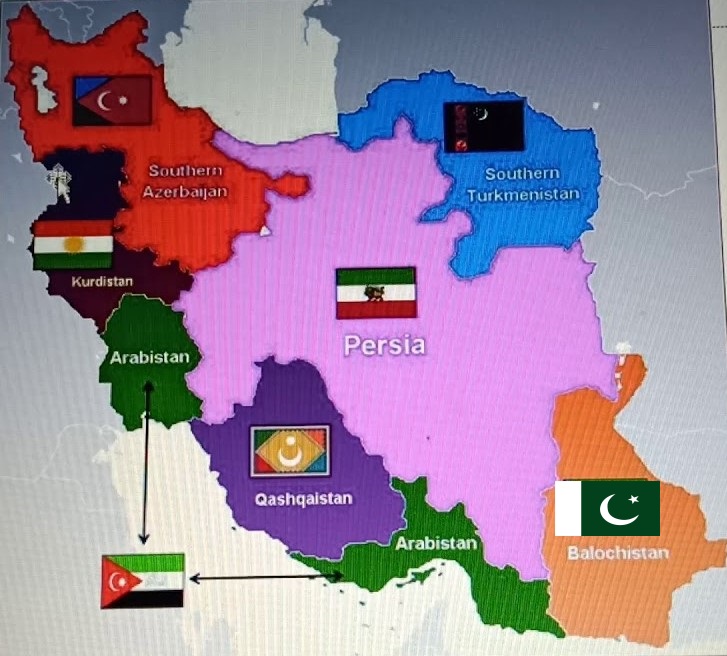
In a regime collapse scenario, the power vacuum will not produce a stable democratic Iran. It will produce competing factions, with the strongest being the IRGC + separatist groups.
The Pahlavi movement has no armed base inside Iran.
58
Israel knows this, and it aligns perfectly with its strategic worldview.
Publicly, it frames the war as "liberation" and calls Iranians to "rise up", but the truth is, Israel doesn't care about them. Its real aim is to accelerate chaos and block any strong, unified successor.
Publicly, it frames the war as "liberation" and calls Iranians to "rise up", but the truth is, Israel doesn't care about them. Its real aim is to accelerate chaos and block any strong, unified successor.
59
This preference is not hidden. Israeli officials and think tanks have long echoed Oded Yinon's ideas of weak neighbours and regional balkanization.
In 2023, 32 Knesset members signed a declaration calling for Iran's partitioning. You can read their logic yourself.
In 2023, 32 Knesset members signed a declaration calling for Iran's partitioning. You can read their logic yourself.
60
We're already seeing this play out: US/Israel arming Kurdish groups in Iraq for cross-border ops into Iran, aiming to seize territory and create buffers. This risks pulling in Iraq and Turkey, and putting millions of Kurdish civilians in Iran at risk of war and retaliation.
61
Understand: Israel is a survivalist nation caught in a trauma loop it can't break. It cares singularly about its own safety.
And it's not exactly thinking long term. It's taking this round by round, and will use whatever opening is available to feel "safer".
And it's not exactly thinking long term. It's taking this round by round, and will use whatever opening is available to feel "safer".
62
But long-term, Israel knows what kind of region fits its ethno-nationalist vision: small, divided ethnic states where hierarchies dominate. Not large multi-ethnic democracies built on citizenship beyond blood.
In a divided region, Israel can thrive. Unity anywhere is a threat.
In a divided region, Israel can thrive. Unity anywhere is a threat.
63
7. Iranians are hurting
I said earlier that the pain will be felt across the world, due to systemic effects. But Iran's people will suffer most, be it civilians or the diaspora communities who love them. Millions are feeling a mix of fear, hope, anger, and deep uncertainty.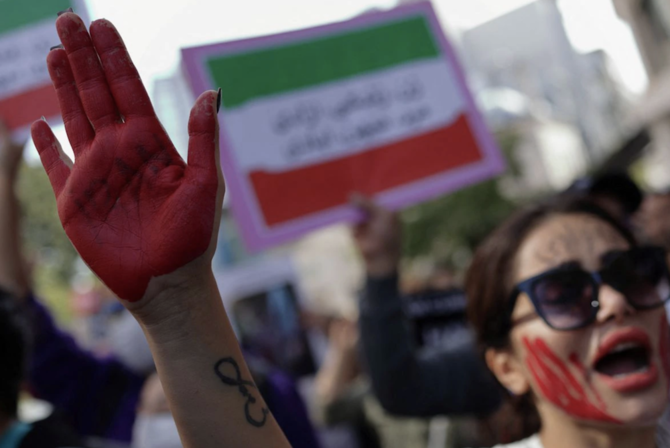
I said earlier that the pain will be felt across the world, due to systemic effects. But Iran's people will suffer most, be it civilians or the diaspora communities who love them. Millions are feeling a mix of fear, hope, anger, and deep uncertainty.
64
If you know Iranians, you'll see many celebrating the targeting of the regime & IRGC. You'll also see many protesting the attack on Iran and the killing of its leadership. You should hold both in the frame. Both exist.
The truth is, almost everyone is scared and anxious.
The truth is, almost everyone is scared and anxious.
65
And as the US and Israel prepare to escalate the war inside Iran, keep in mind that Hegseth has relaxed civilian casualty thresholds, meaning more suffering and death in Iran's cities.
This is also dangerous for everyone else. The IRGC could retaliate in kind across the world.
This is also dangerous for everyone else. The IRGC could retaliate in kind across the world.
66
The Iranian regime has had a serious legitimacy crisis almost since its founding - made worse by repression, brutality, corruption, fanaticism, isolation, economic collapse, and stolen elections.
Yet it retains a loyal support base, especially in rural and conservative areas.
Yet it retains a loyal support base, especially in rural and conservative areas.
67
I haven't seen reliable data as to the levels of support of the regime, but I suspect the majority of Iranians are in the exhausted middle who just want to live, work, and feed their families.
Deep polarization among Iranians doesn't bode well for any post-regime future.
Deep polarization among Iranians doesn't bode well for any post-regime future.
68
The Pahlavi wing is sold as the natural successor: pro-Western, pro-Israel, ready for democratic transition. But Pahlavi has zero chance of seizing or holding actual power inside Iran.
Truth is, the Pahlavi movement is traumatized, dysfunctional, and increasingly toxic.
Truth is, the Pahlavi movement is traumatized, dysfunctional, and increasingly toxic.
69
It's a movement born of profound national trauma: A proud country with profound civilizational depth reduced to isolation, repression, and fanaticism since 1979.
This has bred anger, dysfunction, and patterns of behavior that alienate many people who want to stand in solidarity.
This has bred anger, dysfunction, and patterns of behavior that alienate many people who want to stand in solidarity.
70
While preparing this thread, pondering the unimaginable costs & risks of this war, I saw that video of Pahlavi supporters doing the Trump dance under an Israeli flag.
Do they realize how this looks to the rest of the world? Doing the dance of a pedophile under a genocidal flag?
Do they realize how this looks to the rest of the world? Doing the dance of a pedophile under a genocidal flag?
71
Trump is already signaling that he's discarding Pahlavi, preferring "someone from within" and is "currently popular". And believe me, Trump wouldn't have said this had he not discussed it with the Israelis.
Looks like Pahlavi didn't learn the lesson from Machado.
Looks like Pahlavi didn't learn the lesson from Machado.
72
And after being abandoned by Trump and Israel, the risk is that the opposition movement will be left broken, betrayed, demoralized, angry, and even more traumatized - and spiral into further dysfunction.
Instead of advancing, the Iran freedom cause could regress for years.
Instead of advancing, the Iran freedom cause could regress for years.
73
The Pahlavi movement lacks the vision or patience to bridge divides or heal wounds.
Real progress demands slow, strategic, trauma-informed organizing, not shortcuts through collaboration with genociders and predators.
We will never stop believing in a free Iran.
Real progress demands slow, strategic, trauma-informed organizing, not shortcuts through collaboration with genociders and predators.
We will never stop believing in a free Iran.
74
8. Announcing: Kulna
I've been doing these threads for a decade. I've always wanted to build something bigger.
I'm thrilled to announce that on April 15th, we launch @Kulna_co, an independent media platform dedicated to collective liberation and systems change.
I've been doing these threads for a decade. I've always wanted to build something bigger.
I'm thrilled to announce that on April 15th, we launch @Kulna_co, an independent media platform dedicated to collective liberation and systems change.
75
@kulna_co From Kulna you can expect honesty about power, moral clarity without cynicism, and a focus on the longer arcs of history, where real change happens.
Come build with us. Be the first to join Kulna, or add your email to the waitlist, on this link.
kulna.co/subscribe/
Come build with us. Be the first to join Kulna, or add your email to the waitlist, on this link.
kulna.co/subscribe/
