🧵The Development of Karl Marx in Three Phases: Before and After...

Yuri Bezmenov's Ghost@Ne_pas_couvrir
18 views
Mar 12, 2026
~33 min read
1
🧵The Development of Karl Marx in Three Phases: Before and After Meeting Moses Hess.
x.com/Ne_pas_couvrir…
x.com/Ne_pas_couvrir…
2
The Thesis is Marx’s intellectual evolution can be traced as a shift in the meaning of “practice.” He moves from the Young Hegelian notion of critique as practice (the idea that theoretical criticism itself is a world-changing force) to Moses Hess’s notion of praxis as deed, a fusion of thought and organized action aimed at repairing social estrangement, and finally to Marx’s own materialist recoding of that praxis. Crucially, Marx preserves much of Hess’s functional architecture of alienation and reintegration even as he rejects Hess’s mystical or ethical idiom (what Marx and Engels later dismiss as “True Socialism”).
3
Marx Before Hess (Berlin Young Hegelian Phase, up to ~1842)
Before Hess’s influence, Marx was shaped by the Young Hegelian milieu in Berlin, especially the circle around Bruno Bauer. In the early 1840s Marx was a radical democratic intellectual and critic, not yet a socialist. As Hess later described him in 1841, the young “Dr. Marx” was “hardly 24 years old; but he will give the final blow to all medieval religion and politics”. This captures Marx’s baseline orientation: fiercely anti-clerical and anti-absolutist, wielding Hegelian philosophy as a weapon against archaic institutions.
At this stage, “action” for Marx meant public criticism, meaning attacking censorship, religion, and unjust laws under the premise that exposing an illusion or injustice was in itself a practical act. In other words, Marx initially treated critique as the lever of history, reflecting the Young Hegelian belief that negating ideas (e.g. criticising religion) would by itself negate the material relations sustained by those ideas.
This outlook was “post-Hegelian” in the sense that it drew on Hegel’s notion of world-history driven by the negation of the old by the new. But it was also limited: it targeted the realm of ideas (religious mystifications, reactionary philosophy) rather than the realm of social relations or political economy.
As we will cover, Hess’s impact on Marx would be to change the mode and target of action, from purely critical negation aimed at consciousness to organized revolutionary deeds aimed at material conditions.
Before Hess’s influence, Marx was shaped by the Young Hegelian milieu in Berlin, especially the circle around Bruno Bauer. In the early 1840s Marx was a radical democratic intellectual and critic, not yet a socialist. As Hess later described him in 1841, the young “Dr. Marx” was “hardly 24 years old; but he will give the final blow to all medieval religion and politics”. This captures Marx’s baseline orientation: fiercely anti-clerical and anti-absolutist, wielding Hegelian philosophy as a weapon against archaic institutions.
At this stage, “action” for Marx meant public criticism, meaning attacking censorship, religion, and unjust laws under the premise that exposing an illusion or injustice was in itself a practical act. In other words, Marx initially treated critique as the lever of history, reflecting the Young Hegelian belief that negating ideas (e.g. criticising religion) would by itself negate the material relations sustained by those ideas.
This outlook was “post-Hegelian” in the sense that it drew on Hegel’s notion of world-history driven by the negation of the old by the new. But it was also limited: it targeted the realm of ideas (religious mystifications, reactionary philosophy) rather than the realm of social relations or political economy.
As we will cover, Hess’s impact on Marx would be to change the mode and target of action, from purely critical negation aimed at consciousness to organized revolutionary deeds aimed at material conditions.
4
Practice Before Praxis: Critique as Sufficient Action
In Marx’s Young Hegelian phase, “practice” was essentially understood as practical criticism. The Young Hegelians, following Feuerbach and Bauer, argued that by criticizing religion and ideology, one was already doing the work of liberation. Bruno Bauer (Marx’s mentor in this period) famously claimed that “theory is now the strongest practice”, insisting that sharpening philosophy into ruthless critique was the most powerful way to change the world.
Bauer envisioned philosophers as the “masters of the world” who, by developing the “true theory” and applying it, would “once and for all prepare a new path for history”. In short, he believed, as Marx did in these years, that radical ideas themselves could impel reality forward. Bauer wrote, “theory is the only help… to free us and others,” and even characterized theory as “the strongest practice, and we cannot yet predict in how great a sense it will become practical”.
Marx’s early career in the early 1840s exemplified this ethos. He engaged in polemics against theological conservatism and Prussian state repression, assuming that demystifying the status quo would itself create momentum for change. This phase could be described as an attempt to make philosophy realize itself through criticism. However, as Rosen observes, there was an internal tension in this approach: the drive of philosophy to “realize” itself in the world always risked being co-opted or becoming ineffectual once it left the realm of pure thought. Marx was increasingly driven “to concreteness,” wanting theory to meet reality, yet the Young Hegelian strategy offered few tools beyond critical intellect. This tension set the stage for why Hess’s idea of uniting thought with deed would prove attractive to Marx by 1842-1843.
In Marx’s Young Hegelian phase, “practice” was essentially understood as practical criticism. The Young Hegelians, following Feuerbach and Bauer, argued that by criticizing religion and ideology, one was already doing the work of liberation. Bruno Bauer (Marx’s mentor in this period) famously claimed that “theory is now the strongest practice”, insisting that sharpening philosophy into ruthless critique was the most powerful way to change the world.
Bauer envisioned philosophers as the “masters of the world” who, by developing the “true theory” and applying it, would “once and for all prepare a new path for history”. In short, he believed, as Marx did in these years, that radical ideas themselves could impel reality forward. Bauer wrote, “theory is the only help… to free us and others,” and even characterized theory as “the strongest practice, and we cannot yet predict in how great a sense it will become practical”.
Marx’s early career in the early 1840s exemplified this ethos. He engaged in polemics against theological conservatism and Prussian state repression, assuming that demystifying the status quo would itself create momentum for change. This phase could be described as an attempt to make philosophy realize itself through criticism. However, as Rosen observes, there was an internal tension in this approach: the drive of philosophy to “realize” itself in the world always risked being co-opted or becoming ineffectual once it left the realm of pure thought. Marx was increasingly driven “to concreteness,” wanting theory to meet reality, yet the Young Hegelian strategy offered few tools beyond critical intellect. This tension set the stage for why Hess’s idea of uniting thought with deed would prove attractive to Marx by 1842-1843.
5
Early Journalism: Strains in the Critique-Only Mode
Marx’s work as a young journalist in 1842 already revealed the limits of critique-as-practice. As editor at the Rheinische Zeitung in Cologne, he tackled concrete social issues, such as press freedom, the plight of Mosel wine-farmers, and the infamous debate on the law against wood theft. Note: Hess was appointed editor of Rheinische Zeitung on January 1, 1842, and Marx becomes editor later the same year.
In these articles, Marx’s writing began to pry at economic and social contradictions. For instance, in “Debates on the Law on Thefts of Wood” (1842) he denounced how laws favored property-owners over poor peasants gathering firewood, exposing the “egoism of private interest” underlying property rights. This was a shift toward social and economic critique, yet Marx still operated within a moral and legal framework. He criticized abuses of property but stopped short of questioning private property as such. In Rosen’s terms, the young Marx was not yet a communist, he was highlighting injustices, but not calling for the abolition of private property at that time.
This time in early 1842 showed Marx that critique alone, even when aimed at economic issues, ran up against material realities. The Rheinische Zeitung was soon banned by Prussian censors in 1843, underscoring the power of that state to blunt criticism. Marx was then confronting the “practical” problem that critical journalism, however incisive, could not by itself transform the social conditions it exposed. His Young Hegelian tools were proving inadequate. It is precisely at this juncture, late 1841 through 1842, that Moses Hess enters the picture as a catalyst for Marx’s development.
Marx’s work as a young journalist in 1842 already revealed the limits of critique-as-practice. As editor at the Rheinische Zeitung in Cologne, he tackled concrete social issues, such as press freedom, the plight of Mosel wine-farmers, and the infamous debate on the law against wood theft. Note: Hess was appointed editor of Rheinische Zeitung on January 1, 1842, and Marx becomes editor later the same year.
In these articles, Marx’s writing began to pry at economic and social contradictions. For instance, in “Debates on the Law on Thefts of Wood” (1842) he denounced how laws favored property-owners over poor peasants gathering firewood, exposing the “egoism of private interest” underlying property rights. This was a shift toward social and economic critique, yet Marx still operated within a moral and legal framework. He criticized abuses of property but stopped short of questioning private property as such. In Rosen’s terms, the young Marx was not yet a communist, he was highlighting injustices, but not calling for the abolition of private property at that time.
This time in early 1842 showed Marx that critique alone, even when aimed at economic issues, ran up against material realities. The Rheinische Zeitung was soon banned by Prussian censors in 1843, underscoring the power of that state to blunt criticism. Marx was then confronting the “practical” problem that critical journalism, however incisive, could not by itself transform the social conditions it exposed. His Young Hegelian tools were proving inadequate. It is precisely at this juncture, late 1841 through 1842, that Moses Hess enters the picture as a catalyst for Marx’s development.
6
The Hinge: Cologne and the Encounter with Hess
Marx’s move to Cologne in 1842 to edit the Rheinische Zeitung (RZ) is the hinge between his purely critical phase and his turn toward communism. The reason is that Moses Hess was already active in the Rhenish radical scene and at the RZ itself, and through this connection Hess became Marx’s mentor in revolutionary praxis.
Hess, a generation older, had co-founded the RZ earlier in 1842 and was using it as a vehicle to “smuggle” socialist ideas into public debate. When Marx joined the paper, he stepped into Hess’s milieu – a world of underground socialist organizing and bold calls for social action that went beyond the Young Hegelian focus on religion or philosophy.
Historically, Marx and Hess likely met in late summer 1841, and certainly no later than early 1842. Hess himself wrote to a friend on 2 September 1841 boasting of a brilliant new colleague in Cologne: “You will be glad to make the acquaintance of a man who belongs to us… Dr. Marx - this is the name of my idol…he combines the deepest philosophical seriousness with the most biting wit”.
Hess’s gushing report shows that by late 1841, he saw a talent in Marx’s and was already drawing Marx into his circle. In Cologne’s ferment, Marx was exposed to Hess’s brand of socialism which emphasized not just writing about change but organizing for it.
Cologne, as a contact zone, pressured Marx’s notion of “practice” toward something more concrete. Here, intellectuals like Hess were not only publishing ideas but also coordinating workers’ clubs, drafting programmes, and corresponding with French socialists. Marx began to see “practice” as something that could be collective and coordinated, not just individual critique. Hess’s presence thus turned the RZ from a liberal newspaper into a conduit for socialist thought, which in turn pushed Marx beyond the confines of left-Hegelianism.
A striking marker of Hess’s catalytic role comes from Friedrich Engels’s recollection of this period. Engels met Hess around the same time and later wrote that Hess was the man who converted him to communism. Hess, on his way to Paris in late 1842, stopped in Cologne and spoke with Engels (then a young radical like Marx). By Hess’s own proud account to Berthold Auerbach, “last year, as I was about to travel to Paris, [Engels] came from Berlin through Cologne; we spoke about contemporary issues, and he… parted from me as the most fervent communist.”.
This Cologne conversion of Engels in 1842 (while Marx was chief editor nearby) shows Hess’s role as a revolutionary relay. It was Hess who introduced both Engels and Marx to the ideas and methods of communism. Engels’s transformation “from a bourgeois radical into a communist” virtually overnight foreshadowed the similar impact Hess would have on Marx’s trajectory around 1843.
Marx’s move to Cologne in 1842 to edit the Rheinische Zeitung (RZ) is the hinge between his purely critical phase and his turn toward communism. The reason is that Moses Hess was already active in the Rhenish radical scene and at the RZ itself, and through this connection Hess became Marx’s mentor in revolutionary praxis.
Hess, a generation older, had co-founded the RZ earlier in 1842 and was using it as a vehicle to “smuggle” socialist ideas into public debate. When Marx joined the paper, he stepped into Hess’s milieu – a world of underground socialist organizing and bold calls for social action that went beyond the Young Hegelian focus on religion or philosophy.
Historically, Marx and Hess likely met in late summer 1841, and certainly no later than early 1842. Hess himself wrote to a friend on 2 September 1841 boasting of a brilliant new colleague in Cologne: “You will be glad to make the acquaintance of a man who belongs to us… Dr. Marx - this is the name of my idol…he combines the deepest philosophical seriousness with the most biting wit”.
Hess’s gushing report shows that by late 1841, he saw a talent in Marx’s and was already drawing Marx into his circle. In Cologne’s ferment, Marx was exposed to Hess’s brand of socialism which emphasized not just writing about change but organizing for it.
Cologne, as a contact zone, pressured Marx’s notion of “practice” toward something more concrete. Here, intellectuals like Hess were not only publishing ideas but also coordinating workers’ clubs, drafting programmes, and corresponding with French socialists. Marx began to see “practice” as something that could be collective and coordinated, not just individual critique. Hess’s presence thus turned the RZ from a liberal newspaper into a conduit for socialist thought, which in turn pushed Marx beyond the confines of left-Hegelianism.
A striking marker of Hess’s catalytic role comes from Friedrich Engels’s recollection of this period. Engels met Hess around the same time and later wrote that Hess was the man who converted him to communism. Hess, on his way to Paris in late 1842, stopped in Cologne and spoke with Engels (then a young radical like Marx). By Hess’s own proud account to Berthold Auerbach, “last year, as I was about to travel to Paris, [Engels] came from Berlin through Cologne; we spoke about contemporary issues, and he… parted from me as the most fervent communist.”.
This Cologne conversion of Engels in 1842 (while Marx was chief editor nearby) shows Hess’s role as a revolutionary relay. It was Hess who introduced both Engels and Marx to the ideas and methods of communism. Engels’s transformation “from a bourgeois radical into a communist” virtually overnight foreshadowed the similar impact Hess would have on Marx’s trajectory around 1843.
7
What Hess Gave Marx: From Critique to Deed (Geist “tikkun-ized” into Praxis)
By 1843, through personal contact and shared work in the Rhineland, Marx absorbed key ideas from Moses Hess. Hess provided Marx with a new framework in which alienation was a material and social problem and revolutionary action (Tat) was the solution. In effect, Hess transposed the speculative “reconciliation” logic Marx inherited from Hegel into a practical program of communal action, and a structure of Geist. Pure Being contracts, like Ein Sof, in tzimtzum, yielding Difference and Nothing; this self-limitation explodes as Nature, a world of finite forms mirroring shevirat ha-kelim, where Spirit's light is refracted into opaque shards (Magee 228–229). History becomes the labor of Weltgeist, a collective agent gathering sparks through determinate negation (Aufhebung): each contradiction is preserved, lifted, and woven into fuller unity, a rational tikkun. The triad of Logic-Nature-Spirit secularizes theosophy, with categories unfolding like the Sefirot in dialectical reconciliation, culminating in the ethical state where freedom realizes itself (Magee 174–175; Hegel, Philosophy of Right 257).
By 1843, through personal contact and shared work in the Rhineland, Marx absorbed key ideas from Moses Hess. Hess provided Marx with a new framework in which alienation was a material and social problem and revolutionary action (Tat) was the solution. In effect, Hess transposed the speculative “reconciliation” logic Marx inherited from Hegel into a practical program of communal action, and a structure of Geist. Pure Being contracts, like Ein Sof, in tzimtzum, yielding Difference and Nothing; this self-limitation explodes as Nature, a world of finite forms mirroring shevirat ha-kelim, where Spirit's light is refracted into opaque shards (Magee 228–229). History becomes the labor of Weltgeist, a collective agent gathering sparks through determinate negation (Aufhebung): each contradiction is preserved, lifted, and woven into fuller unity, a rational tikkun. The triad of Logic-Nature-Spirit secularizes theosophy, with categories unfolding like the Sefirot in dialectical reconciliation, culminating in the ethical state where freedom realizes itself (Magee 174–175; Hegel, Philosophy of Right 257).
8
Hess’s influence on Marx can be distilled into several components:
Redefining Practice as Deed: Hess insisted that thought must merge with action. “Philosophy must become worldly” in order to change the world. He criticized the Young Hegelians for believing in the “omnipotence of philosophy” and mere “freedom of mind” while neglecting real “social freedom”. Instead, Hess asserted that only human deeds could carry out what Hegelian Geist left abstract.
As Hess put it, the point was not a new theory but “the transition from idea to deed” a transition he believed the French Revolution had already begun by uniting thought with political action. Hess’s writings of the early 1840s (such as Die europäische Triarchie and “Philosophy of the Deed” manuscript) say that “the idea alone cannot fundamentally change reality. This work can only be accomplished by the deed.” In his view, history had to become a “free act” of humanity, no longer an “unconscious process” - “In our time,” Hess wrote, “history, which is no longer an unconscious fact but should be a free act, must always be preceded by the consciousness of history”.
This notion that conscious human action is the motive force of history was a direct relay to Marx’s later formulation in 1845 that “the coincidence of the changing of circumstances and of human activity can be conceived only as revolutionary practice.” Indeed, Hess’s influence is transparent in Marx’s famous Thesis III on Feuerbach.
An Alienation–Reconciliation “Repair” Schema: Hess gave Marx a new social ontology centered on alienation (Entfremdung) and its overcoming. While Left Hegelians tended to discuss alienation in religious or philosophical terms, Hess secularized it: for Hess, alienation was concretely embodied in money, private property, class division, meaning all the ways humans become estranged from their own collective essence in modern society.
In 1844 Hess wrote “On the Essence of Money” (Über das Geldwesen), saying “What God is for theoretical life, money is for the practical life of this inverted world: the alienated and externalized essence of human potentiality and life activity.” Money, he argued, is the visible “incarnation of alienated man”, the “blood and sweat” of the poor coagulated into an impersonal power over their lives. This economic alienation was tied to Hess’s ethical vision: he portrayed private property and the “money-devil” as the source of social fragmentation, the obstacle to human wholeness. On the flip side, Hess defined communism as the reestablishment of a true human community, essentially a project of repairing the broken social bonds and restoring humans to themselves.
In his Holy History of Mankind (1837) and later writings, Hess cast this in religious terms (calling the future classless society the realization of the “Kingdom of God on Earth”), but what’s important is the underlying pattern: a fall into estrangement and a redemption through re-union. Marx’s notion of communism as the aufhebung (sublation) of human self-estrangement in 1844 (See screenshot) clearly echoes Hess’s influence. Marx’s early economic manuscripts describe communism as “the positive transcendence of private property as human self-estrangement, and therefore the real re-appropriation of the human essence” which is essentially, man returning to himself as a social being. This is precisely Hess’s repair grammar in Marx’s own words.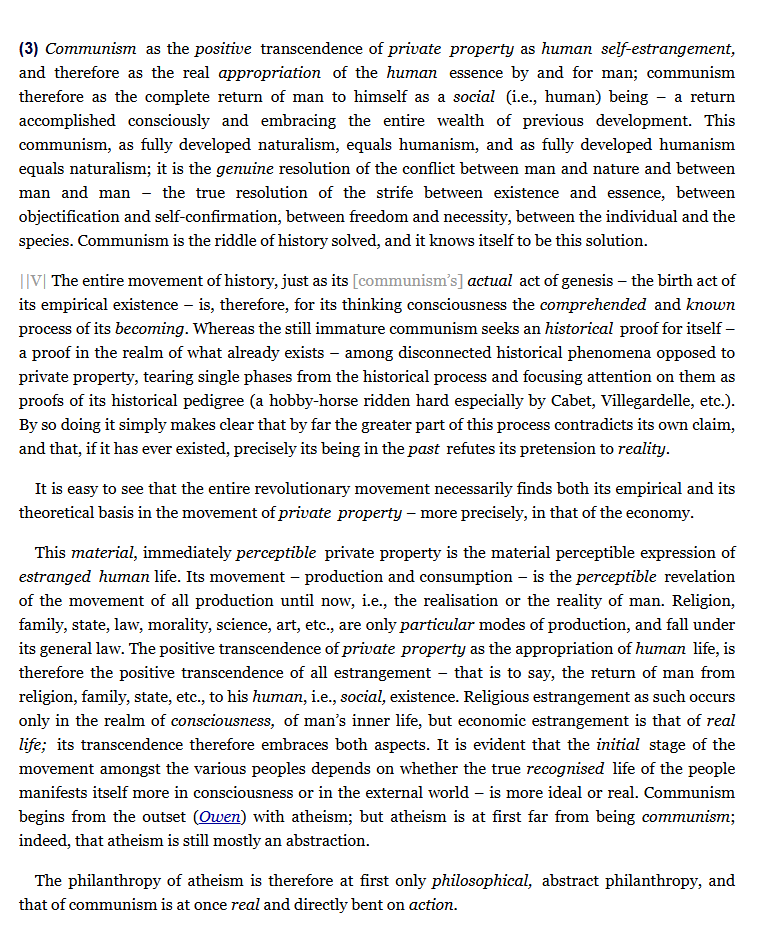
Redefining Practice as Deed: Hess insisted that thought must merge with action. “Philosophy must become worldly” in order to change the world. He criticized the Young Hegelians for believing in the “omnipotence of philosophy” and mere “freedom of mind” while neglecting real “social freedom”. Instead, Hess asserted that only human deeds could carry out what Hegelian Geist left abstract.
As Hess put it, the point was not a new theory but “the transition from idea to deed” a transition he believed the French Revolution had already begun by uniting thought with political action. Hess’s writings of the early 1840s (such as Die europäische Triarchie and “Philosophy of the Deed” manuscript) say that “the idea alone cannot fundamentally change reality. This work can only be accomplished by the deed.” In his view, history had to become a “free act” of humanity, no longer an “unconscious process” - “In our time,” Hess wrote, “history, which is no longer an unconscious fact but should be a free act, must always be preceded by the consciousness of history”.
This notion that conscious human action is the motive force of history was a direct relay to Marx’s later formulation in 1845 that “the coincidence of the changing of circumstances and of human activity can be conceived only as revolutionary practice.” Indeed, Hess’s influence is transparent in Marx’s famous Thesis III on Feuerbach.
An Alienation–Reconciliation “Repair” Schema: Hess gave Marx a new social ontology centered on alienation (Entfremdung) and its overcoming. While Left Hegelians tended to discuss alienation in religious or philosophical terms, Hess secularized it: for Hess, alienation was concretely embodied in money, private property, class division, meaning all the ways humans become estranged from their own collective essence in modern society.
In 1844 Hess wrote “On the Essence of Money” (Über das Geldwesen), saying “What God is for theoretical life, money is for the practical life of this inverted world: the alienated and externalized essence of human potentiality and life activity.” Money, he argued, is the visible “incarnation of alienated man”, the “blood and sweat” of the poor coagulated into an impersonal power over their lives. This economic alienation was tied to Hess’s ethical vision: he portrayed private property and the “money-devil” as the source of social fragmentation, the obstacle to human wholeness. On the flip side, Hess defined communism as the reestablishment of a true human community, essentially a project of repairing the broken social bonds and restoring humans to themselves.
In his Holy History of Mankind (1837) and later writings, Hess cast this in religious terms (calling the future classless society the realization of the “Kingdom of God on Earth”), but what’s important is the underlying pattern: a fall into estrangement and a redemption through re-union. Marx’s notion of communism as the aufhebung (sublation) of human self-estrangement in 1844 (See screenshot) clearly echoes Hess’s influence. Marx’s early economic manuscripts describe communism as “the positive transcendence of private property as human self-estrangement, and therefore the real re-appropriation of the human essence” which is essentially, man returning to himself as a social being. This is precisely Hess’s repair grammar in Marx’s own words.
9
The Unity of Thought and Deed (Hess’s “Tikkunizing” of Hegel): At a theoretical level, Hess translated Hegel’s idea of Spirit achieving self-consciousness (the reconciliation of subject and object) into an injunction that humans themselves must undertake the reconciliation through action. Hess was steeped in the same intellectual currents as Hegel, including Christian mystics and Lurianic Kabbalah, and he inherited from them a model of contraction, rupture, and restoration. Hess’s originality was to secularize these motifs. Drawing on Spinoza as well, who treated thought and extension as two aspects of one substance, Hess imagined a future society where mind and matter, individual and community, are one: a monism of human life. In Hegel’s terms, Hess wanted the “Idea” to become actual through human praxis.
Hess explicitly criticized Hegel for leaving too much to the autonomous “cunning of Geist.” Instead, Hess argued, “the conscious act must precede” fulfillment: history must be made deliberately by people, not allowed to unfold behind their backs. This adds a theurgic element to Hess’s socialism: humanity must perform the “reconciliation” that God or Geist failed to accomplish. As above and so below. Hess effectively “tikkun-izes” Hegel, taking a structure of fall and reconciliation that Hegel had described in philosophical terms, and insisting that only through collective, material deeds (not mere contemplation) will it be realized.
Marx in 1843–45 absorbed this lesson deeply, which is why his Theses on Feuerbach stress that “the educator must himself be educated” and that only practical critical activity (revolutionary practice) overcomes the division between theory and reality.
Hess explicitly criticized Hegel for leaving too much to the autonomous “cunning of Geist.” Instead, Hess argued, “the conscious act must precede” fulfillment: history must be made deliberately by people, not allowed to unfold behind their backs. This adds a theurgic element to Hess’s socialism: humanity must perform the “reconciliation” that God or Geist failed to accomplish. As above and so below. Hess effectively “tikkun-izes” Hegel, taking a structure of fall and reconciliation that Hegel had described in philosophical terms, and insisting that only through collective, material deeds (not mere contemplation) will it be realized.
Marx in 1843–45 absorbed this lesson deeply, which is why his Theses on Feuerbach stress that “the educator must himself be educated” and that only practical critical activity (revolutionary practice) overcomes the division between theory and reality.
10
Pedagogy and Organization:
Hess not only supplied ideas but also concrete templates for organizing a movement. He introduced Marx to the use of catechisms and programs to educate and unify revolutionaries. In 1846, Hess wrote a “Communist Confession of Faith” (a catechism in Q&A form) and a few years earlier a text called Socialism and Communism. These were meant to instill socialist principles in a broad audience. Hess’s emphasis on self-education within an organic community profoundly influenced Marx’s thinking about how a class becomes conscious. Hess wrote that history, once on the level of “organic life,” would be “the self-education of free men” living in communal society. In an unpublished 1844 draft, Hess described how in a true community, individuals develop “with body and soul” together with their social labor, such that any separation between a person and his work or his community would be as absurd as “leaping out of one’s own skin.” Humanity, he argued, must educate itself through and for freedom. This notion directly prefigures Marx’s point that in communist revolution, “the coincidence of the changing of circumstances and of human activity [or self-change]” is achieved.
In fact, Marx’s Thesis III (Feuerbach) -“The materialist doctrine that men are products of circumstances and upbringing… forgets that it is men who change circumstances and that the educator must himself be educated. … The coincidence of the changing of circumstances and of human activity can be conceived and understood only as revolutionary practice.” - is a compressed rule drawn straight from Hess’s program.
Hess had outlined, in Rosen’s words, “the pedagogical logic” of revolution (the idea that the masses must emancipate themselves through their own conscious activity), and Marx canonized this into a general principle in 1845. Hess also imparted to Marx the practical lesson that a successful movement needs discipline and focus. As we will see, Marx and Engels later enforced a stricter “party line” partly by rejecting Hess’s overly sentimental or religious phrasing, but they were following Hess’s lead in understanding the value of a clear program.
The 1847 “Hellish Trick”
A concrete example of Hess’s ongoing role and Marx’s divergence is the infamous incident in late 1847 when Engels and Marx supplanted Hess’s draft program for the Communist League. Initially, the League (a secret organization of German workers and intellectuals) had asked Hess to write a draft catechism of communist principles. Hess’s draft, true to form, presented communism in a broad, humanistic way - speaking of free development of each person’s powers, community of goods, even touching on progressive ideas about marriage and the family influenced by Charles Fourier.
Engels, however, found Hess’s draft too idealistic and insufficiently hard-headed. In October 1847, Engels reported to Marx that “I played a hellish trick on Mosi [Hess]… He had pushed through a splendidly ‘improved’ confession of faith. Last Friday I took it up in the meeting, question by question, and I hadn’t even gotten halfway when the people declared themselves ‘satisfied.’ Without any opposition I was commissioned to draft a new one, which will now be discussed… and sent to London behind the communities’ backs.”
Engels’ subterfuge, replacing Hess’s catechism with his own (“The Principles of Communism,” soon to be further refashioned by Marx into The Communist Manifesto), was a power move to enforce a new idiom and strategy. Engels’s new draft stripped away Hess’s prophetic tone and added a material scaffolding, emphasizing class struggle, economic analysis, and direct political demands (like abolition of bourgeois property).
This “hellish trick” was essentially Marx and Engels ensuring their materialist scaffold replaced Hess’s esoteric or romantic language. They did it covertly, indicating the delicate politics: “of course, no one must find out about this, or we’ll all be deposed, and there’ll be a huge scandal,” Engels warned.
The incident shows Marx and Engels asserting leadership by policing the register of discourse. They consciously edged out Hess’s style (the Hessian idiom) while quietly incorporating many of Hess’s substantive ideas into their own platform. For instance, Hess’s emphasis on abolishing inheritance and private property as foundations of community made it into the Manifesto, but shorn of any references to “Kingdom of God” or natural right. This episode, documented by Rosen (see below), shows how Marx both owed a debt to Hess’s content and concealed that debt by purging Hess and papering over this theft with materialist terms.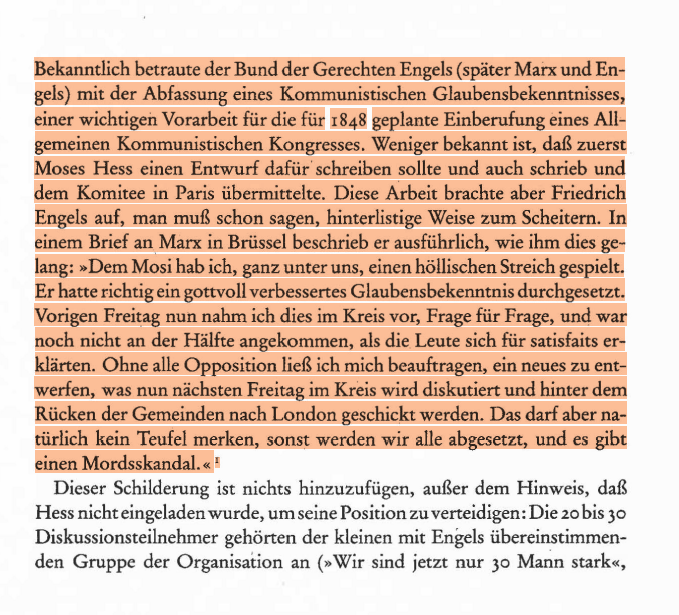
Hess not only supplied ideas but also concrete templates for organizing a movement. He introduced Marx to the use of catechisms and programs to educate and unify revolutionaries. In 1846, Hess wrote a “Communist Confession of Faith” (a catechism in Q&A form) and a few years earlier a text called Socialism and Communism. These were meant to instill socialist principles in a broad audience. Hess’s emphasis on self-education within an organic community profoundly influenced Marx’s thinking about how a class becomes conscious. Hess wrote that history, once on the level of “organic life,” would be “the self-education of free men” living in communal society. In an unpublished 1844 draft, Hess described how in a true community, individuals develop “with body and soul” together with their social labor, such that any separation between a person and his work or his community would be as absurd as “leaping out of one’s own skin.” Humanity, he argued, must educate itself through and for freedom. This notion directly prefigures Marx’s point that in communist revolution, “the coincidence of the changing of circumstances and of human activity [or self-change]” is achieved.
In fact, Marx’s Thesis III (Feuerbach) -“The materialist doctrine that men are products of circumstances and upbringing… forgets that it is men who change circumstances and that the educator must himself be educated. … The coincidence of the changing of circumstances and of human activity can be conceived and understood only as revolutionary practice.” - is a compressed rule drawn straight from Hess’s program.
Hess had outlined, in Rosen’s words, “the pedagogical logic” of revolution (the idea that the masses must emancipate themselves through their own conscious activity), and Marx canonized this into a general principle in 1845. Hess also imparted to Marx the practical lesson that a successful movement needs discipline and focus. As we will see, Marx and Engels later enforced a stricter “party line” partly by rejecting Hess’s overly sentimental or religious phrasing, but they were following Hess’s lead in understanding the value of a clear program.
The 1847 “Hellish Trick”
A concrete example of Hess’s ongoing role and Marx’s divergence is the infamous incident in late 1847 when Engels and Marx supplanted Hess’s draft program for the Communist League. Initially, the League (a secret organization of German workers and intellectuals) had asked Hess to write a draft catechism of communist principles. Hess’s draft, true to form, presented communism in a broad, humanistic way - speaking of free development of each person’s powers, community of goods, even touching on progressive ideas about marriage and the family influenced by Charles Fourier.
Engels, however, found Hess’s draft too idealistic and insufficiently hard-headed. In October 1847, Engels reported to Marx that “I played a hellish trick on Mosi [Hess]… He had pushed through a splendidly ‘improved’ confession of faith. Last Friday I took it up in the meeting, question by question, and I hadn’t even gotten halfway when the people declared themselves ‘satisfied.’ Without any opposition I was commissioned to draft a new one, which will now be discussed… and sent to London behind the communities’ backs.”
Engels’ subterfuge, replacing Hess’s catechism with his own (“The Principles of Communism,” soon to be further refashioned by Marx into The Communist Manifesto), was a power move to enforce a new idiom and strategy. Engels’s new draft stripped away Hess’s prophetic tone and added a material scaffolding, emphasizing class struggle, economic analysis, and direct political demands (like abolition of bourgeois property).
This “hellish trick” was essentially Marx and Engels ensuring their materialist scaffold replaced Hess’s esoteric or romantic language. They did it covertly, indicating the delicate politics: “of course, no one must find out about this, or we’ll all be deposed, and there’ll be a huge scandal,” Engels warned.
The incident shows Marx and Engels asserting leadership by policing the register of discourse. They consciously edged out Hess’s style (the Hessian idiom) while quietly incorporating many of Hess’s substantive ideas into their own platform. For instance, Hess’s emphasis on abolishing inheritance and private property as foundations of community made it into the Manifesto, but shorn of any references to “Kingdom of God” or natural right. This episode, documented by Rosen (see below), shows how Marx both owed a debt to Hess’s content and concealed that debt by purging Hess and papering over this theft with materialist terms.
11
To sum Hess’s impact in Marx’s development, it’s useful to directly compare a few functional roles in their respective writings:
Thought vs. Deed: Hess’s 1843 Philosophy of the Deed asserted the “union of thought and deed” and claimed “not being but the act is first and last”. Marx’s Theses on Feuerbach in 1845 encode the same idea: rejecting contemplative materialism in favor of “revolutionary practice”, where thinking and doing are merged. In Marx’s later work, this becomes the concept of praxis (the conscious class struggle and revolutionary activity), stripped of Hess’s spiritual verbiage but identical in function.
Alienation as Real Mediation: Hess identified tangible mediators of alienation - money, private property, the state - which make human creations dominate their creators.
Marx’s 1844 writings mirror Hess point for point: Marx describes money as “the estranged essence of man’s labor and life”, effectively paraphrasing Hess. In Capital (1867), Marx will recode this into the theory of commodity fetishism, the idea that relations between people assume the fantastic form of relations between things (commodities), an idea already implicit in Hess’s critique of money as “the estranged and externalized essence of human wealth”. The form (humans dominated by their own products) is the same; Marx’s mature analysis just gives it a more rigorous, economic formulation.
Self-education vs. Revolutionary Agency: Hess’s vision of the “self-education of free men” in an organic society (as quoted above) emphasizes that people must collectively lift themselves; no elite vanguard can do it for them. Marx absorbs this into his insistence that “the emancipation of the working classes must be conquered by the working classes themselves.” The third Thesis on Feuerbach explicitly rejects any division of society into educators and beneficiaries. Marx’s later organizing work (the International Workingmen’s Association, etc.) continued to stress workers’ self-emancipation - a principle that can be traced to Hess’s influence.
Programmatic Form: Hess pioneered the use of catechisms and manifestos in German socialism (his 1846 catechism, etc.), framing communist ideas in a popular, pedagogical way.
Marx and Engels famously authored the Communist Manifesto (1848) in a narrative form rather than Q&A, but the Manifesto was commissioned only after Engels first drafted a Q&A catechism (the Principles of Communism). That catechism in turn was, as noted, a replacement for Hess’s draft. So even the genre of the communist program that Marx became famous for was shaped by Hess’s prior work, albeit modified. The continuity here is that both Hess and Marx saw the need for clarity and unity in expression to forge a movement, whether via catechism or manifesto. The discontinuity is that Marx and Engels aggressively stripped away Hess’s terminology (no more talk of “love” or the “true socialists”) to establish their scientific-socialist brand.
To sum, Hess provided Marx with a template of praxis: a theory that only through collective, conscious action can philosophy become reality, coupled with a vision of communism as the restoration of human community (the repair of alienation). Marx’s subsequent development would largely consist of condensing, purging, and rebuilding this template on a new foundation.
Thought vs. Deed: Hess’s 1843 Philosophy of the Deed asserted the “union of thought and deed” and claimed “not being but the act is first and last”. Marx’s Theses on Feuerbach in 1845 encode the same idea: rejecting contemplative materialism in favor of “revolutionary practice”, where thinking and doing are merged. In Marx’s later work, this becomes the concept of praxis (the conscious class struggle and revolutionary activity), stripped of Hess’s spiritual verbiage but identical in function.
Alienation as Real Mediation: Hess identified tangible mediators of alienation - money, private property, the state - which make human creations dominate their creators.
Marx’s 1844 writings mirror Hess point for point: Marx describes money as “the estranged essence of man’s labor and life”, effectively paraphrasing Hess. In Capital (1867), Marx will recode this into the theory of commodity fetishism, the idea that relations between people assume the fantastic form of relations between things (commodities), an idea already implicit in Hess’s critique of money as “the estranged and externalized essence of human wealth”. The form (humans dominated by their own products) is the same; Marx’s mature analysis just gives it a more rigorous, economic formulation.
Self-education vs. Revolutionary Agency: Hess’s vision of the “self-education of free men” in an organic society (as quoted above) emphasizes that people must collectively lift themselves; no elite vanguard can do it for them. Marx absorbs this into his insistence that “the emancipation of the working classes must be conquered by the working classes themselves.” The third Thesis on Feuerbach explicitly rejects any division of society into educators and beneficiaries. Marx’s later organizing work (the International Workingmen’s Association, etc.) continued to stress workers’ self-emancipation - a principle that can be traced to Hess’s influence.
Programmatic Form: Hess pioneered the use of catechisms and manifestos in German socialism (his 1846 catechism, etc.), framing communist ideas in a popular, pedagogical way.
Marx and Engels famously authored the Communist Manifesto (1848) in a narrative form rather than Q&A, but the Manifesto was commissioned only after Engels first drafted a Q&A catechism (the Principles of Communism). That catechism in turn was, as noted, a replacement for Hess’s draft. So even the genre of the communist program that Marx became famous for was shaped by Hess’s prior work, albeit modified. The continuity here is that both Hess and Marx saw the need for clarity and unity in expression to forge a movement, whether via catechism or manifesto. The discontinuity is that Marx and Engels aggressively stripped away Hess’s terminology (no more talk of “love” or the “true socialists”) to establish their scientific-socialist brand.
To sum, Hess provided Marx with a template of praxis: a theory that only through collective, conscious action can philosophy become reality, coupled with a vision of communism as the restoration of human community (the repair of alienation). Marx’s subsequent development would largely consist of condensing, purging, and rebuilding this template on a new foundation.
12
Marx After Hess (1843–1848): Uptake, Transformation, and Recoding
In 1843, Marx moved to Paris, where Hess was also active, and plunged into economic and philosophical studies that culminated in the Economic-Philosophical Manuscripts of 1844. These 1844 writings demonstrate how thoroughly Marx had absorbed Hess’s “repair” logic. Marx’s manuscript on alienated labor and communism reads at times like Hess in Marx’s own words.
For example, as discussed above, Marx writes that communism is “the positive transcendence of private property as human self-estrangement, and therefore the real appropriation of the human essence by and for man. It is the complete return of man to himself as a social (i.e., human) being”. This is almost a verbatim adoption of Hess’s view that communism means man’s return from his alienated condition to a genuine community. Marx further calls communism “the genuine resolution of the conflict between man and nature, and between man and man… the riddle of history solved”, again echoing Hess’s idea of communism as a reconciliatory “Kingdom of God” in secular terms.
Importantly, Marx’s 1844 notes also mirror Hess’s insistence that communism is not an ideal fantasy but a real movement: Marx says the “entire movement of history… is the act of genesis (process of coming-to-be) of communism”, and that this movement “both in its origin and its goal is the conscious return of man – emerging from estrangement – to his human essence.” He even chastises earlier socialists for hunting in the past for “proofs” of communism instead of seeing it as the outcome of contemporary historical processes. This aligns with Hess’s rejection of purely utopian or backward-looking socialism; Hess too rooted his socialism in the historical development of “the contradictions of the Krämerwelt (shopkeeper’s world)” reaching a breaking point.
In the 1844 manuscripts Marx also places an empirical anchor exactly where Hess did: in the economy. Marx argues that the emergence of communism “finds both its empirical and its theoretical basis in the movement of private property”, since private property is the “material perceptible expression of estranged human life.” This is a direct correspondence to Hess’s thesis that political economy is to earthly life what theology is to heaven – the science of earthly alienation, analyzing how human essence is estranged through material relations. Furthermore, Marx’s 1844 discussion of money (often noted as one of the most “Hessian” parts of his work) echoes Hess’s language: Marx describes money as the “visible deity” and universal whore, the power that can transform fidelity into treachery, love into hate, virtue into vice, alluding to the same inversion that Hess described when he said “money is the practical God” of our world. In short, Marx in 1844 had not yet discarded Hess’s humanist and even religious-philosophical idiom – he talks of human essence, species-being, alienation and reconciliation in a way entirely continuous with Hess. As Rosen puts it, Marx’s 1844 writings parallel Hess “point for point” in analysis of alienation.
Finally, in the 1844 manuscripts Marx underscores something Hess had hammered home: praxis as the criterion. Marx contrasts what he calls “immature” communists (who might be merely contemplative or sectarian) with his concept of communism as “at once real and directly bent on action”. He notes that atheism (mere critique of religion) is a starting point, but insufficient; it must give way to communism, which “is at once atheism realized and the loss of religion, and the positive supersession of private property”, i.e. a real, practical movement. This emphasis that communism is “at once real” and “bent on action” is pure Hess in spirit. The Paris manuscripts show Marx using Hess’s relay in full: he has taken the notion of alienation and practical reconciliation, applied it to political economy, and asserted the primacy of action.
In 1843, Marx moved to Paris, where Hess was also active, and plunged into economic and philosophical studies that culminated in the Economic-Philosophical Manuscripts of 1844. These 1844 writings demonstrate how thoroughly Marx had absorbed Hess’s “repair” logic. Marx’s manuscript on alienated labor and communism reads at times like Hess in Marx’s own words.
For example, as discussed above, Marx writes that communism is “the positive transcendence of private property as human self-estrangement, and therefore the real appropriation of the human essence by and for man. It is the complete return of man to himself as a social (i.e., human) being”. This is almost a verbatim adoption of Hess’s view that communism means man’s return from his alienated condition to a genuine community. Marx further calls communism “the genuine resolution of the conflict between man and nature, and between man and man… the riddle of history solved”, again echoing Hess’s idea of communism as a reconciliatory “Kingdom of God” in secular terms.
Importantly, Marx’s 1844 notes also mirror Hess’s insistence that communism is not an ideal fantasy but a real movement: Marx says the “entire movement of history… is the act of genesis (process of coming-to-be) of communism”, and that this movement “both in its origin and its goal is the conscious return of man – emerging from estrangement – to his human essence.” He even chastises earlier socialists for hunting in the past for “proofs” of communism instead of seeing it as the outcome of contemporary historical processes. This aligns with Hess’s rejection of purely utopian or backward-looking socialism; Hess too rooted his socialism in the historical development of “the contradictions of the Krämerwelt (shopkeeper’s world)” reaching a breaking point.
In the 1844 manuscripts Marx also places an empirical anchor exactly where Hess did: in the economy. Marx argues that the emergence of communism “finds both its empirical and its theoretical basis in the movement of private property”, since private property is the “material perceptible expression of estranged human life.” This is a direct correspondence to Hess’s thesis that political economy is to earthly life what theology is to heaven – the science of earthly alienation, analyzing how human essence is estranged through material relations. Furthermore, Marx’s 1844 discussion of money (often noted as one of the most “Hessian” parts of his work) echoes Hess’s language: Marx describes money as the “visible deity” and universal whore, the power that can transform fidelity into treachery, love into hate, virtue into vice, alluding to the same inversion that Hess described when he said “money is the practical God” of our world. In short, Marx in 1844 had not yet discarded Hess’s humanist and even religious-philosophical idiom – he talks of human essence, species-being, alienation and reconciliation in a way entirely continuous with Hess. As Rosen puts it, Marx’s 1844 writings parallel Hess “point for point” in analysis of alienation.
Finally, in the 1844 manuscripts Marx underscores something Hess had hammered home: praxis as the criterion. Marx contrasts what he calls “immature” communists (who might be merely contemplative or sectarian) with his concept of communism as “at once real and directly bent on action”. He notes that atheism (mere critique of religion) is a starting point, but insufficient; it must give way to communism, which “is at once atheism realized and the loss of religion, and the positive supersession of private property”, i.e. a real, practical movement. This emphasis that communism is “at once real” and “bent on action” is pure Hess in spirit. The Paris manuscripts show Marx using Hess’s relay in full: he has taken the notion of alienation and practical reconciliation, applied it to political economy, and asserted the primacy of action.
13
1845: Condensation into Theses on Feuerbach (Revolutionary Practice)
If 1844 was the uptake, 1845 was the condensation. In the spring of 1845, Marx wrote his Theses on Feuerbach, never meant for publication, which succinctly capture his break from contemplative materialism and his commitment to praxis. Thesis III, already quoted above, deserves emphasis as Marx’s one-line distillation of the Hessian lesson: “The coincidence of the changing of circumstances and of human activity [or self-change] can be conceived only as revolutionary practice.” In this epigrammatic form, Marx enshrined the idea that humans make their own history through a unity of subjective and objective change - in other words, through praxis.
As Rosen and others have noted, this notion was prepared by Hess’s writings on self-education and social action. Another of the Theses (Thesis II) implicitly references the idea (present in Hess) that “the question whether objective truth can be attributed to human thinking is not a theoretical question, but a practical one”, because truth must prove itself in practice. And famously, Thesis XI declares “philosophers have only interpreted the world; the point, however, is to change it.” This is virtually a slogan for Hess’s Philosophy of the Deed. In effect, Marx has condensed Hess’s entire critique of the old philosophers (who, Hess said, only sought to interpret or only achieved “spiritual freedom”) into that single fiery pronouncement.
The Theses on Feuerbach also mark the moment Marx privately signaled a divergence from Feuerbach and by extension from the abstract humanism he shared with Hess. Marx accuses Feuerbach of not grasping the active side of social life, of seeing humans as products of circumstances rather than as producers of change. But importantly, what Marx is criticizing Feuerbach for is precisely what Hess had already criticized Feuerbach (and the Young Hegelians) for: passivity and abstraction. Marx’s “new” principle of revolutionary practice was not ex nihilo, it was born directly of Hess’s tutoring and the concrete lessons of 1842–44. Thus 1845’s Theses stand as a bridge: Marx setting out his own stall, but the lumber for that bridge was largely milled by Hess.
If 1844 was the uptake, 1845 was the condensation. In the spring of 1845, Marx wrote his Theses on Feuerbach, never meant for publication, which succinctly capture his break from contemplative materialism and his commitment to praxis. Thesis III, already quoted above, deserves emphasis as Marx’s one-line distillation of the Hessian lesson: “The coincidence of the changing of circumstances and of human activity [or self-change] can be conceived only as revolutionary practice.” In this epigrammatic form, Marx enshrined the idea that humans make their own history through a unity of subjective and objective change - in other words, through praxis.
As Rosen and others have noted, this notion was prepared by Hess’s writings on self-education and social action. Another of the Theses (Thesis II) implicitly references the idea (present in Hess) that “the question whether objective truth can be attributed to human thinking is not a theoretical question, but a practical one”, because truth must prove itself in practice. And famously, Thesis XI declares “philosophers have only interpreted the world; the point, however, is to change it.” This is virtually a slogan for Hess’s Philosophy of the Deed. In effect, Marx has condensed Hess’s entire critique of the old philosophers (who, Hess said, only sought to interpret or only achieved “spiritual freedom”) into that single fiery pronouncement.
The Theses on Feuerbach also mark the moment Marx privately signaled a divergence from Feuerbach and by extension from the abstract humanism he shared with Hess. Marx accuses Feuerbach of not grasping the active side of social life, of seeing humans as products of circumstances rather than as producers of change. But importantly, what Marx is criticizing Feuerbach for is precisely what Hess had already criticized Feuerbach (and the Young Hegelians) for: passivity and abstraction. Marx’s “new” principle of revolutionary practice was not ex nihilo, it was born directly of Hess’s tutoring and the concrete lessons of 1842–44. Thus 1845’s Theses stand as a bridge: Marx setting out his own stall, but the lumber for that bridge was largely milled by Hess.
14
1845–47: The Polemical Break - Attacking “True Socialism”
After 1845, Marx and Engels undertook an explicit purge of Hess’s idiom under the label “True Socialism.” In works like The German Ideology (1846, unpublished) and especially in the Communist Manifesto (1848), they lambasted a group of contemporaries in Germany for dressing up socialist ideas in idealist, philosophical garb. Marx and Engels mock the “True Socialists” for preaching abstract “Humanity” and “Essence” instead of engaging in class struggle. This was aimed in part at Hess (though they do not name him explicitly in the Manifesto). By 1847, Hess’s writings and those of others like Karl Grün were being caricatured by Marx as muddle-headed, religiously tainted, or retrograde. For example, Marx and Engels in the Manifesto say, “The French socialist and communist literature was thus completely emasculated [by German True Socialists]. … It spread a diluted form of French socialist ideas, and declared that for the Germans these ideas were not a practical movement but only the absolute truth, human essence, and the essence of humanity.” Marx’s private correspondence around that time is harsher: he accuses Hess of mystical obscurantism and even suggests Hess’s continued talk of love and humanity serves reactionary ends by blunting the revolutionary edge.
What caused this harsh turn on Hess? Two main reasons present themselves:
First, Marx and Engels by 1847 were consolidating their leadership of the international communist movement. To do so, they felt they had to draw clear lines between scientific socialism (their brand) and what they viewed as the moralizing socialism of others. Hess’s style, full of religious metaphors and philosophical rhetoric, was an easy foil. By denigrating “True Socialism” as pseudo-socialism, Marx could assert that his socialism was grounded in the real dynamics of class and material production, not in utopian dreams. It was a branding strategy to position himself above other competitors.
Second, Marx had in the course of 1845–47 developed a more economic structure (helped by Engels’ studies of political economy). He began formulating the concepts of surplus value, historical materialism, etc. In this development, Hess’s earlier analyses lacked this “scientific“ edge. For instance, Hess condemned private property on moral grounds and spoke of “human essence” while Marx in 1847–48 preferred to talk about proletarians and bourgeois, commodity exchange, and the material motor of history. To make the break clean, Marx erased the traces of Hess’s influence in his public works. In The German Ideology, Marx and Engels even parody the language of “true man” and “essence” to bury it once and for all.
However, Marx’s repudiation of Hess was largely a repudiation of form, not substance. Marx did not abandon the notion of alienation or the goal of a reconciled society. He reinterpreted them in new terms. As Rosen notes, Marx “caricatured” Hess’s views in order to distance himself, leaving a distorted image of Hess in the record. The result was that Hess’s real contributions were obscured for decades in the Marxist tradition. By the time Engels wrote Ludwig Feuerbach and the End of Classical German Philosophy (1888), he could paint a lineage from German philosophy to Marx that virtually excised Hess (mentioning him only as a “philosophical socialist” among others). The irony is that Marx and Engels, having been set on the communist path by Hess, found it politically necessary to publicly trash the very idiom through which they had learned those ideas.
A telling confirmation that it was Hess’s idiom rather than architecture that Marx and Engels rejected is the behind-the-scenes organizational relations with Hess. Even after 1850, Hess was not persona non grata; he attended socialist congresses and corresponded with the movement. Engels in private continued to acknowledge Hess’s historical role as “the first communist in the party”. The public polemic, however, consigned Hess to the losing side of history.
After 1845, Marx and Engels undertook an explicit purge of Hess’s idiom under the label “True Socialism.” In works like The German Ideology (1846, unpublished) and especially in the Communist Manifesto (1848), they lambasted a group of contemporaries in Germany for dressing up socialist ideas in idealist, philosophical garb. Marx and Engels mock the “True Socialists” for preaching abstract “Humanity” and “Essence” instead of engaging in class struggle. This was aimed in part at Hess (though they do not name him explicitly in the Manifesto). By 1847, Hess’s writings and those of others like Karl Grün were being caricatured by Marx as muddle-headed, religiously tainted, or retrograde. For example, Marx and Engels in the Manifesto say, “The French socialist and communist literature was thus completely emasculated [by German True Socialists]. … It spread a diluted form of French socialist ideas, and declared that for the Germans these ideas were not a practical movement but only the absolute truth, human essence, and the essence of humanity.” Marx’s private correspondence around that time is harsher: he accuses Hess of mystical obscurantism and even suggests Hess’s continued talk of love and humanity serves reactionary ends by blunting the revolutionary edge.
What caused this harsh turn on Hess? Two main reasons present themselves:
First, Marx and Engels by 1847 were consolidating their leadership of the international communist movement. To do so, they felt they had to draw clear lines between scientific socialism (their brand) and what they viewed as the moralizing socialism of others. Hess’s style, full of religious metaphors and philosophical rhetoric, was an easy foil. By denigrating “True Socialism” as pseudo-socialism, Marx could assert that his socialism was grounded in the real dynamics of class and material production, not in utopian dreams. It was a branding strategy to position himself above other competitors.
Second, Marx had in the course of 1845–47 developed a more economic structure (helped by Engels’ studies of political economy). He began formulating the concepts of surplus value, historical materialism, etc. In this development, Hess’s earlier analyses lacked this “scientific“ edge. For instance, Hess condemned private property on moral grounds and spoke of “human essence” while Marx in 1847–48 preferred to talk about proletarians and bourgeois, commodity exchange, and the material motor of history. To make the break clean, Marx erased the traces of Hess’s influence in his public works. In The German Ideology, Marx and Engels even parody the language of “true man” and “essence” to bury it once and for all.
However, Marx’s repudiation of Hess was largely a repudiation of form, not substance. Marx did not abandon the notion of alienation or the goal of a reconciled society. He reinterpreted them in new terms. As Rosen notes, Marx “caricatured” Hess’s views in order to distance himself, leaving a distorted image of Hess in the record. The result was that Hess’s real contributions were obscured for decades in the Marxist tradition. By the time Engels wrote Ludwig Feuerbach and the End of Classical German Philosophy (1888), he could paint a lineage from German philosophy to Marx that virtually excised Hess (mentioning him only as a “philosophical socialist” among others). The irony is that Marx and Engels, having been set on the communist path by Hess, found it politically necessary to publicly trash the very idiom through which they had learned those ideas.
A telling confirmation that it was Hess’s idiom rather than architecture that Marx and Engels rejected is the behind-the-scenes organizational relations with Hess. Even after 1850, Hess was not persona non grata; he attended socialist congresses and corresponded with the movement. Engels in private continued to acknowledge Hess’s historical role as “the first communist in the party”. The public polemic, however, consigned Hess to the losing side of history.
15
Recoding: A Materialist Scaffold Over the Hessian Architecture
By 1848, Marx had “recoded” the Hessian framework in a fully materialist vocabulary. Class struggle replaced “self-estrangement” as the engine of history; capital replaced “money-devil” as the concrete villain; the abolition of private property in bourgeois terms replaced the more vague “community of goods” or “social love” in Hess’s terms. Yet beneath these terminological changes, Marx’s mature theory still carried out the Hessian program by other means.
Consider Marx’s magnum opus, Capital (1867). At its core is an analysis of how the products of labor (commodities, capital) become alien powers over the worker: a classic alienation theme. Marx discusses commodity fetishism, whereby the relations between people assume the form of relations between things, just as Hess described an “inverted world” where “what is produced by man appears as his master”. Marx’s remedy implied in Capital (and explicit in earlier works like the 1848 Manifesto) is the revolutionary overthrow of capitalist property relations, leading to a classless society - essentially a reconciliation of man with his species-being, though Marx now avoids that phrasing. Marx ridicules terms like “species-being” in The German Ideology, but the idea that under communism individuals will no longer be estranged from the communal essence of humanity reappears in plain clothes as the idea that free individuals will associate and govern their common affairs.
Engels in Anti-Dühring (1878) writes of socialism as the leap of humanity from the realm of necessity to the realm of freedom, a concept of Aufhebung (sublation or uplifting) that is very much in line with Hess’s view of communism as the fulfillment of human development beyond the point of fragmentation.
By 1848, Marx had “recoded” the Hessian framework in a fully materialist vocabulary. Class struggle replaced “self-estrangement” as the engine of history; capital replaced “money-devil” as the concrete villain; the abolition of private property in bourgeois terms replaced the more vague “community of goods” or “social love” in Hess’s terms. Yet beneath these terminological changes, Marx’s mature theory still carried out the Hessian program by other means.
Consider Marx’s magnum opus, Capital (1867). At its core is an analysis of how the products of labor (commodities, capital) become alien powers over the worker: a classic alienation theme. Marx discusses commodity fetishism, whereby the relations between people assume the form of relations between things, just as Hess described an “inverted world” where “what is produced by man appears as his master”. Marx’s remedy implied in Capital (and explicit in earlier works like the 1848 Manifesto) is the revolutionary overthrow of capitalist property relations, leading to a classless society - essentially a reconciliation of man with his species-being, though Marx now avoids that phrasing. Marx ridicules terms like “species-being” in The German Ideology, but the idea that under communism individuals will no longer be estranged from the communal essence of humanity reappears in plain clothes as the idea that free individuals will associate and govern their common affairs.
Engels in Anti-Dühring (1878) writes of socialism as the leap of humanity from the realm of necessity to the realm of freedom, a concept of Aufhebung (sublation or uplifting) that is very much in line with Hess’s view of communism as the fulfillment of human development beyond the point of fragmentation.
16
17
To put it succinctly: Marx kept the script but changed the language. The drama of alienation and return is still playing out in Marx’s historical materialism, but now starring proletarians and capitalists instead of “Man” and “Essence,” and narrated in terms of economics rather than religion or philosophy. The function of Hess’s concepts survived. For example, Hess’s “human essence” became Marx’s “Gattungswesen” (species-being) in the 1844 manuscripts and later simply the ensemble of social relations; Hess’s “alienation” became Marx’s Entfremdung and then more concretely exploitation or reification; Hess’s vision of reconciled communal life became Marx’s vision of a classless associative mode of production.
One of the clearest through-lines is the idea of history as a process of estrangement that generates its own negation (and thus its potential transcendence). Hess saw history as the “story of the alienation of mankind” reaching a “culmination” in modern capitalism’s complete fragmentation of community, which would provoke a restoration of harmony. Marx’s historical materialism similarly sees capitalism as generating both the highest alienation (workers reduced to appendages of machines, all social ties dissolved into cash relations) and the conditions for its supersession (associated labor, conscious planning). This is effectively Hess’s eschatology in a new scientific guise. As Magee points out, even Marx’s secular historiography retains a millenarian structure inherited from Judeo-Christian thought (and figures like Joachim de Fiore): Marx imagines a leap from prehistory into truly human history, analogous to Joachim’s Third Age or Hess’s “Holy History” of a redeemed mankind. Magee goes so far as to call Marx “the true modern disciple of Joachim”, suggesting that Marx took the Hermetic-millenarian baton further than Hegel.
Marx’s recoding was thus a double move: dissociate from the old language, but secretly conserve the logical structure by embedding it in a new empirical analysis. It's possible (I think doubtful) Marx himself might not have framed it as “secret” or intentional concealment. Nevertheless, the continuity is evident with hindsight and documented by scholars like Rosen and Avineri. Shlomo Avineri notes that even as Marx denounced Hess’s talk of “love” and “essence,” he and Engels incorporated “several of Hess’s esoteric programmatic elements,” merely translating them into the historically concrete register.
One of the clearest through-lines is the idea of history as a process of estrangement that generates its own negation (and thus its potential transcendence). Hess saw history as the “story of the alienation of mankind” reaching a “culmination” in modern capitalism’s complete fragmentation of community, which would provoke a restoration of harmony. Marx’s historical materialism similarly sees capitalism as generating both the highest alienation (workers reduced to appendages of machines, all social ties dissolved into cash relations) and the conditions for its supersession (associated labor, conscious planning). This is effectively Hess’s eschatology in a new scientific guise. As Magee points out, even Marx’s secular historiography retains a millenarian structure inherited from Judeo-Christian thought (and figures like Joachim de Fiore): Marx imagines a leap from prehistory into truly human history, analogous to Joachim’s Third Age or Hess’s “Holy History” of a redeemed mankind. Magee goes so far as to call Marx “the true modern disciple of Joachim”, suggesting that Marx took the Hermetic-millenarian baton further than Hegel.
Marx’s recoding was thus a double move: dissociate from the old language, but secretly conserve the logical structure by embedding it in a new empirical analysis. It's possible (I think doubtful) Marx himself might not have framed it as “secret” or intentional concealment. Nevertheless, the continuity is evident with hindsight and documented by scholars like Rosen and Avineri. Shlomo Avineri notes that even as Marx denounced Hess’s talk of “love” and “essence,” he and Engels incorporated “several of Hess’s esoteric programmatic elements,” merely translating them into the historically concrete register.
18
Outcome and Transition
By the revolutions of 1848, Marx’s distinctive synthesis was largely in place. The practical core of Marxism - the emphasis on class praxis, the critique of alienated labor, the vision of a coming human community - was forged through the relay from Hess. Hess’s role as a conduit cannot be overstated: he was the one who made Marx (and Engels) communists, who provided the first vocabulary for alienation and supersession that Marx would later transform, and who drafted early communist programs that Marx would refashion. The tension between Hess and Marx, collaboration followed by repudiation, also had a lasting effect on the culture of Marxism, contributing to a self-image of Marxism as sharply distinct from “utopian” or ethical socialism.
In consolidating their leadership, Marx and Engels effectively wrote Hess out of the foundation story. As a result, only in the late 20th century did researchers like Zvi Rosen bring to light how much of Marx’s 1844–45 conceptual apparatus was prefigured by Hess. With our current perspective, we can appreciate that Marxism did not arise ex nihilo from Marx’s genius alone, but through a network of radical thought in which Hess was a key node, connecting the esoteric heritage of German Idealism (with its Kabbalistic and Christian mystical strains) to the exoteric needs of a mass workers’ movement.
By the revolutions of 1848, Marx’s distinctive synthesis was largely in place. The practical core of Marxism - the emphasis on class praxis, the critique of alienated labor, the vision of a coming human community - was forged through the relay from Hess. Hess’s role as a conduit cannot be overstated: he was the one who made Marx (and Engels) communists, who provided the first vocabulary for alienation and supersession that Marx would later transform, and who drafted early communist programs that Marx would refashion. The tension between Hess and Marx, collaboration followed by repudiation, also had a lasting effect on the culture of Marxism, contributing to a self-image of Marxism as sharply distinct from “utopian” or ethical socialism.
In consolidating their leadership, Marx and Engels effectively wrote Hess out of the foundation story. As a result, only in the late 20th century did researchers like Zvi Rosen bring to light how much of Marx’s 1844–45 conceptual apparatus was prefigured by Hess. With our current perspective, we can appreciate that Marxism did not arise ex nihilo from Marx’s genius alone, but through a network of radical thought in which Hess was a key node, connecting the esoteric heritage of German Idealism (with its Kabbalistic and Christian mystical strains) to the exoteric needs of a mass workers’ movement.
19
Lastly, recognizing Hess’s influence allows us to understand an esoteric foundation to Marxist theory. We can, for example, distinguish two registers in Marx’s own work: an exoteric register of material analysis (value, class, production) and a more esoteric subtext (alienation, “humanity”, reappropriation of powers) which is the legacy of that contraction -rupture - repair grammar Marx inherited via Hess and ultimately from Hegel. As Magee argued regarding Hegel, one must sometimes “see the identity in difference” - different vocabularies masking an underlying common structure.
In Marx’s case, the language of political economy masks an ethos of emancipation that is continuous with a long tradition of philosophical theodicy and redemption. Marx’s theory of overcoming reification (as later highlighted by Georg Lukács) is, in essence, a translation of Hess’s theory of overcoming alienation into the reified relations of capitalist society. In Lukács’ terms, the proletariat by overcoming reification achieves the identical subject-object of history, which is a direct conceptual descendant of that moment of “return to self” that Hess and Marx (in 1844) described as the end of estrangement.
Hess’s contribution to Marx was to re-ground German philosophy in social reality and action - to demand of Hegel’s legacy that it be “bent on action”. Marx took that baton and ran with it, eventually discarding the gilded baton itself but keeping a firm grip on its substance. Understanding this relay enriches our understanding of Marxism not as a clean break with “utopian” predecessors, but as a result of sublation: Marx absorbed Hess (and others), negated them in form, but preserved their essential movement within his own theory. This layered lineage suggests that to fully appreciate Marx (and later Marxists like Lukács), one should be aware of both the exoteric structure (class, labor, production) and the esoteric echo (alienation, the quest for wholeness, the humanistic motive). In the end, the path from Hegel to Marx through Hess shows Marx’s own dictum: men make their own history, but not under circumstances they choose. Marx made his theory under circumstances and with conceptual tools provided by Hess and the intellectual tradition Hess carried, a tradition that, as Magee reminds us, includes a decidedly esoteric foundation.
In Marx’s case, the language of political economy masks an ethos of emancipation that is continuous with a long tradition of philosophical theodicy and redemption. Marx’s theory of overcoming reification (as later highlighted by Georg Lukács) is, in essence, a translation of Hess’s theory of overcoming alienation into the reified relations of capitalist society. In Lukács’ terms, the proletariat by overcoming reification achieves the identical subject-object of history, which is a direct conceptual descendant of that moment of “return to self” that Hess and Marx (in 1844) described as the end of estrangement.
Hess’s contribution to Marx was to re-ground German philosophy in social reality and action - to demand of Hegel’s legacy that it be “bent on action”. Marx took that baton and ran with it, eventually discarding the gilded baton itself but keeping a firm grip on its substance. Understanding this relay enriches our understanding of Marxism not as a clean break with “utopian” predecessors, but as a result of sublation: Marx absorbed Hess (and others), negated them in form, but preserved their essential movement within his own theory. This layered lineage suggests that to fully appreciate Marx (and later Marxists like Lukács), one should be aware of both the exoteric structure (class, labor, production) and the esoteric echo (alienation, the quest for wholeness, the humanistic motive). In the end, the path from Hegel to Marx through Hess shows Marx’s own dictum: men make their own history, but not under circumstances they choose. Marx made his theory under circumstances and with conceptual tools provided by Hess and the intellectual tradition Hess carried, a tradition that, as Magee reminds us, includes a decidedly esoteric foundation.
20
Bibliography
Avineri, Shlomo. Moses Hess: Prophet of Communism and Zionism. New York and London: New York University Press, 1985.
Berlin, Isaiah. “The Life and Opinions of Moses Hess.” In Against the Current: Essays in the History of Ideas, 213–51. New York: Viking Press, 1980.
Hess, Moses. Ausgewählte Schriften. Ausgewählt und eingeleitet von Horst Lademacher. Köln: Joseph Melzer Verlag, 1962.
Hess, Moses. Die europäische Triarchie. Leipzig: Otto Wigand, 1841.
Hess, Moses. The Holy History of Mankind and Other Writings. Translated and edited by Shlomo Avineri. Cambridge: Cambridge University Press, 2004.
Magee, Glenn Alexander. Hegel and the Hermetic Tradition. Ithaca: Cornell University Press, 2001.
Marx, Karl. “The Difference Between the Democritean and Epicurean Philosophy of Nature.” In Marx-Engels Collected Works, vol. 1, Karl Marx: 1835–1843, 25–107. New York: International Publishers, 1975.
Marx, Karl. Early Writings. Translated by Rodney Livingstone and Gregor Benton. Introduced by Lucio Colletti. Harmondsworth: Penguin Books, 1975.
Rosen, Zvi. Moses Hess und Karl Marx: Ein Beitrag zur Entstehung der Marxschen Theorie. Hamburg: Christians, 1983.
Avineri, Shlomo. Moses Hess: Prophet of Communism and Zionism. New York and London: New York University Press, 1985.
Berlin, Isaiah. “The Life and Opinions of Moses Hess.” In Against the Current: Essays in the History of Ideas, 213–51. New York: Viking Press, 1980.
Hess, Moses. Ausgewählte Schriften. Ausgewählt und eingeleitet von Horst Lademacher. Köln: Joseph Melzer Verlag, 1962.
Hess, Moses. Die europäische Triarchie. Leipzig: Otto Wigand, 1841.
Hess, Moses. The Holy History of Mankind and Other Writings. Translated and edited by Shlomo Avineri. Cambridge: Cambridge University Press, 2004.
Magee, Glenn Alexander. Hegel and the Hermetic Tradition. Ithaca: Cornell University Press, 2001.
Marx, Karl. “The Difference Between the Democritean and Epicurean Philosophy of Nature.” In Marx-Engels Collected Works, vol. 1, Karl Marx: 1835–1843, 25–107. New York: International Publishers, 1975.
Marx, Karl. Early Writings. Translated by Rodney Livingstone and Gregor Benton. Introduced by Lucio Colletti. Harmondsworth: Penguin Books, 1975.
Rosen, Zvi. Moses Hess und Karl Marx: Ein Beitrag zur Entstehung der Marxschen Theorie. Hamburg: Christians, 1983.
21
@threadreaderapp unroll
22
@threadreaderapp Additionally:
x.com/Ne_pas_couvrir…
x.com/Ne_pas_couvrir…
23