👀🧵THREAD: Here's a quick look at the updated dietary guidance from...

The HighWire@HighWireTalk
11 views
Jan 08, 2026
~6 min read
Advertisement
1
👀🧵THREAD: Here's a quick look at the updated dietary guidance from HHS/USDA:
What the latest dietary guidance emphasizes:
🎯Calories are individualized - Calorie needs vary based on age, sex, weight, and activity level. Portion awareness is encouraged, especially with calorie-dense foods. Hydration is highlighted, with a preference for water and unsweetened beverages.
🥩 Protein at every meal - The guidance prioritizes high-quality, nutrient-dense protein at each meal.
Protein sources include:
– Animal-based: eggs, poultry, seafood, red meat
– Plant-based: beans, lentils, peas, nuts, seeds, soy
Recommended intake ranges from 1.2–1.6 grams per kilogram of body weight per day, depending on individual needs.
Cooking methods such as baking, roasting, grilling, or stir-frying are preferred. Added sugars and refined carbohydrates are discouraged.
🥚 Dairy included
Full-fat dairy without added sugars is included as a source of protein, fats, vitamins, and minerals.
General guidance recommends up to 3 servings per day, adjusted according to individual calorie needs.
🦠Gut health matters - A healthy microbiome is linked to digestion and overall health.
🎯Highly processed foods are noted as disruptive, while fermented and high-fiber foods (such as sauerkraut, kimchi, kefir, and miso) are highlighted as supportive.
2
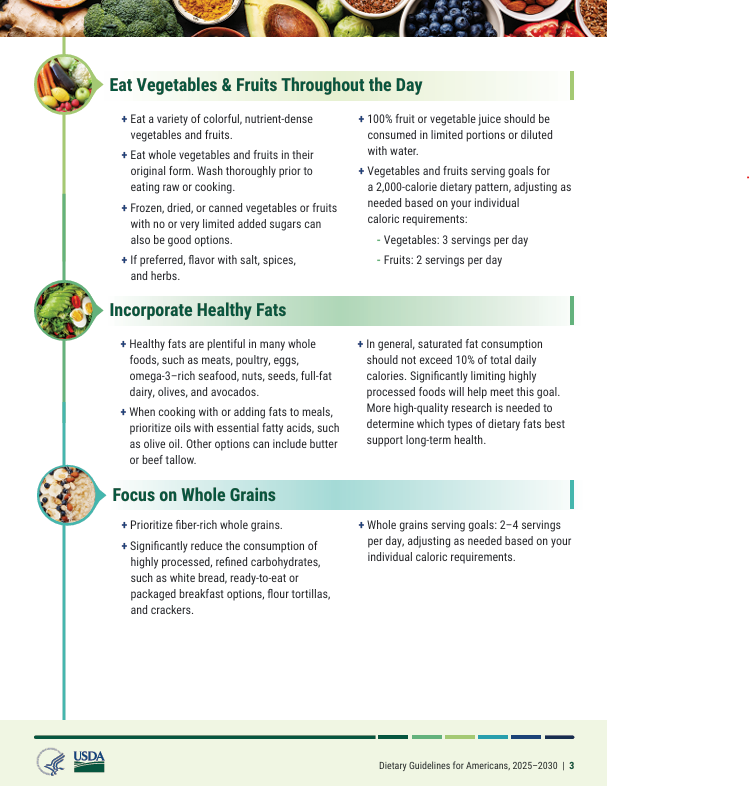
🍓🥕Eat vegetables and fruits throughout the day, prioritizing a variety of colorful, nutrient-dense options. Choose whole fruits and vegetables when possible; frozen, dried, or canned options with little or no added sugar are acceptable
🧃Limit 100% fruit or vegetable juice, or dilute with water
General serving guidance is provided (adjusted for individual needs):
– Vegetables: 3 servings per day
– Fruits: 2 servings per day
🦞🥛🥑 Include healthy fats from whole foods such as meat, eggs, seafood, full-fat dairy, nuts, seeds, olives, and avocados
🫒 Use oils with essential fatty acids (such as olive oil) when cooking; butter and beef tallow are also listed options
🍞 Prioritize fiber-rich whole grains
They recommend reducing highly processed and refined carbohydrates, including white bread and packaged grain products
Suggested whole grain intake: 2–4 servings per day, based on calorie needs
.
🧃Limit 100% fruit or vegetable juice, or dilute with water
General serving guidance is provided (adjusted for individual needs):
– Vegetables: 3 servings per day
– Fruits: 2 servings per day
🦞🥛🥑 Include healthy fats from whole foods such as meat, eggs, seafood, full-fat dairy, nuts, seeds, olives, and avocados
🫒 Use oils with essential fatty acids (such as olive oil) when cooking; butter and beef tallow are also listed options
🍞 Prioritize fiber-rich whole grains
They recommend reducing highly processed and refined carbohydrates, including white bread and packaged grain products
Suggested whole grain intake: 2–4 servings per day, based on calorie needs
.
3
Dietary guidance on processed foods and added sugars:
🎯Limit highly processed foods, including ready-to-eat or ready-to-heat packaged foods that are salty, sweet, or high in added sugars and sodium
🎯Prioritize nutrient-dense, whole foods and home-prepared meals when possible
When eating out, choose nutrient-dense options
🎯 Limit foods and beverages containing:
– Added sugars
– Artificial flavors and preservatives
– Petroleum-based dyes
– Non-nutritive sweeteners
🎯 Avoid sugar-sweetened beverages such as:
– Sodas
– Fruit drinks
– Energy drinks
🎯 Added sugars are not recommended as part of a healthy diet
🎯Daily intake guidance suggests no more than 10 grams of added sugar per day
🎯Snack guidance:
– Grain snacks (e.g., crackers): no more than 5 grams of added sugar per ¾-cup equivalent
– Dairy snacks (e.g., yogurt): no more than 2.5 grams of added sugar per ⅔-cup equivalent
🔎Identifying added sugars:
👀Look for ingredients containing “sugar,” “syrup,” or ending in “-ose”
🎯 Added sugars may appear under names such as:
– High-fructose corn syrup
– Cane sugar, beet sugar
– Rice syrup, agave syrup, honey, molasses
– Dextrose, fructose, glucose, maltose
🎯Non-nutritive sweeteners listed include aspartame, sucralose, saccharin, xylitol, and acesulfame K
🎯Naturally occurring sugars in foods like whole fruits and plain milk are not considered added sugars
4
🥂Alcohol consumption:
– Recommends consuming less alcohol for overall health
– Certain groups should completely avoid alcohol, including:
➡️ Pregnant women
➡️Individuals recovering from alcohol use disorder
➡️Those unable to control the amount they drink
➡️People taking medications or with medical conditions that interact with alcohol
🎯Notes increased risk for those with a family history of alcoholism
🎯Sodium intake:
– Sodium and electrolytes are recognized as important for hydration
– General guidance for ages 14 and older: less than 2,300 mg per day
– Highly active individuals may require more sodium due to sweat loss
🧒Children’s sodium recommendations:
– Ages 1–3: less than 1,200 mg/day
– Ages 4–8: less than 1,500 mg/day
– Ages 9–13: less than 1,800 mg/day
🍭 Processed foods
– Highly processed foods high in sodium are discouraged
5
Dietary guidance for infants & early childhood (birth–4 years):
👶 Birth to ~6 months:
– Breast milk is recommended as the primary source of nutrition
– If breast milk is not available, iron-fortified infant formula is recommended
🍼 Breastfeeding and formula:
– Breastfeeding may continue as long as mutually desired by parent and child
– If using formula, transition off formula at 12 months and introduce whole milk
– Breastfed infants and formula-fed infants consuming less than 32 ounces per day should receive 400 IU of vitamin D daily, starting shortly after birth
– Some infants may require iron supplementation; consult a healthcare professional
🍗 Introducing solid foods (~6 months):
– Solid foods may be introduced around 6 months while continuing breast milk or formula
– Breast milk or formula should remain the primary source of nutrition through 12 months
🎯 Allergen introduction:
– Potentially allergenic foods (including peanut, egg, shellfish, and wheat) may be introduced around 6 months
– For infants at high risk of peanut allergy (e.g., severe eczema or egg allergy), peanut may be introduced earlier (4–6 months) under medical guidance
🎯 Food variety:
– Infants should receive a diverse range of nutrient-dense foods in age-appropriate textures
– Examples include:
– Meat, poultry, and seafood
– Vegetables and fruits
– Full-fat yogurt and cheese
– Whole grains
– Legumes and nut- or seed-containing foods prepared safely
🚫 Foods to avoid:
– Added sugars should be avoided during infancy and early childhood
– Highly processed foods are discouraged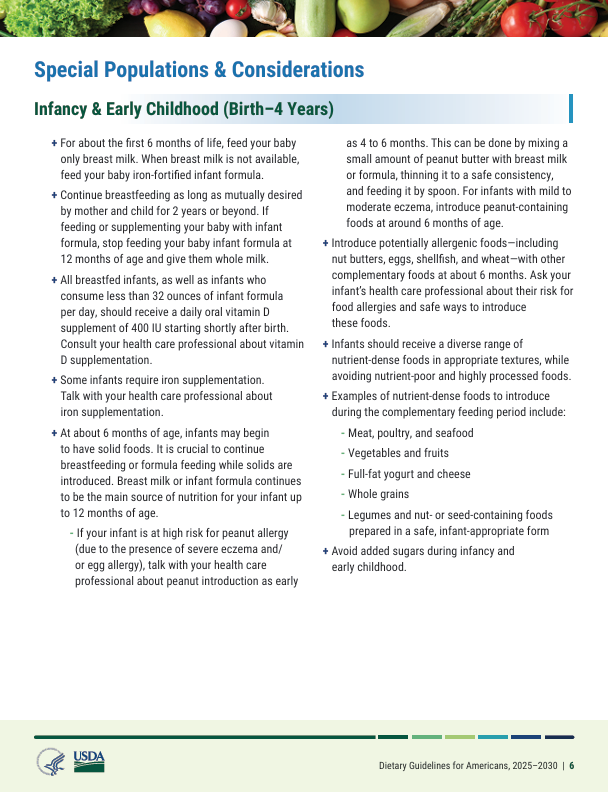
👶 Birth to ~6 months:
– Breast milk is recommended as the primary source of nutrition
– If breast milk is not available, iron-fortified infant formula is recommended
🍼 Breastfeeding and formula:
– Breastfeeding may continue as long as mutually desired by parent and child
– If using formula, transition off formula at 12 months and introduce whole milk
– Breastfed infants and formula-fed infants consuming less than 32 ounces per day should receive 400 IU of vitamin D daily, starting shortly after birth
– Some infants may require iron supplementation; consult a healthcare professional
🍗 Introducing solid foods (~6 months):
– Solid foods may be introduced around 6 months while continuing breast milk or formula
– Breast milk or formula should remain the primary source of nutrition through 12 months
🎯 Allergen introduction:
– Potentially allergenic foods (including peanut, egg, shellfish, and wheat) may be introduced around 6 months
– For infants at high risk of peanut allergy (e.g., severe eczema or egg allergy), peanut may be introduced earlier (4–6 months) under medical guidance
🎯 Food variety:
– Infants should receive a diverse range of nutrient-dense foods in age-appropriate textures
– Examples include:
– Meat, poultry, and seafood
– Vegetables and fruits
– Full-fat yogurt and cheese
– Whole grains
– Legumes and nut- or seed-containing foods prepared safely
🚫 Foods to avoid:
– Added sugars should be avoided during infancy and early childhood
– Highly processed foods are discouraged
6
Dietary guidance by age group:
Introducing food to infants & toddlers:
👧Children may be ready to begin eating solid foods when they can:
– Sit up with or without support
– Control head and neck movements
– Bring objects to their mouth
– Open their mouth when food is offered
– Move food from the front to the back of the tongue and swallow
🎯 Parents are encouraged to offer new foods multiple times; it may take 8–10 exposures before a child accepts a new food
🎯Modeling healthy eating behaviors is encouraged
Middle childhood (ages 5–10)
🍖 Focus on whole, nutrient-dense foods including:
– Protein foods
– Dairy
– Vegetables and fruits
– Healthy fats
– Whole grains
🥛 Full-fat dairy is noted as important for energy needs and brain development
🚫 Avoid caffeinated beverages
🚫No amount of added sugar is recommended
🎯 Cooking meals together is encouraged as part of family routine
Adolescence (ages 11–18)
🎯 Adolescence is a period of rapid growth with increased needs for:
– Energy
– Protein
– Calcium
– Iron (especially for menstruating girls)
🌞 Adequate calcium and vitamin D are emphasized for bone health
🥦 Encourages nutrient-dense foods such as dairy, leafy greens, and iron-rich animal foods
🚫Advises limiting sugary drinks, energy drinks, and highly processed foods
➡️Adolescents are encouraged to participate in food shopping and cooking to build lifelong healthy habits
7
To see the entire guidance workbook, visit: cdn.realfood.gov/DGA.pdf

