The Ice Bath That Might Stop Your Heart Your body doesn't like...

Metabolic Uncle@MetabolicUncle
41 views
Jan 02, 2026
~4 min read
Advertisement
1
The Ice Bath That Might Stop Your Heart
Your body doesn't like receiving contradictory orders.
When you drop into water below 15°C / 59°F, that's exactly what happens. Two ancient survival systems activate simultaneously. One screams "emergency, speed everything up." The other whispers "slow down, conserve what matters." Your heart sits in the middle, trying to obey both.
The result is what researchers call autonomic conflict. Your electrical system misfires. In most people, this resolves quickly. In some, it triggers arrhythmia. In a few, that arrhythmia doesn't stop.
THE DUAL RESPONSE MECHANISM
The cold shock response comes first. Water hits your skin. Receptors fire. Adrenaline floods your system. Your heart rate spikes. Blood vessels constrict. Breathing accelerates. This is your sympathetic nervous system preparing you to fight or run.
But there's a second response happening at the same time. The diving reflex, an evolutionary remnant from our aquatic past. When cold water touches your face, your body assumes you're underwater. Heart rate drops. Blood flow redirects to vital organs. Oxygen conservation mode activates. This is your parasympathetic nervous system preparing you to survive submersion.
Two systems. Opposite commands. Same moment.
Researchers Shattock and Tipton documented this in 2012. They put healthy volunteers in cold water and monitored their hearts. High incidence of arrhythmias. Not occasionally. Consistently. The electrical conflict was measurable and predictable.
Harvard Health published a warning in June 2025. People with heart rhythm abnormalities should avoid cold plunges entirely. Not "be careful with" or "gradually adapt to." Avoid.
THE HIDDEN RISK FACTOR
The problem isn't that cold water is universally dangerous. The problem is that most people don't know if they're in the high-risk group. Atrial fibrillation can be silent. Long QT syndrome often goes undiagnosed until something triggers it. Family history of sudden cardiac death might not seem relevant until it becomes personally relevant.
You might have a rhythm abnormality right now and not know it. No symptoms. No warning signs. Just a heart that works fine until it receives conflicting signals.
The wellness industry sells cold plunges as optimization. The research literature calls them a cardiovascular stressor with modest benefits and real risks. Those are not the same thing.
EXAMINING THE CLAIMED BENEFITS
What about the benefits everyone talks about? Muscle soreness might decrease slightly. Maybe. The evidence is mixed and the effect size is small. Athletic recovery shows some benefit, but contrast baths, alternating hot and cold, work just as well without the autonomic conflict. Mental health improvements are mostly anecdotal. Few controlled trials. Lots of confounding variables.
The benefits are uncertain. The mechanism of risk is well-documented.
Here's what matters. If you've been screened by a cardiologist, have no rhythm abnormalities, no family history of sudden cardiac death, and aren't taking medications that affect heart rate, cold plunges are probably fine. Your autonomic conflict will resolve. Your heart will stabilize.
But if you're doing cold plunges because social media told you it's how serious people optimize their health, you're making a decision based on marketing, not physiology.
WHY THE GUIDANCE DIFFERS FROM HEAT EXPOSURE
Cardiologists don't tell athletes to avoid saunas. Heat stress is predictable. Your body has one clear response. But cold water immersion creates electrical chaos. Two responses fighting each other. That's why the guidance is different.
The current narrative treats cold plunges as a non-negotiable part of peak performance. As if skipping them means you're not committed enough. That's not how cardiovascular risk works. You can't optimize your way out of arrhythmia.
PRACTICAL CONSIDERATIONS
If you want to use cold exposure, know what you're doing. Get screened first. Understand your family history. Know what medications you're taking. Start gradually. Never alone. Pay attention to how your body responds.
But don't confuse a wellness trend with a biological requirement. Your heart doesn't care about your morning routine. It cares about receiving coherent signals. Cold water makes that harder, not easier.
The question isn't whether cold plunges work. The question is whether the modest, uncertain benefits justify a measurable cardiovascular risk. For some people, maybe. For others, definitely not.
The difference is knowing which category you're in before you find out the hard way.
Reference:
Shattock & Tipton (2012) / "Autonomic Conflict" / The foundational research showing cold water immersion induces high incidence of cardiac arrhythmias even in healthy volunteers. PMID: 22547634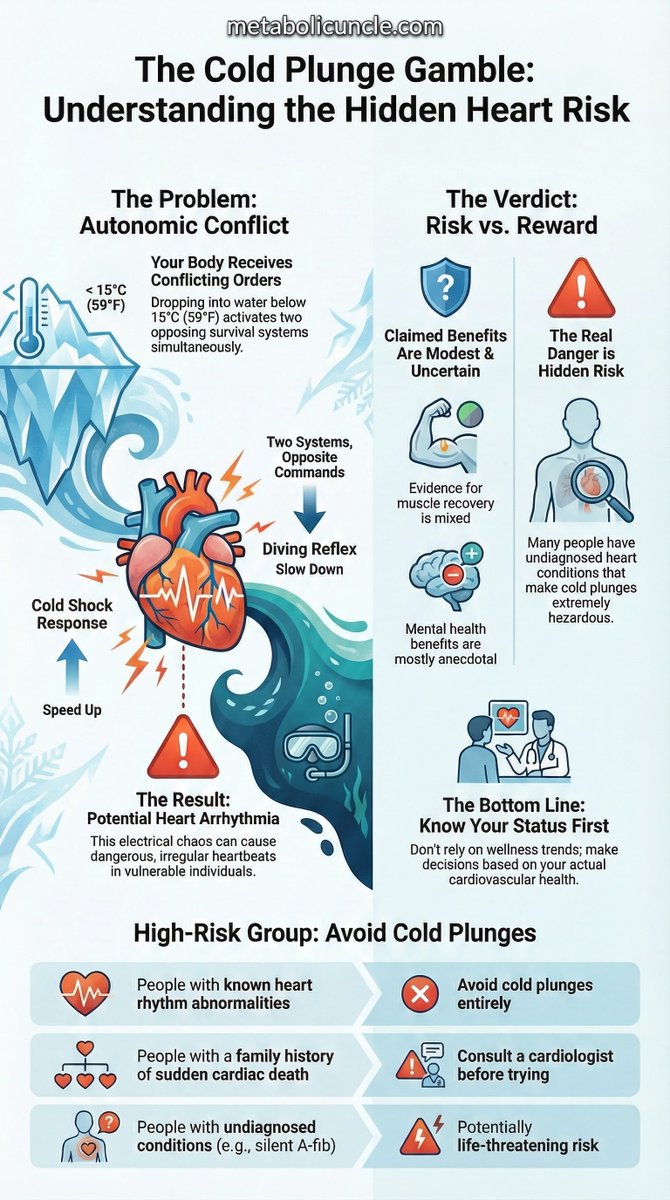
Your body doesn't like receiving contradictory orders.
When you drop into water below 15°C / 59°F, that's exactly what happens. Two ancient survival systems activate simultaneously. One screams "emergency, speed everything up." The other whispers "slow down, conserve what matters." Your heart sits in the middle, trying to obey both.
The result is what researchers call autonomic conflict. Your electrical system misfires. In most people, this resolves quickly. In some, it triggers arrhythmia. In a few, that arrhythmia doesn't stop.
THE DUAL RESPONSE MECHANISM
The cold shock response comes first. Water hits your skin. Receptors fire. Adrenaline floods your system. Your heart rate spikes. Blood vessels constrict. Breathing accelerates. This is your sympathetic nervous system preparing you to fight or run.
But there's a second response happening at the same time. The diving reflex, an evolutionary remnant from our aquatic past. When cold water touches your face, your body assumes you're underwater. Heart rate drops. Blood flow redirects to vital organs. Oxygen conservation mode activates. This is your parasympathetic nervous system preparing you to survive submersion.
Two systems. Opposite commands. Same moment.
Researchers Shattock and Tipton documented this in 2012. They put healthy volunteers in cold water and monitored their hearts. High incidence of arrhythmias. Not occasionally. Consistently. The electrical conflict was measurable and predictable.
Harvard Health published a warning in June 2025. People with heart rhythm abnormalities should avoid cold plunges entirely. Not "be careful with" or "gradually adapt to." Avoid.
THE HIDDEN RISK FACTOR
The problem isn't that cold water is universally dangerous. The problem is that most people don't know if they're in the high-risk group. Atrial fibrillation can be silent. Long QT syndrome often goes undiagnosed until something triggers it. Family history of sudden cardiac death might not seem relevant until it becomes personally relevant.
You might have a rhythm abnormality right now and not know it. No symptoms. No warning signs. Just a heart that works fine until it receives conflicting signals.
The wellness industry sells cold plunges as optimization. The research literature calls them a cardiovascular stressor with modest benefits and real risks. Those are not the same thing.
EXAMINING THE CLAIMED BENEFITS
What about the benefits everyone talks about? Muscle soreness might decrease slightly. Maybe. The evidence is mixed and the effect size is small. Athletic recovery shows some benefit, but contrast baths, alternating hot and cold, work just as well without the autonomic conflict. Mental health improvements are mostly anecdotal. Few controlled trials. Lots of confounding variables.
The benefits are uncertain. The mechanism of risk is well-documented.
Here's what matters. If you've been screened by a cardiologist, have no rhythm abnormalities, no family history of sudden cardiac death, and aren't taking medications that affect heart rate, cold plunges are probably fine. Your autonomic conflict will resolve. Your heart will stabilize.
But if you're doing cold plunges because social media told you it's how serious people optimize their health, you're making a decision based on marketing, not physiology.
WHY THE GUIDANCE DIFFERS FROM HEAT EXPOSURE
Cardiologists don't tell athletes to avoid saunas. Heat stress is predictable. Your body has one clear response. But cold water immersion creates electrical chaos. Two responses fighting each other. That's why the guidance is different.
The current narrative treats cold plunges as a non-negotiable part of peak performance. As if skipping them means you're not committed enough. That's not how cardiovascular risk works. You can't optimize your way out of arrhythmia.
PRACTICAL CONSIDERATIONS
If you want to use cold exposure, know what you're doing. Get screened first. Understand your family history. Know what medications you're taking. Start gradually. Never alone. Pay attention to how your body responds.
But don't confuse a wellness trend with a biological requirement. Your heart doesn't care about your morning routine. It cares about receiving coherent signals. Cold water makes that harder, not easier.
The question isn't whether cold plunges work. The question is whether the modest, uncertain benefits justify a measurable cardiovascular risk. For some people, maybe. For others, definitely not.
The difference is knowing which category you're in before you find out the hard way.
Reference:
Shattock & Tipton (2012) / "Autonomic Conflict" / The foundational research showing cold water immersion induces high incidence of cardiac arrhythmias even in healthy volunteers. PMID: 22547634
2

3


