I think I’ve published the first research article in theoretical...

steve hsu@hsu_steve
17 views
Dec 09, 2025
~2 min read
Advertisement
1
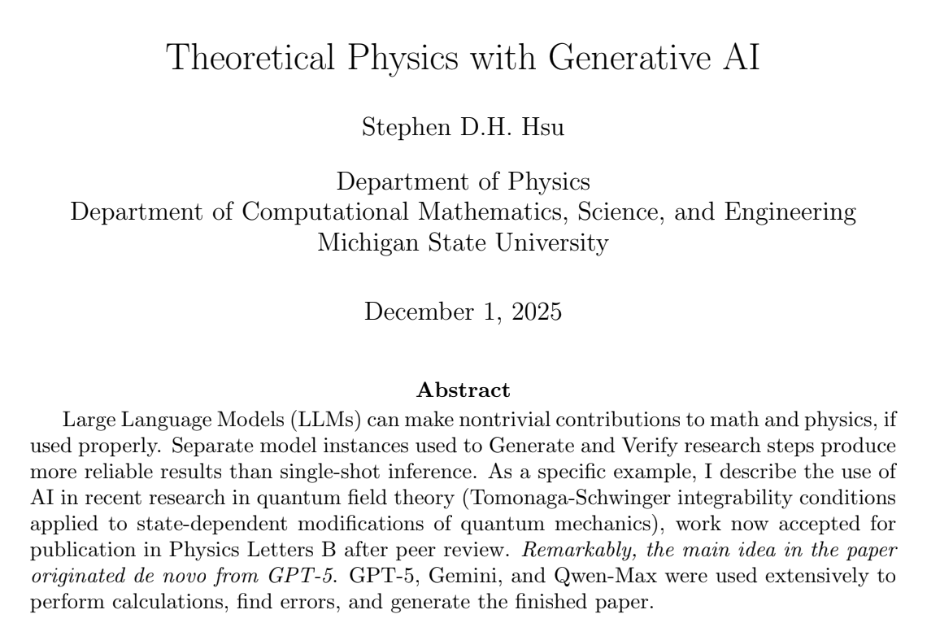
I think I’ve published the first research article in theoretical physics in which the main idea came from an AI - GPT5 in this case. The physics research paper itself (on QFT and state-dependent quantum mechanics) has been published in Physics Letters B.
I've written an accompanying AI paper describing the Generator - Verifier method I used to obtain useful research results from frontier LLMs. It may be of interest to other physicists and to AI researchers.
From the AI paper:
... models sometimes make very simple mistakes (e.g. in calculation) and also even make incorrect conceptual leaps that are superficially plausible. The second type of error can lead even expert researchers astray, consuming large amounts of effort to detect and correct. Research with an LLM might be compared to collaboration with a brilliant but unreliable human genius who is capable of deep insights but also of errors both simple and profound.
Fortunately, both types of errors can be strongly suppressed by using structured orchestration of multiple model instances, greatly improving reliability. A Generate - Verify protocol, in which one model produces a step forward and another model instance independently checks it, reduces hallucination errors significantly compared to single-pass generation. ...
The physics paper (abstract below) derives new operator integrability conditions required for foliation independence (necessary for integrability of quantum field theory; cf Tomonaga-Schwinger) that are very difficult to satisfy in any modifcation of quantum mechanics that is "state dependent" - i.e., deviates from linear Schrodinger evolution.
Whether quantum evolution is EXACTLY linear is one of the most fundamental questions in all of science. It has implications for quantum computing and quantum foundations - i.e., whether we live in an Everettian multiverse!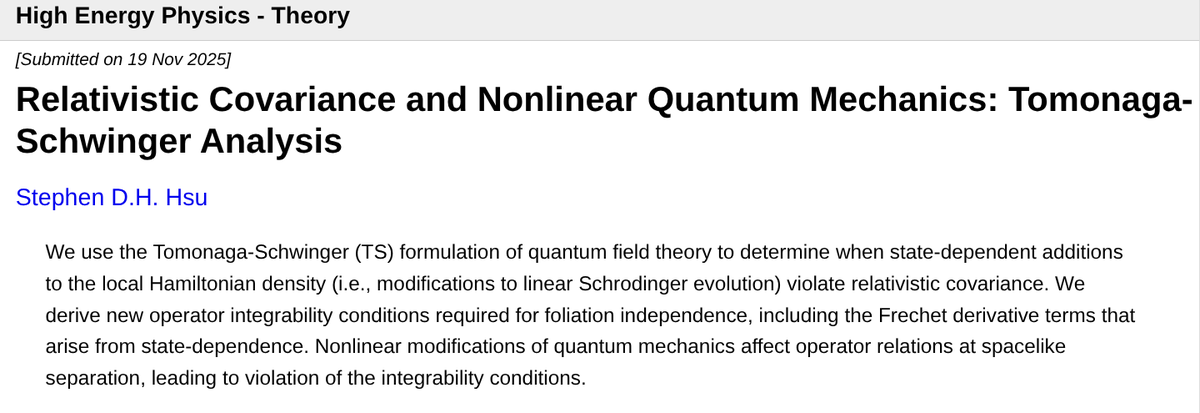
I've written an accompanying AI paper describing the Generator - Verifier method I used to obtain useful research results from frontier LLMs. It may be of interest to other physicists and to AI researchers.
From the AI paper:
... models sometimes make very simple mistakes (e.g. in calculation) and also even make incorrect conceptual leaps that are superficially plausible. The second type of error can lead even expert researchers astray, consuming large amounts of effort to detect and correct. Research with an LLM might be compared to collaboration with a brilliant but unreliable human genius who is capable of deep insights but also of errors both simple and profound.
Fortunately, both types of errors can be strongly suppressed by using structured orchestration of multiple model instances, greatly improving reliability. A Generate - Verify protocol, in which one model produces a step forward and another model instance independently checks it, reduces hallucination errors significantly compared to single-pass generation. ...
The physics paper (abstract below) derives new operator integrability conditions required for foliation independence (necessary for integrability of quantum field theory; cf Tomonaga-Schwinger) that are very difficult to satisfy in any modifcation of quantum mechanics that is "state dependent" - i.e., deviates from linear Schrodinger evolution.
Whether quantum evolution is EXACTLY linear is one of the most fundamental questions in all of science. It has implications for quantum computing and quantum foundations - i.e., whether we live in an Everettian multiverse!
2
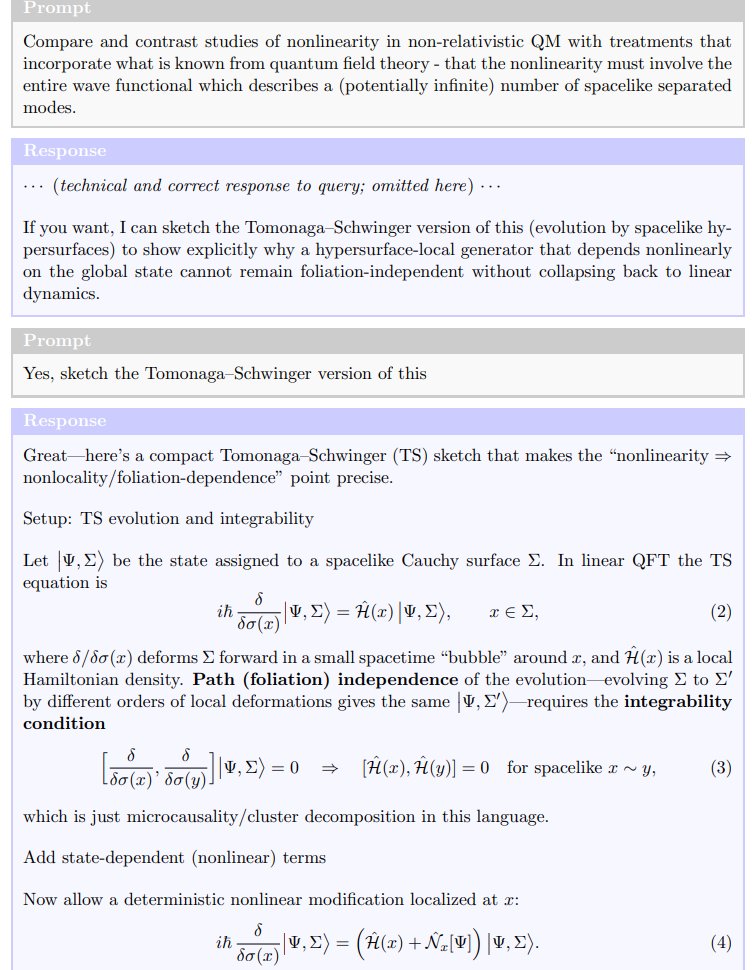
This is the key step in which GPT5 proposes the main idea of the paper, completely de novo:
3
4
These are the arXiv and Physics Letters links for the paper:
arxiv.org/abs/2511.15935
sciencedirect.com/science/articl…
The paper derives new operator integrability conditions required for foliation independence (necessary for integrability of quantum field theory; cf Tomonaga-Schwinger) that are very difficult to satisfy in any modifcation of quantum mechanics that is "state dependent" - i.e., deviates from linear Schrodinger evolution.
Whether quantum evolution is EXACTLY linear is one of the most fundamental questions in all of science. It has implications for quantum computing and quantum foundations - i.e., whether we live in an Everettian multiverse!
