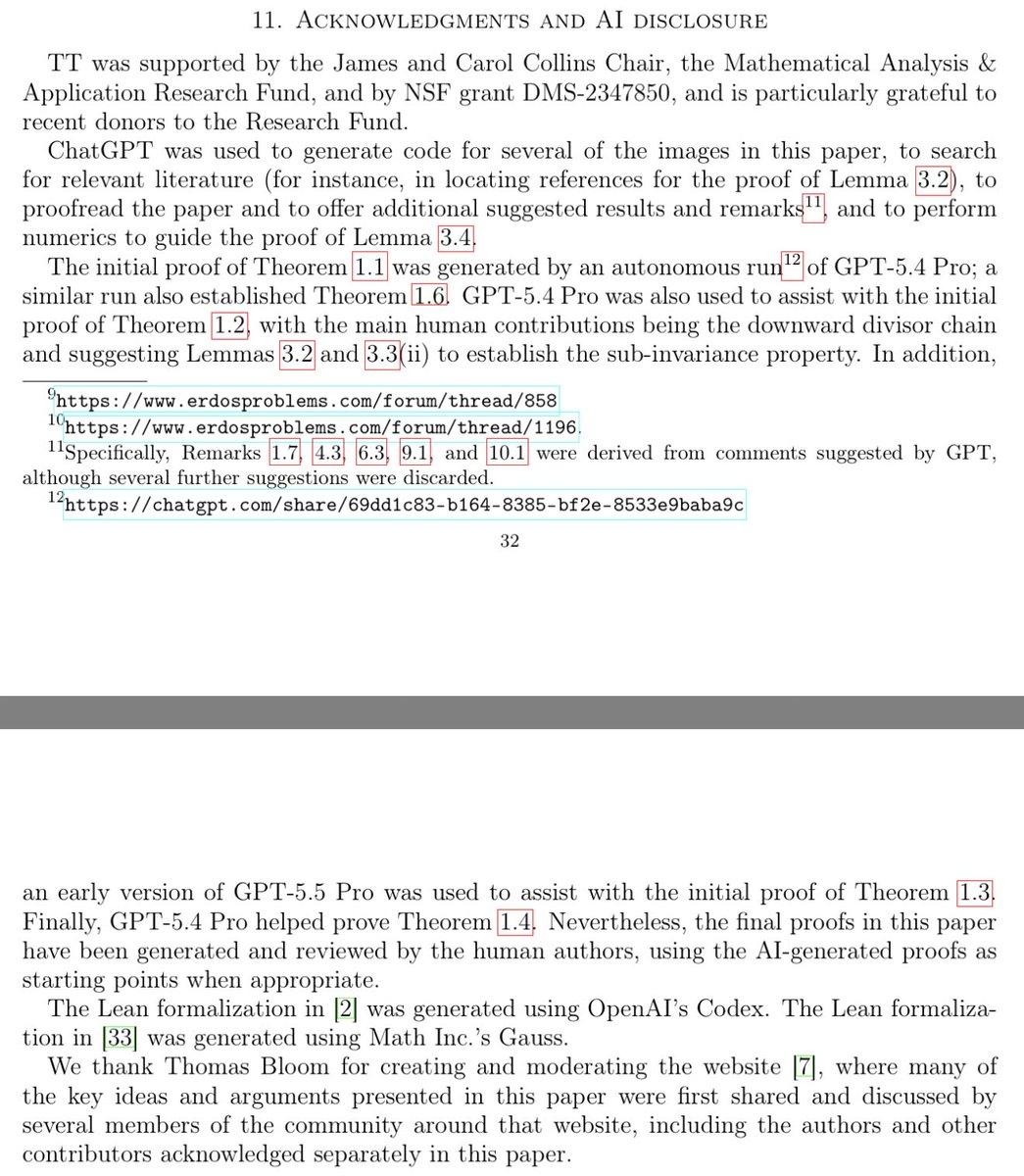
I've been collecting examples of actually useful AI in research...

gavin leech (Non-Reasoning)@gleech
45 views
Dec 01, 2025
~3 min read
Advertisement
1
I've been collecting examples of actually useful AI in research maths:
(I'm not disagreeing with Ege & Daniel's claim, which is carefully phrased as "[novel] concept")


(I'm not disagreeing with Ege & Daniel's claim, which is carefully phrased as "[novel] concept")
Daniel Litt@littmath
This, from @EgeErdil2 on the @dwarkesh_sp podcast, has held up pretty well so far IMO, despite the increasing usefulness of reasoning models for math research.
2
In 2023, Tao used Copilot for one line of the formalisation of Polynomial Freiman-Ruzsa.
"it offered a suggestion which was almost correct"
terrytao.wordpress.com/2023/11/18/for…
"it offered a suggestion which was almost correct"
terrytao.wordpress.com/2023/11/18/for…
3
@robertghrist flow-cut duality from 2024.
an AI conjecture followed by an o1 full proof on the first try (using a prompt iterated on over 6 weeks of wrong AI proofs)

an AI conjecture followed by an o1 full proof on the first try (using a prompt iterated on over 6 weeks of wrong AI proofs)
prof-g@prof_g
it's been a little over a year since i first used an LLM (gpt-o1) to prove a mathematics result that was novel and [to me] interesting. the result is a type of flow-cut duality over directed networks with capacities in a distributive lattice...
---
the conjecture arose in conversations with claude + gpt in august 2024. i then spent about 6 weeks generating wrong proofs using claude, gpt, and gemini, mapping out a "subspace" of bad proofs. i knew the conjecture was true since my students (j. gould and m. lopez) proved it using birkhoff's representation theorem. i was careful not to ever "leak" the independent proof to any AIs i used...
---
then, just a little over a year ago, gpt-01 came out and 1-shotted the proof, using an elegant approach that was better than birkhoff...
---
it's nice to see others also finding that current models (which are **so** much stronger) can likewise solve some minor mathematics conjectures.
---
the conjecture arose in conversations with claude + gpt in august 2024. i then spent about 6 weeks generating wrong proofs using claude, gpt, and gemini, mapping out a "subspace" of bad proofs. i knew the conjecture was true since my students (j. gould and m. lopez) proved it using birkhoff's representation theorem. i was careful not to ever "leak" the independent proof to any AIs i used...
---
then, just a little over a year ago, gpt-01 came out and 1-shotted the proof, using an elegant approach that was better than birkhoff...
---
it's nice to see others also finding that current models (which are **so** much stronger) can likewise solve some minor mathematics conjectures.
4
GPT-5T saved Aaronson a week or two on limits of black-box amplification in QMA.
'anyone engaged in mathematical research knows that an AI that can “merely” fill in the insights that “should’ve been” obvious to you is a really huge freaking deal!'
scottaaronson.blog/?p=9183
'anyone engaged in mathematical research knows that an AI that can “merely” fill in the insights that “should’ve been” obvious to you is a really huge freaking deal!'
scottaaronson.blog/?p=9183
5
What about the splashy Gauss autoformalisation?
A very nontrivial result (1000 lemmas, 25 KLOC).
Many hundreds of hours of human effort, so call this a Tao-Lichtman result with crucial help from the AI.
(And but formalisation isn't mostly concepts)
A very nontrivial result (1000 lemmas, 25 KLOC).
Many hundreds of hours of human effort, so call this a Tao-Lichtman result with crucial help from the AI.
(And but formalisation isn't mostly concepts)
Daniel Litt@littmath
Very cool, but I think it’s worth clarifying:
(1) it seems that the work here relies on 18 months of work by human mathematicians—it’s not independent, and
(2) if I understand correctly what was done here, I don’t think it’s accurate to describe it as “autonomous.”
(1) it seems that the work here relies on 18 months of work by human mathematicians—it’s not independent, and
(2) if I understand correctly what was done here, I don’t think it’s accurate to describe it as “autonomous.”
6
What of the big Deepmind search systems? (Not LLMs, or not centrally.) As @wtgowers notes, it's mostly just improving bounds.
FunSearch (cap set problem n=8)
nature.com/articles/s4158…

FunSearch (cap set problem n=8)
nature.com/articles/s4158…
Timothy Gowers @wtgowers@wtgowers
This sort of thing is interesting and nice, but calling it “new theorems” is slightly misleading when we’re talking about improved bounds discovered through a big search.
7
The unstable singularities in fluid dynamics stuff was just (very cool, unprecedently precise) numerics
arxiv.org/pdf/2509.14185
arxiv.org/pdf/2509.14185
8
Rybin's fast outer product algorithm was found through RL-guided search (not LLMs)
arxiv.org/abs/2505.09814
arxiv.org/abs/2505.09814
9
There will of course be dozens of successful "shadow prompts" where the mathematicians don't credit it.
10

Paata Ivanisvili@PI010101
GPT-5 Pro found a counterexample to the NICD-with-erasures majority optimality (Simons list, p.25).
simons.berkeley.edu/sites/default/…
At p=0.4, n=5, f(x) = sign(x_1-3x_2+x_3-x_4+3x_5) gives E|f(x)|=0.43024 vs best majority 0.42904.
simons.berkeley.edu/sites/default/…
At p=0.4, n=5, f(x) = sign(x_1-3x_2+x_3-x_4+3x_5) gives E|f(x)|=0.43024 vs best majority 0.42904.


11

Bartosz Naskręcki@nasqret
I have managed to orchestrate GPT 5 pro to prove a group presentation problem. The solution is much more elegant than the one I did myself a while ago. This was never publicly documented so the model did all by itself and I only was redirecting its outputs to rewrite the paper.
x.com/nasqret/status…
x.com/nasqret/status…
13
12 hours of prompting. 80% error rate, but still usable.

Ernest Ryu@ErnestRyu
ChatGPT's contribution:
- Producing the final proof argument.
- Significantly accelerating my (or our) exploration of the many dead-end arguments, rapidly ruling out approaches that did not work.
(10/N)
- Producing the final proof argument.
- Significantly accelerating my (or our) exploration of the many dead-end arguments, rapidly ruling out approaches that did not work.
(10/N)
14
minor example (1 hour saved), added here because it is the first time Tim Gowers was notably assisted
Timothy Gowers @wtgowers@wtgowers
the time it would have taken me would probably have been of order of magnitude an hour (an estimate that comes with quite wide error bars). So it looks as though we have entered the brief but enjoyable era where our research is greatly sped up by AI but AI still needs us. 3/3
15
A gang of Google models attempt 67 solved and unsolved problems, aided by Terry Tao. As in past work they "just" involve improving bounds, mostly finite special cases (though not always!).
Also solved IMO2025 P6 (but couldn't prove that it was optimal).
terrytao.wordpress.com/2025/11/05/mat…
Also solved IMO2025 P6 (but couldn't prove that it was optimal).
terrytao.wordpress.com/2025/11/05/mat…
16
Sawhney and GPT-5 Pro prove Erdős #848 for the first time.
We have the full session so I can tell you that Sawhney provided 1849 tokens plus (mid-session) a two-page summary with a bunch of errors removed (probably another 1000). Human compaction.
chatgpt.com/share/68ec50da…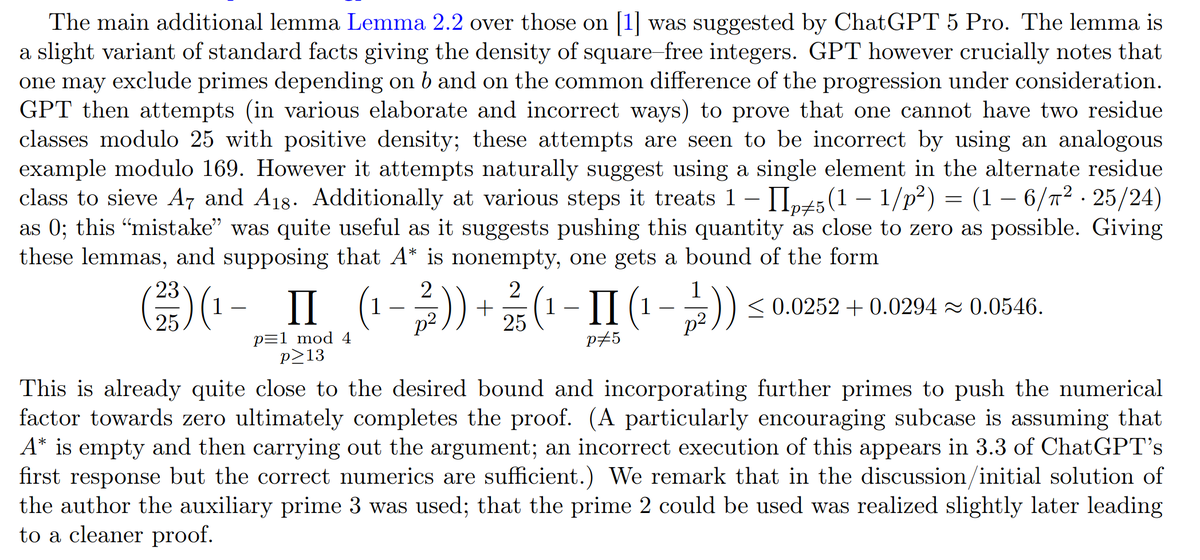
We have the full session so I can tell you that Sawhney provided 1849 tokens plus (mid-session) a two-page summary with a bunch of errors removed (probably another 1000). Human compaction.
chatgpt.com/share/68ec50da…
17
Interesting despite being a rediscovery: Erdős #707
"the Lean community were able to verify the proof within 30mins of learning of the announcement"
"no LLM could find Hall’s [1947] result, even with substantial prompting that the result indeed exists"
borisalexeev.com/pdf/erdos707.p…
"the Lean community were able to verify the proof within 30mins of learning of the announcement"
"no LLM could find Hall’s [1947] result, even with substantial prompting that the result indeed exists"
borisalexeev.com/pdf/erdos707.p…
18
Erdős #367 solved and formalised in ~two days. Van Doorn again did the whole strategy and half the proof; Gemini gave the other half (in an overelaborate way which Tao simplified); Alexeev and Harmonic then formalised it.
mathstodon.xyz/@tao/115591487…
mathstodon.xyz/@tao/115591487…
19
Group theory puzzle (from Machinarium) solved by GPT-5-Pro and formalised overnight by the Harmonic prover. The result was automatically refined with only a little nudging and cleanup by Bartosz.


Bartosz Naskręcki@nasqret
I have personally crossed a line, and I am a bit in awe.
This is my first fully automated, LLM-generated and auto-formalized proof of a new mathematical theorem.
Let me set up the problem: we have three rotating circles with six positions each, all three intersecting in a total of six points.
Prove that the group of motions they generate is the full symmetric group S_{12}.
This is a problem I originally noticed in a lovely puzzle in the game Machinarium by Amanita Design.
The task is not extremely hard, but it apparently has two proofs:
1. A brute-force search over conjugacy classes to represent all transpositions (I did this many years ago but never published it).
2. An LLM-generated proof (in this case produced about three months ago by GPT-5-Pro), or actually two proofs, both using in a brilliant way a theorem of Jordan about primitive groups (or a closely related variant that is even more direct). (github.com/nasqret/12puzz…)
What I was missing until tonight was a tool to auto-formalize this proof.
Thanks to @HarmonicMath , I gained access to their remarkable software, Aristotle. In summary, here is what I did:
A. Auto-generated the proof with an LLM (and ran it multiple times to obtain a much improved version).
B. Trimmed the proof to the bare mathematical text—definitions, propositions, lemmas, theorems—with proofs supplied by the LLM.
C. Ran the Aristotle system overnight (via API). This morning I received a fully formalized version in Lean (about 700 lines of code).
The code compiles, so I now have a certificate confirming that the LLM-generated proof indeed led to a correct solution. Moreover, I got a conceptual proof, better than my own brute-force. I am planning to push it further to more broad class of such algebra problems.
It is a small project, but for me personally it marks a milestone. I now have tools which, with my orchestration, can genuinely help me discover, formalize, and study proofs of mathematical theorems. This is non-trivial.
Questions:
1. How will this scale in the future?
2. How much training will be necessary to be successful on such tasks?
3. How should we treat authorship of such proofs?
4. What is the deeper role of mathematicians?
20
The impressive part here is Physical Letters having a one month review cycle

steve hsu@hsu_steve
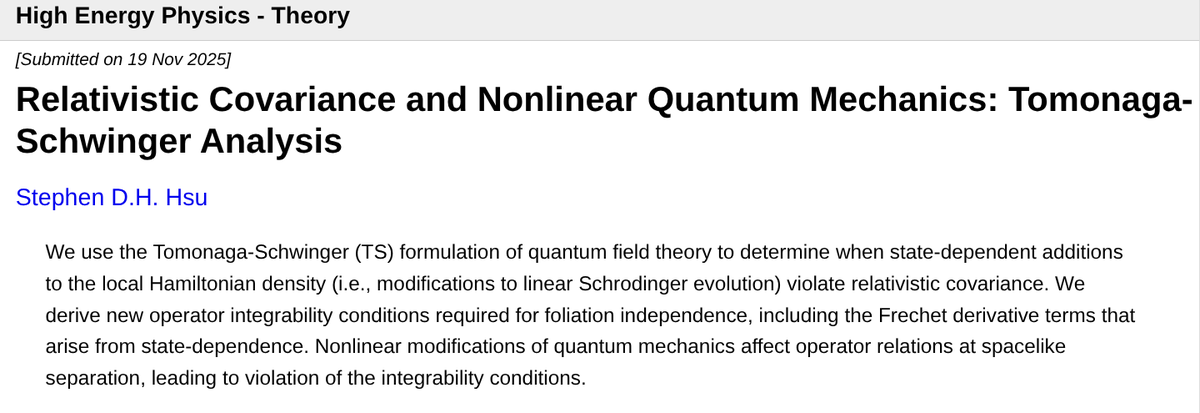
I think I’ve published the first research article in theoretical physics in which the main idea came from an AI - GPT5 in this case. The physics research paper itself (on QFT and state-dependent quantum mechanics) has been published in Physics Letters B.
I've written an accompanying AI paper describing the Generator - Verifier method I used to obtain useful research results from frontier LLMs. It may be of interest to other physicists and to AI researchers.
From the AI paper:
... models sometimes make very simple mistakes (e.g. in calculation) and also even make incorrect conceptual leaps that are superficially plausible. The second type of error can lead even expert researchers astray, consuming large amounts of effort to detect and correct. Research with an LLM might be compared to collaboration with a brilliant but unreliable human genius who is capable of deep insights but also of errors both simple and profound.
Fortunately, both types of errors can be strongly suppressed by using structured orchestration of multiple model instances, greatly improving reliability. A Generate - Verify protocol, in which one model produces a step forward and another model instance independently checks it, reduces hallucination errors significantly compared to single-pass generation. ...
The physics paper (abstract below) derives new operator integrability conditions required for foliation independence (necessary for integrability of quantum field theory; cf Tomonaga-Schwinger) that are very difficult to satisfy in any modifcation of quantum mechanics that is "state dependent" - i.e., deviates from linear Schrodinger evolution.
Whether quantum evolution is EXACTLY linear is one of the most fundamental questions in all of science. It has implications for quantum computing and quantum foundations - i.e., whether we live in an Everettian multiverse!
21

Alex Kontorovich@AlexKontorovich
This is wild! Johannes Schmitt used GPT5 to solve his own open problem on intersection numbers on moduli spaces of curves (the proof turns out to be unexpectedly simple, "low hanging fruit"). He wrote up the paper, being careful to point out which *entire paragraphs* were written by a human vs AI. Will this become the future protocol?..


22
Tao enumerates all AI results so far. So far not a single green result on any open problem
github.com/teorth/erdospr…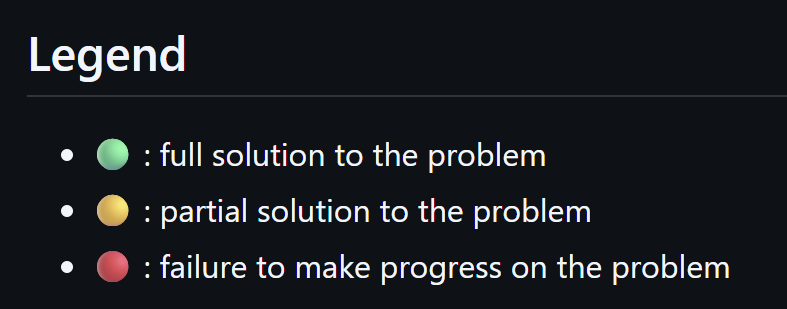
github.com/teorth/erdospr…
23
5.2 + Aristotle give an incrementally new proof for Erdos 728. Tao is inclined to give this the first green sticker even given the similarity to Pomerance 2014 (but watch this space).
erdosproblems.com/forum/thread/7…
erdosproblems.com/forum/thread/7…
24
A new Gemini finetune, "FullProof", helps prove something about the Grothendieck group. Strong contribution, but I find the pictured line ("that close") to be faint praise
arxiv.org/pdf/2601.07222

arxiv.org/pdf/2601.07222
25
Erdős #281 solved by GPT-5.2 with 42mins of inference. Zero human touches, apparently novel.
22 hours later, user KoishiChan points out that the (1980) problem was solved in ~1936 (by an incredibly short method quite different from the AI proof) and collapses
22 hours later, user KoishiChan points out that the (1980) problem was solved in ~1936 (by an incredibly short method quite different from the AI proof) and collapses
26
Cool paper under a layer of PR grease
Abstract: "We address 13 problems marked 'Open' in the database: 5 through seemingly novel autonomous solution"
Body: "Problems autonomously solved by AI (2)"
Barreto: the given proof of #1051 needed a human fix*
arxiv.org/abs/2601.22401…
Abstract: "We address 13 problems marked 'Open' in the database: 5 through seemingly novel autonomous solution"
Body: "Problems autonomously solved by AI (2)"
Barreto: the given proof of #1051 needed a human fix*
arxiv.org/abs/2601.22401…
27

Dmitry Rybin@DmitryRybin1
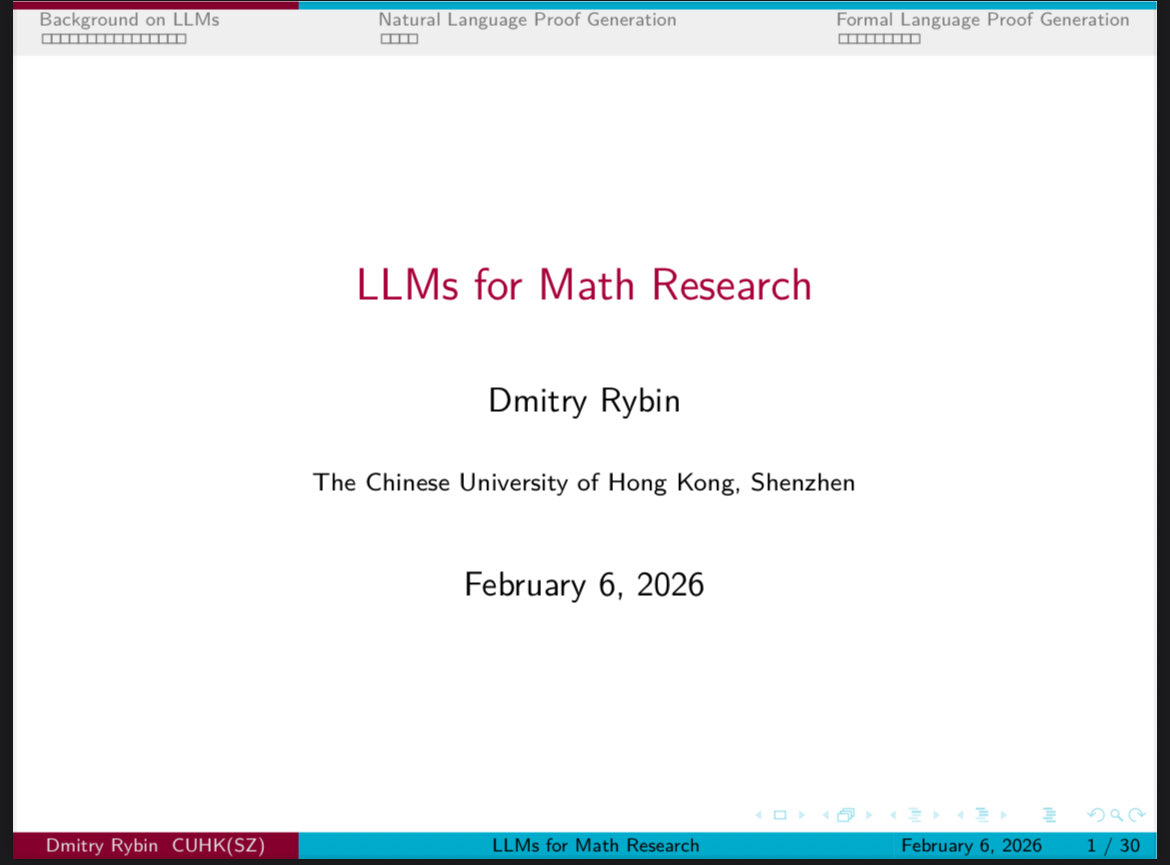
Recently I gave a talk on LLMs for Math Research (mostly to an audience of pure and applied mathematicians)
I tried to compile the latest progress in one presentation
pdf and video recording: drive.google.com/drive/folders/…
I tried to compile the latest progress in one presentation
pdf and video recording: drive.google.com/drive/folders/…


29

Yang Liu@yangpliu
The proof’s main ideas are essentially from arXiv:0808.0163 and arXiv:0911.1114. For those in this area, these are the obvious references, so I wouldn’t call this solution “new ideas”—it’s an impressive synthesis of existing work.
30
Daniel Litt@littmath
No need to amplify further, OAI confirms it’s “likely incorrect.”
31
I haven't been following this area lately so don't take this gap as indicative.
Another 5 Erdos solves via the Alexeev gang, 4 "unassisted by humans"
arxiv.org/abs/2604.06609
Another 5 Erdos solves via the Alexeev gang, 4 "unassisted by humans"
arxiv.org/abs/2604.06609
32
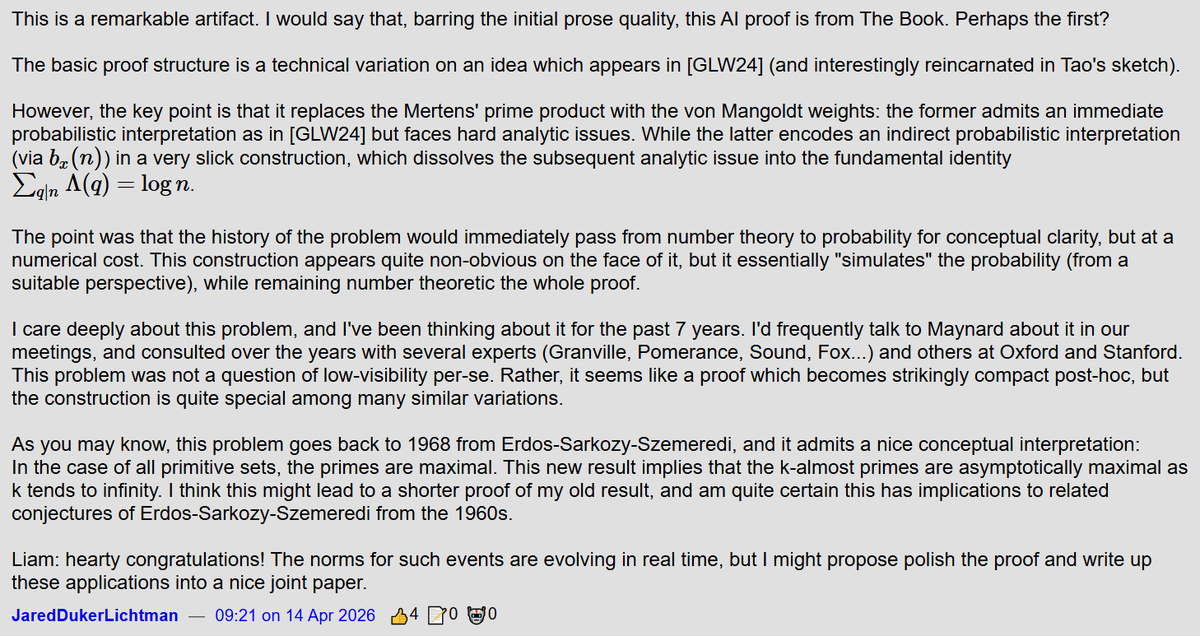
We're up to 4 true AI Erdos solves (green), two in January and two in March. Too early to say if current models have hit their limit yet; I doubt they have
github.com/teorth/erdospr…
github.com/teorth/erdospr…
33

34

Acer@AcerFur
@drdomicile @Liam06972452 it’s moreso the former but it does have some vibes of the latter in that this Markov chain technique hasn’t really been applied in this specific context before, and can likely be applied to very similar problems
35
a transient golden age

Alex Kontorovich@AlexKontorovich
None of this is new. In my Big Proof lecture at the Newton Institute @NewtonInstitute about a year ago, I quoted Tim Gowers, from a quarter century before that:
"such a golden age, if it occurs, is unlikely to last for long. The next stage might be one where only a very few outstanding mathematicians could discover proofs that were inaccessible to computers. Perhaps others would concentrate on teaching... In the end, the work of the mathematician would be simply to learn how to use theorem-proving machines effectively and to find interesting applications for them. This would be a valuable skill, but it would hardly be pure mathematics as we know it today."
"such a golden age, if it occurs, is unlikely to last for long. The next stage might be one where only a very few outstanding mathematicians could discover proofs that were inaccessible to computers. Perhaps others would concentrate on teaching... In the end, the work of the mathematician would be simply to learn how to use theorem-proving machines effectively and to find interesting applications for them. This would be a valuable skill, but it would hardly be pure mathematics as we know it today."
36
Acer@AcerFur
Super grateful and proud of everyone who worked on this paper. Check out how much GPT contributed to this work!