I spent the past year building AI for robots at Tesla Optimus and...

anandmaj@Almondgodd
31 views
Nov 15, 2025
~3 min read
Advertisement
1
I spent the past year building AI for robots at Tesla Optimus and Dyna
Now I'm introducing ANDROID DREAMS: an essay of my predictions for the next 20 years of robotics, inspired by Situational Awareness and AI2027.
I predict EGI by 2031 and more robots than humans by 2045👇🏼
Now I'm introducing ANDROID DREAMS: an essay of my predictions for the next 20 years of robotics, inspired by Situational Awareness and AI2027.
I predict EGI by 2031 and more robots than humans by 2045👇🏼
0:24
2
Read the full version below:
android-dreams.ai
I predict how embodied general intelligence (EGI) will be created, and on the way, how the US will out-manufacture China, endure political upheaval, and produce more robots than humans.
(While I used to work at Dyna and Tesla Optimus, all predictions are based on publicly available information)
Android Dreams unfolds in 5 eras, from 2023 to 2045.
3
Dawn Era, 2023-2025
LLMs prove scaling works, and many new robotics companies raise $400M rounds to create an "LLM for robots".
It fails in pretraining because there’s no internet of robot data. RL also fails because the real world is too slow for robots to learn from many interactions.
Across the Pacific, Xi's shadow grows. China is manufacturing at 10x the capacity of the US and 2.2x the energy production, and growing.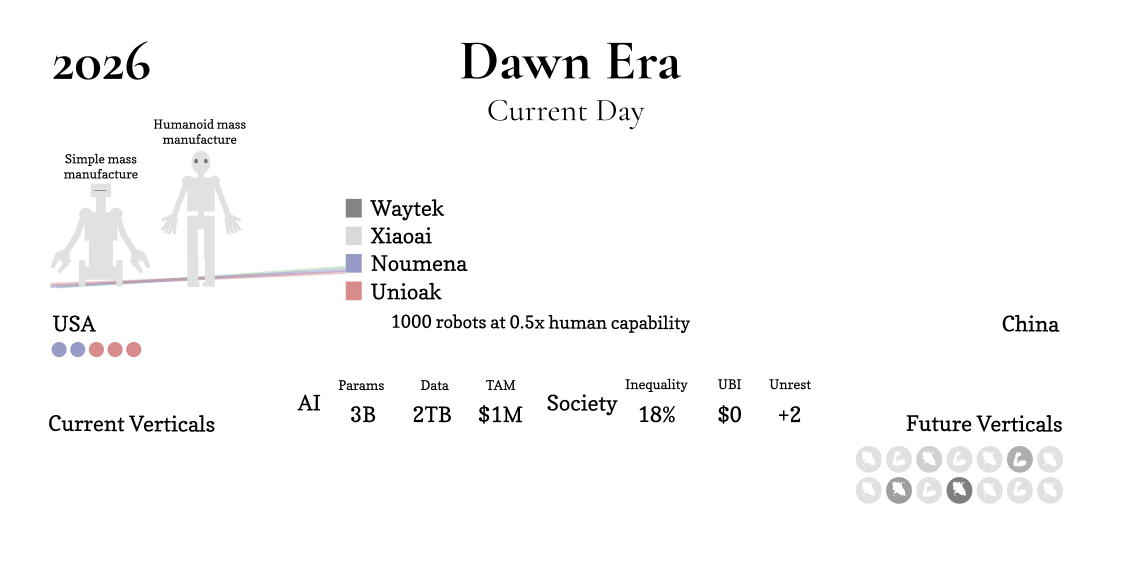
LLMs prove scaling works, and many new robotics companies raise $400M rounds to create an "LLM for robots".
It fails in pretraining because there’s no internet of robot data. RL also fails because the real world is too slow for robots to learn from many interactions.
Across the Pacific, Xi's shadow grows. China is manufacturing at 10x the capacity of the US and 2.2x the energy production, and growing.
4
Vertical Era, 2026-2032
A new robotics company, Waytek, uses teleoperation on easy tasks to gather volumes of single-task data, train models, automate simple jobs, and make money in the millions.
Many Waytek clones scale using the same formula, which is constrained to simple, repetitive tasks.
China is the real winner because its supply chains develop rapidly (vertical robotics companies all use Chinese hardware).
The US now realizes that winning robotics is a national security issue, because robots have backdoors.
Through years of integration, Waytek wins billion-dollar task domains without any EGI.
5
Humanoid Era, 2028-2037
Humanoid companies like Noumena scale to difficult tasks like manufacturing and construction using learning from human videos. Their models improve using RL in world models and across deployed robots.
Humanoids can now automate their own manufacturing process. A slow but sure self-reinforcing exponential manufacturing curve starts.
America’s chance to win is now to automate and subsidize actuator manufacturing. Then the US automates every other production layer: mining, mineral processing, machining, and assembly.
China has the same strategy.
Societal unrest grows in the US as AI displaces jobs.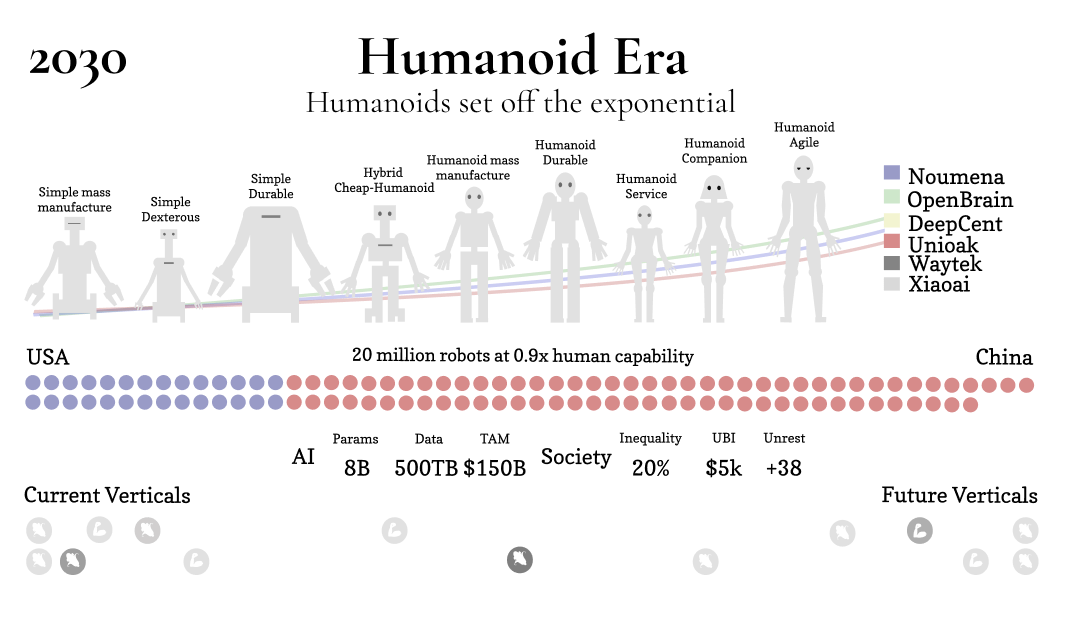
Humanoid companies like Noumena scale to difficult tasks like manufacturing and construction using learning from human videos. Their models improve using RL in world models and across deployed robots.
Humanoids can now automate their own manufacturing process. A slow but sure self-reinforcing exponential manufacturing curve starts.
America’s chance to win is now to automate and subsidize actuator manufacturing. Then the US automates every other production layer: mining, mineral processing, machining, and assembly.
China has the same strategy.
Societal unrest grows in the US as AI displaces jobs.
6
General Intelligence Era, 2030-2045
AI Lab researchers solve adaptive long-term memory, the last bottleneck to virtual AGI.
Then, they unlock internet-scale data for robotics through post-training from foundation video models, the last bottleneck to Embodied General Intelligence. By predicting videos including humans, video models already contain generalizable action models.
Paired with a humanoid company for hardware, labs scale EGI to all industries.
China continues to scale low-cost manufacturing, but America uses its EGI advantage to produce more humanoid units. Geopolitical tensions continue, but don’t accelerate: each side has much to lose and is tightly intertwined.
There are now classes of robots, from inexpensive wheeled robots doing repetitive tasks, to high-quality human-looking androids for service and companionship, to ultra-engineered F1 humanoids for sport combat.
Political unrest is at an all-time high, and the stakes for resource allocation have never been higher. Society is unequal, but everyone has enough resources to live well.
7
Superintelligence Era, 2045+
AI continuously improves by learning from interactions with the real world. Humans still work in domains where humanness matters, like healthcare, education, resource allocation, and the arts.
Humans live more diverse lives.
Many new ideologies form, including a return to the natural state of man (Naturalism), movements to delete AI (Butlerianism), and pursuits of pleasure (Hedonism), beauty (Hyper-Aesthetism), status (Husk-Elitism), and self-ascendancy (Homotranscendism).
Humanity now asks the right questions and explores the answers.
8
Read the full version below:
android-dreams.ai
Inspired by Daniel Kokatajlo et al, AI 2027 and Leopold Aschenbrenner, Situational Awareness
Thank you to Adam Majmudar, Ahalya Nava, and Sourish Jasti for their feedback
android-dreams.ai
Inspired by Daniel Kokatajlo et al, AI 2027 and Leopold Aschenbrenner, Situational Awareness
Thank you to Adam Majmudar, Ahalya Nava, and Sourish Jasti for their feedback
