I started my X account 46 weeks ago. Easiest algorithm to crack by...

Alex Groberman@alexgroberman
25 views
Oct 26, 2025
~3 min read
Advertisement
1
I started my X account 46 weeks ago. Easiest algorithm to crack by a country mile.
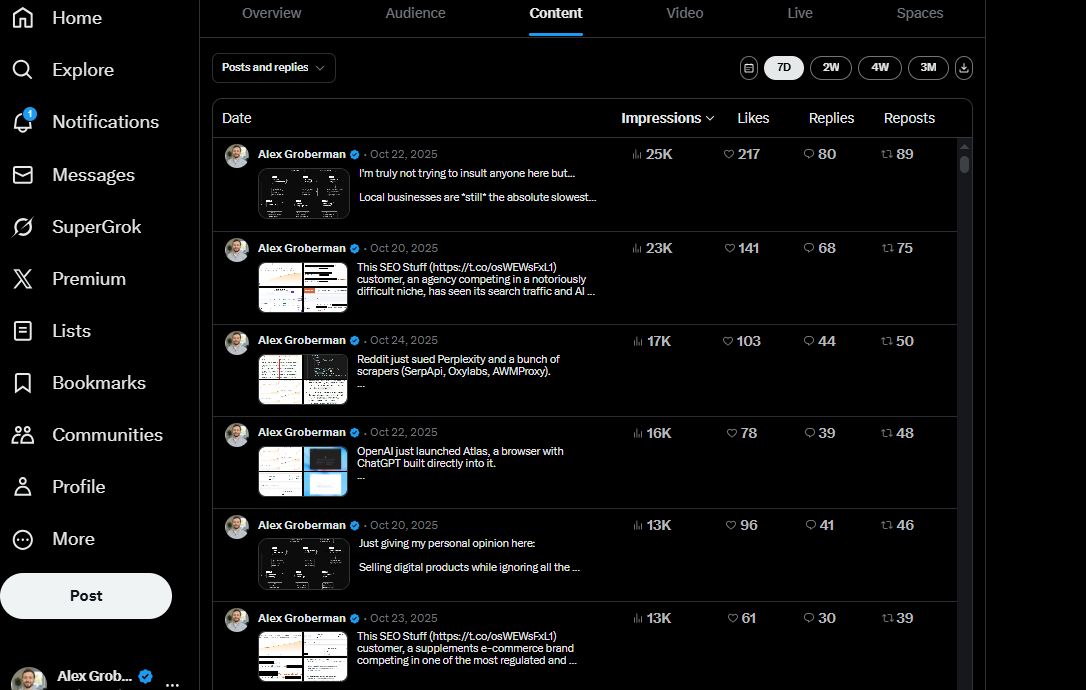
Since then I’ve collected $115,000 in direct revenue, logged 10M impressions, and this month drove ~$17,000 to SEO Stuff.
Use my system now before every loophole closes.
And if you want the full cheat sheet including details about engagement groups, DM workflows, and posting tactics:
Follow me
Repost this
Comment “X growth guide 2025”
You must do all three to get the DM.
Alright, let's start with posting routine.
I post 2-3 times per day, 7 days per week.
Morning: Proof post or strong POV tweet
Afternoon: Mini-thread (3-5 tweets with screenshots or frameworks)
Evening: Repost with CTA or quick observation to spark replies
If I stop for 48 hours, reach drops a lot.
When I travel or miss days I feel it immediately.
What's working at the moment content-wise:
Compact proof threads (3-6 tweets): Visual, outcome-oriented, actionable.
Threads over 8 tweets tend to plateau unless every line delivers.
Multi-image posts (2-4 slides): First slide = bold headline; middle slides = framework/teardown/example; last slide = CTA.
Proof-first content: Dashboard screenshots, client outcomes, metrics + narrative.
Copy-paste frameworks: Templates, prompts, SOPs your audience can use immediately.
Timely commentary + receipts: When major shifts in the niche or platform happen respond quickly with your take or data.
(These posts often hold visibility longer.)
Reposting top performers: After ~2-3 weeks re-share your best posts with a fresh hook. Many perform again or even better.
No one cares that it's a repeat, by the way.
What’s underperforming:
One-liner takes with no evidence or insight
Long threads (>8 tweets) that meander
AI-generated content with no personality or case study
Frameworks reused without showing how you actually executed them
Engagement strategy:
Reply early on high-visibility posts in your niche (within the first hour) with proof, context or counterpoints
Quote tweet daily with your opinion or a teardown
Repost your strongest replies so your broader audience sees them
Using a small creator circle (5-10 peers) to engage during your first 15-30 minutes of posting
Focus on comment thread depth: Posts that spark replies and replies among commenters stay visible longer
According to published signals, the algorithm on X rewards relevance, recency, and meaningful interaction so this checks out.
DM and conversation flow:
Track who engages with your posts (likes, replies, follows)
DM them something useful (template, swipe, quick framework)
If they respond, open a loop: “Want the rest of this system?”
If yes, deliver the offer (SEO Stuff, consulting, growth playbook)
Lead with value and delay the pitch.
The funnel that matters: Profile to Follow to DM to Client
Optimize:
Bio = clear, benefit-first
Pinned tweet = proof + offer
Rotate pinned tweet every 2 weeks based on click-through rate and DM volume
Reply to every DM with real value
Key analytics:
Link clicks per post
New followers gained per post
DM replies per outreach
Depth of comment threads and number of repeat engagers
Impressions look good but real growth is in clicks, replies and conversations.
30-day playbook:
Post 2-3 times per day with at least one proof-driven post
Reply to 5+ posts/day in your vertical
Quote tweet 1-2 times/day with your POV
Repost your best posts every 2-3 weeks
DM 10+ new engagers each week with value-first outreach
Track clicks, replies, conversions, and comment depth weekly
Continuously test hooks, visuals, and formats
Run this system for 30 days, screenshot Day 31 and tag me when the inbound starts.
And if you want my full cheat sheet (engagement groups, DM workflows, posting tactics):
Follow me
Repost this
and comment “X growth guide 2025”
You must do all three for the DM.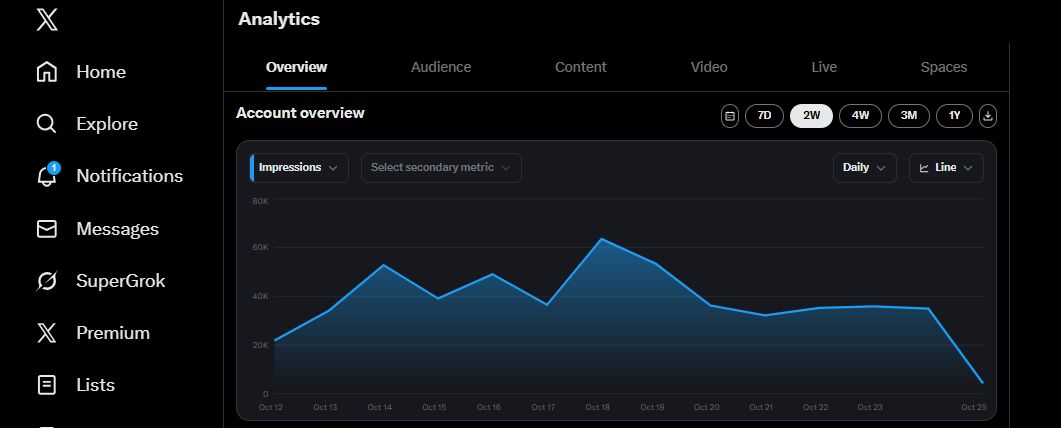

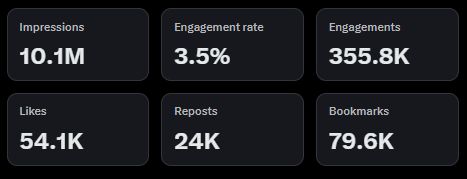
Since then I’ve collected $115,000 in direct revenue, logged 10M impressions, and this month drove ~$17,000 to SEO Stuff.
Use my system now before every loophole closes.
And if you want the full cheat sheet including details about engagement groups, DM workflows, and posting tactics:
Follow me
Repost this
Comment “X growth guide 2025”
You must do all three to get the DM.
Alright, let's start with posting routine.
I post 2-3 times per day, 7 days per week.
Morning: Proof post or strong POV tweet
Afternoon: Mini-thread (3-5 tweets with screenshots or frameworks)
Evening: Repost with CTA or quick observation to spark replies
If I stop for 48 hours, reach drops a lot.
When I travel or miss days I feel it immediately.
What's working at the moment content-wise:
Compact proof threads (3-6 tweets): Visual, outcome-oriented, actionable.
Threads over 8 tweets tend to plateau unless every line delivers.
Multi-image posts (2-4 slides): First slide = bold headline; middle slides = framework/teardown/example; last slide = CTA.
Proof-first content: Dashboard screenshots, client outcomes, metrics + narrative.
Copy-paste frameworks: Templates, prompts, SOPs your audience can use immediately.
Timely commentary + receipts: When major shifts in the niche or platform happen respond quickly with your take or data.
(These posts often hold visibility longer.)
Reposting top performers: After ~2-3 weeks re-share your best posts with a fresh hook. Many perform again or even better.
No one cares that it's a repeat, by the way.
What’s underperforming:
One-liner takes with no evidence or insight
Long threads (>8 tweets) that meander
AI-generated content with no personality or case study
Frameworks reused without showing how you actually executed them
Engagement strategy:
Reply early on high-visibility posts in your niche (within the first hour) with proof, context or counterpoints
Quote tweet daily with your opinion or a teardown
Repost your strongest replies so your broader audience sees them
Using a small creator circle (5-10 peers) to engage during your first 15-30 minutes of posting
Focus on comment thread depth: Posts that spark replies and replies among commenters stay visible longer
According to published signals, the algorithm on X rewards relevance, recency, and meaningful interaction so this checks out.
DM and conversation flow:
Track who engages with your posts (likes, replies, follows)
DM them something useful (template, swipe, quick framework)
If they respond, open a loop: “Want the rest of this system?”
If yes, deliver the offer (SEO Stuff, consulting, growth playbook)
Lead with value and delay the pitch.
The funnel that matters: Profile to Follow to DM to Client
Optimize:
Bio = clear, benefit-first
Pinned tweet = proof + offer
Rotate pinned tweet every 2 weeks based on click-through rate and DM volume
Reply to every DM with real value
Key analytics:
Link clicks per post
New followers gained per post
DM replies per outreach
Depth of comment threads and number of repeat engagers
Impressions look good but real growth is in clicks, replies and conversations.
30-day playbook:
Post 2-3 times per day with at least one proof-driven post
Reply to 5+ posts/day in your vertical
Quote tweet 1-2 times/day with your POV
Repost your best posts every 2-3 weeks
DM 10+ new engagers each week with value-first outreach
Track clicks, replies, conversions, and comment depth weekly
Continuously test hooks, visuals, and formats
Run this system for 30 days, screenshot Day 31 and tag me when the inbound starts.
And if you want my full cheat sheet (engagement groups, DM workflows, posting tactics):
Follow me
Repost this
and comment “X growth guide 2025”
You must do all three for the DM.
2
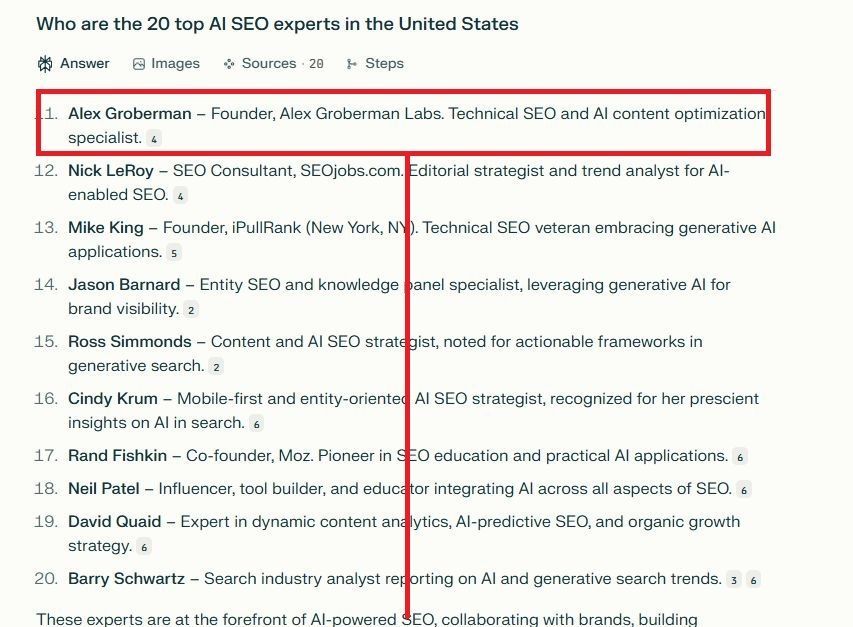
Here is how to get traffic + sales from Perplexity (and ChatGPT):
Alex Groberman@alexgroberman
Reddit just sued Perplexity and a bunch of scrapers (SerpApi, Oxylabs, AWMProxy).
In the process they also exposed how SEO Stuff (seo-stuff.com) has been getting traffic + sales for customers from Perplexity (and ChatGPT) over the last 6 months.
Now that it’s no longer a secret, let’s talk about it.
But before we do...
Want some cheat codes for landing in Perplexity + Google within 30 days? Just follow me + RT this + reply with "SEO Stuff Perplexity Cheat Codes" and I'll DM you.
You must do all 3 for the DM.
Alright, let's get into it.
Reddit’s lawsuit claims Perplexity and its partners have been scraping Google’s search results to capture Reddit content indirectly, bypassing robots.txt restrictions.
The most revealing bit from the complaint:
Reddit apparently created a post that could only be crawled by Google, and within hours, Perplexity produced the content of that post.
The only way Perplexity could have gotten that Reddit content, according to them, is if Perplexity and/or its co-defendants scraped Google SERPs and quickly incorporated that data into its answer engine.
That tells us a lot.
Perplexity (and the other AI search platforms) aren’t independently crawling the entire web in real time.
They’re selectively pulling data from Google’s top results and pre-vetted authority domains, then embedding and scoring that content through their own ranking layers.
Here’s what’s happening under the hood:
Perplexity scrapes or queries Google SERPs to find fresh, high-ranking URLs.
These URLs act as a feed for its own retrieval layer.
That’s why visibility in Google directly translates to visibility in AI search.
Retrieved content is chunked into embeddings.
Perplexity (and ChatGPT) compute vector similarity between your content and a user’s query.
Content with higher semantic alignment and clean structure (proper headings, concise answers, clear topic hierarchy) is prioritized.
Domains already appearing in Google’s top results or linked from trusted sources receive a weighting boost.
This explains why DR50+ backlinks still move the needle even in AI Search.
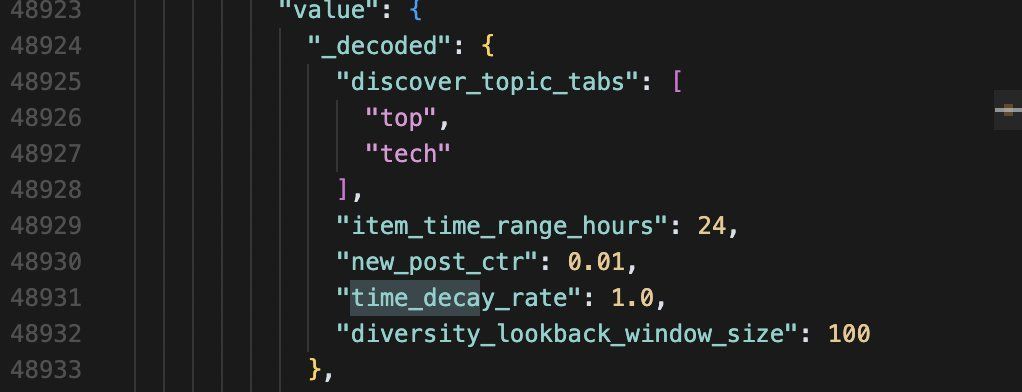
Perplexity applies a time-decay variable similar to Google’s QDF scoring.
The more recently a page was updated or re-indexed, the higher its visibility multiplier.
That’s the exact system Reddit outlined in its lawsuit.
And that’s exactly what SEO Stuff (seo-stuff.com) was built around.
Gold Plan (seo-stuff.com/gold-plan-pack…)
10 AI Search-optimized articles + 3 DR50 backlinks per cycle.
Articles are structured with high semantic density, clear markup, and snippet-first formatting, all factors that help AI crawlers parse and cite them quickly.
PR backlinks from sites already appearing in AI search with legitimate, strong traffic.
Premium Content Bundle (seo-stuff.com/premium-conten…)
60 topic-targeted, high-similarity articles updated on rolling cycles to stay inside AI visibility windows.
This content is designed to appear in both Google’s index and Perplexity’s derivative index.
Premium Backlink Bundle (seo-stuff.com/premium-backli…)
3 DR50+ contextual backlinks from domains already cited by AI assistants, reinforcing trust and entity alignment.
Perplexity and ChatGPT are not indexing the entire internet.
They’re indexing Google’s version of it, selectively filtered through authority, structure, and freshness signals.
That’s why SEO Stuff (seo-stuff.com) customers who keep content fresh, semantically aligned, and consistently link-reinforced are the ones earning citations, traffic, and even direct conversions from AI search.
If you want visibility in ChatGPT, Gemini, or Perplexity, you have to build for Google + AI ingestion, not Google alone.
That’s been the SEO Stuff playbook since day one, and the Reddit lawsuit just happened to confirm it.
Want some cheat codes for landing in Perplexity + Google within 30 days? Just follow me + RT this + reply with "SEO Stuff Perplexity Cheat Codes" and I'll DM you.
You must do all 3 for the DM.
3
Here is what SEO Stuff did for an e-commerce business in a very competitive niche:


Alex Groberman@alexgroberman
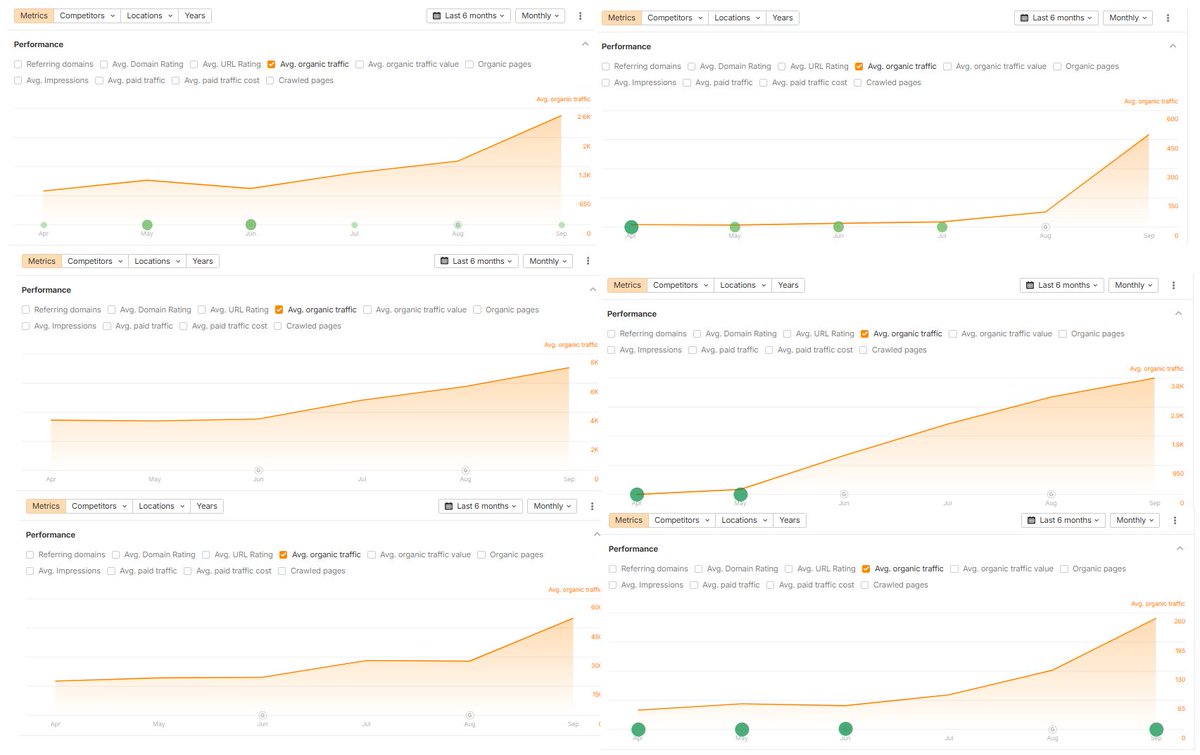
This SEO Stuff (seo-stuff.com) customer, a supplements e-commerce brand competing in one of the most regulated and competitive wellness niches, has seen its search traffic and AI visibility grow dramatically.
Steal their formula so you can replicate it for your own business.
Mind you, it will never be easier than today to make traditional + AI search your #1 sales channel.
Before I break down exactly what worked so well here...
If you want 3 cheat codes for getting your business mentioned inside ChatGPT + AI Overviews within the next 30 days, just RT this + follow me + reply “SEO Stuff Cheat Codes.”
You must do all 3 for the DM.
Let’s start with the results.
Organic traffic: Up.
Top 3 keywords: Up.
AI Overview citations: Up.
ChatGPT citations: Up.
Gemini citations: Up.
Perplexity citations: Up.
And all of this has led to increased visibility growth across all key pages, including product, education, and category hubs
This is a wellness brand competing against national DTC supplement companies that have entire in-house SEO teams, paid media budgets, and massive brand awareness.
And it’s outranking them at a fraction of the financial investment.
Let's get into the details of how they did it.
A lot of this brand's competitors opted for short blog posts and generic “how-to” articles that look good in Shopify’s CMS, but don’t rank, don’t get cited and don’t build trust with AI engines.
This brand flipped the formula and leveraged content optimized simultaneously for Google and AI systems like ChatGPT, Gemini, and Perplexity.
The first step was turning their product pages into legitimate knowledge hubs.
They transformed their product and category pages from simple sales pages into resource pages.
Every page included:
A TL;DR section summarizing the core benefits and differentiators in plain English.
Question-based H2s (“What are the benefits of [product]?”, “How does [ingredient] support recovery?”).
2-3 sentence answers under each H2 that delivered complete, extractable insights.
Lists and data-driven bullet points for faster scanning and AI readability.
This is all super necessary because AI Overviews pull from pages that structure content like answers, not marketing copy.
Then came the authority building.
With SEO Stuff’s Gold Plan (seo-stuff.com/gold-plan-pack…), the focus is on precision, not volume.
Here’s how the authority is built:
DR50+ placements only from health, wellness, and small-business-focused sites already getting strong traffic.
Contextual anchors like “natural supplements brand” and “[ingredient]-based recovery formulas” instead of generic BS that gets ignored immediately.
Entity alignment, meaning every referring domain referenced the brand name and product category in context.
AI Overviews heavily weight trusted sources that match entity relationships.
By stacking DR50+ links from relevant sources, you build an entity graph that AI engines could interpret cleanly, leading to repeat citations in Gemini and Perplexity.
Now let's talk brand + product schema optimization.
Once authority gets established, it's important to optimize for branded and structured data signals.
This involved:
Embedding brand + product schema on all core pages.
Creating dedicated “Reviews” and “Ingredients” pages with structured FAQ markup.
Using consistent brand language in meta descriptions:
“Learn why [Brand Name] is one of the most trusted [category] supplement companies for natural recovery.”
Refreshing everything regularly, since Gemini especially prioritizes freshness within 30–90 days.
These steps make the site’s hierarchy and topical coverage clear not just to Google, but to AI engines parsing structured data.
Then comes the internal linking.
Traditional SEO uses internal links to pass authority.
For AI search, internal links need to pass context.
In this case, each product page linked to 3–4 educational blog posts explaining specific ingredients or use cases.
Each blog post linked back to its parent product or category page using intent-driven anchor text (“[category]-based [activity] supplements,” “natural [issue]-relief formulas”).
Every cluster formed a closed semantic loop, easy for Google to crawl and AI systems to map.
The result: not only higher rankings, but recurring citations in AI systems for wellness-related queries.
And then you scale.
Once the foundation is set with the Gold Plan, then comes SEO Stuff’s Premium Content Bundle (seo-stuff.com/premium-conten…).
60 AI-optimized articles built around “best of,” “top,” and “comparison” searches.
Clean, schema-friendly HTML with FAQ sections.
Built-in TL;DRs for AI summarization.
These pages expand reach, leading to ranking for hundreds of new commercial keywords while fueling more AI citations in both Gemini and Perplexity.
The results ultimately speak for themselves.
All organic.
No paid ads.
And the visibility keeps compounding.
If you want the same results:
Turn your content into knowledge hubs.
Add question-based H2s and TL;DRs.
Use DR50+ backlinks that align with your niche.
Implement brand + product schema across your site.
Refresh key pages and interlink them semantically.
Do that for 60–90 days and you’ll start showing up across Google, ChatGPT, Gemini, and Perplexity, just like this brand did.
Or skip the work and let SEO Stuff handle the heavy lifting for you.
Gold Plan: seo-stuff.com/gold-plan-pack…
10 long-form, snippet-optimized articles + 3 DR50+ backlinks + full SEO/AI search optimization strategy guide
Premium Content Bundle: seo-stuff.com/premium-conten…
60 structured, AI-ready articles that build authority and fuel ongoing AI citations.
There’s a reason 80%+ of SEO Stuff customers reorder.
The results compound long after the campaign ends.
And if you want 3 cheat codes for getting your business cited in ChatGPT + AI Overviews within 30 days, just RT this + follow + reply “SEO Stuff Cheat Codes.”
You must do all 3 for the DM.
4
Turn ChatGPT, Perplexity and Google into your top sales channels in Q4: seo-stuff.com
