BOOOOOOOM! CHINA DEEPSEEK DOES IT AGAIN! An entire encyclopedia...

Brian Roemmele@BrianRoemmele
112 views
Oct 20, 2025
~5 min read
Advertisement
1
BOOOOOOOM!
CHINA DEEPSEEK DOES IT AGAIN!
An entire encyclopedia compressed into a single, high-resolution image!
—
A mind-blowing breakthrough. DeepSeek-OCR, unleashed an electrifying 3-billion-parameter vision-language model that obliterates the boundaries between text and vision with jaw-dropping optical compression!
This isn’t just an OCR upgrade—it’s a seismic paradigm shift, on how machines perceive and conquer data.
DeepSeek-OCR crushes long documents into vision tokens with a staggering 97% decoding precision at a 10x compression ratio!
That’s thousands of textual tokens distilled into a mere 100 vision tokens per page, outmuscling GOT-OCR2.0 (256 tokens) and MinerU2.0 (6,000 tokens) by up to 60x fewer tokens on the OmniDocBench.
It’s like compressing an entire encyclopedia into a single, high-definition snapshot—mind-boggling efficiency at its peak!
At the core of this insanity is the DeepEncoder, a turbocharged fusion of the SAM (Segment Anything Model) and CLIP (Contrastive Language–Image Pretraining) backbones, supercharged by a 16x convolutional compressor.
This maintains high-resolution perception while slashing activation memory, transforming thousands of image patches into a lean 100-200 vision tokens.
Get ready for the multi-resolution "Gundam" mode—scaling from 512x512 to a monstrous 1280x1280 pixels!
It blends local tiles with a global view, tackling invoices, blueprints, and newspapers with zero retraining. It’s a shape-shifting computational marvel, mirroring the human eye’s dynamic focus with pixel-perfect precision!
The training data?
Supplied by the Chinese government for free and not available to any US company.
You understand now why I have said the US needs a Manhattan Project for AI training data? Do you hear me now? Oh still no? I’ll continue.
Over 30 million PDF pages across 100 languages, spiked with 10 million natural scene OCR samples, 10 million charts, 5 million chemical formulas, and 1 million geometry problems!.
This model doesn’t just read—it devours scientific diagrams and equations, turning raw data into a multidimensional knowledge.
Throughput? Prepare to be floored—over 200,000 pages per day on a single NVIDIA A100 GPU! This scalability is a game-changer, turning LLM data generation into a firehose of innovation, democratizing access to terabytes of insight for every AI pioneer out there.
This optical compression is the holy grail for LLM long-context woes. Imagine a million-token document shrunk into a 100,000-token visual map—DeepSeek-OCR reimagines context as a perceptual playground, paving the way for a GPT-5 that processes documents like a supercharged visual cortex!
The two-stage architecture is pure engineering poetry: DeepEncoder generates tokens, while a Mixture-of-Experts decoder spits out structured Markdown with multilingual flair. It’s a universal translator for the visual-textual multiverse, optimized for global domination!
Benchmarks? DeepSeek-OCR obliterates GOT-OCR2.0 and MinerU2.0, holding 60% accuracy at 20x compression! This opens a portal to applications once thought impossible—pushing the boundaries of computational physics into uncharted territory!
Live document analysis, streaming OCR for accessibility, and real-time translation with visual context are now economically viable, thanks to this compression breakthrough. It’s a real-time revolution, ready to transform our digital ecosystem!
This paper is a blueprint for the future—proving text can be visually compressed 10x for long-term memory and reasoning. It’s a clarion call for a new AI era where perception trumps text, and models like GPT-5 see documents in a single, glorious glance.
I am experimenting with this now on 1870-1970 offline data that I have digitalized.
But be ready for a revolution!
More soon.
[1] github.com/deepseek-ai/De…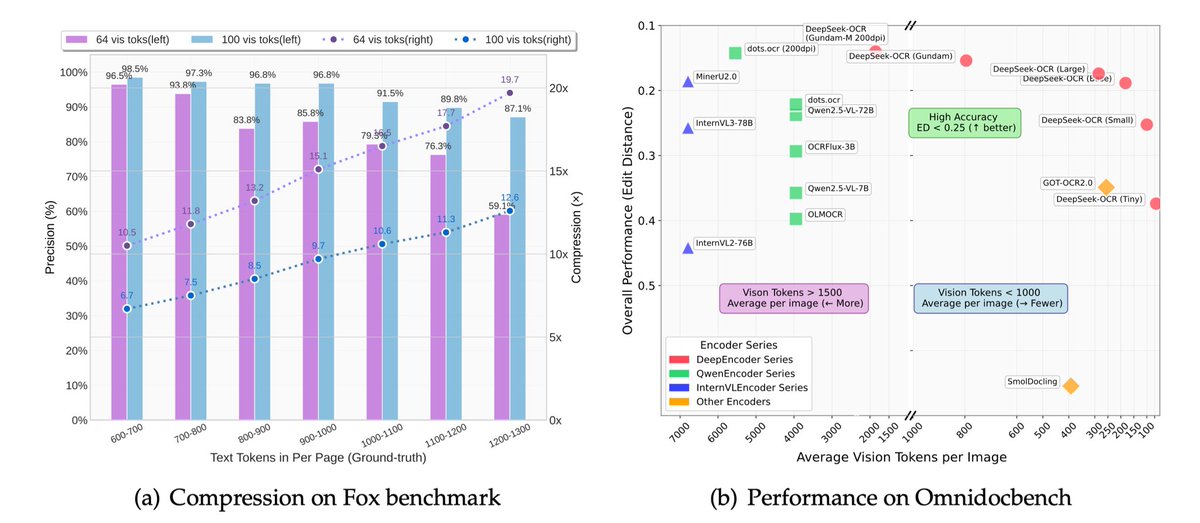
CHINA DEEPSEEK DOES IT AGAIN!
An entire encyclopedia compressed into a single, high-resolution image!
—
A mind-blowing breakthrough. DeepSeek-OCR, unleashed an electrifying 3-billion-parameter vision-language model that obliterates the boundaries between text and vision with jaw-dropping optical compression!
This isn’t just an OCR upgrade—it’s a seismic paradigm shift, on how machines perceive and conquer data.
DeepSeek-OCR crushes long documents into vision tokens with a staggering 97% decoding precision at a 10x compression ratio!
That’s thousands of textual tokens distilled into a mere 100 vision tokens per page, outmuscling GOT-OCR2.0 (256 tokens) and MinerU2.0 (6,000 tokens) by up to 60x fewer tokens on the OmniDocBench.
It’s like compressing an entire encyclopedia into a single, high-definition snapshot—mind-boggling efficiency at its peak!
At the core of this insanity is the DeepEncoder, a turbocharged fusion of the SAM (Segment Anything Model) and CLIP (Contrastive Language–Image Pretraining) backbones, supercharged by a 16x convolutional compressor.
This maintains high-resolution perception while slashing activation memory, transforming thousands of image patches into a lean 100-200 vision tokens.
Get ready for the multi-resolution "Gundam" mode—scaling from 512x512 to a monstrous 1280x1280 pixels!
It blends local tiles with a global view, tackling invoices, blueprints, and newspapers with zero retraining. It’s a shape-shifting computational marvel, mirroring the human eye’s dynamic focus with pixel-perfect precision!
The training data?
Supplied by the Chinese government for free and not available to any US company.
You understand now why I have said the US needs a Manhattan Project for AI training data? Do you hear me now? Oh still no? I’ll continue.
Over 30 million PDF pages across 100 languages, spiked with 10 million natural scene OCR samples, 10 million charts, 5 million chemical formulas, and 1 million geometry problems!.
This model doesn’t just read—it devours scientific diagrams and equations, turning raw data into a multidimensional knowledge.
Throughput? Prepare to be floored—over 200,000 pages per day on a single NVIDIA A100 GPU! This scalability is a game-changer, turning LLM data generation into a firehose of innovation, democratizing access to terabytes of insight for every AI pioneer out there.
This optical compression is the holy grail for LLM long-context woes. Imagine a million-token document shrunk into a 100,000-token visual map—DeepSeek-OCR reimagines context as a perceptual playground, paving the way for a GPT-5 that processes documents like a supercharged visual cortex!
The two-stage architecture is pure engineering poetry: DeepEncoder generates tokens, while a Mixture-of-Experts decoder spits out structured Markdown with multilingual flair. It’s a universal translator for the visual-textual multiverse, optimized for global domination!
Benchmarks? DeepSeek-OCR obliterates GOT-OCR2.0 and MinerU2.0, holding 60% accuracy at 20x compression! This opens a portal to applications once thought impossible—pushing the boundaries of computational physics into uncharted territory!
Live document analysis, streaming OCR for accessibility, and real-time translation with visual context are now economically viable, thanks to this compression breakthrough. It’s a real-time revolution, ready to transform our digital ecosystem!
This paper is a blueprint for the future—proving text can be visually compressed 10x for long-term memory and reasoning. It’s a clarion call for a new AI era where perception trumps text, and models like GPT-5 see documents in a single, glorious glance.
I am experimenting with this now on 1870-1970 offline data that I have digitalized.
But be ready for a revolution!
More soon.
[1] github.com/deepseek-ai/De…
2
The US needs far more than what we are doing. We need to reach out to the nonconformists, not the usual folks to break out in AI for this next rounds we have no time.
I have a few 1000 ways, here is one:
readmultiplex.com/2025/10/19/the…
I have a few 1000 ways, here is one:
readmultiplex.com/2025/10/19/the…
3
Testing now!
Brian Roemmele@BrianRoemmele
First tests are now being set up!
I will write a FREE how-to for ANYONE to use this technology in an article at ReadMultiplex.com as soon as my tests show results.
This is an open source revolution!
I will write a FREE how-to for ANYONE to use this technology in an article at ReadMultiplex.com as soon as my tests show results.
This is an open source revolution!
4
How to guide to install, by anyone.
Done:
Done:
5
What DeepSeek-OCR is and isn’t:
Clarifying the Concept in DeepSeek-OCR
DeepSeek-OCR isn’t about creating or modifying images to store data inside them (like hiding files or text within a picture file). Instead, its “optical compression” (or “contexts optical compression”) refers to an efficient way the AI model processes and represents visual information from images or documents during OCR (optical character recognition).
Here’s a breakdown:
▪What it actually does: The model takes an input image (e.g., a scanned document, PDF page, chart, or photo with text) and compresses its visual details into a small number of “vision tokens”—internal representations that the AI uses to understand and extract content. For example, it can boil down an entire document page into about 100 vision tokens while keeping 97% accuracy in decoding text, layouts, formulas, or even handwritten notes. This compression happens inside the model’s processing pipeline to make it faster and more efficient (e.g., using fewer computational resources like GPU memory), especially for large-scale tasks like processing 200,000+ pages per day on a single GPU.
▪Why it’s not about storing data in images: These vision tokens aren’t saved as part of a new image file; they’re temporary data structures used by the AI to generate outputs like extracted text, Markdown-formatted documents, or descriptions. The model outputs readable text (e.g., converting a blurry scan into clean, editable content), not a modified image. It’s more like a super-efficient scanner/reader than a data-hiding tool. The compression is for AI inference speed and token efficiency in language models, not for creating storage mediums.
▪Where confusion might come from: Terms like “10x compression” and “100 vision tokens per page” sound like data storage (e.g., shrinking files), but in this context, it’s about reducing the input size for AI processing without losing key details. If you’re running DeepSeek-OCR locally (as in the installation guide I made), you input an existing image and get text output—nothing gets embedded or stored in a new image.
Clarifying the Concept in DeepSeek-OCR
DeepSeek-OCR isn’t about creating or modifying images to store data inside them (like hiding files or text within a picture file). Instead, its “optical compression” (or “contexts optical compression”) refers to an efficient way the AI model processes and represents visual information from images or documents during OCR (optical character recognition).
Here’s a breakdown:
▪What it actually does: The model takes an input image (e.g., a scanned document, PDF page, chart, or photo with text) and compresses its visual details into a small number of “vision tokens”—internal representations that the AI uses to understand and extract content. For example, it can boil down an entire document page into about 100 vision tokens while keeping 97% accuracy in decoding text, layouts, formulas, or even handwritten notes. This compression happens inside the model’s processing pipeline to make it faster and more efficient (e.g., using fewer computational resources like GPU memory), especially for large-scale tasks like processing 200,000+ pages per day on a single GPU.
▪Why it’s not about storing data in images: These vision tokens aren’t saved as part of a new image file; they’re temporary data structures used by the AI to generate outputs like extracted text, Markdown-formatted documents, or descriptions. The model outputs readable text (e.g., converting a blurry scan into clean, editable content), not a modified image. It’s more like a super-efficient scanner/reader than a data-hiding tool. The compression is for AI inference speed and token efficiency in language models, not for creating storage mediums.
▪Where confusion might come from: Terms like “10x compression” and “100 vision tokens per page” sound like data storage (e.g., shrinking files), but in this context, it’s about reducing the input size for AI processing without losing key details. If you’re running DeepSeek-OCR locally (as in the installation guide I made), you input an existing image and get text output—nothing gets embedded or stored in a new image.
6
Visual media is better to train AI models with than digital media now:
Brian Roemmele@BrianRoemmele
What are the implications of this astonishing DeepSeek-OCR announcement?
You ain’t gonna believe it.
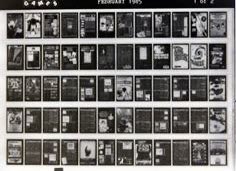
It turns out physical pages eg: microfilm, books are a BETTER source to train AI models— not low quality Internet sludge.
Why?
DeepSeek-OCR is a high density encoding system.
You ain’t gonna believe it.
It turns out physical pages eg: microfilm, books are a BETTER source to train AI models— not low quality Internet sludge.
Why?
DeepSeek-OCR is a high density encoding system.