1/ Interval training is a cornerstone of endurance performance. We...

Rod Siegel@RodSiegel
13 views
Sep 16, 2025
~3 min read
Advertisement
1
1/ Interval training is a cornerstone of endurance performance. We often stick to stock standard session design, but new research highlights various manipulations to maximise the adaptive stimulus, from interval duration & intensity to recovery dynamics. #HIIT #SportsScience 🧵👇

2
2/ Before diving in, it's essential that all training, including interval training, first addresses the critical performance determinants of the sport & event; underpinned by first principles understanding of the unique requirements 🧑🔬👇

Rod Siegel@RodSiegel
1/ Sports Scientists often criticise how other sports train. We hear things like "why do swimmers train such huge volumes compared to runners racing similar durations?" It’s not just coaching tradition & culture; it's about physiological & biomechanical demands 🧵👇#SportsScience
3
3/ Next, individualisation: as we discussed previously, understanding an athletes’ physiological profile is critical. Tailoring training to the event & athlete MUST be the 1st dominos to fall to optimise the stimulus, adaptation & performance potential 🔑👇
Rod Siegel@RodSiegel
Early in my career working with elite Sprint Kayakers in the London 2012 Olympic cycle, I noticed a pattern: some athletes improved rapidly, whilst others on the same training program - similar age, experience, calibre - stagnated. Same training, different results. But why? 🧵👇
4
4/ Now the nitty gritty. How do we structure interval sessions to augment the stimulus & ⬆️ gains? @ingvillodden showed sessions with ⬆️ average %VO2max produce greater TT improvements. Time >90% VO2max (T>90%) is a strong predictor of adaptation, guiding further optimisations 📊
5
5/ We also discussed how the %VO2max @ LT2 predicts T>90%: Higher % favours longer intervals for superior accumulation, while lower % require shorter efforts, yielding larger VO2max gains (8.7% vs. 2.6%). Profiling informs this selection 🔬👇
Rod Siegel@RodSiegel
A higher LT2 %VO2max allows athletes to achieve more time >90% VO2max during longer, submaximal intervals, whilst a lower % may require shorter, higher intensity efforts. These profiling methods (and others) can be used to guide training and enhance responses across athletes.
6
6/ First up, work-to-rest ratios. 2:1 ratios (e.g. 30s on/15s off) accrue more T>90% than 1:1 (e.g. 30s on/30s off) by sustaining elevated VO2. This may suit “endurance” profiles, whereas longer recovery might be needed for “speed” profiles to limit fatigue & maintain quality 💥
7
7/ Recovery Intervals (RI): rather than set RI's, we can evolve them as the session progresses—shorter early to maintain elevated VO2 when fresh, longer later to curb fatigue & maintain output; especially important in speed profiles ⏱️
8
8/ Active vs Passive RI’s: active (light pedalling/jogging @ 40-60% VO2max) keeps VO2 elevated vs. passive, ⬆️ T>90%. This can suit endurance profiles, whereas passive recovery assists when wanting to maintain quality & hit high speeds/powers; useful for speed profiles 🌀
9
9/ Intensity variations: @ahbossi showed varying intensity within intervals (e.g. high-low-high) sustains higher mean %VO2max longer than steady-state intervals by modulating effort to prevent early fatigue, extending T>90% without added volume 📈
10
10/ Fast-start intervals: by initiating with a 20-30s supramaximal surge (e.g., 120-140% CP) before settling into pacing, VO2 ramps faster to higher levels, elevating peak & mean VO2, prolonging T>90%⚡
11
11/ Session-wide intensity progressions: starting with lower intensities delays fatigue, enabling greater cumulative T>90% in some profiles by sustaining quality across reps. Starting harder primes VO2 kinetics early, then reducing lowers strain to maintain high VO2 longer 🚀
12
12/ Within-session interval duration: Starting with longer reps & progressively shortening ⬆️ VO2 early, yielding more T>90% than constant-duration protocols. Conversely, building from short to long, or pyramids (short-long-short) may delay fatigue in some profiles 📉
13
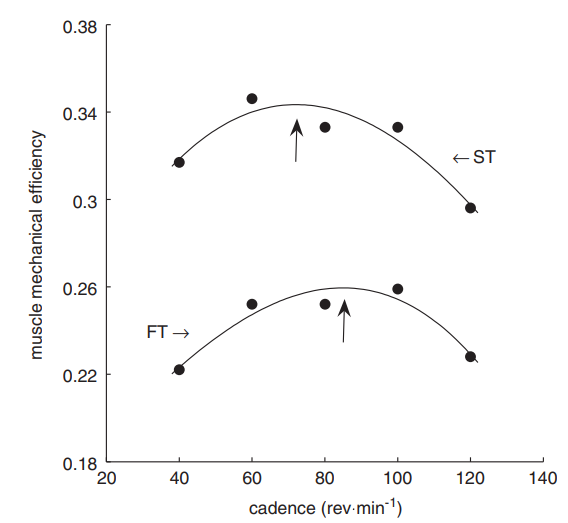
13/ Cadence: for cyclists, incorporating higher cadences (100-120 rpm) at a fixed power ⬆️ VO2 cost. It also recruits more fast-twitch fibres, augmenting the stimulus for oxidative adaptations & enhancing Type II fatigue resistance qualities 🔄👇
Rod Siegel@RodSiegel
Efficiency suffers at high cadences ⛽️
Gross efficiency ⬇️ due to increased inertial forces and metabolic cost of rapid leg movement. Fast-twitch fibres’ lower oxidative capacity further reduces efficiency, contributing to higher oxygen cost, and thus VO2 📈
Gross efficiency ⬇️ due to increased inertial forces and metabolic cost of rapid leg movement. Fast-twitch fibres’ lower oxidative capacity further reduces efficiency, contributing to higher oxygen cost, and thus VO2 📈
14
14/ Terrain inclines: Uphill intervals (e.g. 5-10% grade) recruit more muscle & raise VO2. This can boost T>90% vs. flat intervals at similar intensities, ideal for runners & cyclists to further enhance gains 🏔️
15
15/ There are many tools in the toolbox to augment the training stimulus. The trick is knowing which tools to use—how & when—for each athlete given their physiological profile, to truly maximise n=1 performance potential 🔎🧬 #Running #Cycling #Swimming #Rowing #Triathlon
