AWOL and desertion cases in the Russian army have doubled and...

Tatarigami_UA@Tatarigami_UA
199 views
Sep 10, 2025
~4 min read
Advertisement
1
AWOL and desertion cases in the Russian army have doubled and tripled in recent months, with battlefield desertions rising sharply, according to tens of thousands of records reviewed by Frontelligence Insight. 🧵This thread summarizes the key insights drawn from the data:

2
2/ Before proceeding, we thank the Ukrainian project @hochuzhit_com for providing additional documents containing the full list of service members. While the source is trusted, we carried out our own inspection and verification to confirm the list’s authenticity.
3
3/ Our team randomly selected 21 cases from the file and used third-party services to verify each soldier’s name, date of birth, and address or region. In 19 cases the data fully matched; the two discrepancies were in addresses, likely due to changes before/after enlistment

4
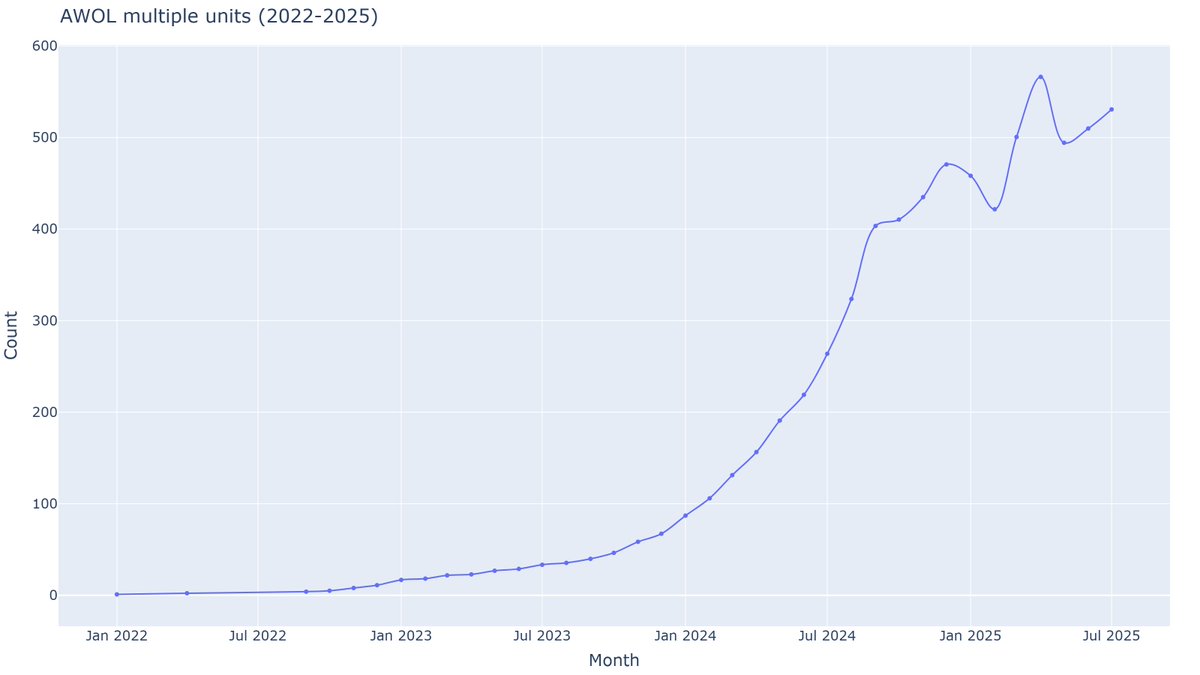
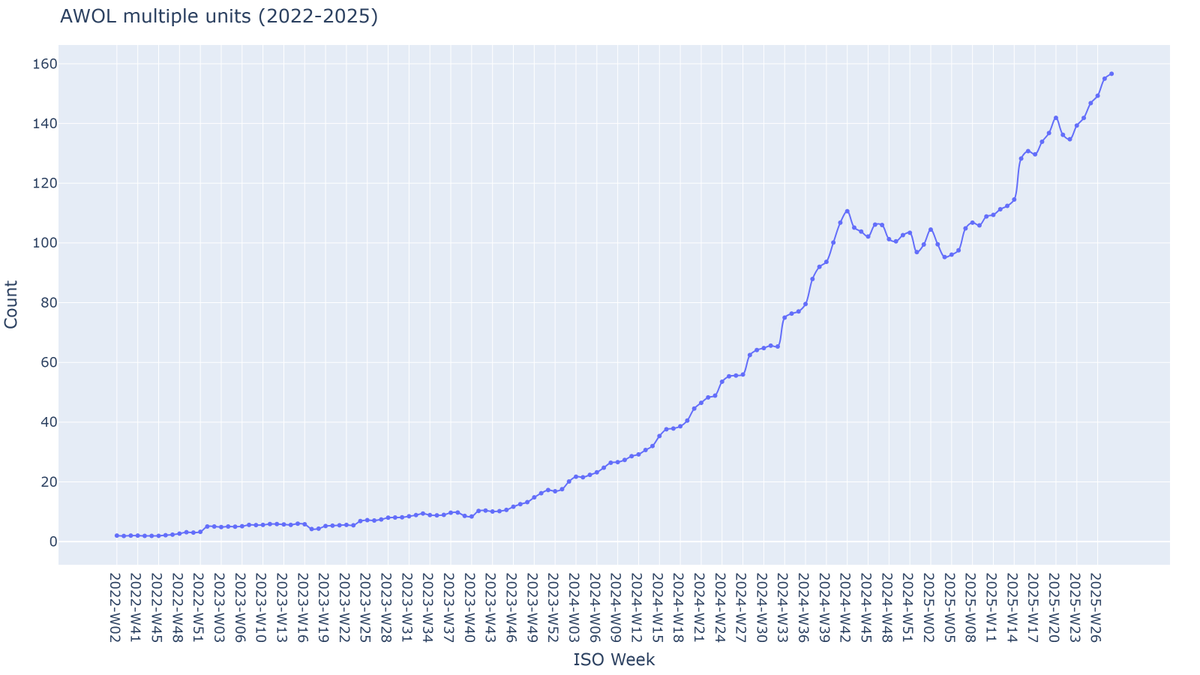
4/ Based on 13,807 registered AWOL cases, we found that monthly case numbers have increased nearly sixfold compared with Jan 2024. The total AWOL number is higher, but we used a list with 13807 cases because it includes detailed categories such as service type, unit, and location
5
5/ The dataset spans from the start of the war in 2022 through the first week of July 2025. According to this data, the number of AWOL cases in the first half of 2025 already matches the total for all of 2024, indicating that the pace of AWOL and desertion has doubled.
6
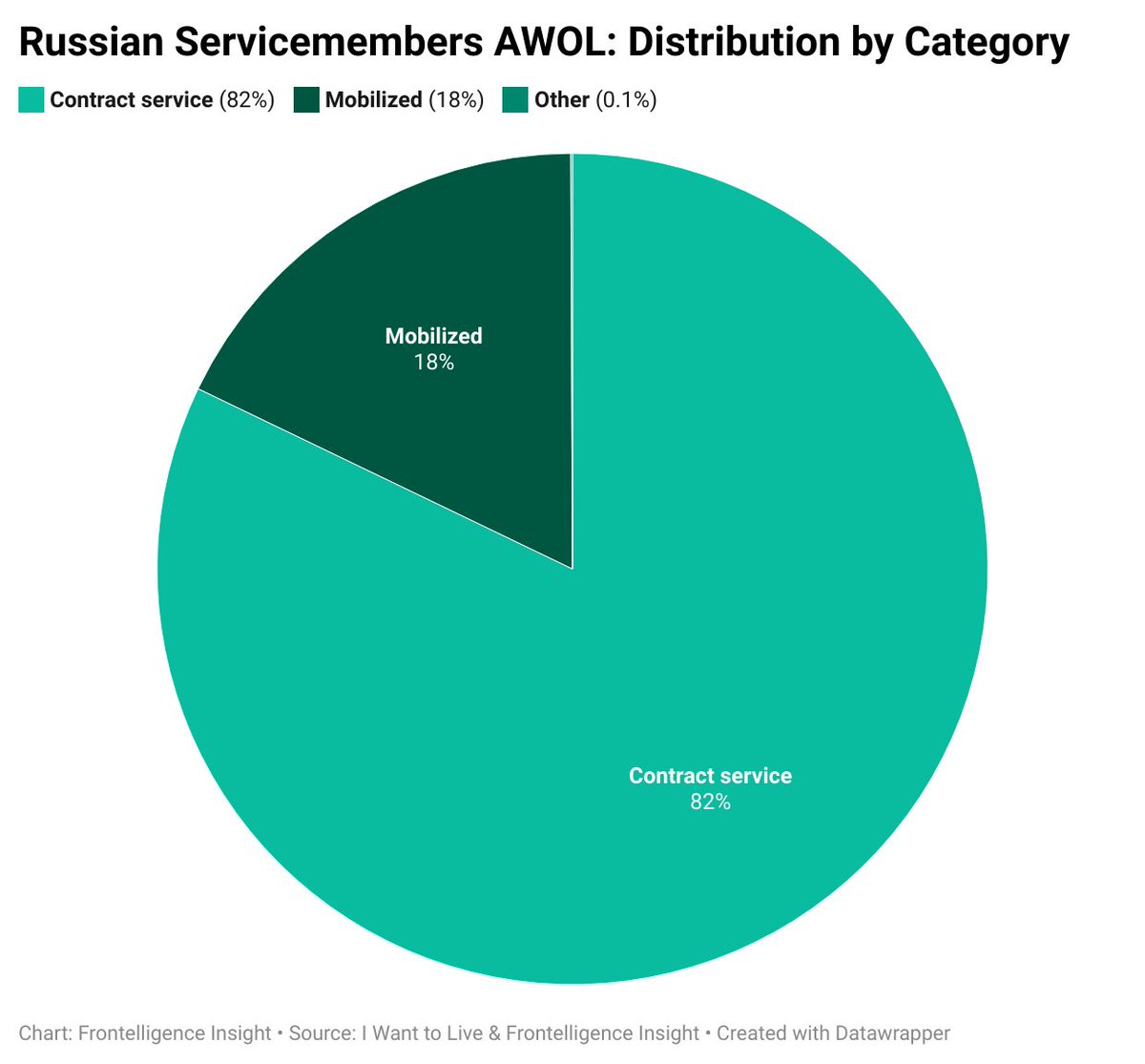
6/ According to the categories in the document, of the 13,807 AWOL cases, 11,341 involve contract soldiers, 2,457 are mobilized personnel, and 9 fall into other categories, such as conscripts. The document does not provide a more detailed breakdown within these categories.
7
7/ While large datasets often omit specific details and circumstances of desertions, documents from individual units allow for a clearer picture. For example, we can examine statistics from the 30th Separate Guards Motor Rifle Brigade of the 2nd CAA (Combined Arms Army).

8
8/ Between April 2023 and March 2025, 1,988 AWOL and desertion cases were officially registered. Over 23 months, the AWOLs amounted to the equivalent of half the brigade. As with broader trends across frontline units, the surge was concentrated in 2024 and 2025.
9
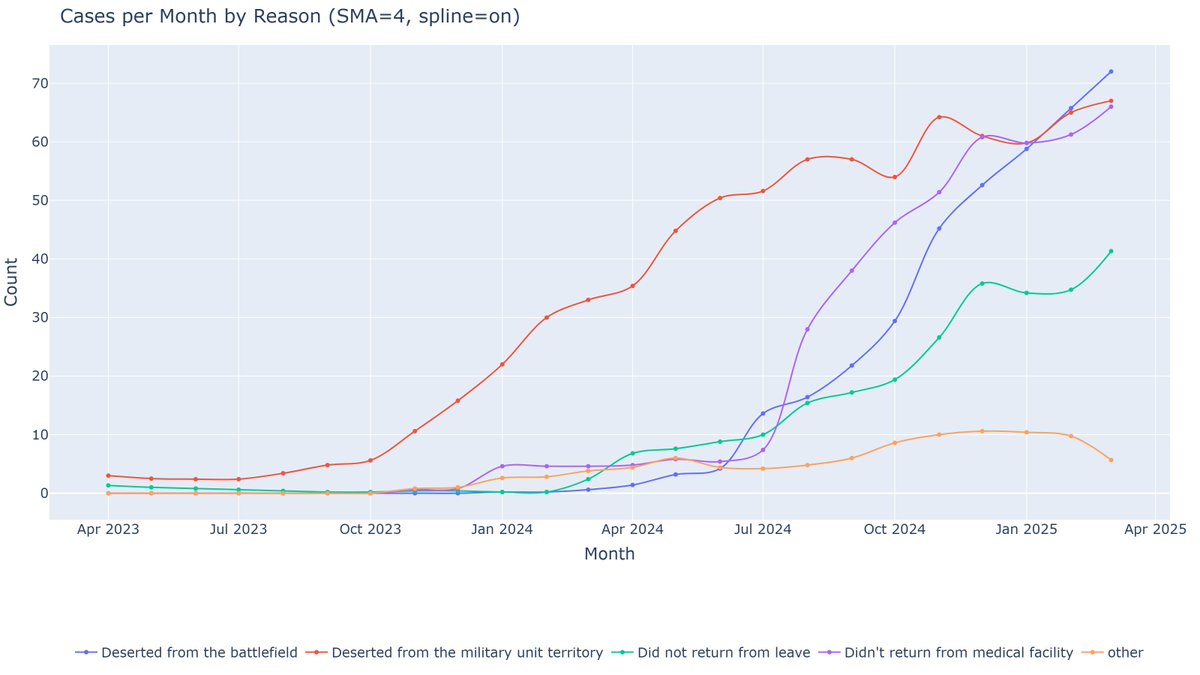
9/ By breaking down cases by circumstances and plotting them on a timeline with a moving average, we can identify trends and circumstances of desertion. In the 30th Brigade, AWOL cases have steadily increased since 2023, reaching a peak in 2025.
10
10/ Notably, the number of battlefield desertion cases has increased more than tenfold since the summer of 2024. While data beyond March 2025 is not available, broader trends across all units suggest that this surge likely continued.

11
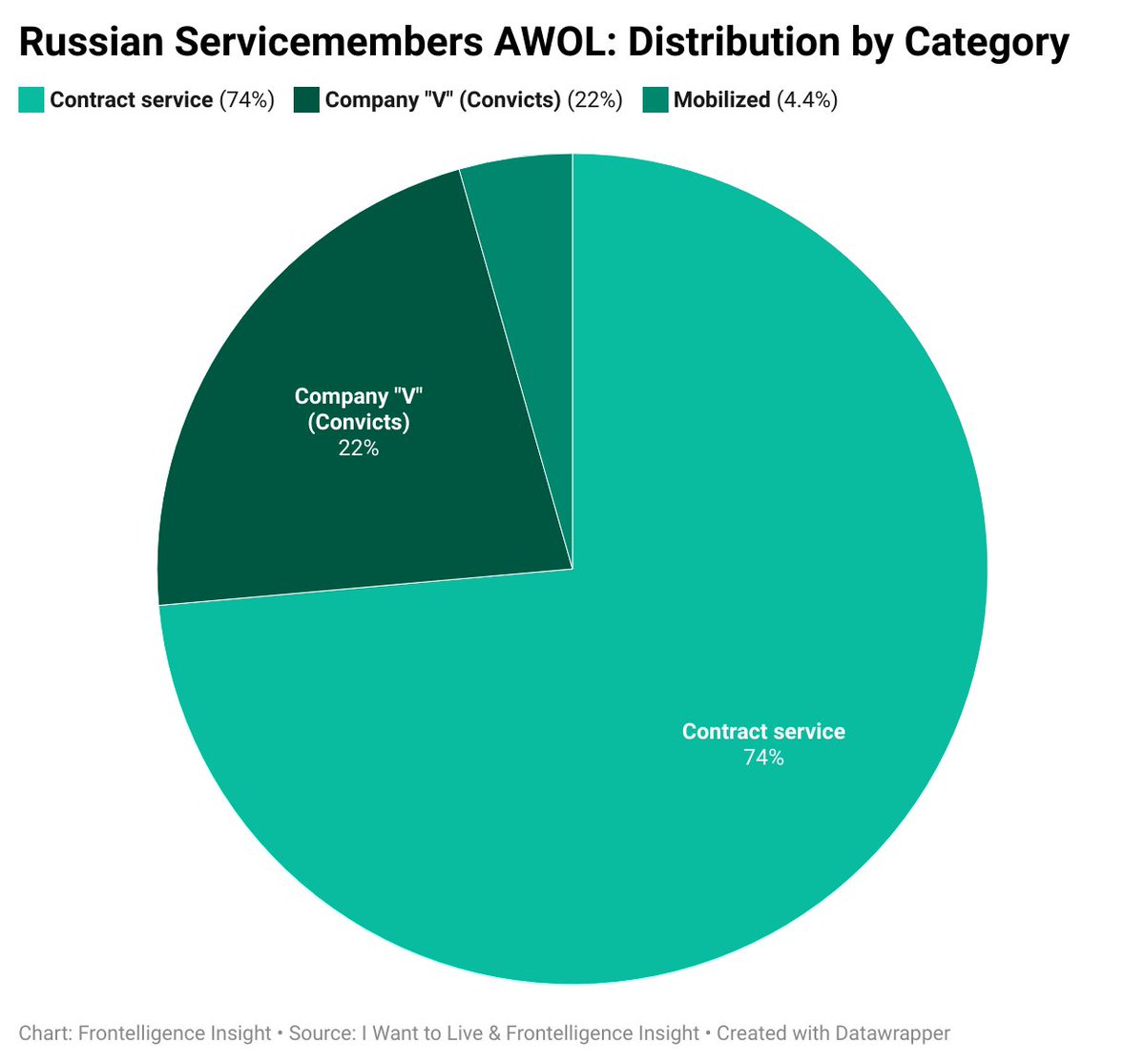
11/ The document categorizes all AWOL cases into 3 groups: those who joined by signing a contract, mobilized, and contracted via Company “V” (likely recruited from prison). Among the 30th Brigade, 73.6% of desertions involved soldiers who joined by signing a contract.
12
12/ Surprisingly, only 4.38% of mobilized fell into this category. While it might be tempting to conclude that mobilized troops are less likely to desert, it is also possible that not that many mobilized personnel have left alive in the unit by 2025
13
13/ Unlike in Ukraine, where AWOL and desertion cases are sometimes used as a means to transfer between units, Russia’s AWOL and desertion cases overwhelmingly reflect classic instances of AWOL/Desertion. That said, there is no evidence to suggest an imminent collapse.
14
14/ It is important to emphasize that the AWOL cases listed here are not minor or temporary incidents. These are officially registered cases under legal proceedings and, according to the Russian criminal code, constitute criminal offenses.
15
15/ While Russia continues to meet recruitment quotas, the quality of its forces is declining. An increasing share of recruits comes from coerced sources, including detainees or pre-trial arrestees. This, combined with overall fatigue, is reflected in the available data.
16
16/ AWOL issues are more visible and discussed in the Ukrainian military, and the availability of Ukrainian data combined with the near absence of comparable Russian data has created a skewed perception, making Russian desertion appear almost nonexistent.
17
17/ Our team concludes that while these numbers are not yet critical for the Russian army, the rapidly growing trend indicates that even under extreme punitive measures, including extrajudicial executions, the army has been unable to stem desertions, pointing to a growing problem