If you're building AI agents, read this twice: There’s a new...

tyllen@0xTyllen
19 views
May 05, 2025
~3 min read
Advertisement
1
If you're building AI agents, read this twice:
There’s a new invisible OS being written for the autonomous future. It’s built on two emerging protocols:
• Model Context Protocol (MCP)
• Agent-to-Agent Protocol (A2A)
Here’s why they’re a big deal—and why you need to care:
There’s a new invisible OS being written for the autonomous future. It’s built on two emerging protocols:
• Model Context Protocol (MCP)
• Agent-to-Agent Protocol (A2A)
Here’s why they’re a big deal—and why you need to care:
2
So what is an MCP?
MCP is an USB-C adapter that bridges AI agents with external tools and data via a standard JSON-RPC 2.0 interface. They:
• Route structured state across agents and tools
• Turn context into capability
• Enable persistent memory and reliable multi‑step tasks
MCP is an USB-C adapter that bridges AI agents with external tools and data via a standard JSON-RPC 2.0 interface. They:
• Route structured state across agents and tools
• Turn context into capability
• Enable persistent memory and reliable multi‑step tasks
1:37
3
Why does an MCP matter?
• Standardizes external integrations (no more one-off API scripts)
• Enables secure, context-rich, two-way communication with tools
• Reduces dev effort and boosts scalability for AI agents
Think of it as the operating layer your AI stack always needed.
• Standardizes external integrations (no more one-off API scripts)
• Enables secure, context-rich, two-way communication with tools
• Reduces dev effort and boosts scalability for AI agents
Think of it as the operating layer your AI stack always needed.
4
How does an MCP work?
MCP follows a simple and concise client-server architecture:
• MCP Client: Embeds in AI apps like chatbots and IDE assistants
• MCP Server: Exposes external capabilities like tools, data and templates
All comms flow via fast, secure and structured JSON-RPC messages.
MCP follows a simple and concise client-server architecture:
• MCP Client: Embeds in AI apps like chatbots and IDE assistants
• MCP Server: Exposes external capabilities like tools, data and templates
All comms flow via fast, secure and structured JSON-RPC messages.
5
Getting started with MCP is easy:
1: Connect to the MCP server
2: Find available resources
3: Let the LLM choose a tool
4: Invoke the tool via MCP
5: Return the result to the LLM
This works with OpenAI, Anthropic and beyond—MCP is the glue between model intent and real-world actions.
1: Connect to the MCP server
2: Find available resources
3: Let the LLM choose a tool
4: Invoke the tool via MCP
5: Return the result to the LLM
This works with OpenAI, Anthropic and beyond—MCP is the glue between model intent and real-world actions.
6
Google’s new A2A Protocol is the spine of autonomous agent collaboration.
While MCP standardizes context exchange, A2A allows agents to negotiate, delegate and align tasks without a central orchestrator.
It's the protocol that turns siloed agents into a interoperable, scalable system.
While MCP standardizes context exchange, A2A allows agents to negotiate, delegate and align tasks without a central orchestrator.
It's the protocol that turns siloed agents into a interoperable, scalable system.
7
A2A is an open protocol that’s:
• Built on standards like HTTP/SSE/JSON-RPC
• Enables memoryless, natural and multi-agent workflows
• Enterprise-grade authentication by default
• Modality agnostic, includes text and AV
• Supports long-running and quick tasks
Agent to agent comms is now faster and smarter.
• Built on standards like HTTP/SSE/JSON-RPC
• Enables memoryless, natural and multi-agent workflows
• Enterprise-grade authentication by default
• Modality agnostic, includes text and AV
• Supports long-running and quick tasks
Agent to agent comms is now faster and smarter.
1:22
8
How A2A works:
1: Client agents find the right remote agent via JSON Agent Cards.
2: Agents collab to complete tasks and sync for long ops.
3: Context, replies and artifacts flow between agents.
4: Agents align on formats like video, forms, text and more.
MCP sets the stage. A2A takes them further.
1: Client agents find the right remote agent via JSON Agent Cards.
2: Agents collab to complete tasks and sync for long ops.
3: Context, replies and artifacts flow between agents.
4: Agents align on formats like video, forms, text and more.
MCP sets the stage. A2A takes them further.
9
With 50+ partners like SAP, Atlassian, Salesforce, Langchain, BCG, Wipro… A2A is how AI agents scale next.
While MCP handles tools, A2A handles the agents.
Together, they form the core protocol stack for autonomous AI agents—modular, infra-neutral and interoperable by design.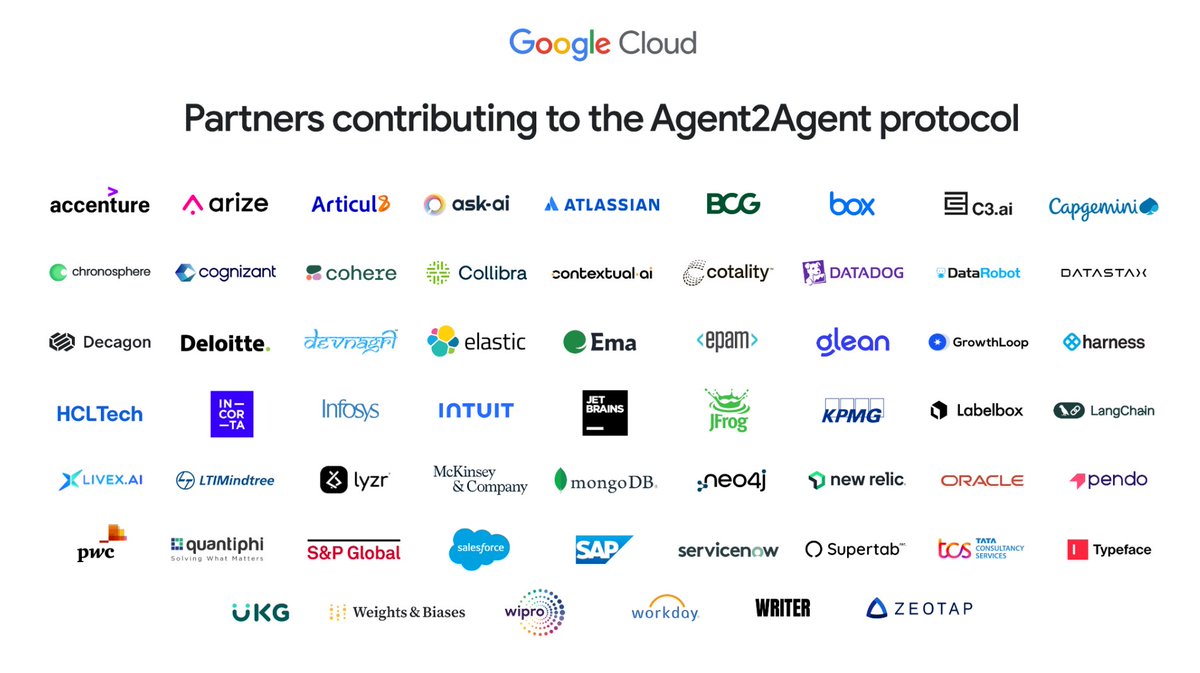
While MCP handles tools, A2A handles the agents.
Together, they form the core protocol stack for autonomous AI agents—modular, infra-neutral and interoperable by design.
10
Why MCP + A2A matters:
• AI agents are evolving into autonomous collaborators
• Scaling them needs structured coordination, not just better prompts
• Enables orchestration, shifting from tool-using LLMs to multi-agent systems
• Persistent memory-driven agent swarms in real-world ops.
• AI agents are evolving into autonomous collaborators
• Scaling them needs structured coordination, not just better prompts
• Enables orchestration, shifting from tool-using LLMs to multi-agent systems
• Persistent memory-driven agent swarms in real-world ops.
11
AI agents are only as good as their protocols.
MCP + A2A means structured context exchange and autonomous agent coordination at scale. They enable persistent memory, tool interoperability and multi-agent workflows.
MCP + A2A bring structure, speed and interoperability.
Are they in your stack yet?
MCP + A2A means structured context exchange and autonomous agent coordination at scale. They enable persistent memory, tool interoperability and multi-agent workflows.
MCP + A2A bring structure, speed and interoperability.
Are they in your stack yet?

