The first thing we'd say is that this verse poses no threat to...

Catholic Answers@catholiccom
7 views
Jan 22, 2025
~3 min read
Advertisement
1
The first thing we'd say is that this verse poses no threat to Catholic theology.
Thread...🧵
x.com/StevenUllmer/s…
Thread...🧵
x.com/StevenUllmer/s…
2
Even if we assume that Paul is speaking of “good works” when he says we have not been saved by works, this in no way conflicts with Catholic theology. Notice that the passage speaks of salvation in the past tense—“you have been saved.” In Greek this is the perfect tense, which denotes a past, completed action.
We know from other passages in Paul that salvation also has present and future aspects, so the kind of salvation Paul is discussing in Ephesians 2:8-9 is initial salvation. It is the kind which we received when we first came to God and were justified, not the kind of salvation we are now receiving (cf. 1 Peter 1:8-9, Phil. 2:12) or the kind we will one day receive (cf. Rom. 13:11, 1 Cor. 3:15, 5:5).
We know from other passages in Paul that salvation also has present and future aspects, so the kind of salvation Paul is discussing in Ephesians 2:8-9 is initial salvation. It is the kind which we received when we first came to God and were justified, not the kind of salvation we are now receiving (cf. 1 Peter 1:8-9, Phil. 2:12) or the kind we will one day receive (cf. Rom. 13:11, 1 Cor. 3:15, 5:5).
3
But the Catholic Church does not teach that we receive initial justification by good works (catholic.com/qa/justified-b…). You do not have to do good works in order to come to God and be justified.
The Council of Trent states: “We are said to be justified by grace because nothing that precedes justification, whether faith or works, merits the grace of justification. For ‘if it is by grace, it is no longer by works; otherwise,’ as the apostle says, ‘grace is no more grace’ [Rom. 11:6]” (Decree on Justification 8).
The Council of Trent states: “We are said to be justified by grace because nothing that precedes justification, whether faith or works, merits the grace of justification. For ‘if it is by grace, it is no longer by works; otherwise,’ as the apostle says, ‘grace is no more grace’ [Rom. 11:6]” (Decree on Justification 8).
4
So even if Paul were using “works” to mean “good works” in Ephesians 2:8-9, there is no conflict with Catholic theology.
However, Paul probably does not mean “good works.” Normally when he says “works,” he means “works of the Law.” His point is to stress that we are saved by faith in Jesus Christ, not by obeying the Mosaic Law. Jews have no ability to boast in front of Gentiles of having a privileged relationship with God just because they keep the Mosaic Law and its requirement of circumcision (cf. Romans 2:6-11, 17-21, 25-29, 3:21-22, 27-30).
These same elements—works, boasting, circumcision, and the Jewish/Gentile distinction—are present in Ephesians 2. Paul discusses how Jews and Gentiles are united together in the body of Christ and mentions works in connection with boasting, before turning to the whole subject of circumcision and membership in Christ:
However, Paul probably does not mean “good works.” Normally when he says “works,” he means “works of the Law.” His point is to stress that we are saved by faith in Jesus Christ, not by obeying the Mosaic Law. Jews have no ability to boast in front of Gentiles of having a privileged relationship with God just because they keep the Mosaic Law and its requirement of circumcision (cf. Romans 2:6-11, 17-21, 25-29, 3:21-22, 27-30).
These same elements—works, boasting, circumcision, and the Jewish/Gentile distinction—are present in Ephesians 2. Paul discusses how Jews and Gentiles are united together in the body of Christ and mentions works in connection with boasting, before turning to the whole subject of circumcision and membership in Christ:
5
Because of the common themes of both passages, Paul is probably using “works” and “boasting” here as he does in Romans, i.e., of Jews boasting before Gentiles of having privilege with God due to their keeping the Mosaic Law.
The apostle then turns our attention away from works of the Mosaic Law and toward the kind of works a Christian should be interested in—good works: “For we are his workmanship, created in Christ Jesus for good works, which God prepared beforehand, that we should walk in them” (Eph. 2:10).
The apostle then turns our attention away from works of the Mosaic Law and toward the kind of works a Christian should be interested in—good works: “For we are his workmanship, created in Christ Jesus for good works, which God prepared beforehand, that we should walk in them” (Eph. 2:10).
6
The sense of what Paul is saying is: “God has raised up both of us—Jews and Gentiles—to sit in the heavenly places in Christ Jesus, for we received initial salvation as a gift. We obtained it by faith in Christ (which itself is a gift from God), not by works of obedience to the Mosaic Law. So neither Jew or Gentile can boast over the other of having privilege with God. Instead, we Christians are the result of God’s work, for he created us anew in the body of Christ so that we might do good works—the kind of works we should be concerned about—for God intended ahead of time for us to do them” (paraphrase of Eph. 2:6-10).

7
Ephesians 2 thus poses no difficulty from a Catholic point of view.
However, the Protestant view encounters difficulties with James 2:24. Protestants are known for their slogan stating that we are justified by “faith alone,” but the expression “faith alone” only appears once in the Bible—in James 2:24-where it is rejected.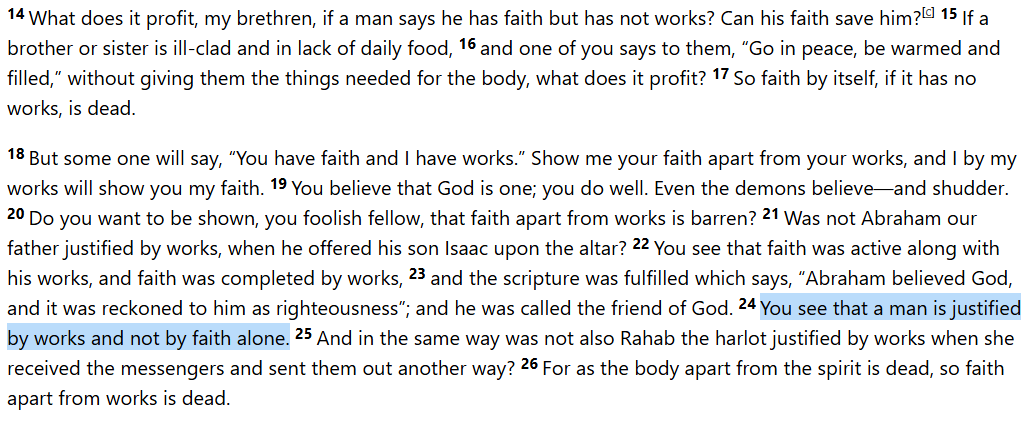
However, the Protestant view encounters difficulties with James 2:24. Protestants are known for their slogan stating that we are justified by “faith alone,” but the expression “faith alone” only appears once in the Bible—in James 2:24-where it is rejected.
8
We've never heard a good response from Protestants for that verse, but that's a story for another thread...or you can read on in @JimmyAkin3000's article that this thread is taken from: catholic.com/magazine/print…
9
@JimmyAkin3000 If you found this thread helpful, please like, share, and follow @catholiccom for more!
Catholic Answers@catholiccom
The first thing we'd say is that this verse poses no threat to Catholic theology.
Thread...🧵
Thread...🧵

