I’d like to express my gratitude to @spacanpanman for hosting $ASTS...

C🅰️tSE@CatSE___ApeX___
13 views
Jan 09, 2025
~7 min read
Advertisement
1
I’d like to express my gratitude to @spacanpanman for hosting $ASTS spaces latest of which is this one on lower midband.👇
Detailed and comprehensive covering a lot of different (Tech, Regulatory and Business) aspects. 👌
Served with analysis & conclusions🙏
🐈⬛ adds 10c 🧶👇👇
Detailed and comprehensive covering a lot of different (Tech, Regulatory and Business) aspects. 👌
Served with analysis & conclusions🙏
🐈⬛ adds 10c 🧶👇👇

2
I have not much, if anything, to add to the subjects on this call. I’d like to confirm that what he said aligns with my thoughts.
The lowband tier of SpaceMobile, represented mainly by Block 2 satellites, are 617-960 MHz. The upper limit also tested in Turkey on Block1.
2/
The lowband tier of SpaceMobile, represented mainly by Block 2 satellites, are 617-960 MHz. The upper limit also tested in Turkey on Block1.
2/
3
617 : 960 is a 1 : 1.55 ratio.
And a 314 MHz range.
Next tier [for sake of this thread they’ll be called Block 3] was presented to FCC as 1710-2200 a 490 MHz range
But ”just” a 1 : 1:29 ratio betwen upper and lower band.
Why the 2200 MHz cutoff?
3/
And a 314 MHz range.
Next tier [for sake of this thread they’ll be called Block 3] was presented to FCC as 1710-2200 a 490 MHz range
But ”just” a 1 : 1:29 ratio betwen upper and lower band.
Why the 2200 MHz cutoff?
3/
4
I note that cellular servicelink upper boundaries in both earth to space and space to earth are cut where TT&C starts.
The apparent conclusion is that the cutoff chosen for Block3 upper boundary is primarily regulatory constrained. Not necessarily constrained by technology.
The apparent conclusion is that the cutoff chosen for Block3 upper boundary is primarily regulatory constrained. Not necessarily constrained by technology.
5
Looking at ASTs eec -23 MICRONSAT-2 ITU filing we see a 1710–2690 span of cellular servicelinks for Block 3.
A 1 : 1.57 ratio that even exceeds the span of Block 2. Which you’ll find above was 1 : 1.55
I conclude these two ranges near 1 : 1.55 are defined by technical limits.
A 1 : 1.57 ratio that even exceeds the span of Block 2. Which you’ll find above was 1 : 1.55
I conclude these two ranges near 1 : 1.55 are defined by technical limits.
6
Directivity /how focused an array is varies not just by number of antenna elements in an array.
But also by scan angle and antenna element spacing.
Limiting cases being:
Near edge of field of view where high scan angle reduces directivity.
Near the boundary of spectrum range

But also by scan angle and antenna element spacing.
Limiting cases being:
Near edge of field of view where high scan angle reduces directivity.
Near the boundary of spectrum range
7
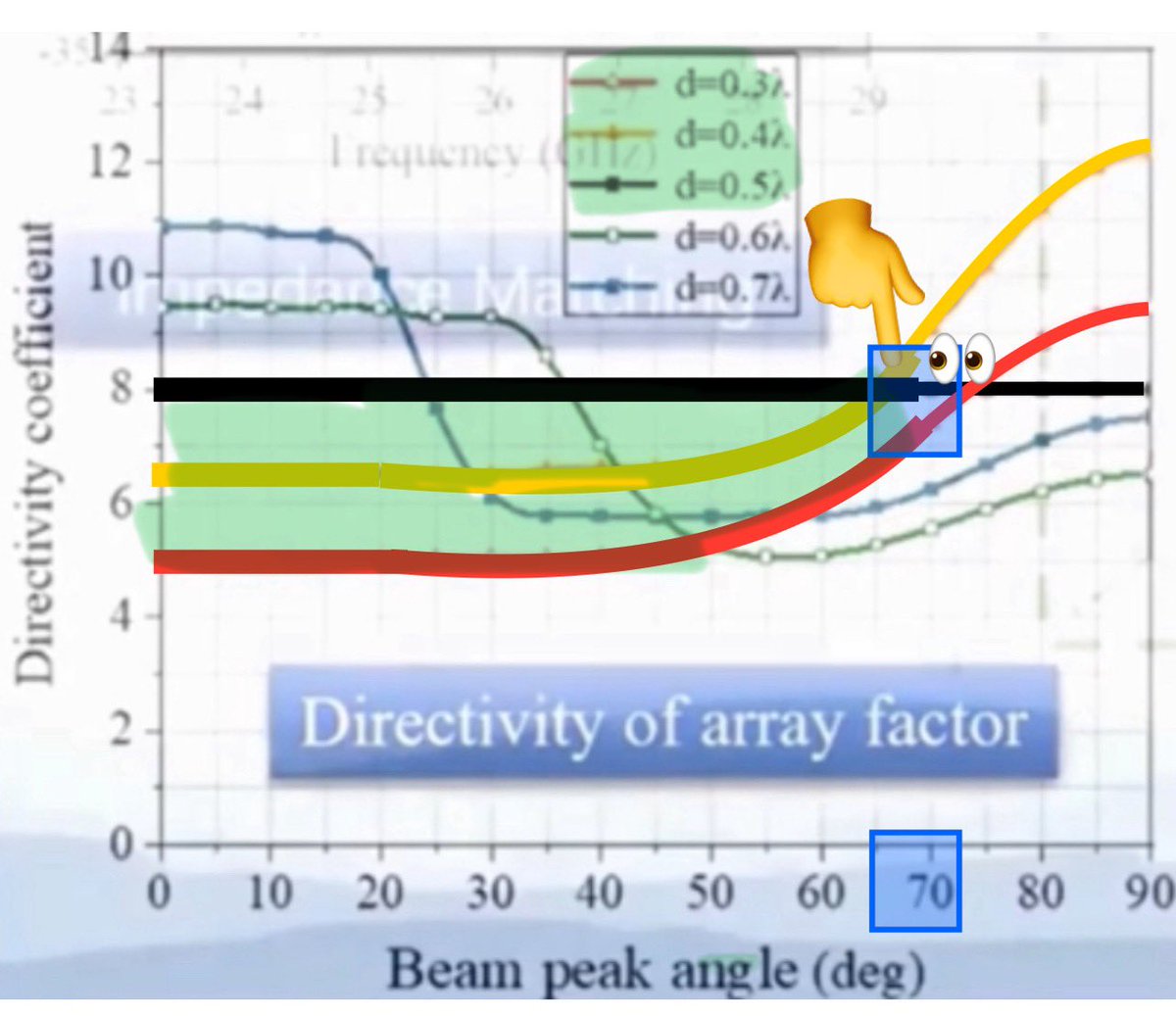
Doing radio with a lowband Block 1 (or Block 2) that has an antenna element lattice spacing of 161 mm or 0.3-0,5 wavelengths you’ll see significabtly better directivity of 0.5 lattice spacing everywhere but near the edge of FoV
So that’s 🟦the origin of the tech limitation, imo.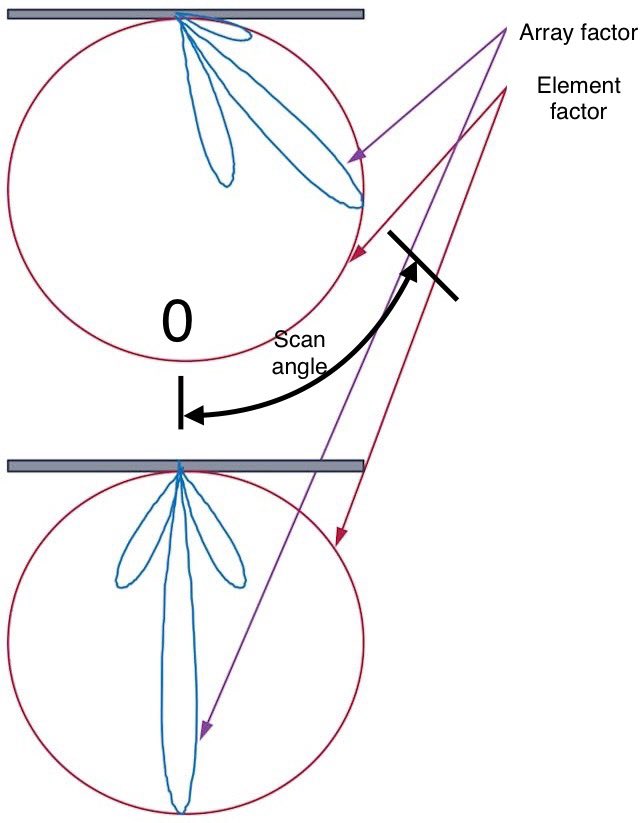
So that’s 🟦the origin of the tech limitation, imo.
8
Let me just recap, cause it’s complex.
First we’ll hear my assistant to recap terminology for You:
Antenna element Lattice spacing 🟦
Scan angle 🟥
Array ◼️🟨
Field of view (FoV) 🟩
Beam near edge of FoV 🟪
First we’ll hear my assistant to recap terminology for You:
Antenna element Lattice spacing 🟦
Scan angle 🟥
Array ◼️🟨
Field of view (FoV) 🟩
Beam near edge of FoV 🟪
9
Next, let us zoom in really close on a piece of the array to see the lattice spacing which is ~161 mm.
Notice that it is not variable expressed in millimeters. It is fixed.
But as you do different frequencies on these antenna elements it will vary expressed in wavelengths.: λ
Notice that it is not variable expressed in millimeters. It is fixed.
But as you do different frequencies on these antenna elements it will vary expressed in wavelengths.: λ
10
-Now?
-Sorry, what?
-The sign!
-Yes please, show it.
-You really need an assistant, cat.
Forgets stuff. Can’t spell. Wears the same outfit three years in a row..🙄
-Yes, well, glad you’re here to help.
-Sorry, what?
-The sign!
-Yes please, show it.
-You really need an assistant, cat.
Forgets stuff. Can’t spell. Wears the same outfit three years in a row..🙄
-Yes, well, glad you’re here to help.
11
- Do you think we should expand on how the optimized element factor / antenna element gain contour helps AST push the limits for the full array antenna gain pattern and push that edge case further out or get back to the edge case?
-I don’t think this needs more complexity, cat.

-I don’t think this needs more complexity, cat.
12
Right.
So we’re back to this blue nox defining the spectrum range.
Why is it there. Near 65 degrees off boresight.
-You didn’t ask me to show thenm boresight, cat.
Nadir?
-Nope.
So we’re back to this blue nox defining the spectrum range.
Why is it there. Near 65 degrees off boresight.
-You didn’t ask me to show thenm boresight, cat.
Nadir?
-Nope.
13
Right, so scan angle is messured from boresight or Nadir, which is perpendicular from the array straight down on earth. And so 65 degrees off to the side from the satellite looking down, roughly equates to 25 degrees above the horizon when looking back up on it from earth.

14
Out there edge FoV 20-25 degrees above horizon we find the limiting factors.
AST handles that limiting use case by using full width of their wide arrays creating a much more focused beam.
So focused that it creates an equal sized footprint even though the distance is longer.

AST handles that limiting use case by using full width of their wide arrays creating a much more focused beam.
So focused that it creates an equal sized footprint even though the distance is longer.
15
And so that’s our blue box.
The green field here is ASTs targeted operating range.
The scan angles and the array lattice spacings expressed as fractions of wavelength they operate in.
-Very technical, cat. I foresee complaints.
We can make a TL/DR for them?
-Yes. I’m at it.
The green field here is ASTs targeted operating range.
The scan angles and the array lattice spacings expressed as fractions of wavelength they operate in.
-Very technical, cat. I foresee complaints.
We can make a TL/DR for them?
-Yes. I’m at it.
16
And you’ll notice that near the edge of the FoV the 0.3-0.4 λ directivity increases to/near the level of 0.5 λ
- 0.5 λ is optimal for every scan angle except the hardest one just above horizon where ~0.4 shines and 0.3 is as good. Couldn’t you just have made that one tweet?
- 0.5 λ is optimal for every scan angle except the hardest one just above horizon where ~0.4 shines and 0.3 is as good. Couldn’t you just have made that one tweet?
17
I’m well. Yes. I’ll cut to the point soon.
Let me just point out that for every other scan angle, where 0.3-0.4 λ underperforms AST has a fix for it to get the directivity up on par with 0.5 λ and keep cell size and gain comparable.
- use more of the array than on 0.5 λ !
Yes.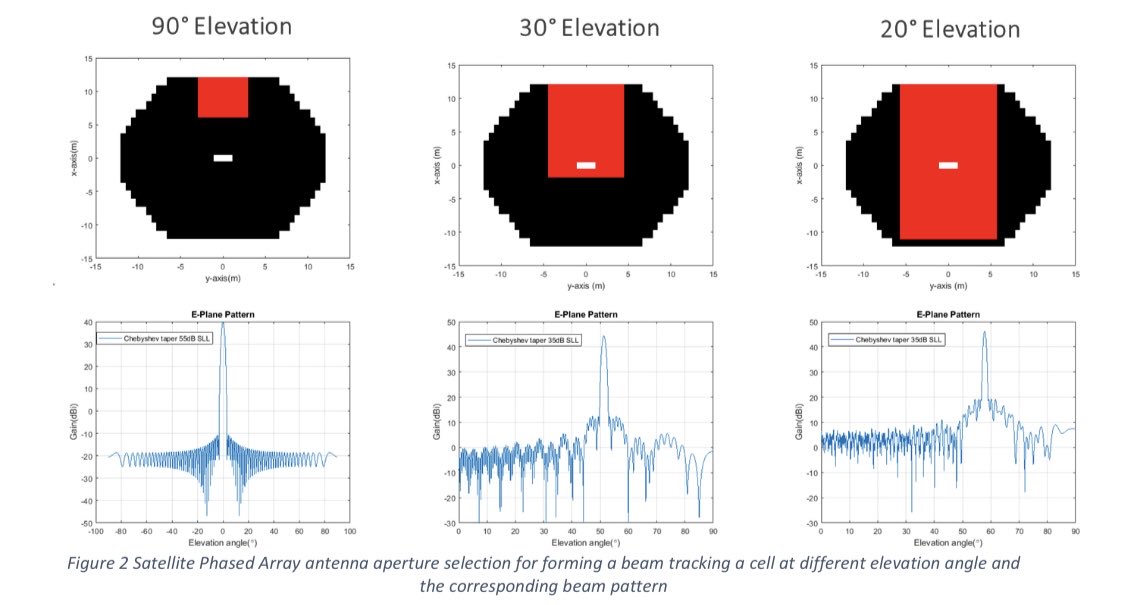

Let me just point out that for every other scan angle, where 0.3-0.4 λ underperforms AST has a fix for it to get the directivity up on par with 0.5 λ and keep cell size and gain comparable.
- use more of the array than on 0.5 λ !
Yes.
18
And that’s why we see this ~1: 1.5 ratio between upper and lower boundary for Block 2 lowband capability.
And for the Micronsat-2 filing range for Block3 ~same ratio.
-Is this you cutting to the point fast?
Hold on. Helping Anpan adress his question. And base that on physics.
And for the Micronsat-2 filing range for Block3 ~same ratio.
-Is this you cutting to the point fast?
Hold on. Helping Anpan adress his question. And base that on physics.
19
-I’ll tell you when I see that. So far you managed to make FCC look fast, cat.
Well. I’m adressing the trade-off to do Ligado lower midband spectrum.
As Anpan outlined the ASIC chip is prepared for this spectrum. Good to go.
We’ll discuss Block 3 design.
-Get
-On
-With
-It
Well. I’m adressing the trade-off to do Ligado lower midband spectrum.
As Anpan outlined the ASIC chip is prepared for this spectrum. Good to go.
We’ll discuss Block 3 design.
-Get
-On
-With
-It
20
Right.
Fim Tarrar, a highly regarded expert, recently tweeted that AST would need to redesign their satellites for lower midband spectrum.
While being precise and consistent on the subject of AST this particular consultant is precisely and consistently wrong.
Fim Tarrar, a highly regarded expert, recently tweeted that AST would need to redesign their satellites for lower midband spectrum.
While being precise and consistent on the subject of AST this particular consultant is precisely and consistently wrong.
21
AST ASIC 5000 chip needs not be redesigned.
And Block 2 needs not be ”redesigned” as they’re feederlink constrained and made for a fairly wide range of lowband.
Never intended for midband nor lower midband.
They are for 617-960 MHz.
They’re in priduction.
First tier to launch
And Block 2 needs not be ”redesigned” as they’re feederlink constrained and made for a fairly wide range of lowband.
Never intended for midband nor lower midband.
They are for 617-960 MHz.
They’re in priduction.
First tier to launch
22
Next tier, we’ll call Block 3.
1526-1536 MHz and 1627.5-1637.5 MHz
are spectrum ranges on the first domino aquired from Ligado.
We are going to use the lower boundary 1526 MHz and apply that to the 1:1.55 ratio which is a Block 3 design criteria.
We then arrive at 2365 MHz
1526-1536 MHz and 1627.5-1637.5 MHz
are spectrum ranges on the first domino aquired from Ligado.
We are going to use the lower boundary 1526 MHz and apply that to the 1:1.55 ratio which is a Block 3 design criteria.
We then arrive at 2365 MHz
23
2365 MHz is less than the 2690 of MICRONSAT-2 a 325 MHz block of ”upper” midband spectrum that an Block 3 will likely not be able to do when targeting lower midband.
And so what to make of that tradeoff?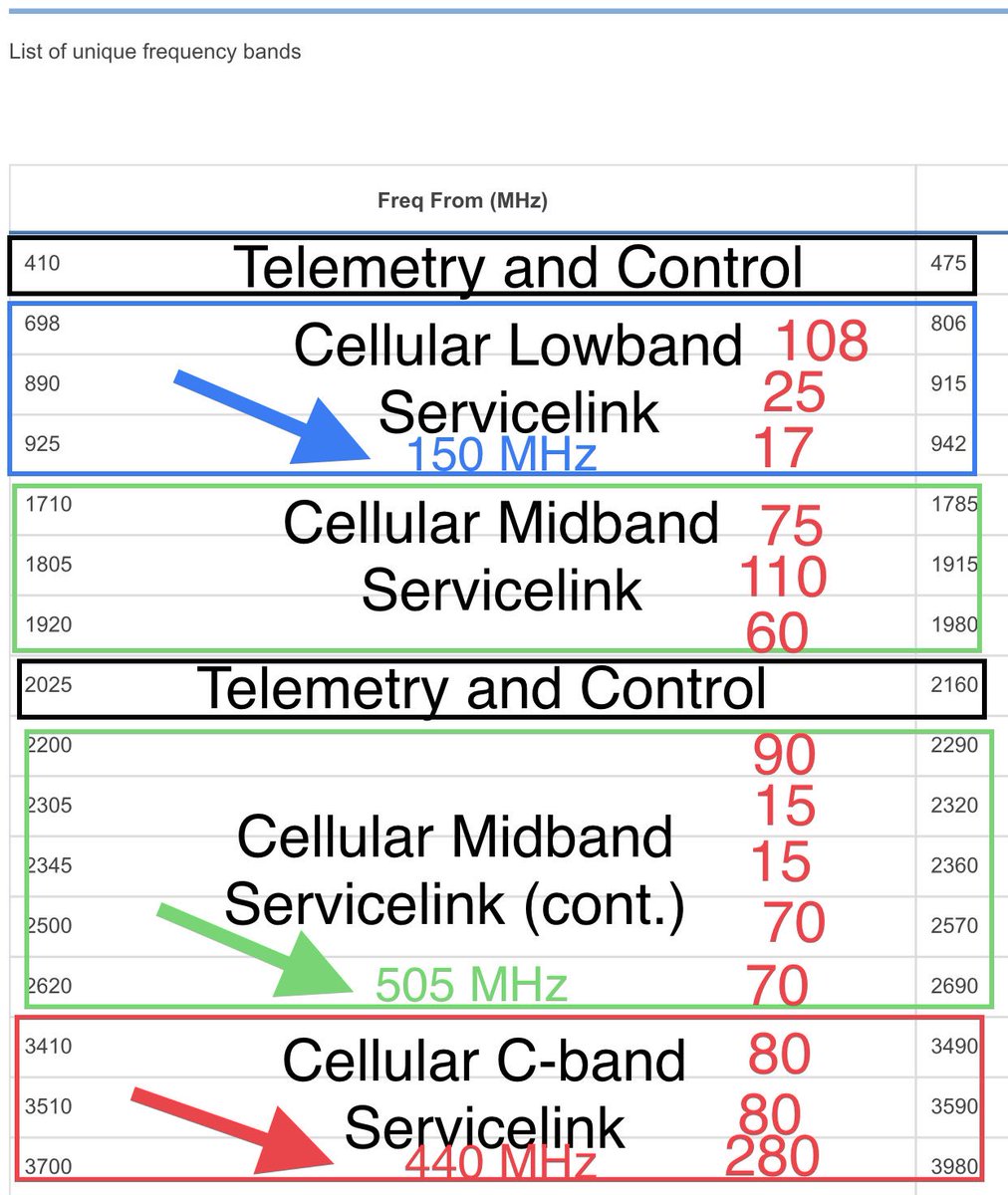
And so what to make of that tradeoff?
24
The range includes Some 5G bands:
n7: 2500-2570 MHz (uplink) and 2620-2690 MHz (downlink) - FDD (Frequency Division Duplex)
n38: 2570-2620 MHz - TDD (Time Division Duplex)
n41: 2496-2690 MHz - TDD
If /when doing these AST would be supplementary. It’d also be on towers.
n7: 2500-2570 MHz (uplink) and 2620-2690 MHz (downlink) - FDD (Frequency Division Duplex)
n38: 2570-2620 MHz - TDD (Time Division Duplex)
n41: 2496-2690 MHz - TDD
If /when doing these AST would be supplementary. It’d also be on towers.
25
When doing lower midband it would be omnipresent. Also rural and suburban.
This adds the omipresent satellite component in 6G nicely without becoming an opportunity cost tug of war between satellites or tower use of midband spectrum.
Revenue share cut increased for AST.
This adds the omipresent satellite component in 6G nicely without becoming an opportunity cost tug of war between satellites or tower use of midband spectrum.
Revenue share cut increased for AST.
26
Then, as Anpanman covered, the propagation charachteristics of lower midband (1.6 GHz) through buildings/walls and foliage is vastly better than ”upper” midband (2.7 Ghz) so it makes sense to rather incorporate the lower than upper end of that range.
27
Finally the spectrum that AST ”gives up” by incorporating the lower midband is primarily owned by T-Mobile in the USA and or fractionated and used for other stuff than 5G.
So in the single most important market they can’t do it anyway.
I conclude capturing 1.5-1.7 is worth it


So in the single most important market they can’t do it anyway.
I conclude capturing 1.5-1.7 is worth it
28
Capturing up to -2360 MHz is more important than capturing 2496- and above the way the Spectrum is owned.
And to the best of my understanding a Block3 satellite would be able to span to 2365 while also capturing Ligados band.
It’s fitting that’s were AT&T ends and TMUS start 🐾

And to the best of my understanding a Block3 satellite would be able to span to 2365 while also capturing Ligados band.
It’s fitting that’s were AT&T ends and TMUS start 🐾
29
- Can I do the TL/DR now?
Yes please. I see you prepared a sign to show it. I’m glad I finally got an assistant.
-You’re welcome. I also have a link.

Yes please. I see you prepared a sign to show it. I’m glad I finally got an assistant.
-You’re welcome. I also have a link.

