Huawei is strategically differentiating its product lines globally...

Living In Harmony ⭕🔥🥉🏅🕊🦾🆙🆗🎯🔑💼🛡️👑🇨@LivingInHarmony
33 views
Dec 15, 2024
~4 min read
Advertisement
1
Huawei is strategically differentiating its product lines globally while leveraging its large install base in China. Here's a detailed breakdown of their approach:
1. Pura Series: Focused on high-end camera technology, the Pura series aims to deliver exceptional photography

1. Pura Series: Focused on high-end camera technology, the Pura series aims to deliver exceptional photography
2
experiences. This series is designed for users who prioritize camera performance¹(techadvisor.com/article/254817…).
2. Mate Series: Emphasising innovative foldable designs, the Mate series, including models like the Mate X6, showcases Huawei's advancements in foldable technology. These
2. Mate Series: Emphasising innovative foldable designs, the Mate series, including models like the Mate X6, showcases Huawei's advancements in foldable technology. These
3
devices combine powerful performance with sleek, durable designs²(trustedreviews.com/news/huawei-ma…)³(en.wikipedia.org/wiki/List_of_H…).
3. Nova Series: The Nova 12/Pro/i models cater to the mid-range market, offering a balance of performance and affordability. These devices are streamlined to
3. Nova Series: The Nova 12/Pro/i models cater to the mid-range market, offering a balance of performance and affordability. These devices are streamlined to
4
provide a solid user experience without the premium price tag³(en.wikipedia.org/wiki/List_of_H…).
4. China Market: In China, Huawei introduces various flagship and foldable models tailored to meet local market demands. This allows them to maintain a strong presence in their home market
4. China Market: In China, Huawei introduces various flagship and foldable models tailored to meet local market demands. This allows them to maintain a strong presence in their home market
5
while also catering to global consumers with specialized product lines¹(techadvisor.com/article/254817…)²(trustedreviews.com/news/huawei-ma…).
5. MatePad Tablets, MateBook Laptops, AIO PCs, and Foldable PCs: Huawei continues to expand its ecosystem with a range of devices, including MatePad tablet
5. MatePad Tablets, MateBook Laptops, AIO PCs, and Foldable PCs: Huawei continues to expand its ecosystem with a range of devices, including MatePad tablet
6
s, MateBook laptops, all-in-one PCs, and foldable PCs. These products are designed to offer seamless integration and a cohesive user experience across different device categories³(en.wikipedia.org/wiki/List_of_H…).
6. Wearables: Huawei's wearable lineup includes the health-focused D
6. Wearables: Huawei's wearable lineup includes the health-focused D
7
series, the sports-orientated GT series, and the casual wear Watch line. These wearables cater to different user needs, from health monitoring to fitness tracking and everyday use³(en.wikipedia.org/wiki/List_of_H…).
8
This multi-faceted strategy helps Huawei cater to diverse consumer needs and preferences, ensuring they remain competitive in various market segments
9
Huawei is indeed adopting a dual strategy:
1. Global Market: Similar to Apple's approach, Huawei is focusing on streamlined, high-end product lines like the Pura series for exceptional camera capabilities and the Mate series for innovative foldable designs. This strategy helps
1. Global Market: Similar to Apple's approach, Huawei is focusing on streamlined, high-end product lines like the Pura series for exceptional camera capabilities and the Mate series for innovative foldable designs. This strategy helps
10
them maintain a strong, premium brand image internationally.
2. Chinese Market: At home, Huawei embraces a more diverse, Android-like strategy. They offer a wide range of products, including various flagship and foldable models, to cater to different consumer preferences. This
2. Chinese Market: At home, Huawei embraces a more diverse, Android-like strategy. They offer a wide range of products, including various flagship and foldable models, to cater to different consumer preferences. This
11
includes a broad ecosystem of devices like MatePad tablets, MateBook laptops, AIO PCs, foldable PCs, and a variety of wearables (health-focused D series, sports-orientated GT series, and casual Watch line) worldwide.
This dual approach allows Huawei to leverage its strengths and
This dual approach allows Huawei to leverage its strengths and
12
adapt to different market demands effectively.
Are you more interested in Huawei's global offerings or their diverse range of products in China?
Are you more interested in Huawei's global offerings or their diverse range of products in China?
13
The sales volume of Mate 40 is the highest in the Mate series, with a sales record of 32.3 million units, which is expected to be broken in the future... let's wait to Mate 90 or Pura 90
14
(Mate 80 H2 2025, Pura 90/Mate 90 2026 eras—time will tell on the Mate flagship smartphone return in 2025-2026 or foldable Mate brand handsets being the norm—most likely the latter)
15
With dual Apple style niche approach globally and Android-style approach in China in product line streamlining, they can approach dual domestic and global markets with Huawei branded growth growing HarmonyOS against Apple/Google branded Premium lines on top of growing
16
OpenHarmony while getting vendors all in on OpenHarmony domestic computing growth and global growth on Oniro in China. As a result, growing OpenHarmony worldwide entirely competitively against Android/Windows large volume mobile/PC targets
17
"and enter international markets in 2026 to compete directly with Android."
Bare in mind Google plans to expand their Android large volume global mobile install base into the PC segement around this time period 2025-2026+.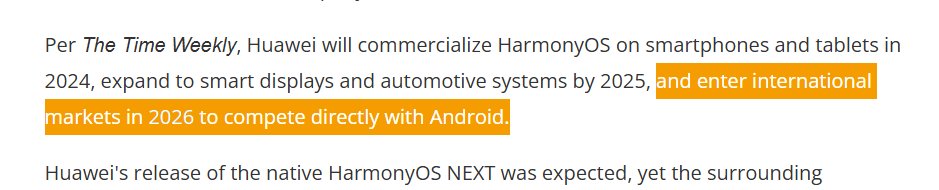
Bare in mind Google plans to expand their Android large volume global mobile install base into the PC segement around this time period 2025-2026+.
18
Huawei's HarmonyOS plans global expansion by 2026, taking on Android with ground-up developer migration digitimes.com/news/a20241111…
19
A Google PC running Android could be in the works
A new rumor points to the release of a high-end laptop running Google's Android operating system, coming in 2025....
Google is reportedly working on an Android-based PC.
msn.com/en-us/news/tec….
A new rumor points to the release of a high-end laptop running Google's Android operating system, coming in 2025....
Google is reportedly working on an Android-based PC.
msn.com/en-us/news/tec….
20
Digitimes and it's source, The Time Weekly, were actually talking about OpenHarmony on PC market
21
3rd party hardwares
22
same with the headsets in 2026. I believe OpenAtom will give room for Huawei growth in 2025 in both PC and headset segments. before 3rd party vendors in China and shortly global pursuing their own from Eclipse
23
Huawei has to lead the way in the OpenHarmony segment before success can be replicated in the right way, right execution of these volatile segments unlike mobile and tablets, wearables.
24
If Huawei don't lead it, no hardware category expansions
25
There's a reason why in China, there is a division called "Huawei terminals" on it's BiliBili account