Hi everyone I can't post articles but I just want to give free info...

giyu_codes@giyu_codes
8 views
Dec 02, 2025
~6 min read
Advertisement
1
Hi everyone I can't post articles but I just want to give free info so here you go:
Here is what I learned from building an "AI on Small-Medium Enterprise" app as the sole Full Stack AI/ML developer.
This helped one client, who manages over 150+ businesses, save significant time and money by leveraging their own operational intelligence.
post 1/??
Here is what I learned from building an "AI on Small-Medium Enterprise" app as the sole Full Stack AI/ML developer.
This helped one client, who manages over 150+ businesses, save significant time and money by leveraging their own operational intelligence.
post 1/??
2
Data silos are killing your efficiency.
Your data is isolated in accounting, CRM, emails, documents, phonecalls, ticketing systems —all disconnected.
Result? Wasted time and missed opportunities.
Stop looking up the same things up each time and renewing SOPs.
2/??
Your data is isolated in accounting, CRM, emails, documents, phonecalls, ticketing systems —all disconnected.
Result? Wasted time and missed opportunities.
Stop looking up the same things up each time and renewing SOPs.
2/??
3
I built a system of specialized workers, each handling a data source, all orchestrated by an AI Agent/Engine facilitated through natural language.
Real work and real results through actionable feedback and REPORTS.
3/??
Real work and real results through actionable feedback and REPORTS.
3/??
4
Tech stack is secondary. Use what fits your use case and the comfort of your dev team.
I used Python, FastAPI, a vector DB, and MongoDB for storage.
You can definitely use Postgresql with pgvector.
Don't fight me on this, use whatever.
Key: rapid iteration and deployment. Focus on the data, not the shiny tools.
4/??
I used Python, FastAPI, a vector DB, and MongoDB for storage.
You can definitely use Postgresql with pgvector.
Don't fight me on this, use whatever.
Key: rapid iteration and deployment. Focus on the data, not the shiny tools.
4/??
5
Build connectors to ingest data from multiple sources. Standardized the format on the way in.
Devs: Modular design is key. Adding a new third party API source should take days, not weeks. 2-3 days on average for me.
This include Oauth2, encryption handling, data ETL, etc.
I'll talk about legacy stuff later, but that's a pain in the butt and I did it for an IT company.
5/??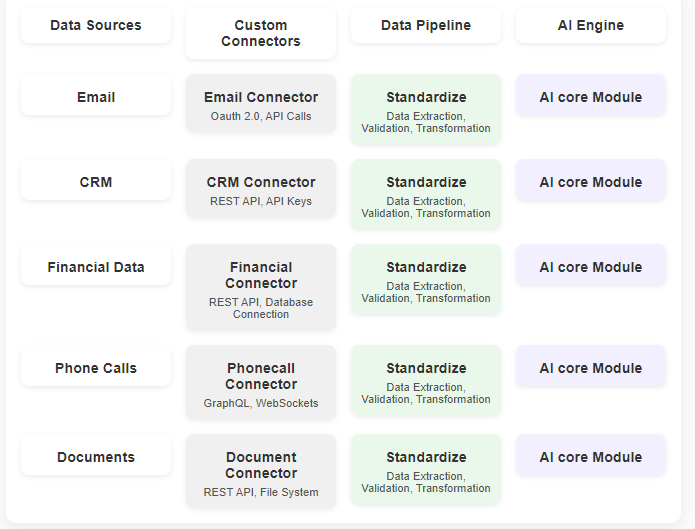
Devs: Modular design is key. Adding a new third party API source should take days, not weeks. 2-3 days on average for me.
This include Oauth2, encryption handling, data ETL, etc.
I'll talk about legacy stuff later, but that's a pain in the butt and I did it for an IT company.
5/??
6
Look at your data, love your data, BE THE DATA. Utilize structured outputs.
We're talking layers: chunking, topic extraction (LDA), entity detection (NER). We're mapping the *meaning* of your text and associating your ecosystem so it knows who is who and what is what.
Real data, real search results.
Make sure you build this pipeline out in a way that is repeatable and recordable, because then you'll benefit by being able to take advantage of new properties that you might need later on.
Example:
If you're using MongoDB's ENN search, you can update the properties and add them as filters - making it easier to go from structured output -> retrievals.
6/??
We're talking layers: chunking, topic extraction (LDA), entity detection (NER). We're mapping the *meaning* of your text and associating your ecosystem so it knows who is who and what is what.
Real data, real search results.
Make sure you build this pipeline out in a way that is repeatable and recordable, because then you'll benefit by being able to take advantage of new properties that you might need later on.
Example:
If you're using MongoDB's ENN search, you can update the properties and add them as filters - making it easier to go from structured output -> retrievals.
6/??
7
Vector DBs are great, but consider MongoDB or PostgreSQL.
Filtering is powerful, but schema flexibility matters more long-term. Adapt to your existing auth and user roles. You don't want to be sloppy and send privileged information to the wrong users.
7/??
Filtering is powerful, but schema flexibility matters more long-term. Adapt to your existing auth and user roles. You don't want to be sloppy and send privileged information to the wrong users.
7/??
8
LLMs: Context window, embeddings, output structure matter more than how the response "feels". Don't settle for a vibe check.
Prompt engineering is great! But, it is important to build a RAG architecture that feeds the LLM precisely what it needs.
Record your outputs, get users feedback from a UI that isn't just thumbs up/thumbs down.
If you don't want to get user feedback, at least know what data was sent to them so you can review it yourself early on and determine whether or not it was relevant to the query.
Test it, validate it, iterate!
8/??
Prompt engineering is great! But, it is important to build a RAG architecture that feeds the LLM precisely what it needs.
Record your outputs, get users feedback from a UI that isn't just thumbs up/thumbs down.
If you don't want to get user feedback, at least know what data was sent to them so you can review it yourself early on and determine whether or not it was relevant to the query.
Test it, validate it, iterate!
8/??
9
Data Cleaning Strategy Across Sources:
Extract Key Entities: Every source has critical information to unpack
Emails: Remove noise like disclaimers, signatures, social media links in the closing tags - via regex
Docs: Capture structured metadata, restructure and summarize docs in smaller chunks for efficiency, make sure you keep track of who created the document, who it was shared to, and all other RBAC.
Financial: Map amounts, invoices, timestamps, turn this into human readable sentences and create stories from them for possible summarizations.
CRM: Categorize topics, assign data to the correct people
Voice: Transcribe, extract topics, take note of who is involved, use any metadata to improve the prompts before you tanscribe. Even better, gather all transcriptions and create summaries by company, by employees, by employee->customer, gather sentiment, etc.
9/??
Extract Key Entities: Every source has critical information to unpack
Emails: Remove noise like disclaimers, signatures, social media links in the closing tags - via regex
Docs: Capture structured metadata, restructure and summarize docs in smaller chunks for efficiency, make sure you keep track of who created the document, who it was shared to, and all other RBAC.
Financial: Map amounts, invoices, timestamps, turn this into human readable sentences and create stories from them for possible summarizations.
CRM: Categorize topics, assign data to the correct people
Voice: Transcribe, extract topics, take note of who is involved, use any metadata to improve the prompts before you tanscribe. Even better, gather all transcriptions and create summaries by company, by employees, by employee->customer, gather sentiment, etc.
9/??
10
Context is king, but data is the kingdom.
- Transform raw data into human-readable insights
- Metadata guides search, not just keywords.
- Use past successes to improve extraction.
- Respect access controls
- Adaptive Cleaning: No one-size-fits-all approach.
10/??
- Transform raw data into human-readable insights
- Metadata guides search, not just keywords.
- Use past successes to improve extraction.
- Respect access controls
- Adaptive Cleaning: No one-size-fits-all approach.
10/??
11
Deduplication is a must-have.
For emails: we use message IDs + fuzzy matching on content. One source of truth, tied to correct users and permissions.
For documents: keep track of who created, who it's shared to, and who can read it. Update last edits, on occasion and use any algorithm you want to determine how often you should update. IMO, it should be max once a day before the work day to start.
11/??
For emails: we use message IDs + fuzzy matching on content. One source of truth, tied to correct users and permissions.
For documents: keep track of who created, who it's shared to, and who can read it. Update last edits, on occasion and use any algorithm you want to determine how often you should update. IMO, it should be max once a day before the work day to start.
11/??
12
This app was built with the goal of soc2 compliance including encryption on credentials like API keys, encryption on data at rest/data in transit, multi-factor auth, data minimization/retention/disposal, change management, risk management, but still some ways to go.
12/??
12/??
13
IT/OT integration is a nightmare. ERP, NUCs, legacy hardware, etc.
The AI engine ingests data from anything with a pulse – custom connectors, secure protocols, edge devices, you name it.
STANDARDIZE YOUR DATA PROPERTIES. Metadata, timestamps, data type (ticket, incidents ids, emails, phonecall source, you name it).
You'll likely have to make custom integration via REST or SOAP apis, maybe even some middleware. If you're lucky, all of your data will be available through third party api (jokes on you this is like nobody ever)
You can keep your data as is from your prem, but again STANDARDIZE IT to your AI Engine data schema.
You will need to spend the most time here standardizing your data btw.
13/??
The AI engine ingests data from anything with a pulse – custom connectors, secure protocols, edge devices, you name it.
STANDARDIZE YOUR DATA PROPERTIES. Metadata, timestamps, data type (ticket, incidents ids, emails, phonecall source, you name it).
You'll likely have to make custom integration via REST or SOAP apis, maybe even some middleware. If you're lucky, all of your data will be available through third party api (jokes on you this is like nobody ever)
You can keep your data as is from your prem, but again STANDARDIZE IT to your AI Engine data schema.
You will need to spend the most time here standardizing your data btw.
13/??
14
Results:
We're talking slashed reporting times, quicker RFPs, automated SOPs with context and verified incidents to help support the case.
What took days now takes minutes.
Faster response times, and data-driven decisions that help boost the bottom line and increase revenue. This is about building value.
Imagine you get out of the elevator, sit in your desk, and within 30 seconds you have your assignments with context on how to solve those problems, phone numbers of who to call, and now you're prepared to kick ass.
You're welcome, you just saved 30 minutes of preparation time and 15% or more off car insurance when using geico.
14/??
We're talking slashed reporting times, quicker RFPs, automated SOPs with context and verified incidents to help support the case.
What took days now takes minutes.
Faster response times, and data-driven decisions that help boost the bottom line and increase revenue. This is about building value.
Imagine you get out of the elevator, sit in your desk, and within 30 seconds you have your assignments with context on how to solve those problems, phone numbers of who to call, and now you're prepared to kick ass.
You're welcome, you just saved 30 minutes of preparation time and 15% or more off car insurance when using geico.
14/??
15
I wish I could make it all fun and fancy with tons of images, docs, and code, but this was just a writing bender to get all of this out there and im not trying to be an influencer.
If you want more details, book a call now, hire me, or get in line because there are people already interested in this from me. (with love I promise).
Please comment, criticize, tell me im wrong, tell me im right, anything. I want to learn from everyone else just as much as you might want to learn from me.
If I could restart this project now, I would do it a bit different and it would be WAY better because of all of the recent AI improvements over the last 6 months from when I last worked on this.
15/15
If you want more details, book a call now, hire me, or get in line because there are people already interested in this from me. (with love I promise).
Please comment, criticize, tell me im wrong, tell me im right, anything. I want to learn from everyone else just as much as you might want to learn from me.
If I could restart this project now, I would do it a bit different and it would be WAY better because of all of the recent AI improvements over the last 6 months from when I last worked on this.
15/15

