Thoughts on the #SAFC & #LUFC Out of Possession (OOP) shapes 👇 I...

SAFC Tactical@TacticalSAFC
12 views
Oct 12, 2024
~7 min read
Advertisement
1
Thoughts on the #SAFC & #LUFC Out of Possession (OOP) shapes 👇
I didn't catch the game live, but after watching up to the first goal, it was interesting to compare Sunderland and Leeds' differing approaches to their Out of Possession shapes - and how they reveal the weaknesses of one another
In the previous few games, post-Mayenda, Sunderland's 442 defensive block has repeatedly been exposed. Teams have focused on wide overloads and patient centre back build up with the following objective:
1) Draw in the wide midfielders towards the centre by circulating the ball in the half spaces, either side of Sunderland's front two
2) Find a wide player near the touchline behind Sunderland's wide midfielder, forcing the full back to step up
3) Exploit the gap created behind the full back for early crosses, cut backs and cut-ins against a retreating and stretched back line
This would frequently result in the opposition making in roads behind Cirkin when he stepped up, or Hume being dragged across on the opposite flank. In the latter case, Neil would drop from his RCM position into RCB, sometimes starting in that position for opposition goal kicks.
This caused indecision within the block, and left a vacuum in the centre of the pitch that Rigg would have to plug, causing our 442 to collapse into a poorly coordinated 541/451, with the back line sitting deeper and deeper as the front press lost its bite.
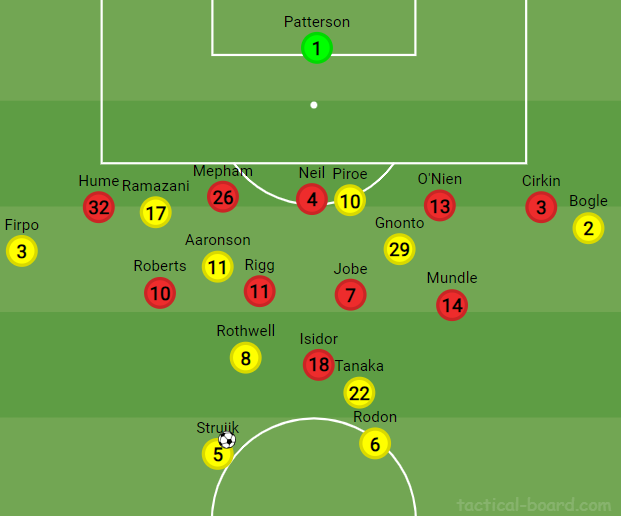
As Ethan mentions here, to alleviate these recurrent problems, Sunderland started with a 541 defensive shape this game. I believe the guiding principles are as follows:
1) Reduce the movement required from Neil by only having him drop vertically into the CCB position, rather than diagonally/laterally into the RCB position to cover Hume
2) Maintain width in the back line by default, rather than having a FB compromise the shape of the block when he presses the the winger
3) When the FBs do press, have them covered by a CB - who are better in 1v1 duels than Neil. By keeping Neil central, you prioritise his intercepting ability, and mitigate his weak 1v1 ground duelling
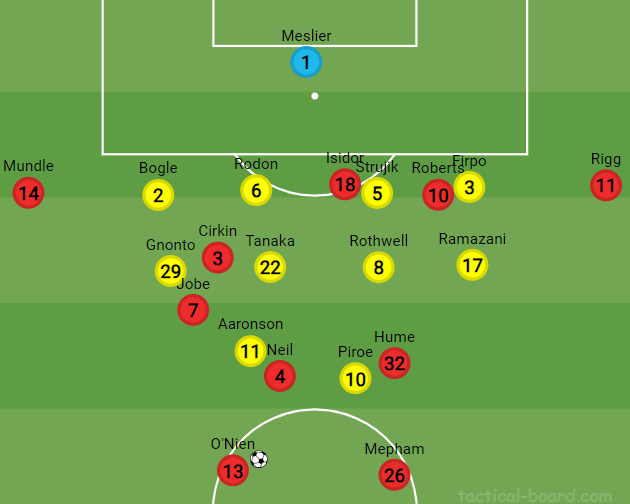
In contrast, Leeds opted for our typical 442 shape - two rigid banks of four protecting the centre, shuttling across from flank to flank in unison and dropping deep as one unit in transition:
Both out of possession shapes showcased the vulnerabilities - and subsequent dilemmas - that a team faces when choosing their OOP shape:
Leeds:
▫️ A 442 block depends on;
- The discipline of the team to maintain the shape and move around the pitch in-sync
- Competent interceptors in central midfield + minimising gaps between the lines in transition to protect the middle
- Wingers willing to track back to protect the full back (either by covering them, or pressing the attacking winger themselves)
▫️ Sunderland repeatedly exposed the vulnerabilities in a defensive block that fails to adhere to these rules:
🟥Example 1 (5th Minute):
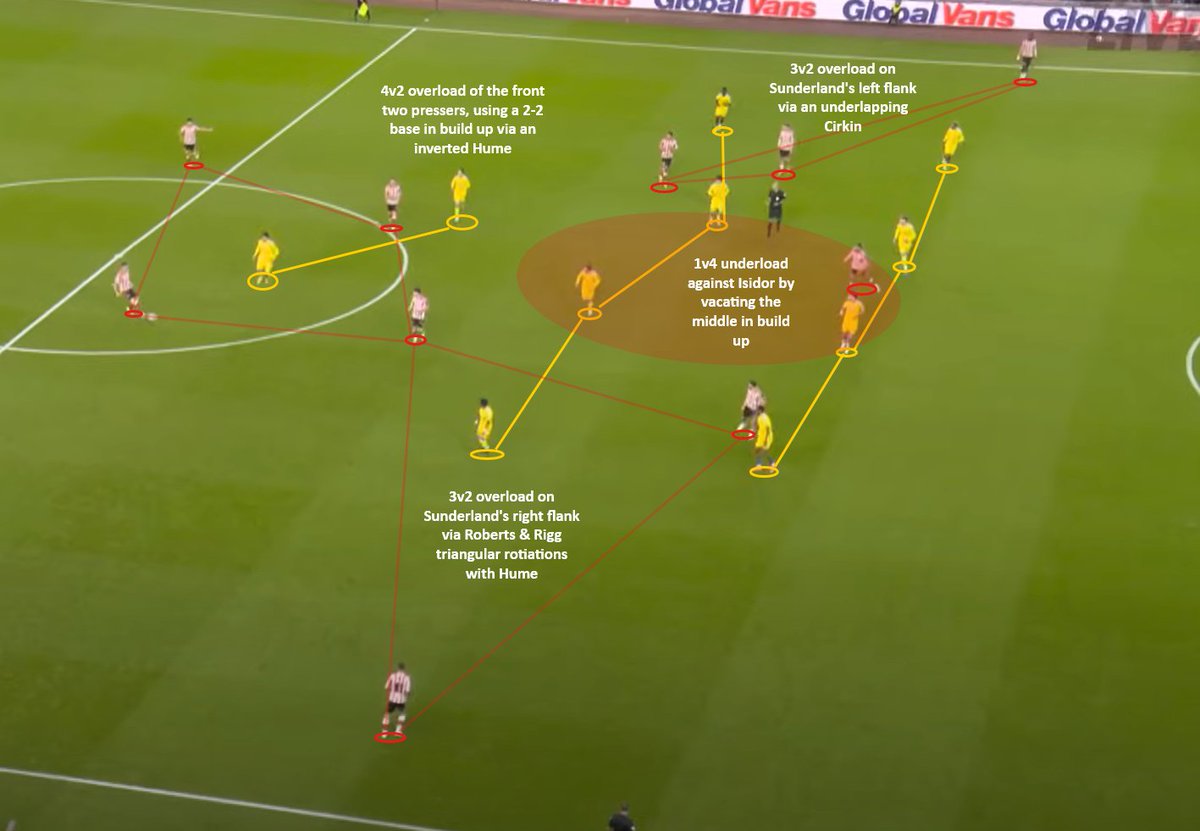
🔺Sunderland use a 2-2 build up by Hume inverting alongside Neil, to overload Aaronson and Piroe
🔺As in previous games, they emphasise triangular rotations and overloads out wide, rather than building through the centre of a block - Hume/Roberts/Rigg on the right, Cirkin/Jobe/Mundle on the left - this also leaves the striker isolated (intentionally) in build up
🔺The ball is played into Hume (drawing in the LCM and LM), who fires a through ball into Rigg down the flank, which in turn forces Firpo to come across
🔺Large gaps form between between the lines, where Rigg is able to find Roberts with a cut back in acres of space, before he passes to Jobe on the edge (who skies it over the crossbar)
🟥 Example 2 (1st Goal):
🔺Sunderland circulate the ball to the right wing following possession on the left, finding Roberts out wide and again forcing Firpo across
🔺Due to the lateral switch of possession, the Leeds block has to shuttle across in unison so they can engage Roberts without compromising the shape
🔺However Gnonto fails to track back, leading to the midfield being stretched - Aaronson has to drop from the front line to compensate, but Leeds fail to plug the hole behind Firpo and Hume is able to make an underlapping run
🔺Simultaneously, Jobe and Cirkin overload the far side - with Cirkin able to get a shot off at the back post
🔺With the block uncoordinated and in disarray, Rigg is able to waltz into a large gap in the centre, ready for the tap in from Cirkin's deflected shot
These passages of play show that - although a 442 block can be difficult to play through when the defending team are highly coordinated and willing to track back consistently - it can be easily pulled apart by clever rotations and numerical overloads in wide zones
Sunderland's 541 was intended to compensate for these flaws, by minimising the running and covering required against a competent possession-based team like Leeds. It should in theory reduce the possibility of underlaps and gaps in the backline.
However, that too comes with it's own flaws, which led to the first Leeds goal:
🔺The shape trades an aggressive front press for a wider back line, which in turn cedes possession either side of the lone striker - meaning Isidor frequently had to shuttle from side to side or have a winger tuck in behind him. However, this meant Leeds were able to progress up the half spaces with their centre-backs or double pivot largely unopposed
▫️ The Goal
🔺Carry up right half space from Rothwell, gaining about 20 yards into Sunderland's half, whilst drawing Mundle centrally and Jobe forward before finding Bogle out wide
🔺With Sunderland's midfield pulled forward, Leeds' attackers rush to overload the defence, and a retreating back line creates large gaps between the defence and midfield
🔺(With the assumed cover of the back 5, and Mundle pulled centrally by Rothwell) Cirkin rushes to press Bogle, leaving a gap behind him that Gnonto occupies, with O'Nien chasing. Instead, Bogle tries to find Aaronson in the right half space instead, causing O'Nien to freeze when he initially moves to intercept
🔺However, Jobe is tracking back to plug the gaps between the lines, and his outstretched leg intercepts the pass, but diverts the ball straight to the now-unmarked Gnonto
🔺Meanwhile, Mepham has been tracking Piroe, but he holds the line for a fraction of a second to play him offside. However, with O'Nien caught in two minds, he continues to back pedal - staying level with Piroe and (in the eyes of the linesman at least) keeping him onside and enabling him to get free of Mepham for the goal
So for all the 541 is intended to stop those wide overloads stretching the play, the lack of pressure against Leeds' build up enables them to pull the wide midfielders centrally and manufacture the same overloads that were created against our 442
The goal comes from a well-intended effort by Jobe to close the gap in the centre, but one which ultimately freed Gnonto for a deep cross. Some (honestly negligible) offside positioning by Piroe, enabled by a backpedalling O'Nien caught in two minds, meant the width benefit of the new shape were made redundant.
(End of Analysis)
Still yet to watch the rest of the game, but thought the opening 20 minutes and plenty to feast on - lots to talk about for the differing in-possession approaches against hard working blocks two
(note from the first two graphics, that the approaches are largely the same, with a 2-2 base and 6v4 or 6v5 against the back line - the difference is which players you allocate to which roles, and Leeds willingness to rotate centrally, rather than just out wide)
Let me know if you enjoyed this piece or have any thoughts! Might do some more after watching the full game, given that it's an international break
#Sunderland #LeedsUnited #EFL #Championship


I didn't catch the game live, but after watching up to the first goal, it was interesting to compare Sunderland and Leeds' differing approaches to their Out of Possession shapes - and how they reveal the weaknesses of one another
In the previous few games, post-Mayenda, Sunderland's 442 defensive block has repeatedly been exposed. Teams have focused on wide overloads and patient centre back build up with the following objective:
1) Draw in the wide midfielders towards the centre by circulating the ball in the half spaces, either side of Sunderland's front two
2) Find a wide player near the touchline behind Sunderland's wide midfielder, forcing the full back to step up
3) Exploit the gap created behind the full back for early crosses, cut backs and cut-ins against a retreating and stretched back line
This would frequently result in the opposition making in roads behind Cirkin when he stepped up, or Hume being dragged across on the opposite flank. In the latter case, Neil would drop from his RCM position into RCB, sometimes starting in that position for opposition goal kicks.
This caused indecision within the block, and left a vacuum in the centre of the pitch that Rigg would have to plug, causing our 442 to collapse into a poorly coordinated 541/451, with the back line sitting deeper and deeper as the front press lost its bite.
As Ethan mentions here, to alleviate these recurrent problems, Sunderland started with a 541 defensive shape this game. I believe the guiding principles are as follows:
1) Reduce the movement required from Neil by only having him drop vertically into the CCB position, rather than diagonally/laterally into the RCB position to cover Hume
2) Maintain width in the back line by default, rather than having a FB compromise the shape of the block when he presses the the winger
3) When the FBs do press, have them covered by a CB - who are better in 1v1 duels than Neil. By keeping Neil central, you prioritise his intercepting ability, and mitigate his weak 1v1 ground duelling
In contrast, Leeds opted for our typical 442 shape - two rigid banks of four protecting the centre, shuttling across from flank to flank in unison and dropping deep as one unit in transition:
Both out of possession shapes showcased the vulnerabilities - and subsequent dilemmas - that a team faces when choosing their OOP shape:
Leeds:
▫️ A 442 block depends on;
- The discipline of the team to maintain the shape and move around the pitch in-sync
- Competent interceptors in central midfield + minimising gaps between the lines in transition to protect the middle
- Wingers willing to track back to protect the full back (either by covering them, or pressing the attacking winger themselves)
▫️ Sunderland repeatedly exposed the vulnerabilities in a defensive block that fails to adhere to these rules:
🟥Example 1 (5th Minute):
🔺Sunderland use a 2-2 build up by Hume inverting alongside Neil, to overload Aaronson and Piroe
🔺As in previous games, they emphasise triangular rotations and overloads out wide, rather than building through the centre of a block - Hume/Roberts/Rigg on the right, Cirkin/Jobe/Mundle on the left - this also leaves the striker isolated (intentionally) in build up
🔺The ball is played into Hume (drawing in the LCM and LM), who fires a through ball into Rigg down the flank, which in turn forces Firpo to come across
🔺Large gaps form between between the lines, where Rigg is able to find Roberts with a cut back in acres of space, before he passes to Jobe on the edge (who skies it over the crossbar)
🟥 Example 2 (1st Goal):
🔺Sunderland circulate the ball to the right wing following possession on the left, finding Roberts out wide and again forcing Firpo across
🔺Due to the lateral switch of possession, the Leeds block has to shuttle across in unison so they can engage Roberts without compromising the shape
🔺However Gnonto fails to track back, leading to the midfield being stretched - Aaronson has to drop from the front line to compensate, but Leeds fail to plug the hole behind Firpo and Hume is able to make an underlapping run
🔺Simultaneously, Jobe and Cirkin overload the far side - with Cirkin able to get a shot off at the back post
🔺With the block uncoordinated and in disarray, Rigg is able to waltz into a large gap in the centre, ready for the tap in from Cirkin's deflected shot
These passages of play show that - although a 442 block can be difficult to play through when the defending team are highly coordinated and willing to track back consistently - it can be easily pulled apart by clever rotations and numerical overloads in wide zones
Sunderland's 541 was intended to compensate for these flaws, by minimising the running and covering required against a competent possession-based team like Leeds. It should in theory reduce the possibility of underlaps and gaps in the backline.
However, that too comes with it's own flaws, which led to the first Leeds goal:
🔺The shape trades an aggressive front press for a wider back line, which in turn cedes possession either side of the lone striker - meaning Isidor frequently had to shuttle from side to side or have a winger tuck in behind him. However, this meant Leeds were able to progress up the half spaces with their centre-backs or double pivot largely unopposed
▫️ The Goal
🔺Carry up right half space from Rothwell, gaining about 20 yards into Sunderland's half, whilst drawing Mundle centrally and Jobe forward before finding Bogle out wide
🔺With Sunderland's midfield pulled forward, Leeds' attackers rush to overload the defence, and a retreating back line creates large gaps between the defence and midfield
🔺(With the assumed cover of the back 5, and Mundle pulled centrally by Rothwell) Cirkin rushes to press Bogle, leaving a gap behind him that Gnonto occupies, with O'Nien chasing. Instead, Bogle tries to find Aaronson in the right half space instead, causing O'Nien to freeze when he initially moves to intercept
🔺However, Jobe is tracking back to plug the gaps between the lines, and his outstretched leg intercepts the pass, but diverts the ball straight to the now-unmarked Gnonto
🔺Meanwhile, Mepham has been tracking Piroe, but he holds the line for a fraction of a second to play him offside. However, with O'Nien caught in two minds, he continues to back pedal - staying level with Piroe and (in the eyes of the linesman at least) keeping him onside and enabling him to get free of Mepham for the goal
So for all the 541 is intended to stop those wide overloads stretching the play, the lack of pressure against Leeds' build up enables them to pull the wide midfielders centrally and manufacture the same overloads that were created against our 442
The goal comes from a well-intended effort by Jobe to close the gap in the centre, but one which ultimately freed Gnonto for a deep cross. Some (honestly negligible) offside positioning by Piroe, enabled by a backpedalling O'Nien caught in two minds, meant the width benefit of the new shape were made redundant.
(End of Analysis)
Still yet to watch the rest of the game, but thought the opening 20 minutes and plenty to feast on - lots to talk about for the differing in-possession approaches against hard working blocks two
(note from the first two graphics, that the approaches are largely the same, with a 2-2 base and 6v4 or 6v5 against the back line - the difference is which players you allocate to which roles, and Leeds willingness to rotate centrally, rather than just out wide)
Let me know if you enjoyed this piece or have any thoughts! Might do some more after watching the full game, given that it's an international break
#Sunderland #LeedsUnited #EFL #Championship
Ethan Todd@Ethan__Todd2
Regis Le Bris admits to Sky Sports that Sunderland’s early defensive shape (5 back) “wasn’t the best”
- love how he takes responsibility when things aren’t going the way we want in the match and always looking to rectify and improve things in-game
Proper good coach 🇫🇷
#SAFC

