WARNING: this is a long ass post (pt 2.) I condensed 10 years of...

Alex Lieberman@businessbarista
68 views
Jul 21, 2024
~13 min read
Advertisement
1
WARNING: this is a long ass post (pt 2.)
I condensed 10 years of work on @MorningBrew into a 6-step process to build a successful newsletter business from scratch.
Let's hop in...
I condensed 10 years of work on @MorningBrew into a 6-step process to build a successful newsletter business from scratch.
Let's hop in...
2
Pt. 1 was a beast (full breakdown 👇).
Step 1: you picked your audience.
Step 2: you developed your content strategy.
Step 3: you mapped out your team.
Pt. 2 is all about execution.
Step 4: creating your newsletter.
Step 5: growing your newsletter.
Step 6: monetizing your newsletter.
we'll go through one-by-one...
Step 1: you picked your audience.
Step 2: you developed your content strategy.
Step 3: you mapped out your team.
Pt. 2 is all about execution.
Step 4: creating your newsletter.
Step 5: growing your newsletter.
Step 6: monetizing your newsletter.
we'll go through one-by-one...
Alex Lieberman@businessbarista
WARNING: this is a long ass post.
But I have a sneaky suspicion it's the most valuable post you'll read all week.
I condensed 10 years of work on @MorningBrew into a 6-step process to build a successful newsletter business from scratch.
Today, I reveal steps 1-3...
But I have a sneaky suspicion it's the most valuable post you'll read all week.
I condensed 10 years of work on @MorningBrew into a 6-step process to build a successful newsletter business from scratch.
Today, I reveal steps 1-3...
3
Step 4: Create the newsletter
tl;dr - A 3-phase, 1-month process to ensure you create a world-class newsletter that finds content-market fit within your niche.
Phase 1 - Nail the content (1 week)
Step 1: Create an MVP of one newsletter in Google Docs (based on pt 1). It should be exactly what you’d plan to send to your audience just without the final design.
- Use @storyarb for it if you need great writers
Step 2: Create a trusted circle of 8-10 readers & critics.
Don’t pick best friends or family. Pick people who are your market of 1 (see pt 1), will give you helpful feedback, and don’t care about hurting your feelings.
Step 3: Send your MVP to the circle & have them answer the following questions:
- Favorite section of the newsletter? Why?
- Least favorite section of the newsletter? Why?
- How would you describe the voice of the newsletter?
- Who would most benefit from reading this newsletter?
- What is one thing you’d change about the newsletter?
- What is one content idea you’d love to see tested?
Step 4: Edit the MVP based on the feedback that you believe enhances the quality of the newsletter.
Once done, you now have your sample newsletter, which will act as your standard (format, voice, quality) moving forward.
4
Phase 2 - Nail the process (1-3 weeks)
Goal: ensure editorial standard is high & editorial process is operating like clockwork.
If your newsletter is daily: send 1 week (5 newsletters) of daily newsletters to your trusted circle.
If your newsletter is weekly: send 2-3 weeks (2-3 newsletters) of weekly newsletters to your trusted circle.
At the same time, you should be ironing out your newsletter launch checklist in the background:
1) Select your email platform: I <3 @beehiiv
2) Design your newsletter: @joinpixels is great.
3) Design your website: i’d use @BrettFromDJ & then build on beehiiv.
4) Write your post-subscribe welcome email: @storyarb writers can crush this. This lets you:
a) Set expectations (what can the reader expect, when can they expect it, why should they be excited about it)
b) Enhance deliverability (instruct them to reply to the
email OR drag email to Primary)
5) Create your GTM plan (step 5 below)
Have at least 1 test run with your trusted circle that includes the full user flow.
website → sign-up → post-signup page → post-subscribe welcome email → email in inbox
Phase 3 - Nail the launch (1 day)
A+ launch =
A+ GTM execution +
A+ newsletter issue #1 execution
5
Step 5: Grow your newsletter
A few golden principles for newsletter growth:
1) Content is your greatest growth lever.
Content-market fit + a great growth plan can create exceptional outcomes. Without content-market fit, growth will always feel like a slog & you’ll never have an exceptional outcome.
2) Second to content, retention is a wildly underrated growth strategy.
It is far easier to keep an existing subscriber (who is in your niche & already consumes newsletters) or re-engage unsubscribes than trying to convince someone new to join the party.
3) Newsletter growth is (almost always) not like social growth.
It’s slow & steady, linear most of the time, with stepwise pops periodically.
4) Quality of subscriber > quantity of subscribers.
Whether you’re monetizing with ads, selling products to your audience, or literally just using your newsletter as a tool to build trust, it will always always always make sense to have a smaller, more engaged subscriber base.
6
Growth option 1: Co-launch with a distributor
We grew Morning Brew from 0 to 1,000,000 subscribers in 4 years.
The only way to speed up that timeline is...
a) by spending a sh*t ton on paid marketing day 1 (risky), b) going viral (highly unlikely)
c) partnering up with a company or creator that has significant, quality distribution in your niche.
Examples:
Publish Press by @ColinandSamir
Arnold’s Pump Club by @Schwarzenegger
3-2-1 by @JamesClear
Here’s how I’d approach a distributor conversation...
1) Have an ironclad plan for a newsletter (by completing pt 1. & pt 2.)
2) Create a list of distributors in your niche
3) Get in touch with a few of the distributors
- If you have connections, use them.
- If you don’t have connections: post your plan on social, tagging your distribution targets, get some friends to engage & reply tagging the targets as well.
Don’t worry about people stealing your idea. A plan is nothing without execution.
7
Growth option 2: Build your base brick-by-brick
My biggest takeaways from @MorningBrew's growth:
1) Subject line testing is an unspoken growth strategy.
High performing SLs can have a 5% higher open rate, which at 1,000,000 subscribers is 50,000 eyeballs pulled out of thin air.
2) People share individual stories not entire newsletters.
3) A referral program can be a massive catalyst for growth if you have content-market fit & create a program that’s low friction & optimized for your super subscribers.
4) Cross-promotions with complementary, highly engaged newsletters will be one of your best channels.
5) Monthly Macbook giveaways for our audience were massive. Drove 40,000+ new subscribers at peak.
6) To win paid acquisition, you need to optimize for subscriber quality, constantly test tons of new creative, and be early to new channels or new products within existing channels.
7) An ambassador program is a great early way to drive growth by turning your readers into external champions.
8) Understanding your subscriber payback period (read: how long it takes to recoup the cost of a sub from ads/direct monetization) is key.
8
To set your newsletter growth strategy, you should follow my marketing machine process (see below).
Step 1: Who is our ideal reader (read: your market of 1)?
Step 2: List out all of the hubs (marketing channels) that give us access to lots of spokes (your market of 1)?
Here’s a starting point for newsletter hubs:
Step 3: Calculate your marketing math.
- What are your 1, 3, and 6 month subscriber goals (including unsubscribes)?
- How do you define a high-quality subscriber?
Step 4: What are the marketing channels you are going to prioritize & what is your prediction of how many high quality subscribers they will drive?
Step 5: How long will you be testing the channels before looking at performance and prioritizing top performers?
[X LATER BASED ON STEP 5 ANSWER]
Step 6: What were the results from the marketing strategy thus far?
- Are we on/off track to hit our goals?
- What were the highest performing/lowest performing channels?
Step 7: Based on the results what does the go-forward marketing plan look like?
Return to Step 5.
HERE IS THE FULL MARKETING MACHINE THREAD:

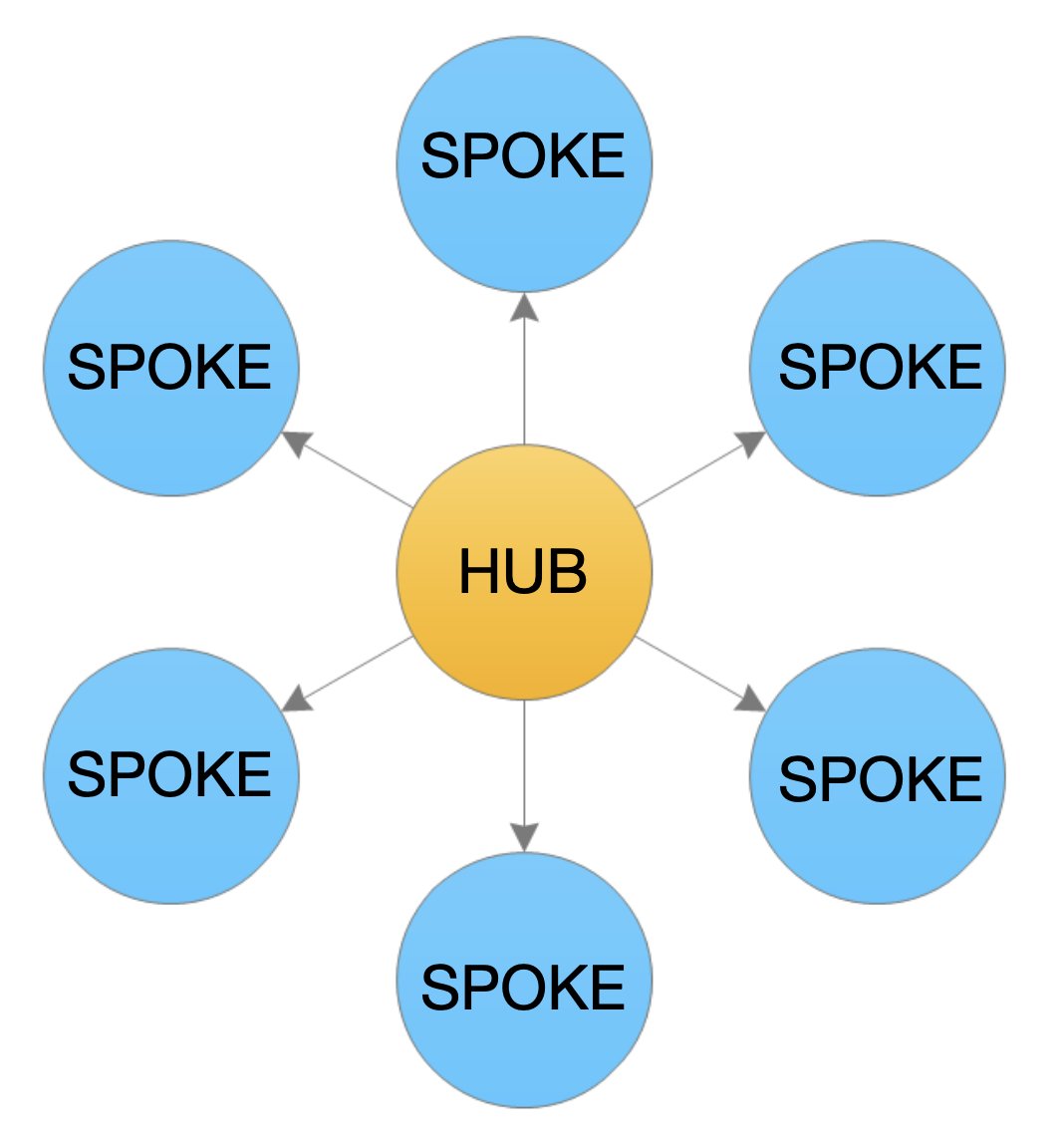


Step 1: Who is our ideal reader (read: your market of 1)?
Step 2: List out all of the hubs (marketing channels) that give us access to lots of spokes (your market of 1)?
Here’s a starting point for newsletter hubs:
Step 3: Calculate your marketing math.
- What are your 1, 3, and 6 month subscriber goals (including unsubscribes)?
- How do you define a high-quality subscriber?
Step 4: What are the marketing channels you are going to prioritize & what is your prediction of how many high quality subscribers they will drive?
Step 5: How long will you be testing the channels before looking at performance and prioritizing top performers?
[X LATER BASED ON STEP 5 ANSWER]
Step 6: What were the results from the marketing strategy thus far?
- Are we on/off track to hit our goals?
- What were the highest performing/lowest performing channels?
Step 7: Based on the results what does the go-forward marketing plan look like?
Return to Step 5.
HERE IS THE FULL MARKETING MACHINE THREAD:
Alex Lieberman@businessbarista
I built a process at Morning Brew & storyarb to create a powerful engine for organic growth.
- At the Brew, we scaled to 1,000,000 newsletter subscribers within 4 years, the majority of which we acquired organically.
- At storyarb, we got to $150k in monthly revenue within 12 months & launched a 1,600-person virtual content conference in 30 days on a shoestring budget.
I'm going to share the entire process with you in excruciating detail.
I think you’ll find my approach is simple & intuitive, but not easy to execute.
Fair warning: this post will be lengthy.
But I hope it gives you a specific & actionable approach to setting & executing on your own company’s marketing strategy.
THE PROCESS: 7 STEPS TO THE MARKETING MACHINE
It all starts with the process.
To develop a thoughtful marketing plan, you need to be clear on a few things: your customer, your channels, your goals, and your metrics.
Once you go through the steps, I’ll take you through a real-life application of these steps (at one of my company’s) to make this process as tangible as possible.
Step 1: Who is our ideal customer (and what proof is there of that)?
Create your Market of 1.
Get as specific as humanly possible. Write a one-pager describing your avatar. What do they do. What do they need. What are their behaviors.
Have a real person? Even better. Pull their Linkedin URL. Write down everything you know about them.
Step 2: List out all of the hubs (marketing channels) that give us access to lots of spokes (our ideal customer)?
Examples: newsletter, digital conference, ambassador program, SEO, in-person event, channel partnerships, subreddits, producthunt, IRL activation, etc.
Step 3: Calculate your marketing math.
- What are your 1, 3, and 6 month revenue goals?
- What is the average value of your ideal customer?
- How many more customers are needed in 1, 3, and 6 months to hit revenue goals?
- How do you define a qualified lead?
- What is the conversion rate of a qualified lead to a closed won customer?
- How many qualified leads are needed in 1, 3, and 6 months to hit your closed won customer number needed to hit revenue goals?
Step 4: What are the marketing channels you are going to prioritize & what is your prediction of how many qualified leads they will drive?
Prioritizing channels isn’t easy, especially when you have no historical data & resources (time/money) are limited.
A helpful way to compare & prioritize channels is by creating a simple matrix that allows you to compare channels across a number of categories:
- Cost
- Effort
- Predicted Effectiveness
Step 5: Who will own each channel?
A channel owner is responsible for:
- Setting the specific channel’s strategy
- Tracking performance
- Reporting performance to marketing owner
- Recommending changes based on performance
Step 6: How long will you be testing the channels before looking at performance and making adjustments/prioritizing top performers?
Early on, I suggest quarterly. As your business matures, monthly.
[X WEEKS/MONTHS LATER]
Step 7: What were the results from the marketing strategy?
- Are we on/off track to hit our goals?
- What were the highest performing/lowest performing channels?
Step 8: Based on the results what does the go-forward marketing plan look like?
Return to Step 4..
THE APPLICATION: BUILDING THE MARKETING MACHINE AT @storyarb
Step 1:
A Head of (Content) Marketing at a mid-sized company ($10m+ revenue).
They understand the value of content & has lots of content needs within their business, but is unsatisfied with what is being produced as a result of insufficient or improper resources.
Our Market of 1: Nehal Tenany, Content Marketing Lead at Clari.
Step 2: See all current marketing tactics here...
Step 3:
Given our current demo/call volume & conversion rates, we’ll hit our key milestones on the following dates:
$200,000 monthly revenue:
- At 18 demos/week: 9.76 weeks (8/24/2024)
- At 8 calls/week: 4.24 weeks (7/16/2024)
$416,667 monthly revenue:
- At 18 demos/week: 49 weeks (5/27/2025)
- At 8 calls/week: 21 weeks (11/13/2024)
$833,333 monthly revenue:
- At 18 demos/week: 123 weeks (10/25/2026)
- At 8 calls/week: 53 weeks (6/24/2025)
Here is a revenue scenario & the corresponding leads needed:
End of Q3 (9/30): $250,000
- Demos: 626 (per week: 48)
- Calls: 120 (per week: 9)
End of Q4 (12/31): $416,667
- Demos: 886 (per week: 34)
- Calls: 170 (per week: 7)
To hit our current, ambitious revenue goals, we need to increase our leads/week. This can happen in a few ways:
- Demos must increase from 18/week to 48/week OR
- Calls must increase from 8/week to 9/week OR
- Demo or call conversion rate must increase (current: 5% & 26%)
There are a number of levers to pull to increase our demos/demo CVR:
1. More traffic to site - by executing on a thoughtful marketing strategy & generating more awareness for storyarb, site traffic should increase
2. Better traffic to site - by optimizing our marketing strategy based on performance, we can improve the quality of the user coming to our website, which increases the odds that they are in our ICP & will request a demo
3. Better site conversion - run a/b tests on-site that allow us to streamline the story & user experience such that the path to requesting a demo/making a purchase is smoother
4. Picking one lead type - instead of allowing users to request a demo OR book a call, prioritize a single lead type
5. Improving lead nurturing --> sale
Demo request
- Creating a better/more valuable demo video
- Improving the initial demo email
- Improving our email marketing drip post initial email
Call request
- Improve sales pitch/objection handling
- Improve post-call follow-up sequence
My recommendations:
1. Pick one lead type: CALLS
Calls are currently converting 5x better than async demos, which means that we only need to increase our current weekly call volume by 12.5% vs. 3.9x our current demo volume to be on track to hit our revenue goals.
By definition, call bookings will be high intent prospects given they’re going to be putting in the effort to speak with our team.
While taking away demos will remove a list of warm leads, we’ll still be capturing emails which we’ll be nurturing on a monthly (or more frequent basis) and always giving the option to book a call via our site/footer of our newsletter.
2. Improve site conversion:
Have someone be responsible for owning site conversion.
- Site change recommendations
- Remove the process step-by-step
- Get testimonials
- Have more robust examples of our work
- Make the content offerings static (movement creates mental fatigue for the user)
- A/B test the header/subheader of the intro card
- Make the bottom card newsletter sign-up vs. product demo
- More/better traffic to site: marketing strategy to come below
Step 4:
The table above lists the marketing tactics I believe we should be prioritizing (for the next 3 months) as well as the predicted sales calls each channel will drive over the course of a month.
Remember, if we focus on calls as our lead type, 40/month is our goal (based on the current 26% CVR) to hit our revenue goals.
I’ll walk through each channel briefly:
1. CommaCon
I believe CommaCon can be for storyarb what Dreamforce is for Salesforce, Adobe MAX is for Adobe, and Pulse is for Gainsight.
It will become the go-to live events franchise for content/content marketing, which will act as our biggest top-of-funnel, flowing through to several of our other marketing channels, namely newsletter, digital community, and social.
2. Newsletter
Like Marketing Examined (by Alex Garcia), Future Social (Jack Appelby), or 3-2-1 (Harry Dry), I believe we should be approaching storyarb’s newsletter as its own product.
What that means is the content should be so good/value add that 1) people will be referred to it without any prior knowledge of storyarb and 2) it could stand alone as a successful newsletter even if storyarb didn’t exist.
I also believe that if we want this to truly be an indispensable part of a marketer’s content diet, we’ll ultimately need to ramp the newsletter up to 1x/week minimum.
3. Team-based social strategy
I think we should dogfood our advice to our executive social clients and create a team-based social strategy.
I think of it like the Avengers, where each superhero has its own identity, storyline, and superpowers that attracts a certain fan, but each superhero is part of a bigger unit (aka storyarb).
Each of us will post 3-4x/week & cross-promote the posts of everyone else in our squad.
Starting Squad (and potential pillars):
Abby (CEO):
- Building a productized service
- B2B marketing lessons/case studies
Magda (Content Strategist):
Executive social strategy
Company social strategy
Jeanine (Community):
Community-building best practices
Alex (Chairman):
Marketing lessons/case studies
Content/copywriting best practices
4. Live workshops (aka presence in digital communities)
This strategy involves a storyarb team leader leading a workshop with a community in which many of its members sit within our ICP.
This marketing strategy can serve dual purposes, each of which would be worth the time investment on their own.
- Generating leads from these workshops
- Understanding how other marketing communities are run to inform the way in which we run ours
5. Channel Partnerships
There are a number of complementary companies that share a similar ICP to ours.
Finding, prioritizing & striking the right deals with the right companies to drive predictable lead flow can be a low lift marketing channel once a process is set up.
6. Referral Program
If you have product-market fit, a referral program should always be a predictable source of quality leads. It’s a no-brainer to set up a simple referral program that provides a strong incentive for our best customers to be our best ambassadors externally.
7. Targeted Linkedin Outreach
This can be hit or miss, but given the specificity of our ICP, the low cost of a VA who can support this effort, and the messages coming from my account, I think it could prove fruitful & scaleable.
I think there are really clever ways that we can create lead lists that a VA can reach out to from my Linkedin account. I also think the copy of the outreach can be a soft sell for just how good storyarb is at copy.
Company Size: 25+
Titles: Heads of Content, Content Marketing, Editor, Head of Comms, Head of Growth Marketing
Miscellaneous: Scan all open product marketing, content, marketing manager roles & do targeted outreach to hiring manager.
8. Digital Community for Content Marketers
Community can be an amazing way to continue to nurture our CRM that we build through a variety of channels (newsletter, commacon, calls), convert community members into customers at the right time, and also learn what our ICP needs from us as it relates to our current (or potentially future) products.
Community is also another potential monetization channel down the road. We also have a talented team member who would go all out to run the arb’s digital community.
9. Upsells
Similar to referrals, if we are crushing it for our clients, there should be opportunities throughout the life of a customer to upsell them into our a la carte offerings or higher subscription tiers.
This is especially important for our executive social clients, who we know are a ticking time bomb and are not our ICP.
Step 5:
Once we agree upon our go forward marketing strategy, I think we should give it one quarter before making any macro changes (adding/subtracting tactics from the overall strategy).
I think we can make micro strategies throughout (i.e. a/b testing, evolving content pillars, changing lead lists based on response rate, etc).
To execute this strategy well, we need a singular owner for each tactic (several tactics can have the same owner). A tactic owner will be responsible for:
- Completed strategy
- Successful execution
- Micro changes
- Data collection
- Reporting & analysis at the end of 3 months
- Recommendation for following quarter based on reporting
9
Step 6: Monetize your newsletter (via ads)
My biggest takeaways...
1) Direct response/performance advertisers are always more willing to take risks & work with you when you’re relatively unknown. When you first start selling sponsorships, focus on DR.
2) Big brand advertisers typically only become interested in working with you once you’ve hit a scale that is worth their time. Anecdotally, I found that to be ~250,000 subscribers.
3) I found the following profiles to be the warmest leads in the early days of selling ads:
- Chronic newsletter advertisers (brands that already sponsor newsletters)
- ICP subscribers (marketers that are subscribed to your newsletter & therefore understand the value)
- Top spending DR brands (make a list of sponsors that frequent performance channels: podcast, youtube, etc)
4) There are a number of ways to diversify revenue risk if you solely focus on advertising to monetize your newsletter:
- Product: if you have more than one newsletter/content product, make sure that no product is responsible for more than 50% of your revenue
- Industry: if you have advertisers across multiple industries, make sure that no industry group is responsible for more than 50% of your revenue
- Partner Count: no one advertiser should be responsible for more than 20% of revenue & your top 10 advertisers shouldn’t be responsible for more than 50% of revenue
- Marketing goal: you should have a good mix of direct response & brand advertisers.
5) Once your newsletter reaches a certain scale and/or your sponsorships hit a certain $ amount, brands will look for more holistic marketing packages.
- For brand marketers, buying 12 ads in a newsletter becomes uninteresting & unexciting
- For direct response brands, buying 12 ads in a newsletter leads to poor performance because you’ll likely exhaust the audience
6) The less involved a brand is in the creation of sponsorship copy, the better it performs.
You (as a newsletter) know your audience & voice better than anyone. It is in a brand’s best interest to give you talking points and then get out of the way.
7) The easiest way to price newsletter sponsorships is a flat fee, but just know that marketers (especially DR-focused marketers) will back out the expected CPM (cost per 1,000 opens) and CPC (cost per click) to make sure it feels reasonable to them.
8) Sponsorship CTR will go down over time. It’s inevitable. As @andrewchen explained in Law of Shitty Clickthroughs, ad engagement decays with time. Here’s what you can control to slow the decay...
- Audience quality: keep your audience as high quality as possible by creating really good content that people desperately need & optimizing your marketing channels to acquire the right type of subscribers
- Ad creative: fight click decay by introducing new ad units, retiring old ad units, and making the ad copy as enjoyable as all other copy in your newsletter
- Advertiser selection: pick advertisers whose products you’d recommend to your reader if you were just hanging with them at a bar in real life
- Advertiser concentration: work with enough advertisers such that your audience is exposed to any given brand no more than 2x in a month
10
Steps to start monetizing:
1) Understand your audience
Bare minimum, have the following info on a solid sample of your audience:
Once you’ve launched your newsletter & have worked with advertisers, there’s a bit more info that enhances your pitch:
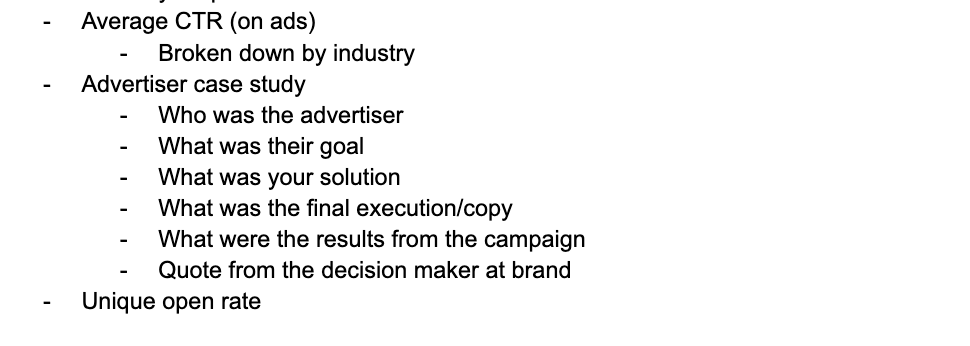
1) Understand your audience
Bare minimum, have the following info on a solid sample of your audience:
Once you’ve launched your newsletter & have worked with advertisers, there’s a bit more info that enhances your pitch:
11
2) Establish your story
There are two types of newsletter sales, but neither is focused on things like tactics or placements.
A newsletter sale is always focused on the quality of the audience & the audience’s trust in you (the newsletter) combined with deeply understanding the advertiser's goals/needs.
First sale (if the advertiser doesn’t have newsletter experience):
- Value of newsletters: opt-in, owned audience, undivided attention, deep relationship with reader (becomes a habit)
- Value of audience: at @MorningBrew it was upwardly mobile, high-earning, well-educated professionals that have huge life moments & big purchases on the horizon
Second sale (if the advertiser does have newsletter experience):
- Value of audience
12
3) Create your ad products
There are tons of different ad products you can offer, but I’d argue that simple is better & you should optimize for the following things in the early days:
- An ad unit that is least disruptive to your readers’ experience
- An ad unit that is easiest to explain & articulate the value of to an advertiser
For most newsletters, I’d suggest starting with 1-2 ad units:
a) Brand Builder: logo at top of newsletter & ~150 word of editorial written by your team (after receiving talking points from the brand) that is placed after the first or second piece of content in your newsletter.
b) Performance Driver: no logo & ~50 words of editorial that is placed either after the third or fourth piece of content or as a sponsored bullet if you have a curated link section
For pricing, I’d also keep things simple & charge a flat fee that gets adjusted each month based on the implied CPM (cost per 1,000 opens).
For the Brand Builder ad unit, I’d charge a $30 CPM.
For the Performance Driver ad unit I’d charge a $15 CPM.
Quick example:
Newsletter subscribers: 500,000
Open rate: 50%
Brand Builder cost: $15,000 (= ((500,000 * .5)/1000)*30)
Performance Driver cost: $7,500 (= ((500,000 * .5)/1000)*15)

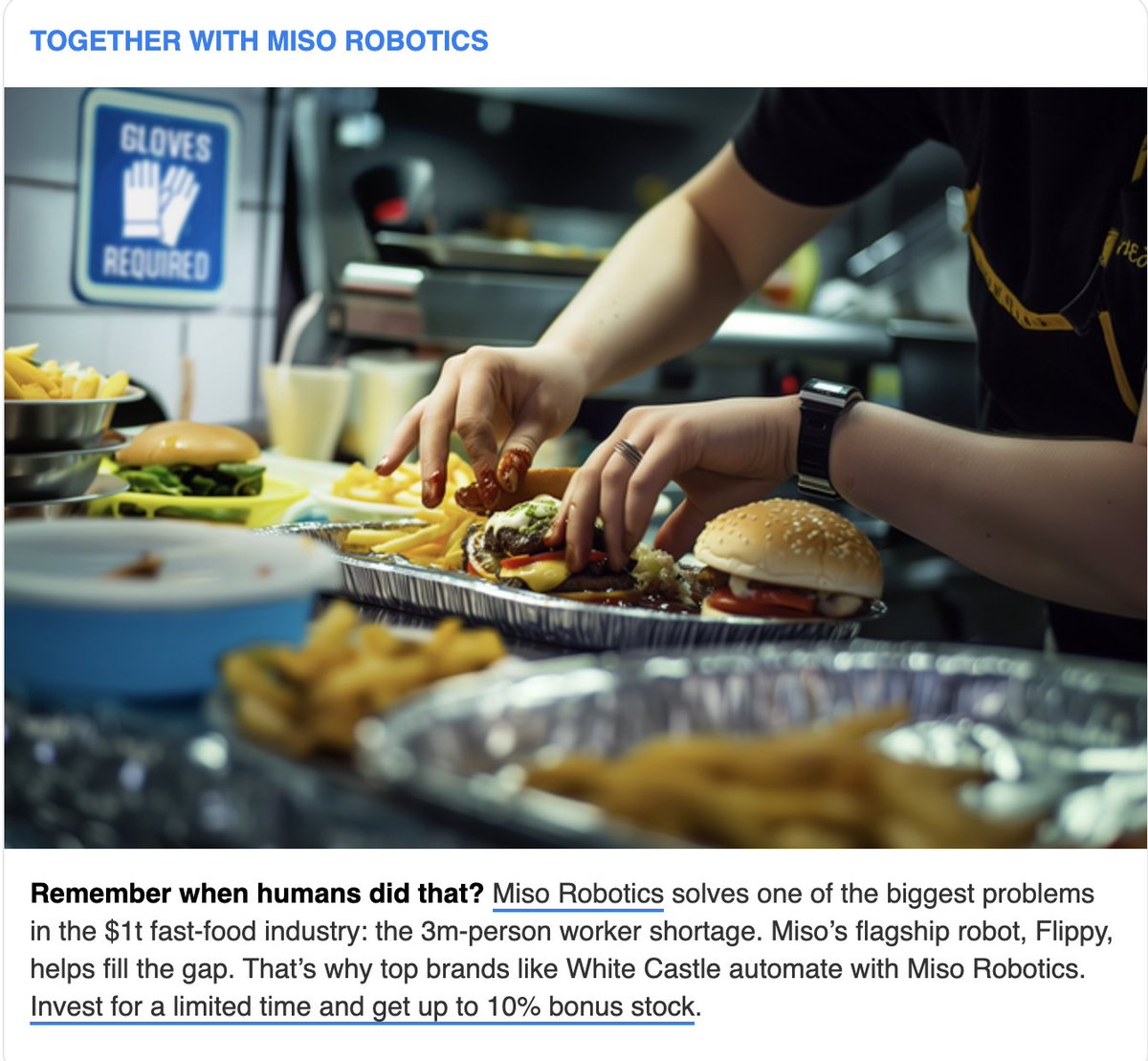
There are tons of different ad products you can offer, but I’d argue that simple is better & you should optimize for the following things in the early days:
- An ad unit that is least disruptive to your readers’ experience
- An ad unit that is easiest to explain & articulate the value of to an advertiser
For most newsletters, I’d suggest starting with 1-2 ad units:
a) Brand Builder: logo at top of newsletter & ~150 word of editorial written by your team (after receiving talking points from the brand) that is placed after the first or second piece of content in your newsletter.
b) Performance Driver: no logo & ~50 words of editorial that is placed either after the third or fourth piece of content or as a sponsored bullet if you have a curated link section
For pricing, I’d also keep things simple & charge a flat fee that gets adjusted each month based on the implied CPM (cost per 1,000 opens).
For the Brand Builder ad unit, I’d charge a $30 CPM.
For the Performance Driver ad unit I’d charge a $15 CPM.
Quick example:
Newsletter subscribers: 500,000
Open rate: 50%
Brand Builder cost: $15,000 (= ((500,000 * .5)/1000)*30)
Performance Driver cost: $7,500 (= ((500,000 * .5)/1000)*15)
13
4) Create your media kit
- Write out your story in Google Docs(from step 2)
....Why you exist
....Who your audience is (pt 1.)
....How you communicate/engage with them
....Evidence that they love/trust you
....How you work with partners (step 3 w/ mock-up)
....Case studies with partners (step 1)
- Share Doc with a designer (@BrettFromDJ, @WeAreOffMenu) and have them create media kit that is less than 10 slides
14
5) Advertiser outreach
a) Build your outreach list
b) Build your outreach process

a) Build your outreach list
b) Build your outreach process
15
6) Crush the pitch
Things that worked for me...
1) Make it a conversation rather than a presentation.
When you present, you’re speaking most of the time and your audience is listening, when you converse there’s a balanced amount of speaking and listening.
2) Ask lots of questions upfront in order to understand
- if the advertiser is a good fit
- if yes, how your pitch needs to evolve in real-time to make them realize they’re a good fit
3) Emphasize your audience & their deep trust.
4) Don’t badmouth other newsletter/companies.
5) Anticipate objections and squash them as you tell your story
6) Get your audience saying yes. First with small yes’ then with big yes’.
- Yes, content marketing is really important to us
- Yes, we want to get in front of high-earning millennials
- Yes, we believe newsletters are a great way to get in front of a trusting, owned audience, natively
- Yes, we believe your newsletter has the audience we want
- Yes, we’d like to explore a partnership together
7) Maintain momentum.
Every day that goes by after you’ve spoken to a potential partner, the odds of closing them goes down. Decreasing time from pitch to close is one of the best ways to increase win %.
8) Create FOMO. Brands hate missing out on new, exciting opportunities & they especially hate seeing their competitors capitalize before them.
16
7) Close the deal
There’s a laundry list to get the deal done:
8) Execute the partnership
9) Reporting & Retention
Goal: understand how the campaign performed based on your partner’s goals & have a gameplan to:
- secure a longer-term partnership & sustain success
- provide recommendations & ideas for making future campaign more successful.
What you want to walk into a post-campaign call armed with:
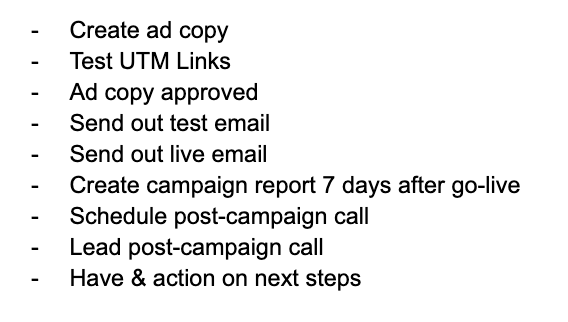

There’s a laundry list to get the deal done:
8) Execute the partnership
9) Reporting & Retention
Goal: understand how the campaign performed based on your partner’s goals & have a gameplan to:
- secure a longer-term partnership & sustain success
- provide recommendations & ideas for making future campaign more successful.
What you want to walk into a post-campaign call armed with:
17
sheeeesh.
That was a borderline obnoxious amount of content, but I hope it was insanely valuable.
Throw me a follow @businessbarista if you want more insanely long media/marketing teardowns.
And check out my biz @storyarb if you need help writing your company newsletter or crushing any of your company content.
