In physics, one often thinks of space and time as being...

Jonathan Gorard@getjonwithit
25 views
Aug 12, 2024
~4 min read
Advertisement
1
In physics, one often thinks of space and time as being fundamental, pre-existing concepts, and proceeds to define everything else (energy, momentum, forces, etc.) in terms of them. But it doesn't need to be so - symplectic geometry shows us how to go the other way. (1/16)

2
Suppose you have two functions, f and g, and you want to quantify "How much does f change as a result of a flow generated by g?"
Well, that's exactly what the Poisson bracket {f, g} measures. [We'll come on to precisely what a "flow generated by g" means in a moment…] (2/16)
Well, that's exactly what the Poisson bracket {f, g} measures. [We'll come on to precisely what a "flow generated by g" means in a moment…] (2/16)
3
Now think of f and g as being functions on a phase space (i.e. a space consisting of all possible position and momentum values of a physical system). Suppose, in particular, that f=q corresponds to a spatial coordinate and g=p corresponds to a momentum coordinate. (3/16)
4
Now, momentum is a generator of translations, so the Poisson bracket {q, p} = 1 (or possibly some other non-zero value, if our coordinate system is weird/non-orthonormal/etc.), because our position coordinate q varies under the flow generated by the momentum coordinate p. (4/16)
5
This only holds if q and p correspond to position and momentum coordinates in the same direction, of course; otherwise {q, p} = 0 (because, e.g., the y position coordinate does not vary under the flow generated by momentum in the x direction, if x and y are orthogonal). (5/16)
6
Likewise, energy (or, more precisely, the Hamiltonian H) is a generator of time evolution, so the Poisson bracket {t, H} = 1 (or, again, possibly some other non-zero value if we're in a strange coordinate system), where t is our time coordinate. (6/16)
7
So if {f, H} = 0, then f is a conserved quantity (because it does not vary under the flow generated by the Hamiltonian, i.e. time). Thus, if we knew a priori what energy (H) and momentum (p) were, then we could define time (t) and space (q) purely in terms of them... (7/16)
8
Specifically, using the algebra of the Poisson bracket, we can simply define time to be whatever function t satisfies {t, H} = 1, and space (in some direction) to be whatever function q satisfies {q, p} = 1. But what does the whole "flow generated by" thing mean, anyway? (8/16)
9
The easy/unenlightening answer is, e.g., that p "generates flows" in q because the two quantities are dual under the (inverse) Fourier transform [though there exists a beautiful generalization of this idea to all locally compact abelian groups called Pontryagin duality]. (9/16)
10
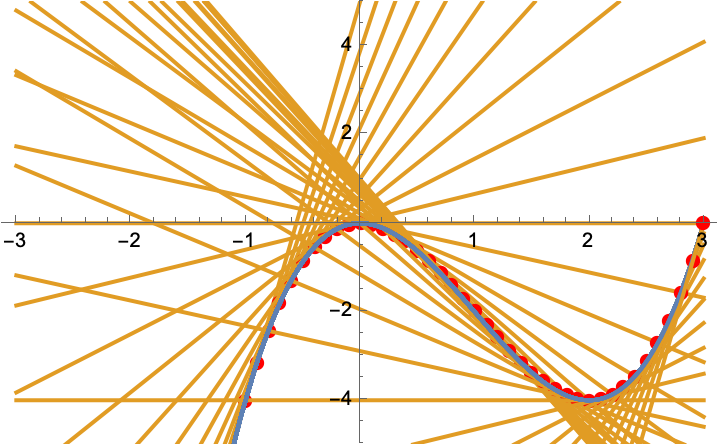
The deeper/more interesting answer is that it's because the p's live in the cotangent spaces generated by the q's. I talked a bit about cotangent spaces/bundles here: . But in brief, at every point in space, you can construct a tangent space to it. (10/16)

Jonathan Gorard@getjonwithit
Fibrations/bundles/sections/etc. are slightly opaque-sounding terms for an otherwise very intuitive idea: that you can parameterize a collection of spaces in terms of points from a different space, and then assemble new spaces out of points taken from that collection... (1/15)
11
The gluing of all of those tangent spaces together is the tangent bundle. Momenta live in the cotangent spaces at each point (cotangent rather than tangent because momenta are derivatives of functions whose domains, not whose ranges, are given by the original manifold). (11/16)
12
So a "momentum space" is really just a cotangent space. And a "phase space" is really just a cotangent bundle (corresponding locally, like any bundle, to a product of the original space and the momentum space at each point, and as physical intuition suggests it should). (12/16)
13
Likewise, just as the cotangent spaces to each point in space correspond to possible momentum values, the cotangent lines to each point on a 1D timeline correspond to possible values of energy (H). It is in this sense that energy/momentum "generate flows" in space/time. (13/16)
14
This extends beautifully to general relativity (via the ADM formalism - a purely Hamiltonian formulation of GR). In ADM, timelike projection of the (contracted) Bianchi identities gives the Hamiltonian constraint, and spacelike projections give the momentum constraints. (14/16)
15
We often think of starting from a space and building its cotangent spaces from it. So it feels intuitive to start from spacetime and define energy and momentum in terms of it. But there's nothing to stop us starting from the cotangent spaces and "drilling down" instead. (15/16)
16
Indeed, tools like the exponential map in differential geometry give one a systematic way to do just that. So just as we can "build" a manifold out of its cotangent spaces, so too can we "build" time and space from energy and momentum, thanks to W. R. Hamilton. (16/16)