Thread on refinery strikes and what we can tell from the data....

Morten Bjørn@Mortenthebjorn
21 views
Mar 23, 2024
~3 min read
Advertisement
1
Thread on refinery strikes and what we can tell from the data.
@benamy and I have over the last week tried to systematically collect data on refineries and refinery strikes, incidents and alleged attacks.
Here is what we can say.
1)
@benamy and I have over the last week tried to systematically collect data on refineries and refinery strikes, incidents and alleged attacks.
Here is what we can say.
1)
2
Caveats. I am not an industry expert; all observations and conclusions should therefore be read in this perspective. Feel free to comment, add data on e.g. strikes/ incidents we have missed or add content. If you have industry insight your comments are very welcom
2)
2)
3
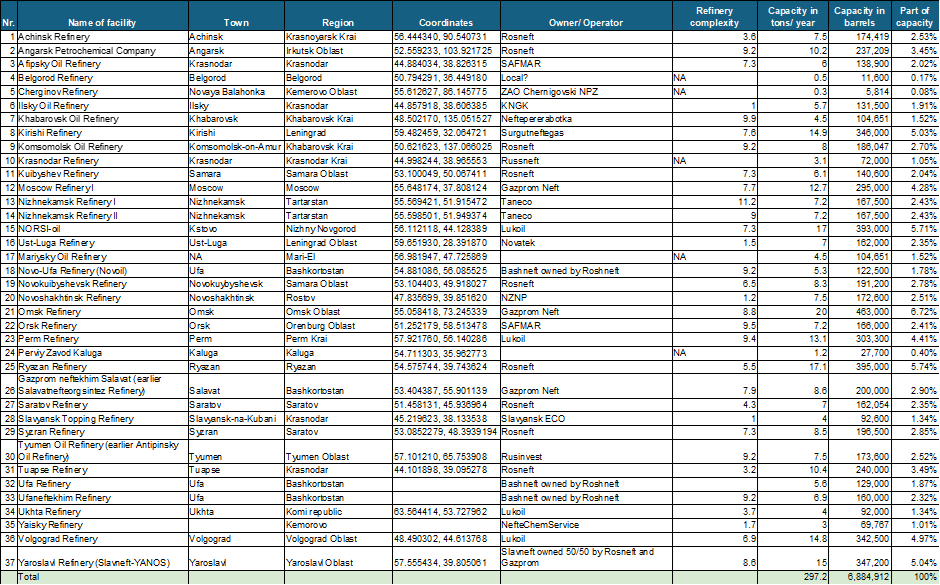
We have identified 37 refineries in Russia of varying size, they can be found in the table below. Some refinery capacities might be a bit off. The facilities are regularly being expanded, so some might be old data.
3)
3)
4
We also made a list of all refinery strikes, incidents and thwarted attacks. A thwarted attack id defined as “ mentioning of drone strikes in sources usually backed up with pictures of downed drones”. As you might see there are incidents pre-dating the invasion in the dataset.
4)
4)
5
When going through all the alleged strikes, I sometimes stumbled on incidents that looked more like accidents than attacks. A good example is this one from the Kransnodar Refinery in June last year.
5)
rbc.ru/politics/13/06…
5)
rbc.ru/politics/13/06…
6
It quickly became obvious that if we had to say anything intelligent about the frequency of the strikes, we would need a baseline. Accidents also happen in war time. Therefore, data on incidents on refineries were collected for four (4) years leading up to the invasion.
6)
6)
7
If plotted on a time scale, you get the following graph. As you’ll find there is relatively solid trend. It almost seems like the Russians are following an old Soviet manual that dictates you have to start a refinery fire every 200 days!
7)
7)
8
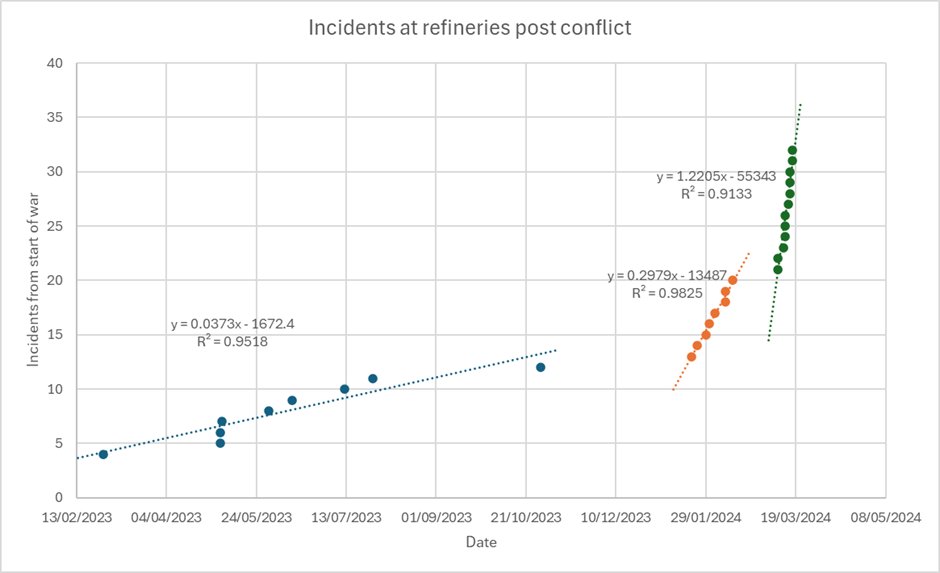
But let us look at what actually happens after the invasion started. For the first period of time nothing really happened before end of 2022 start 2023, where there is an observable up-tick in fires (about factor 6-7).
8)
8)
9
As it can also be seen an additional up-tick in incidents happened around the beginning of 2024, where the rate increases about 4-fold but 27-fold more than the baseline.
As can be seen 3-4 fires during the invasion can statistically be attributed to accidents.
9)
As can be seen 3-4 fires during the invasion can statistically be attributed to accidents.
9)
10
If we decide to break it up a bit more and include incidents without impact (like downed drones). We see the following pattern with three (3) distinct phases. The first phase activity is centred around 3-4 strikes in May 2023.
10)
10)
11
Second phase starts around 20th of Januar and last for two (2) weeks. Then there is an operational pause of about 20 days before another two (2) week campaign.
11)
11)
12
It remains to be seen whether the strike in Samara today was the start of the 4th phase, with another two (2) week campaign. In that case there was only 6-7 days of operational pause.
12) x.com/bayraktar_1lov…
12) x.com/bayraktar_1lov…
13
I will try to expand on my observations the next couple of days. It does seem like the current campaign is definitely having an impact on bulk fuel prices.
end)
end)

