On CIA, KGB, & historical forces; their interplay with 12 years of...

Sreejith Sasidharan@Sreezith
30 views
Aug 28, 2024
~8 min read
Advertisement
1
On CIA, KGB, & historical forces; their interplay with 12 years of boundary negotiations between India & China from 1981 to 1993.
icsin.org/publications/o…
[please click on the picture to download paper]
A thread 🧵
1/
icsin.org/publications/o…
[please click on the picture to download paper]
A thread 🧵
1/
2
I feel diffident because there are brilliant books by scholar-diplomats privy to 81-93 talks. But driven by ignorance, having embarked on a research adventure, it was important to seek answers: why did China make a U-turn on the Venkateswaran formula in 1984
@ShivshankaMenon
2/

@ShivshankaMenon
2/
3
The idea was to (hopefully) assemble missing pieces in the jigsaw. Primarily, to examine how the influence of external actors placed constraints on China-India ties in the 1980s & how policy makers in Beijing & Delhi dealt with those cards.
3/
3/
4
Boundary negotiations started after Mao's death on Sep 9, 1976. Vajpayee visited China in Feb 1979 & Huang Hua visited India on June 26, 1981. This was China's positive signal to Delhi because on that very day, Deng took over as Chair of Central Military Commission.
4/

4/
5
The visit initiated 8 rounds of border talks from 1981 to 1988. China objected to Arunachal dancers performing at the 1982 Asian Games, organized by former R&AW chief K. Shankaran Nair successfully despite terror threat from Khalistan supporters.
5/
5/
6
Subramanian Swamy visited China in April 1981. Indian Marxists led by E.M.S Namboodiripad met Deng Xiaoping, Hu Yaobang, & Qiao Shi in April 1983. The message to China was that political parties across the left-right spectrum, supported improved bilateral relations.
6/
6/
7
The talks almost achieved a breakthrough in 1984. Shyam Saran conveyed to Indira Gandhi's foreign policy advisor G. Parthasarathi that Beijing showed interest in A.P. Venkateswaran’s proposal: - China will give up claim on Arunachal & also return to India 3000 sq km in Ladakh
7/
7/
8
Indira Gandhi wanted to accept it after elections in 1985 but she was assassinated by her bodyguards in Oct 1984. On the day of her assassination, R.N. Kao was in Beijing, for backchannel talks with China to prepare for Gandhi’s visit to Beijing, which never materialized.
8/
8/
9
In the next round of talks, China made a U-turn. Why did China become disinterested in 1984? Possibly because China-US defense cooperation intensified after Zhang Aiping visited the US on 12 June 1984, just a week after Indira Gandhi's horrible mistake: Operation Bluestar.
9/
9/
10
So China's U-turn on Venkateswaran formula & sudden unwillingness to discuss the boundary must be seen in the context of deepening China - US military industrial contacts in the mid-1980s.
Within a year PLA-Indian army clashes occurred at Sumdorong Chu (Wangdong)
10/

Within a year PLA-Indian army clashes occurred at Sumdorong Chu (Wangdong)
10/
11
US Navy warships made a port call to Qingdao in China at the height of India-China crisis even as Gen. K. Sundarji, Lt. Gen Narahari & Maj Gen. J.M. Singh oversaw Operation Falcon. Indian Army took positions on Hathung La ridge on 20 Oct 1986. The situation was tense.
11/
11/
12
In the midst of the crisis, Arunachal was granted statehood in Dec 1986. The Dalai Lama’s peace plan was rejected by China, igniting Tibetan crisis of 1987-1989. Tibet party Secretary Hu Jintao &Gen. Li Lianxiu crushed the uprising. The 10th Panchen Lama died in Jan 1989.
12/
12/
13
In the Soviet Union meanwhile, Yuri Andropov - who crushed the 1956 Hungarian uprising, 1968 Prague Spring, & masterminded the 1979 invasion of Afghanistan - became General Secretary in Nov 1982. Yuri Vladimirovich mentored Mikhail Gorbachev to be his successor.
13/

13/
14
On 11 March 1985, Gorbachev became General Secretary. He reorganized the Politburo with progressive liberal leaders like Alexander Yakovlev & unleashed liberal reforms: perestroika & glasnost. Gorbachev also sought to improve relations with China & the US.
14/
14/
15
In China, Li Peng became Premier in Nov 1987 & Zhao Ziyang became General Secretary. Li was a contemporary of Gorbachev as a student in Moscow in the 1950s & they had a mutual friend – Li’s classmate, Romanian politician, Ion Iliescu.
15/

15/
16
Intense rivalry between Zhao & Li gripped the Politburo. Zhao flirted with 'bourgeois liberalism', which soon morphed into popular protests. To counter Zhao, Li tasked Luo Gan with special services intelligence. By May 1989, 'political turmoil' at Tiananmen Square unfolded.
16/

16/
17
Li Peng obtained Deng’s approval & crushed Tiananmen demonstrations on 3-4 June 1989. On that very night, Khomeini died & Ali Khameini became the new supreme leader of Iran. Jia Chunwang, head of China's external intel (MSS) & his boss Qiao Shi blamed CIA for Tiananmen events
17/

17/
18
Well before June 1989, India’s R&AW chief, A.K. Verma established a backchannel with Qiao Shi & Jia Chunwang, which helped in Rajiv Gandhi’s visit to China in Dec 1988. Internal security threats -Tibet uprising & Tiananmen possibly pushed China to seek a consensus with India.
18/
18/
19
Meanwhile, unhappy with liberal reforms, hardliners in the Soviet Union staged a coup to remove Gorbachev on 19 August 1991, placing him under house arrest in Crimea. Boris Yeltsin led a people's resistance against the coup. Yeltsin’s defiant speech boosted his public image.
19/
19/
20
The coup failed & Gorbachev returned to Moscow safely, but he knew that Soviet Union was beyond redemption. He resigned from the post of General Secretary on 24 Aug 1991. Thus, the failed coup of Aug 1991 triggered the sudden collapse of the Soviet Union.
20/
20/
21
In May 1991, three months before collapse, Soviet Union signed a border agreement with China. During Rajiv Gandhi’s tenure, Gorbachev encouraged him to better India’s relations with China, but the KGB viewed China suspiciously because of a China-US axis in Afghanistan.
21/


21/
22
The KGB had by then become a power unto itself & its attitude to Chinese talks with India mattered a great deal. In the 1980s, Yakov Medianik, Leonid Shebarshin, & Vyacheslav Trubnikov oversaw KGB operations from the Mediterranean to the Hindukush to the Bay of Bengal.
22/
22/
23
It was important for the KGB to secure India's support to counter the US-China-Pak axis in Afghanistan. The CIA wanted China on its side to weaken Moscow.
In other words, an India-China rapprochement was not useful for either CIA or KGB interests in the 1980s.
23/
In other words, an India-China rapprochement was not useful for either CIA or KGB interests in the 1980s.
23/
24
Which American politician personally sought permission from Deng Xiaoping for CIA – PLA intel cooperation in April 1979? Joseph R. Biden.
This cooperation started under D-CIA Stansfield Turner & intensified under PLA’s intel Director Xiong Guangkai & CIA’s Robert Gates.
24/
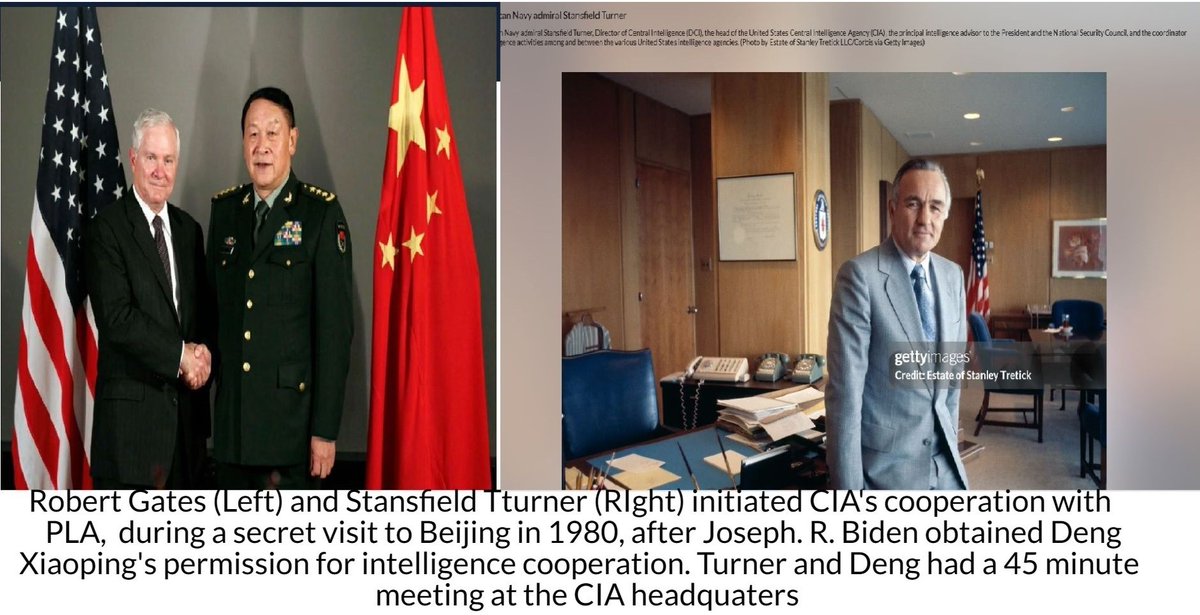

This cooperation started under D-CIA Stansfield Turner & intensified under PLA’s intel Director Xiong Guangkai & CIA’s Robert Gates.
24/
25
Thus, Delhi & Beijing were on opposite sides of the great game in Afghanistan & dependent on KGB & CIA respectively. Under those circumstances, “convincing adversaries (like China or Pak) of India’s conciliatory intentions, was an impossible task” - @PaliwalAvi
25/

25/
26
@PaliwalAvi India’s security threats multiplied during this period. LTTE was unhappy over the 1987 India-Sri Lanka accord. Khalistan movement met with Operation Black Thunder, May 1988. Troubles in Kashmir were also mounting. Naturally, India preferred peace with China in the Himalayas.
26/
26/
27
@PaliwalAvi These were internal the security circumstances during which Rajiv Gandhi visited China. His meeting with Deng Xiaoping in Dec 1988 made rapprochement possible.
Unfortunately, Rajiv Gandhi was assassinated by the LTTE in May 1991 & thus could not conclude a border agreement.
27/

Unfortunately, Rajiv Gandhi was assassinated by the LTTE in May 1991 & thus could not conclude a border agreement.
27/
28
Over the next 7 months, the Soviet Union collapsed & Cold War ended by 25 Dec 1991. Evgeny Maksimovich Primakov became director of foreign intelligence (SVR) in Oct 1991. He envisaged a Russia-India-China bloc balancing the US [ Primakov doctrine]
28/
28/
29
The CIA- PLA alliance against Moscow was over by then. China was unhappy over CIA’s role in the Tiananmen events. India also realized that relying on Moscow to balance Beijing was no longer a viable proposition especially after the Sino-Soviet agreement in May 1991.
29/
29/
30
P.V. Narasimha Rao became PM in June 1991 & appointed J.N. Dixit as the Foreign Secretary in Nov 1991. New Delhi began redrawing strategic partnerships, upgrading ties with Israel in Jan 1992. India & the US started a naval exercise codenamed Malabar. Why ‘Malabar’?
30/


30/
31
Malabar was a gateway for immigrants, merchants, & imperialists. Columbus’ voyage of 1492 led to the discovery of America but believed falsely that he landed on the Malabar coast of India. Malabar exercise started in May 1992, on the 500th anniversary of Columbus voyage.
31/


31/
32
In other words, Rao & Dixit were expanding India’s strategic engagement with the world, driven by pragmatism & informed by a profound nuance of history. India crossing the Rubicon in 1992 played its part in China's calculus for them to sign a border agreement.
@Barugaru1
32/


@Barugaru1
32/
33
India-US joint naval exercises in May 1992 would have been unthinkable a year before. In March 1991, @seemasirohi broke a story about a war game by General Dynamics which painted a scenario where the United States would attack India to prevent an Indo- Pak nuclear war.
33/
33/
34
To the Chinese, George H.W. Bush & Gorbachev must have appeared more like friends than foes. The end of CIA-PLA alliance, also therefore, created an impetus for China to sign the ‘Peace & Tranquility' agreement in 1993.
34/
34/
35
Concluding thoughts. Although this thread sketches individual personalities, the paper warns: individuals & political leaders have limitations. Historical forces can overtake even the most powerful agents of history such as leaders in India & China.
36/

36/
36
The desire to normalize relations was endorsed by leaders in Delhi & Beijing as early as 1981. Yet, 5 Prime Ministers in India & 4 leaders in China took over 12 years to overcome historical forces, mutual enmities, & balance of power concerns to achieve a consensus in 1993.
End/
End/
37
Addendum: The use of the term Venkateswaran proposal in the paper is to indicate the discussion that happened in 1984. It is incorrect to call it a formula. These changes will be incorporated in the final revised version of the paper.
