One company increased sales 262.5% with this pricing strategy: The...

Barrett O'Neill@barrettjoneill
35 views
Jun 14, 2026
~3 min read
Advertisement
1
One company increased sales 262.5% with this pricing strategy:
The Decoy Effect.
What it is & how to use it: 🧵
The Decoy Effect.
What it is & how to use it: 🧵
2
Companies like AMC, Starbucks, & "The Economist" use psychology to maximize profit.
They leverage behavioral science to shift buyer preferences from the buyers needs to their highest margin products.
Here's how it works ⬇️ ⬇️ ⬇️
They leverage behavioral science to shift buyer preferences from the buyers needs to their highest margin products.
Here's how it works ⬇️ ⬇️ ⬇️
3
The human mind is exceptional at comparing two items.
But, the presence of a 3rd option causes a short circuit.
With a 3rd option present, the mind begins comparing options against one another.
This shifts focus from fulfilling ones needs to finding the best value.
But, the presence of a 3rd option causes a short circuit.
With a 3rd option present, the mind begins comparing options against one another.
This shifts focus from fulfilling ones needs to finding the best value.
4
Companies include "decoy" options to highlight the value of their target (usually highest margin) options.
There is little to no intent to actually sell the decoy.
So, what does a decoy look like?
It's similar, but slightly less appealing than the target.
There is little to no intent to actually sell the decoy.
So, what does a decoy look like?
It's similar, but slightly less appealing than the target.
5
Movie theatre popcorn is a classic example.
The large size is the target option - it's the most expensive & highest margin.
Without the medium, movie-goers are making a decision based on how much they want to eat.
But, add the decoy (medium)...
The large size is the target option - it's the most expensive & highest margin.
Without the medium, movie-goers are making a decision based on how much they want to eat.
But, add the decoy (medium)...
6
And everything changes.
Logically, a large should cost $9 based on the $2.50 increase from small to medium.
BUT with only a 50 cent increase, the perceived value of the large is huge, making it hard to pass up.
Logically, a large should cost $9 based on the $2.50 increase from small to medium.
BUT with only a 50 cent increase, the perceived value of the large is huge, making it hard to pass up.
7
As an avid iced coffee drinker, I'm all too familiar with Starbuck's decoy options.
Below is their recent pricing updates for 2022.
Starbuck's target option is the Venti (medium for non-coffee snobs).
Their decoy option is the Trenta.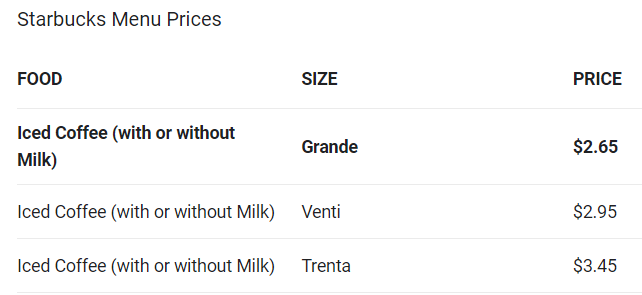
Below is their recent pricing updates for 2022.
Starbuck's target option is the Venti (medium for non-coffee snobs).
Their decoy option is the Trenta.
8
The increase from Grande to Venti is 30 cents.
While the jump from Venti to Trenta is 50 cents.
Usually buyers are rewarded for buying in bulk, but that's not the case at Starbucks.
The low perceived value of Trenta makes Venti look like a value option compared to Grande.
While the jump from Venti to Trenta is 50 cents.
Usually buyers are rewarded for buying in bulk, but that's not the case at Starbucks.
The low perceived value of Trenta makes Venti look like a value option compared to Grande.
9
So is there any hard data to back this up?
In 2008, Dan Ariely (Duke PhD), ran a study on America's brightest students at MIT.
He used pricing from popular magazine, "The Economist" and the results are staggering...
In 2008, Dan Ariely (Duke PhD), ran a study on America's brightest students at MIT.
He used pricing from popular magazine, "The Economist" and the results are staggering...
10
"The Economist" employed one of the most egregious decoy's ever, and it still worked like a charm.
Below is the pricing:
Below is the pricing:
11
The goal was to drive signups of the ultra-profitable Print & Web subscription.
But at over 2X the price of the Web Only option, it wasn't attractive.
They needed a decoy.
The company added the Print Only option, at the SAME price as the Web & Print.
But at over 2X the price of the Web Only option, it wasn't attractive.
They needed a decoy.
The company added the Print Only option, at the SAME price as the Web & Print.
12
Subscribers could now have both options, for the price of the Print Only.
This decoy seems so obvious that it couldn't work.
But it did.
When 100 MIT business students were surveyed, here were the results:
This decoy seems so obvious that it couldn't work.
But it did.
When 100 MIT business students were surveyed, here were the results:
13
Without Decoy:
Web Only: 68 ($59)
Web & Print: 32 ($125)
With Decoy:
Web Only: 16 ($59)
Print Only: 0 ($125)
Web & Print: 84 ($125)
The decoy translated to an increase of 262.5% in target subscriptions despite its significant cost increase.
Web Only: 68 ($59)
Web & Print: 32 ($125)
With Decoy:
Web Only: 16 ($59)
Print Only: 0 ($125)
Web & Print: 84 ($125)
The decoy translated to an increase of 262.5% in target subscriptions despite its significant cost increase.
14
I've talked pricing with hundreds of small businesses & startups -- most of them have no pricing strategy at all.
But the decoy effect isn't reserved for large companies.
You can shift buyer preferences too.
Here's the decoy formula:
But the decoy effect isn't reserved for large companies.
You can shift buyer preferences too.
Here's the decoy formula:
15
Step 1:
Offer 2 options in the same category.
Step 2:
Decide to sell more of the higher margin product.
Step 3:
Create a 3rd DECOY option & make it slightly less attractive than the target.
Offer 2 options in the same category.
Step 2:
Decide to sell more of the higher margin product.
Step 3:
Create a 3rd DECOY option & make it slightly less attractive than the target.
16
The best decoys interrupt unit economics or restrict access to a key feature.
Sometimes, improving profits doesn't require re-inventing products or adding service lines.
Just some ingenuity around pricing options.
Sometimes, improving profits doesn't require re-inventing products or adding service lines.
Just some ingenuity around pricing options.
17
For more on decoys, I highly recommend Dan Ariely's book "Predictably Irrational."
He eloquently lays out strategies for using psychological principles in business.
He eloquently lays out strategies for using psychological principles in business.
18
If you found this helpful please...
Follow me @barrettjoneill for business & growth content.
RT the 1st tweet so others can find it.
Follow me @barrettjoneill for business & growth content.
RT the 1st tweet so others can find it.