
🧵 Why the obsession with p < 0.05 is hurting science. A meme. A truth. A reality check.
1/
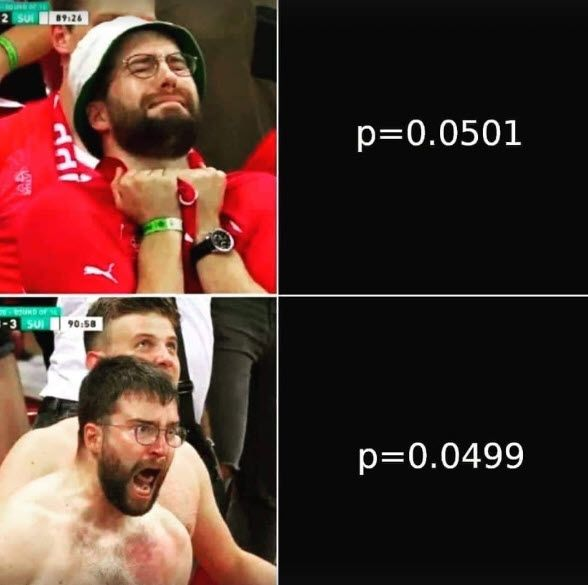
This meme says it all.
p = 0.0501? Pain.
p = 0.0499? Pure euphoria.
Two numbers. Nearly identical. Yet we treat them like night and day.
Why?
This meme says it all.
p = 0.0501? Pain.
p = 0.0499? Pure euphoria.
Two numbers. Nearly identical. Yet we treat them like night and day.
Why?
2/
The 0.05 p-value threshold is arbitrary.
It came from R.A. Fisher in the 1920s.
And we’ve been worshipping it like a sacred line ever since.
But it’s not magic. It's convention.
The 0.05 p-value threshold is arbitrary.
It came from R.A. Fisher in the 1920s.
And we’ve been worshipping it like a sacred line ever since.
But it’s not magic. It's convention.
3/
What does p < 0.05 actually mean?
It means:
If the null hypothesis is true, there’s a 5% chance we’d see this extreme of a result by random chance.
That’s it.
Not: "This is true."
Not: "This will replicate."
What does p < 0.05 actually mean?
It means:
If the null hypothesis is true, there’s a 5% chance we’d see this extreme of a result by random chance.
That’s it.
Not: "This is true."
Not: "This will replicate."
4/
p = 0.0499 and p = 0.0501 are nearly identical.
But one gets you a “significant” label.
The other gets dismissed.
That’s broken thinking.
p = 0.0499 and p = 0.0501 are nearly identical.
But one gets you a “significant” label.
The other gets dismissed.
That’s broken thinking.
5/
Quoting Mike Love:
“A smaller p-value is not more interesting.”
“We should focus on effect sizes.”
He’s right.
Quoting Mike Love:
“A smaller p-value is not more interesting.”
“We should focus on effect sizes.”
He’s right.
6/
What’s an effect size?
It tells you how big the difference is.
Not just if it’s statistically detectable.
A gene with a log2 fold change of 3 matters.
Even if p = 0.06.
What’s an effect size?
It tells you how big the difference is.
Not just if it’s statistically detectable.
A gene with a log2 fold change of 3 matters.
Even if p = 0.06.
7/
P-values shrink with more data.
Got 10,000 samples?
You’ll find “significance” for even the tiniest differences.
Statistically significant ≠ Biologically meaningful.
P-values shrink with more data.
Got 10,000 samples?
You’ll find “significance” for even the tiniest differences.
Statistically significant ≠ Biologically meaningful.
8/
Also, be careful when testing thousands of genes.
Even with a p < 0.05 threshold, false positives will sneak in.
Use multiple testing correction: FDR, Bonferroni. Always.
Also, be careful when testing thousands of genes.
Even with a p < 0.05 threshold, false positives will sneak in.
Use multiple testing correction: FDR, Bonferroni. Always.
9/
Let’s reframe:
Instead of:
“Did I beat the p < 0.05 line?”
Ask:
Is the effect meaningful?
Is it reproducible?
Does it make biological sense?
Let’s reframe:
Instead of:
“Did I beat the p < 0.05 line?”
Ask:
Is the effect meaningful?
Is it reproducible?
Does it make biological sense?
10/
Want a better practice?
Look at the distribution of p-values.
Report adjusted p-values (FDR).
Highlight effect sizes.
Don’t cherry-pick.
Want a better practice?
Look at the distribution of p-values.
Report adjusted p-values (FDR).
Highlight effect sizes.
Don’t cherry-pick.
11/
And don’t forget confidence intervals.
They show the range of plausible effect sizes—not just a binary yes/no.
More context, more truth.
And don’t forget confidence intervals.
They show the range of plausible effect sizes—not just a binary yes/no.
More context, more truth.
12/
Key takeaways:
0.05 is a line in sand, not a cliff
p-values ≠ effect size
Focus on biological meaning
Always correct for multiple testing
Use p-values as part of the story—not the whole story
Key takeaways:
0.05 is a line in sand, not a cliff
p-values ≠ effect size
Focus on biological meaning
Always correct for multiple testing
Use p-values as part of the story—not the whole story
13/
If you're making big decisions based on p = 0.0499 vs 0.0501...
You're not doing science.
You're doing stats theater.
Look deeper. Think harder. Go beyond the stars.
If you're making big decisions based on p = 0.0499 vs 0.0501...
You're not doing science.
You're doing stats theater.
Look deeper. Think harder. Go beyond the stars.
14/
And please—share this with a friend still chasing tiny p-values.
Let’s stop celebrating noise
and start celebrating insight.
And please—share this with a friend still chasing tiny p-values.
Let’s stop celebrating noise
and start celebrating insight.
I hope you've found this post helpful.
Follow me for more.
Subscribe to my FREE newsletter chatomics to learn bioinformatics divingintogeneticsandgenomics.ck.page/profile
Follow me for more.
Subscribe to my FREE newsletter chatomics to learn bioinformatics divingintogeneticsandgenomics.ck.page/profile
View Tweet
Generated by Thread Navigator
Press ⌘ + S to quick-export