N-acetylcysteine (NAC) was shown to reverse brain damage from...

Dalton (Analyze & Optimize)@Outdoctrination
96 views
Feb 13, 2026
~3 min read
1
N-acetylcysteine (NAC) was shown to reverse brain damage from aluminum in a critical study.
(🧵1/8)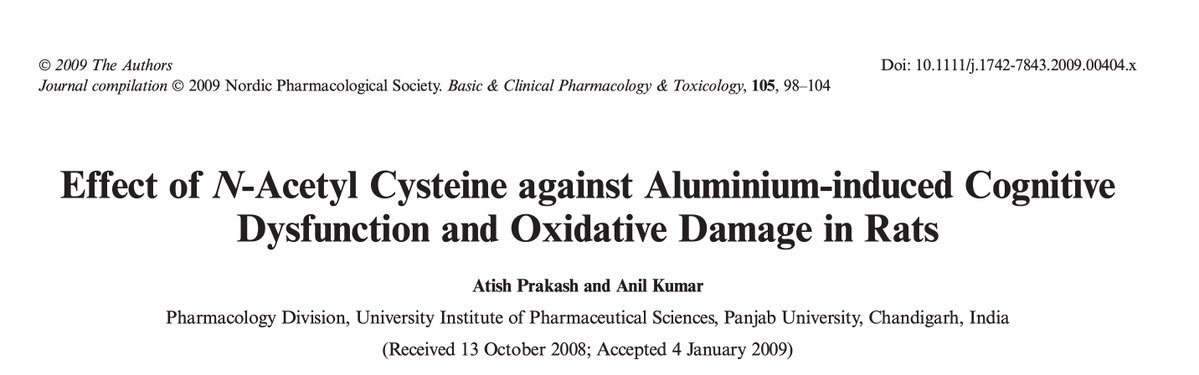
(🧵1/8)
2
Animals were put into 6 groups - either getting aluminum or NAC or both.
The aluminum was administered as aluminum chloride, and it was done so orally.
This is important because roughly only 0.5% of oral aluminum chloride is absorbed, so the real effective doses the animals received were far less than than the 100 mg / kg.
This is still a high dose, but aluminum is known to accumulate in tissues.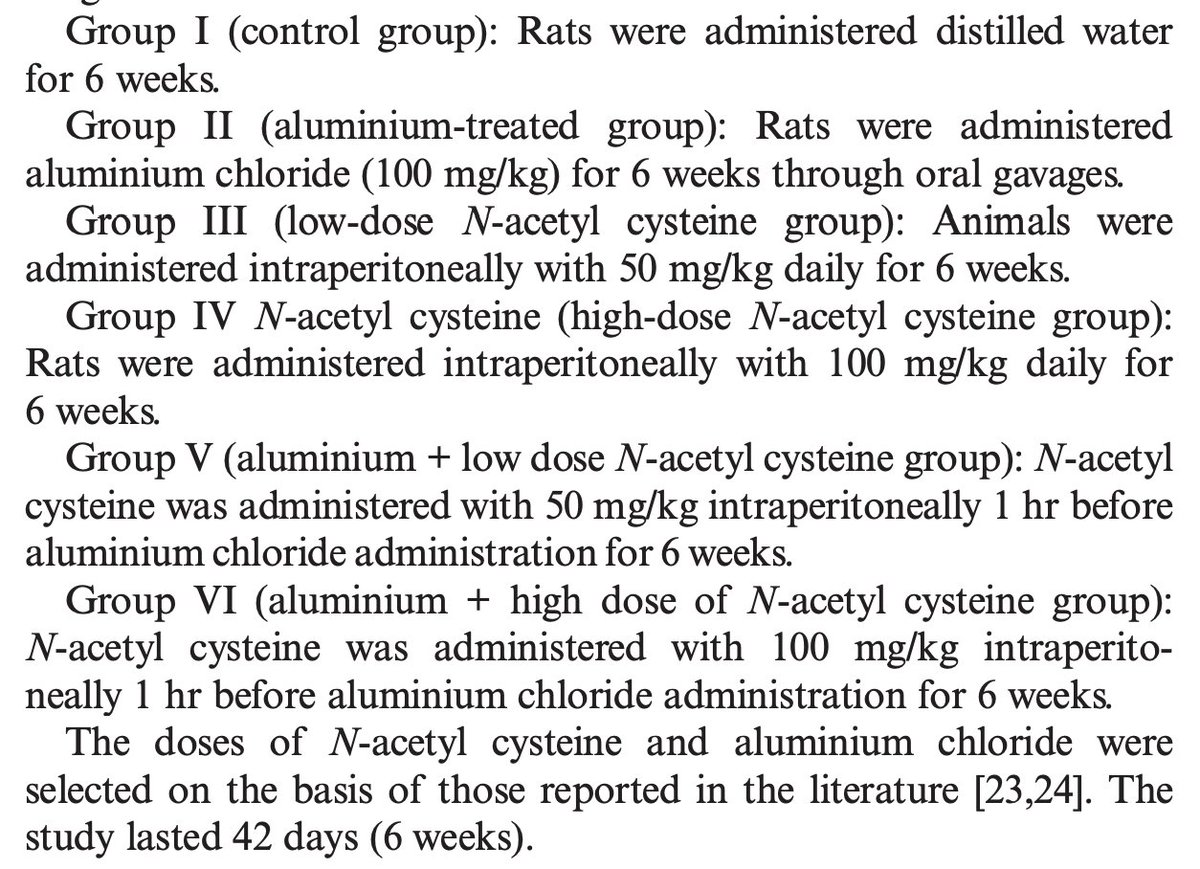
The aluminum was administered as aluminum chloride, and it was done so orally.
This is important because roughly only 0.5% of oral aluminum chloride is absorbed, so the real effective doses the animals received were far less than than the 100 mg / kg.
This is still a high dose, but aluminum is known to accumulate in tissues.
3
Animals had severely impaired memory performance with the aluminum, but this was improved with NAC.
The morris water test trains rats to find a hidden platform in pool.
The latencies (times) is how long it takes to find it on a given day.
Less time = better memory.
As you can see, the high dose NAC almost completely reversed the memory impairment from aluminum.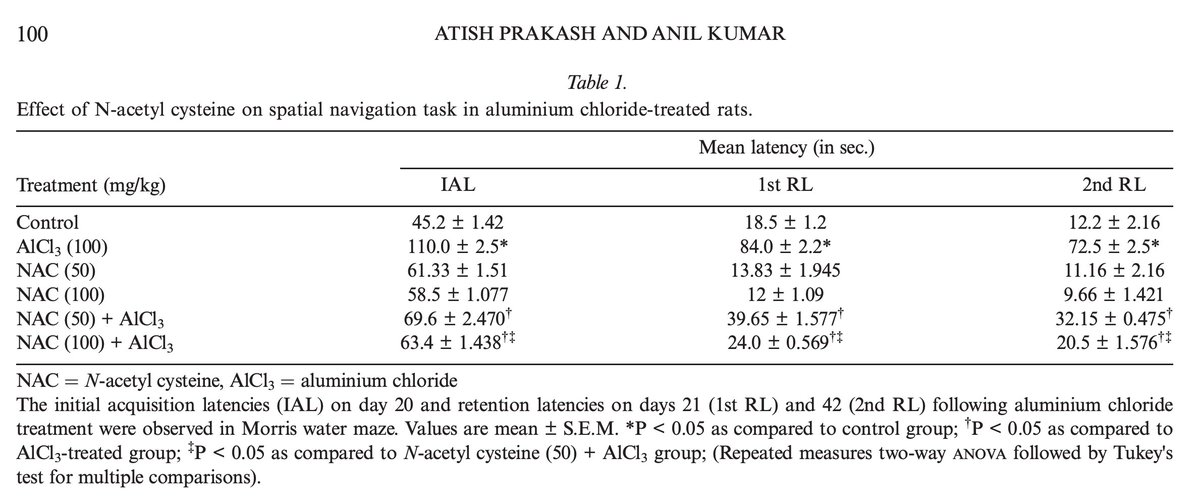
The morris water test trains rats to find a hidden platform in pool.
The latencies (times) is how long it takes to find it on a given day.
Less time = better memory.
As you can see, the high dose NAC almost completely reversed the memory impairment from aluminum.
4
The elevated plus maze is the sort of the same idea. If they remember the maze they get out quickly.
Once again, you can see that aluminum resulted in significant impairment in memory, whereas NAC counteracted this impairment.
Once again, you can see that aluminum resulted in significant impairment in memory, whereas NAC counteracted this impairment.
5
Importantly, they measured overall movement, and this did not change between the groups.
This tells us that the maze time differences were due to memory impairment, not simply being tired or moving less.
This tells us that the maze time differences were due to memory impairment, not simply being tired or moving less.
6
NAC improved all antioxidant / inflammatory measures.
This is likely the key reason why aluminum is so terrible for the brain and why NAC is so protective.
NAC decreased:
◇ TBARS (lipid damage)
◇ Nitrite (nitric oxide estimate, elevated in brain inflammation)
while increasing:
◇ Reduced glutathione (active antioxidant)
◇ Catalase + SOD (key antioxidant enzymes)
This is likely the key reason why aluminum is so terrible for the brain and why NAC is so protective.
NAC decreased:
◇ TBARS (lipid damage)
◇ Nitrite (nitric oxide estimate, elevated in brain inflammation)
while increasing:
◇ Reduced glutathione (active antioxidant)
◇ Catalase + SOD (key antioxidant enzymes)
7
Aluminum also raised the activity of the enzyme acetylcholinesterase.
This is an enzyme that breaks down the neurotransmitter acetylcholine - known for its roles in promoting attention and memory.
Acetylcholine levels are often low in Alzheimer's.
NAC lowered the activity of this enzyme.
This is an enzyme that breaks down the neurotransmitter acetylcholine - known for its roles in promoting attention and memory.
Acetylcholine levels are often low in Alzheimer's.
NAC lowered the activity of this enzyme.
8
While there is technically some controversy around aluminum and Alzheimer's disease, there really shouldn't be.
Aluminum is a known neurotoxin. The only debate is around how much it contributes to the average person's Alzheimer's.
The most recent review looking at exposure of aluminum showed that about half of studies showed an association between higher aluminum and dementia risk, while the other half showed no association.
How does it exert its toxic effects in the brain? Countless ways, a few key ones being:
◇ Promotes reactive oxygen species (ROS) production through interactions with iron - this is the main reason why NAC helps, because it restores glutathione levels needed to protect us from ROS
◇ Disrupt / inhibit mitochondrial energy production
◇ Depletes neurotransmitters
◇ Disrupts / inhibits intracellular signaling cascades
◇ Induces excitotoxicity (calcium overload) in neurons
◇ Increases blood brain barrier permeability
◇ Induces nitric oxide synthesis
◇ Activates microglia (inflammatory cells in brain)
I could go on, but I think you get the point.
Aluminum is a known neurotoxin. The only debate is around how much it contributes to the average person's Alzheimer's.
The most recent review looking at exposure of aluminum showed that about half of studies showed an association between higher aluminum and dementia risk, while the other half showed no association.
How does it exert its toxic effects in the brain? Countless ways, a few key ones being:
◇ Promotes reactive oxygen species (ROS) production through interactions with iron - this is the main reason why NAC helps, because it restores glutathione levels needed to protect us from ROS
◇ Disrupt / inhibit mitochondrial energy production
◇ Depletes neurotransmitters
◇ Disrupts / inhibits intracellular signaling cascades
◇ Induces excitotoxicity (calcium overload) in neurons
◇ Increases blood brain barrier permeability
◇ Induces nitric oxide synthesis
◇ Activates microglia (inflammatory cells in brain)
I could go on, but I think you get the point.
9
Our affiliate NAC brand can be found on this page at the top under "featured."
Doses are typically 600-1200 mg for general antioxidant support.
analyzeandoptimize.io/shop
Doses are typically 600-1200 mg for general antioxidant support.
analyzeandoptimize.io/shop
10
If you want to get some personalized help from us with ANY of your health goals, we’re taking clients virtually worldwide every day at PRISM. Book a free call here for more: go.prism.miami/consultation
12
If you’re interested in getting lab testing, we offer a ton of different tests you can get without even needing to go to a doctor below. revelationdiagnostics.com/?ref=AO