Thread Truncated (Cap Enforced)
Only the first 20 tweets are unrolled into slides to ensure reliable PDF exporting and high server performance.
Canvas & Ratio
Choose your destination platform format
Layout Template
Choose a content structure for your slides
Preset Themes
Typography & Sizing
Brand Kit Customization
AGENCYConfigure brand assets for headers & footers
Outro Slide CTA
Customize your closing call-to-action slide
Background Pattern
Build Your Carousel
Drag and drop any post card below onto a slide, or use the quick buttons to insert content/images instantly!

The best engineers in the world have stopped prompting AI and started building loops.

While everyone else is focused on getting better answers from ChatGPT, they're designing systems that think, act, learn, and improve on their own.
So why has almost nobody applied this approach to the parts of a business that actually generate revenue?
Beats me. But it's a massive opportunity.
Here's why.
---
## So what's a "loop"?
A loop is a small program that prompts the agent for you. It reads what the agent produced, decides whether the job is done, and if it isn't, it prompts again. You stop being the thing inside the work typing all day. You become the author of the loop, and the model becomes a subroutine running inside it.
People argue about whether this is anything new. Is it a Ralph loop? A /goal command? A glorified cron job? The honest answer is that it's the evolution of a cron job, and it's probably the step right before agents that improve themselves. Basically: you stop being the hands and start being the architect.
## This isn't just my idea
It's coming from the people who built the tools you're using every day.
<b>Boris Cherny</b>, the creator of Claude Code, said it about as plainly as it gets: "I don't prompt Claude anymore. What I mostly use now is loops. I create loops, they do the rest of the job."
<b>Peter Steinberger, </b>the creator of OpenClaw, said the same thing, and that post did 7.9 million views: stop prompting your coding agents, start designing the loops that prompt them for you.
<a target="_blank" href="https://x.com/i/status/2063697162748260627" color="blue">https://x.com/i/status/2063697162748260627</a>
Then <b>Matt Van Horn</b> wrote the breakdown that finally put a definition on it, a post that pulled 3.4 million views. He ran a "last 30 days" skill across the whole argument, because nobody could agree on what a loop even was. The cleanest version that came out of it is the one above: you author the loop, the model becomes the subroutine.
<a target="_blank" href="https://x.com/i/status/2063865685558903149" color="blue">https://x.com/i/status/2063865685558903149</a>
When the people who built these tools tell you the way you're using them is already outdated, it's worth a look. So here's how to build one for the parts of your business that bring in money.
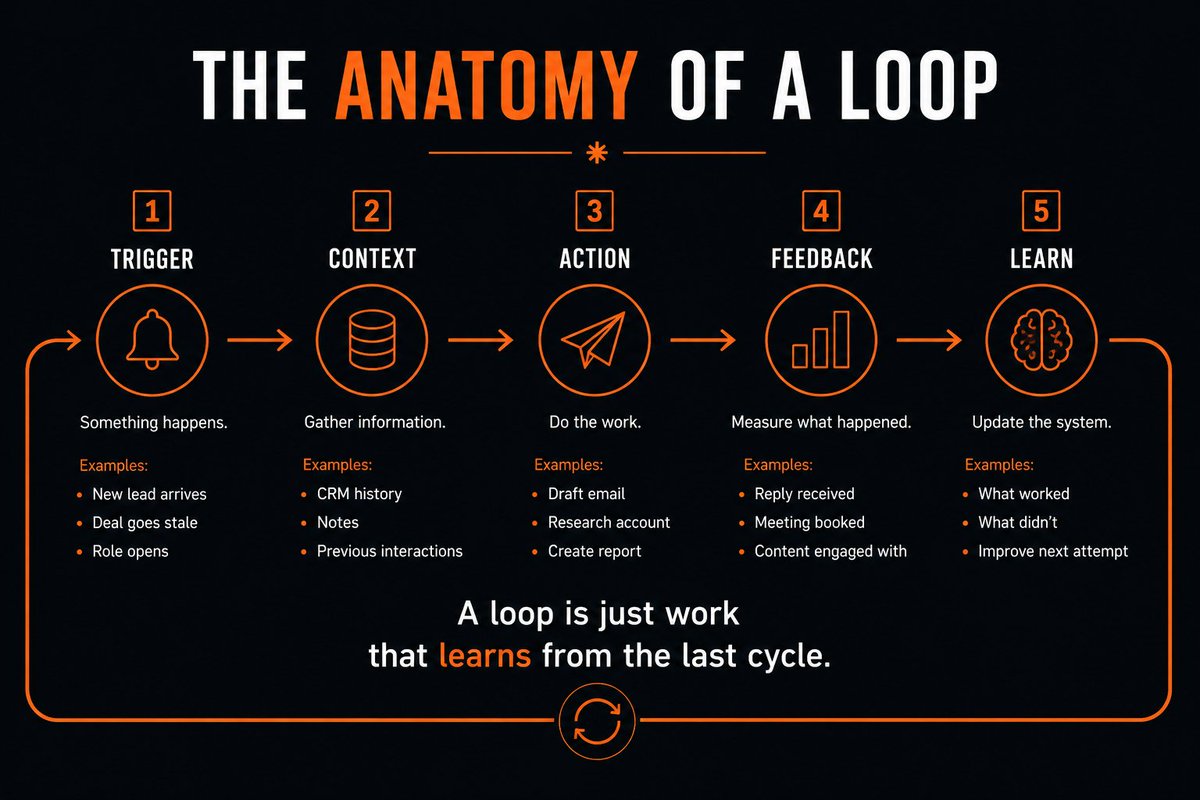
## How to build a business loop
Every loop, in any department of a business , has the same five parts: