Thread Truncated (Cap Enforced)
Only the first 20 tweets are unrolled into slides to ensure reliable PDF exporting and high server performance.
Canvas & Ratio
Choose your destination platform format
Layout Template
Choose a content structure for your slides
Preset Themes
Typography & Sizing
Brand Kit Customization
AGENCYConfigure brand assets for headers & footers
Outro Slide CTA
Customize your closing call-to-action slide
Background Pattern
Build Your Carousel
Drag and drop any post card below onto a slide, or use the quick buttons to insert content/images instantly!

---
Kor Ver. : https://x.com/BSkypia59338/status/2032736168215982243
---
## <b>Exploding AI Infrastructure Demand and Structural Limitations in the HBM4 Supply Chain</b>
The global semiconductor and artificial intelligence (AI) industries are approaching an unprecedented inflection point starting in 2026. AI data center construction projects led by global hyperscalers such as Microsoft, Alphabet (Google), Meta, and Amazon are generating astronomical capital expenditures (CAPEX) of approximately $650 billion (roughly 860 trillion won) this year alone.
At the forefront of these massive investments sits Nvidia’s next-generation AI accelerator platform, “Vera Rubin,” which dominates the global AI computing ecosystem. The most critical bottleneck technology determining the platform’s success is undoubtedly the sixth-generation high-bandwidth memory, “HBM4.”
The global memory semiconductor industry has completely shifted from a mass-production model centered on general-purpose DRAM to a made-to-order industry focused on customized ultra-high-performance memory.
This structural transition is causing severe and long-term supply-demand imbalances across the entire semiconductor supply chain.
Although the three major global memory manufacturers—Samsung Electronics, SK hynix, and Micron—are concentrating their capital and facility investments on HBM, these resources are being directed primarily toward EUV process transitions and advanced packaging line construction rather than immediate wafer output increases. As a result, the actual memory supply shortage is expected to persist until as late as 2028.
In this environment of extreme supply constraints, simultaneously meeting Nvidia’s massive volume requirements and extreme performance demands for HBM4 has emerged as a life-or-death challenge for semiconductor companies.

---
## <b>Early 70:30 Market Share Formation: Past Loyalty and Long-Standing Partnerships</b>
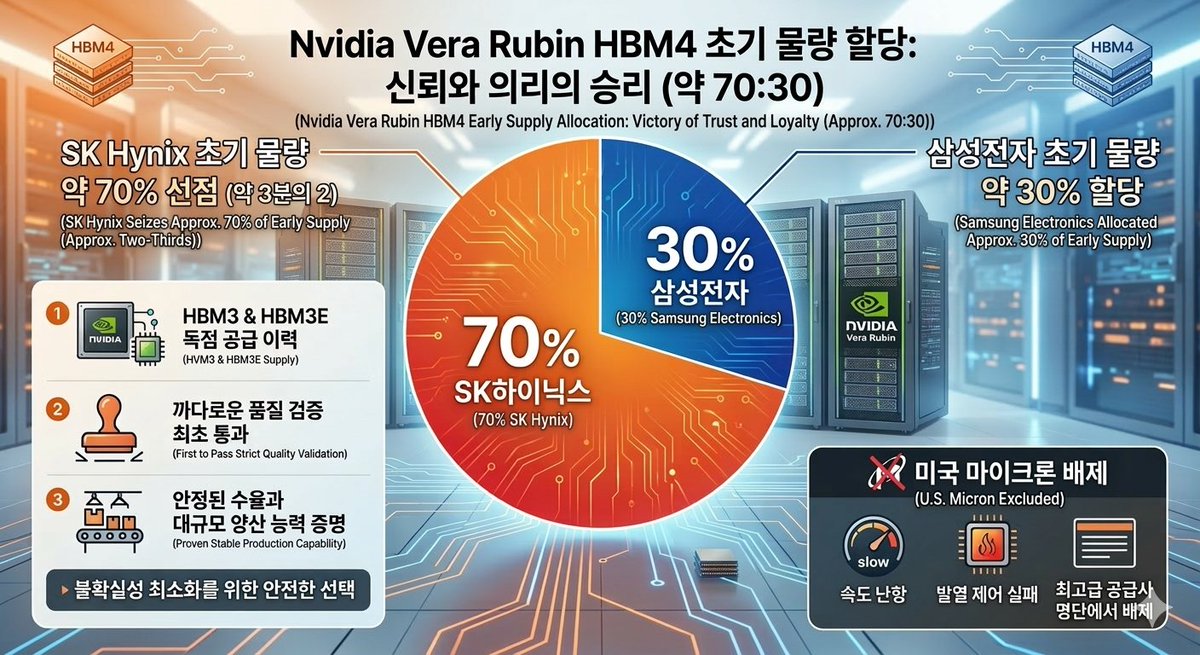
Amid this fierce competition, Nvidia has allocated the initial HBM4 supply for the Vera Rubin platform to Korea’s two memory giants—SK hynix and Samsung Electronics—at an approximate 70:30 ratio.
SK hynix’s ability to secure the overwhelming majority share (about 70%) of the initial volume stems entirely from its historical track record.
From the early days of the HBM market through the HBM3 generation and the current mainstream HBM3E, SK hynix has essentially held a near-monopoly position supplying memory to Nvidia. They were the first to pass Nvidia’s stringent quality verification, stabilized yields, and have been the undisputed primary partner physically supporting the expansion of the global AI server ecosystem.
Therefore, SK hynix securing 70% in this initial HBM4 allocation should be viewed not as proof of new technological superiority, but rather as the result of a strong preemptive advantage built on long-standing solid trust and so-called “loyalty.”
With a flagship product launch of astronomical stakes on the horizon, entrusting the initial leadership to an existing partner who has already proven large-scale mass-production yields was the safest choice to minimize uncertainty.
In contrast, U.S.-based Micron Technology struggled to meet Nvidia’s demanding requirements for speed and heat control, ultimately suffering the humiliation of being effectively excluded from the list of top-tier HBM4 core suppliers for Vera Rubin.