@BSkypia59338: ---...

Kor Ver. : https://x.com/BSkypia59338/status/2032736168215982243
Exploding AI Infrastructure Demand and Structural Limitations in the HBM4 Supply Chain
The global semiconductor and artificial intelligence (AI) industries are approaching an unprecedented inflection point starting in 2026. AI data center construction projects led by global hyperscalers such as Microsoft, Alphabet (Google), Meta, and Amazon are generating astronomical capital expenditures (CAPEX) of approximately $650 billion (roughly 860 trillion won) this year alone.
At the forefront of these massive investments sits Nvidia’s next-generation AI accelerator platform, “Vera Rubin,” which dominates the global AI computing ecosystem. The most critical bottleneck technology determining the platform’s success is undoubtedly the sixth-generation high-bandwidth memory, “HBM4.”
The global memory semiconductor industry has completely shifted from a mass-production model centered on general-purpose DRAM to a made-to-order industry focused on customized ultra-high-performance memory.
This structural transition is causing severe and long-term supply-demand imbalances across the entire semiconductor supply chain.
Although the three major global memory manufacturers—Samsung Electronics, SK hynix, and Micron—are concentrating their capital and facility investments on HBM, these resources are being directed primarily toward EUV process transitions and advanced packaging line construction rather than immediate wafer output increases. As a result, the actual memory supply shortage is expected to persist until as late as 2028.
In this environment of extreme supply constraints, simultaneously meeting Nvidia’s massive volume requirements and extreme performance demands for HBM4 has emerged as a life-or-death challenge for semiconductor companies.

Early 70:30 Market Share Formation: Past Loyalty and Long-Standing Partnerships
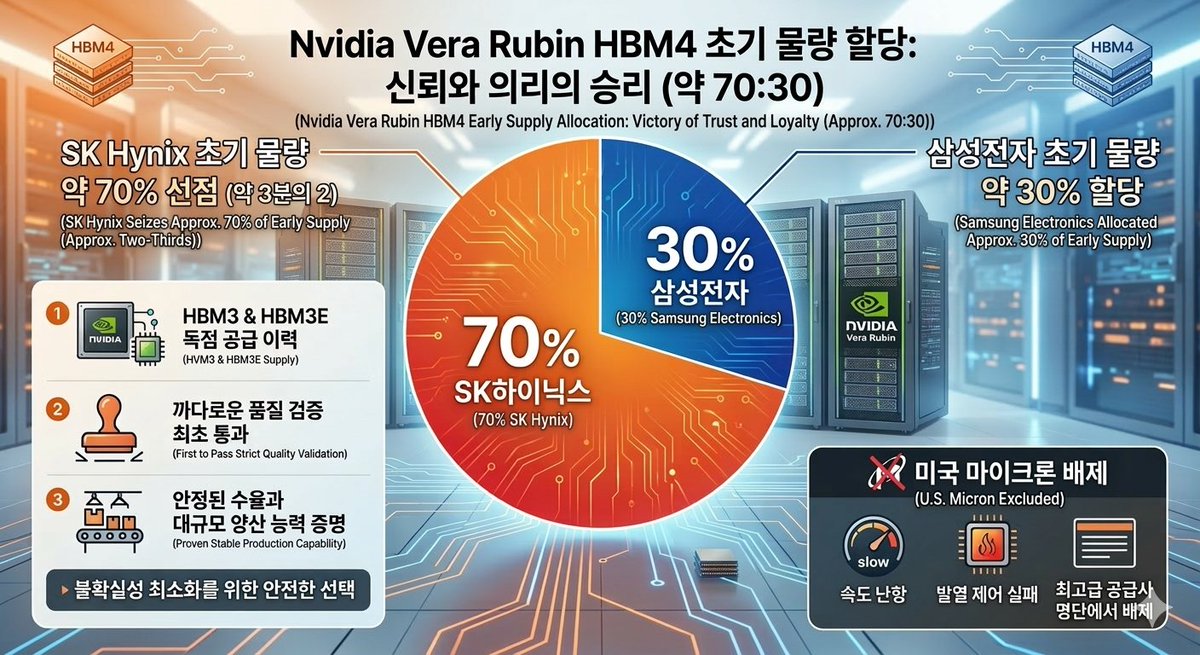
Amid this fierce competition, Nvidia has allocated the initial HBM4 supply for the Vera Rubin platform to Korea’s two memory giants—SK hynix and Samsung Electronics—at an approximate 70:30 ratio.
SK hynix’s ability to secure the overwhelming majority share (about 70%) of the initial volume stems entirely from its historical track record.
From the early days of the HBM market through the HBM3 generation and the current mainstream HBM3E, SK hynix has essentially held a near-monopoly position supplying memory to Nvidia. They were the first to pass Nvidia’s stringent quality verification, stabilized yields, and have been the undisputed primary partner physically supporting the expansion of the global AI server ecosystem.
Therefore, SK hynix securing 70% in this initial HBM4 allocation should be viewed not as proof of new technological superiority, but rather as the result of a strong preemptive advantage built on long-standing solid trust and so-called “loyalty.”
With a flagship product launch of astronomical stakes on the horizon, entrusting the initial leadership to an existing partner who has already proven large-scale mass-production yields was the safest choice to minimize uncertainty.
In contrast, U.S.-based Micron Technology struggled to meet Nvidia’s demanding requirements for speed and heat control, ultimately suffering the humiliation of being effectively excluded from the list of top-tier HBM4 core suppliers for Vera Rubin.
Performance Limits and Diverging Strategies: The Battle for the 11.7Gbps Summit
However, this imbalanced 70:30 split is being severely tested in the face of the extreme performance standards demanded by Nvidia.
The real flashpoint is the ultra-high-speed data transfer rate required by the Vera Rubin platform. Nvidia has set a premium target of up to 11.7Gbps for HBM4—far exceeding the 8.0Gbps standard set by the JEDEC international semiconductor standards body—to maximize performance.
In this extreme speed race, Samsung Electronics, starting with only 30% share, defied market expectations and took the lead. Samsung applied its most advanced sixth-generation 10nm-class (1c) DRAM to HBM4 and perfectly passed verification for Nvidia’s top premium 11.7Gbps performance standard.
Furthermore, leveraging its own foundry capabilities, Samsung became the first in the industry to begin mass production and shipments of HBM4 in February 2026, completely seizing technological leadership.
Meanwhile, the situation for SK hynix, which secured 70% of the initial volume, is more complicated.
To prioritize stability and yield in early mass production, SK hynix adopted a conservative strategy combining fifth-generation 10nm-class (1b) DRAM with Taiwan’s TSMC mature 12nm process base die.
As a result, while it comfortably exceeded Nvidia’s JEDEC standard (8Gbps), it faces physical limitations and optimization challenges in quickly matching the peak speed of 11.7Gbps that Samsung achieved.
Consequently, SK hynix is focusing on mainstream HBM4 mass production operating at around 10Gbps rather than the 11.7Gbps premium line, seeking a point of compromise.

The 1.7Gbps Butterfly Effect: The Decisive Difference Between Premium and Mainstream
On the surface, the 1.7Gbps speed difference between 11.7Gbps and 10Gbps may seem minor on a per-pin basis. However, when scaled to the entire AI accelerator system, this gap becomes the decisive criterion that completely separates premium (high-performance) and mainstream (general-purpose) lineups.
HBM4 has doubled the number of I/O pins for data exchange to 2,048 compared to previous generations. Therefore, a 1.7Gbps speed difference per pin amplifies into a massive bandwidth (data throughput) difference of hundreds of gigabytes per second (GB/s) per HBM4 stack.
In fact, when pin speed increases from 11.7Gbps to 13Gbps, the total bandwidth per stack soars from 2.6TB/s to as high as 3.3TB/s.
Since Nvidia’s Vera Rubin platform is planned to mount up to 16 of these HBM4 stacks, the overall system-wide data processing throughput gap between the two speeds reaches several terabytes per second (TB/s).
Global big tech companies are currently facing a “memory bottleneck,” where the speed of fetching data from memory lags behind the speed of computing devices as AI models grow larger.
In this context, the bandwidth difference created by 1.7Gbps has the power to dramatically shorten training times for ultra-large AI models by tens of percent or more—from weeks to significantly less. This is the core reason Nvidia has no choice but to dualize its lineup by separating top-performance chips from lower-tier ones.

The Emergence of the Dual-Bin Strategy: Inevitable Market Realignment Caused by Supply Shortages
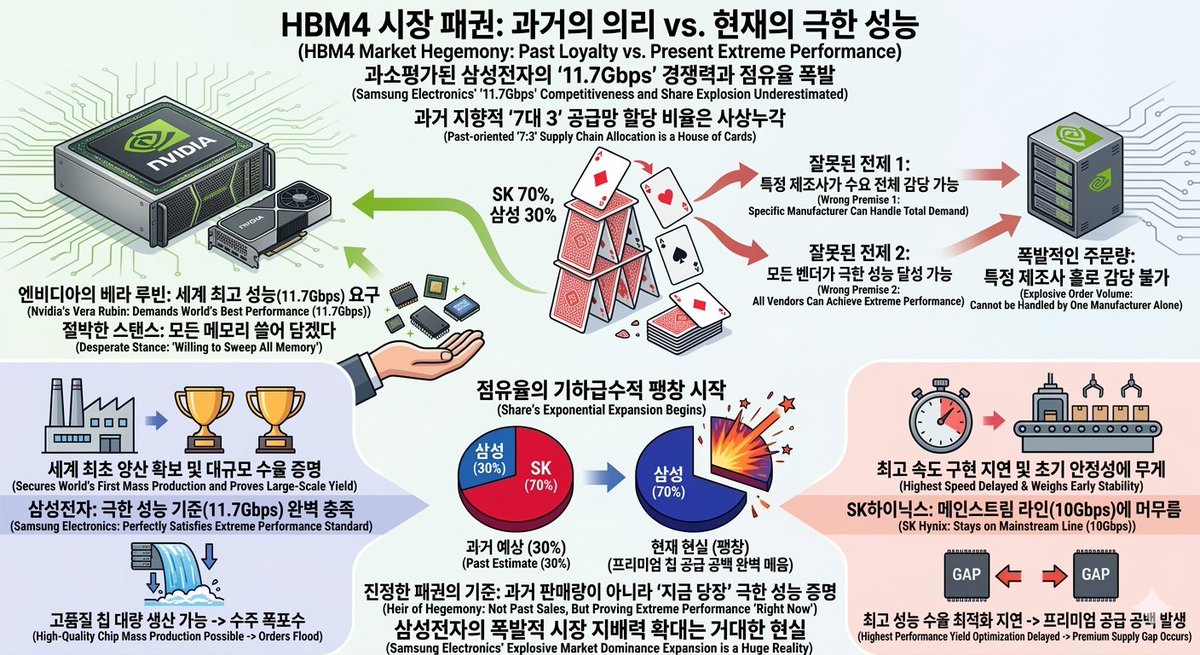
From Nvidia’s perspective, the dilemma is deepening. To showcase Vera Rubin’s absolute performance advantage, top-grade HBM4 supporting 11.7Gbps is essential. However, a single vendor like Samsung alone cannot possibly handle the explosive order volumes from global hyperscalers.
Moreover, the 16-layer stacking process applied to HBM4 inherently suffers from extremely low yields, making productivity declines inevitable.
Ultimately, to resolve the dilemma of exploding demand and performance shortfalls, Nvidia is highly likely to adopt a “Dual-Bin” strategy for Vera Rubin HBM4 supply. This means allocating Samsung’s 1c DRAM-based HBM4, which boasts the highest 11.7Gbps speed, entirely to premium Vera Rubin systems, while equipping lower-tier systems with SK hynix’s 1b DRAM-based HBM4 operating at 10Gbps levels.
Nvidia CEO Jensen Huang’s declaration—“Don’t hesitate to build memory factories. Nvidia will consume all additional production capacity”—clearly illustrates this severe supply crisis.
In the global supply chain ecosystem, past loyalty or preferential treatment toward a specific vendor remains valid only as long as that company can produce the highest specifications in unlimited quantities. With SK hynix currently unable to mass-produce 11.7Gbps premium volumes at the scale the market demands, Nvidia cannot afford to overlook a ready alternative with a perfect mass-production system.

Conclusion: The Collapse of the 70:30 Structure and the Rationale for Samsung Electronics’ Expanding Share
In conclusion, the currently known HBM4 supply allocation ratio of “SK hynix 70%, Samsung Electronics 30%” is an extremely fragile house of cards. It is merely a backward-looking figure derived from the false premise that a single manufacturer can single-handedly handle the enormous total market demand and the assumption that all vendors can equally achieve the extreme 11.7Gbps performance.
Market reality is ruthless.
Nvidia’s Vera Rubin demands world-class performance, and Samsung Electronics has already perfectly met that standard (11.7Gbps), securing the tangible reference of being the world’s first to enter mass production. In contrast, SK hynix has prioritized early production stability while taking a step back from achieving the highest speeds.
Given Nvidia’s desperate stance of scooping up every available memory chip regardless of price fluctuations or unit costs, it is an economic inevitability that orders will pour like a waterfall into Samsung Electronics, which can preemptively mass-produce high-quality chips that fully deliver the required performance (11.7Gbps).
Ultimately, the longer SK hynix remains focused on the mainstream line (10Gbps) and delays optimization of highest-speed yields, the more Samsung Electronics’ market share—capable of perfectly filling the premium chip supply gap—will expand exponentially beyond the originally expected 30%.
The true hegemony in the HBM4 market depends not on who sold the most chips in the past, but on who can currently prove they can deliver extreme 11.7Gbps performance with stable, large-scale yields. From this perspective, Samsung Electronics’ explosive expansion of market dominance is already a massive reality that has begun.
References