Thread Truncated (Cap Enforced)
Only the first 20 tweets are unrolled into slides to ensure reliable PDF exporting and high server performance.
Canvas & Ratio
Choose your destination platform format
Layout Template
Choose a content structure for your slides
Preset Themes
Typography & Sizing
Brand Kit Customization
AGENCYConfigure brand assets for headers & footers
Outro Slide CTA
Customize your closing call-to-action slide
Background Pattern
Build Your Carousel
Drag and drop any post card below onto a slide, or use the quick buttons to insert content/images instantly!

In metaphysics Aristotle considered the world a series of causes and effects. This led him to come up with the concept of the Unmoved Mover an uncaused cause at the beginning of time and center of the universe which started all other chains of causality in the world.
Aristotle spent 20 years in Athens studying with Plato at the Academy before leaving in 347 BC to travel and study botany and zoology across Greece. He intended to compile a large knowledge base of plants and animals.
As art and philosophy was flourishing the political situation in Greece was unstable. Sparta desired to preserve control against an ascendant Thebes. In 376 BC Sparta tried to attack Thebes by sea but was intercepted by an Athenian fleet under Chabrias.

In 375 BC the Thebans under Pelopidas made a move to force the Spartan garrison out of Orchomenus so that all of Boeotia would be under Theban control. The resulting conflict culminated in the Battle of Tegyra outside the city of Orchomenus.
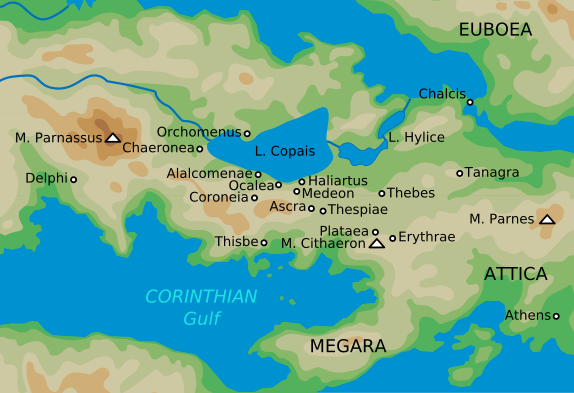
The Spartans were commanded by Polemiarchs Gorgoleon and Theopompus. They outnumbered the Thebans 2 to 1 but had very few Spartiate citizens and mostly Helots, Messinians, or Orchomenian allies.
The number of Spartan citizens trained and raised in the classical Spartan way had significantly declined over time for a variety of reasons. By 375 BC there were perhaps only 4000 men in all of Sparta who were full citizens trained in the classical way.

This included those too old to fight. Sparta could only field perhaps 1500 full Spartans at a time by this period. The majority of Spartan armies were helots, Peloponnesian and other allies, or a rising class of free merchants and farmers who were not Spartan citizens.
At Tegyra the Spartans only had around 1000 men total while Thebes only fielded 500. The previous centuries of war had worn down manpower and the armies of 40,000 Greeks that faced Persia were impossible to raise now.
The Theban Sacred Band organized in a deep formation and crashed right into the Spartiate right. Both Spartan Polemiarchs were cut down. The Spartans tried to open their center expecting the Thebans to flee through it but they turned around and flanked the Spartan phalanx.

The Spartans were massacred at Tegyra by Thebes marking the first time Sparta had been defeated by a numerically inferior enemy ever in their entire history. The Thebans erected a war trophy and forced the Spartans out of Boeotia.

From 375 to 371 BC Sparta and Thebes fought back and forth with King Agiselaus II leading a Spartan invasion of Boeotia which ravaged the countryside but failed to take Thebes. Athens helped Thebes with their navy and raided the Peloponnese.
The Thebans captured Orchomenus and destroyed their ancient rival Plataea. The Plataeans fled as refugees from their burned city to Athens and asked for residence in the city which was granted. Plataean tales of Theban brutality started to sway Athens against Thebes.

The Thebans relied on Athenian naval support but refused to pay for the navy. At this point in 371 BC Athens severed the alliance with Thebes and declared the 2nd Athenian League more or less neutral between Thebes and Sparta.
Meanwhile the Spartans were expected to get the Greek cities to sign the King's Peace again that year. Thebes elected 4 Boeotiarchs signalling their intention to revive the Boeotian League a violation of the autocephaly clause of the King's Peace.
Epaminondas as the leader of the elected Boeotiarchs stepped forward to sign for the entire Boeotian League but King Agiselaus II told him no that Thebes may only sign for Thebes or not at all. Epaminondas chose not at all.
The Spartans saw Theban refusal to assent to the Persian peace as cause to reassert their control over central Greece. King Cleambrotus I of Sparta led 10,000 hoplites mainly made up of helots and Peloponnesian allies and 1000 cavalry over land through Phocis to attack Boeotia

The Spartans took an arduous route through the mountains rather than the traditional coastal route in order to drop into Boeotia by suprise and take the Thebans hopefully unaware.

However Thebes had been preparing for battle and amassing a large force of their allies and Boeotian League members of about 7000 hoplites and 1500 cavalry.
The two cavalry forces met first and the superior Boeotian and Thessalian horsemen drove the Peloponnesians unused to horses off the field. The Spartan's allies seeing their cavalry flee became worried and fearful.

Traditionally in hoplite warfare a phalanx was organized uniformly 12 to 15 men deep with the elite units always placed on the right due to a phalanx's natural tendency to drift right. The elite right always met the enemy phalanx's weak left which often caused them to spin.
