@Tawadros15: In metaphysics Aristotle consi...
@Tawadros15
9 views
Apr 17, 2026
Advertisement
1
In metaphysics Aristotle considered the world a series of causes and effects. This led him to come up with the concept of the Unmoved Mover an uncaused cause at the beginning of time and center of the universe which started all other chains of causality in the world.
2
Aristotle spent 20 years in Athens studying with Plato at the Academy before leaving in 347 BC to travel and study botany and zoology across Greece. He intended to compile a large knowledge base of plants and animals.
3
As art and philosophy was flourishing the political situation in Greece was unstable. Sparta desired to preserve control against an ascendant Thebes. In 376 BC Sparta tried to attack Thebes by sea but was intercepted by an Athenian fleet under Chabrias.

4
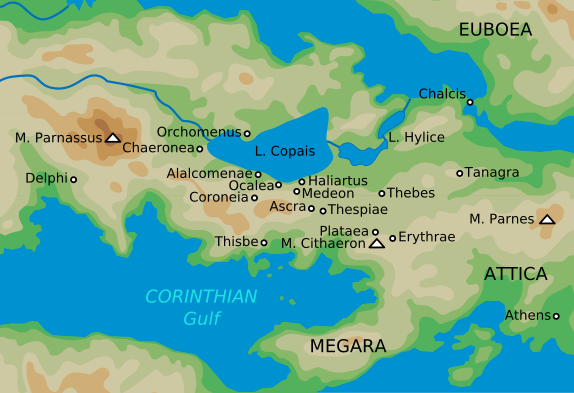
In 375 BC the Thebans under Pelopidas made a move to force the Spartan garrison out of Orchomenus so that all of Boeotia would be under Theban control. The resulting conflict culminated in the Battle of Tegyra outside the city of Orchomenus.
5
The Spartans were commanded by Polemiarchs Gorgoleon and Theopompus. They outnumbered the Thebans 2 to 1 but had very few Spartiate citizens and mostly Helots, Messinians, or Orchomenian allies.
6
The number of Spartan citizens trained and raised in the classical Spartan way had significantly declined over time for a variety of reasons. By 375 BC there were perhaps only 4000 men in all of Sparta who were full citizens trained in the classical way.

7
This included those too old to fight. Sparta could only field perhaps 1500 full Spartans at a time by this period. The majority of Spartan armies were helots, Peloponnesian and other allies, or a rising class of free merchants and farmers who were not Spartan citizens.
8
At Tegyra the Spartans only had around 1000 men total while Thebes only fielded 500. The previous centuries of war had worn down manpower and the armies of 40,000 Greeks that faced Persia were impossible to raise now.
9
The Theban Sacred Band organized in a deep formation and crashed right into the Spartiate right. Both Spartan Polemiarchs were cut down. The Spartans tried to open their center expecting the Thebans to flee through it but they turned around and flanked the Spartan phalanx.

10
The Spartans were massacred at Tegyra by Thebes marking the first time Sparta had been defeated by a numerically inferior enemy ever in their entire history. The Thebans erected a war trophy and forced the Spartans out of Boeotia.

11
From 375 to 371 BC Sparta and Thebes fought back and forth with King Agiselaus II leading a Spartan invasion of Boeotia which ravaged the countryside but failed to take Thebes. Athens helped Thebes with their navy and raided the Peloponnese.
12
The Thebans captured Orchomenus and destroyed their ancient rival Plataea. The Plataeans fled as refugees from their burned city to Athens and asked for residence in the city which was granted. Plataean tales of Theban brutality started to sway Athens against Thebes.

13
The Thebans relied on Athenian naval support but refused to pay for the navy. At this point in 371 BC Athens severed the alliance with Thebes and declared the 2nd Athenian League more or less neutral between Thebes and Sparta.
14
Meanwhile the Spartans were expected to get the Greek cities to sign the King's Peace again that year. Thebes elected 4 Boeotiarchs signalling their intention to revive the Boeotian League a violation of the autocephaly clause of the King's Peace.
15
Epaminondas as the leader of the elected Boeotiarchs stepped forward to sign for the entire Boeotian League but King Agiselaus II told him no that Thebes may only sign for Thebes or not at all. Epaminondas chose not at all.
16
The Spartans saw Theban refusal to assent to the Persian peace as cause to reassert their control over central Greece. King Cleambrotus I of Sparta led 10,000 hoplites mainly made up of helots and Peloponnesian allies and 1000 cavalry over land through Phocis to attack Boeotia

17
The Spartans took an arduous route through the mountains rather than the traditional coastal route in order to drop into Boeotia by suprise and take the Thebans hopefully unaware.

18
However Thebes had been preparing for battle and amassing a large force of their allies and Boeotian League members of about 7000 hoplites and 1500 cavalry.
19
The two cavalry forces met first and the superior Boeotian and Thessalian horsemen drove the Peloponnesians unused to horses off the field. The Spartan's allies seeing their cavalry flee became worried and fearful.

20
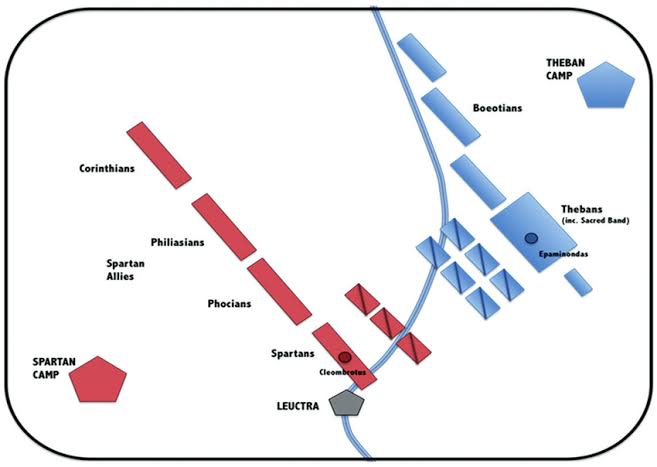
Traditionally in hoplite warfare a phalanx was organized uniformly 12 to 15 men deep with the elite units always placed on the right due to a phalanx's natural tendency to drift right. The elite right always met the enemy phalanx's weak left which often caused them to spin.

21
Epimonadas had broken this at Leuctra and placed his elite Theban Sacred Band at the front of his left in a formation 50 men deep concentrated against the Spartan elites where King Cleombrotus was. This type of tactical thinking is indicative of changes in Greek warfare.
22
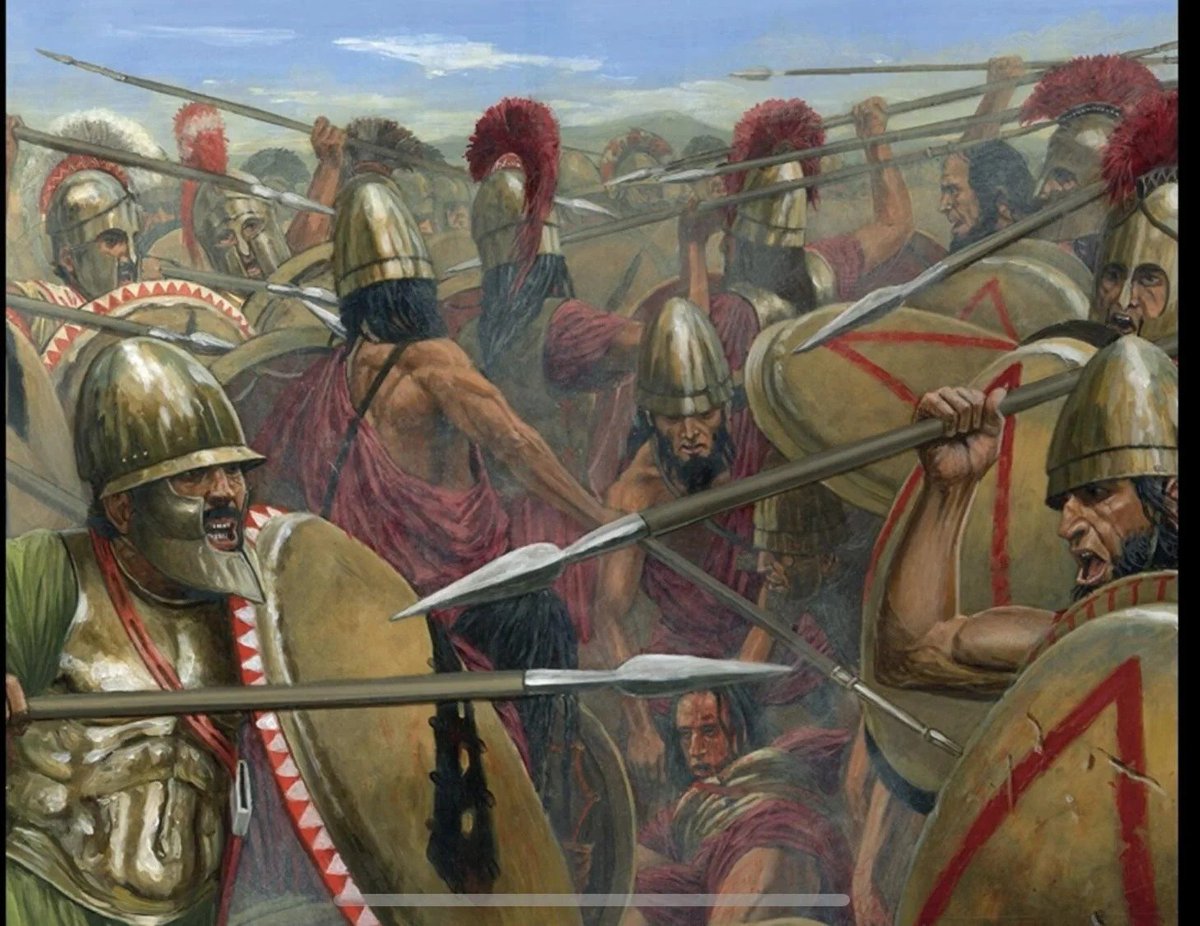
The Theban Sacred Band smashed into the Spartiate right and faced for the first time with men their equal in battle in such a deep formation the Spartans broke. The Theban cavalry flanked them and slaughtered the Spartans.
23
In the fighting King Cleombrotus I of Sparta was killed. The Spartans drug his body off the field in a route. With their Spartan overlords dead or fleeing the Peloponnesians also broke and ran giving Thebes and the Boeotian League the victory at Leuctra.
24
The Battle of Leuctra in 371 BC is considered by historians to mark the end of Spartan hegemony in Greece. Sparta never again could project power into central Greece or up to the northern cities. It was all the Spartans could do to defend the Peloponnese

25
Thebes became the new hegemon of Greece able to march armies and project power across Greece. They even built a navy of 100 triremes to challenge Athens at sea and try to turn Rhodes, Chios, and Lemnos against Athens but failed in this.

26
In 368 BC Thebes, Sparta, Athens and a host of other Greek cities sent diplomats to Susa to try to get Emperor Artaxerxes II to take their side in the ongoing struggles in Greece. Artaxerxes listened to them all and in 366 BC chose to support Thebes to enforce his peace.

27
Artaxerxes did not truly care who the hegemon of Greece was but only that the Greeks were too busy fighting each other to ever challenge him. Right now they were playing right into his hands and running to him to arbitrate their conflicts.
28
Athens and Sparta angry at the result of Artaxerxes' deliberation began to support revolting Satraps and the Pharoah of Egypt in revolt against the Persians Djhedor I who the Greeks called Teos. An Athenian mercenary army fought in Egypt for the Pharoah from 368 to 361 BC

29
King Agiselaus II of Sparta spent the last years of his life in Egypt as an advisor to Pharoah Djhedor. Much of the Pharoah's forces were Greeks. He was unfortunately betrayed to Artaxerxes by his brother Tjahpimu who was happy to be Satrap of Egypt rather than never Pharoah.

30
Thebes invaded the Peloponnese a total of 3 times from 368 to 362 BC. They established the city of Megalopolis in Achaea as a large city of freed helots and Achaeans to be an anti-Spartan buffer to prevent Spartan armies from leaving Laconia.

31
The Spartans could only desperately defend themselves in these wars and keep the Thebans and allies at bay. The 2nd Theban invasion was notable for Iberian mercenaries from Hispania coming to Greece for the first time hired by Dionysius of Syracuse to support Sparta.

32
Thebes also attempted to conquer Thessaly to their north which was ruled by the despot Alexander of Pherae. Much of Theban effort was spent fighting him in the north from 368-360 BC.

33
Epimanondas the man who had engineered the rise of Thebes as hegemon of Greece was killed in the 4th invasion of the Peloponnese at the Battle of Mantinea in 362 BC by a Spartan. It was the largest hoplite battle with 50,000 hoplites participating from nearly every city.

34
Without their leader the Thebans lost much of their appetite for dominance and warfare outside of Boeotia and were content with a much diminished and weak Sparta rather than total destruction of the Spartan state.
35
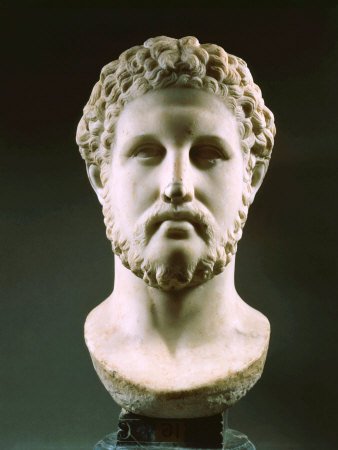
Affairs in Greece after 360 BC would pivot north when in 359 BC the 24 year old prince Phillip would inherit the throne of Macedonia becoming King Phillip II. Macedon had been a very minor part of Greek affairs on the edge of the Greek world but would come to prominance.
36
Macedonia had been founded as a kingdom some time during the Greek Dark Ages with a list of semi-mythical kings going back to King Temenus of Argos in the Peloponnese a descendant of Hercules. The kings of Macedon held their ancestor Caranus had come from Argos

37
Macedonia lay on the edge of the Greek world where Greek and Thracian/Illyrian civilizations met. The word Macedon is thought to come from Greek makednos meaning tall. As Macedonians were taller than Greeks further south.