
# The Claude Agent Playbook
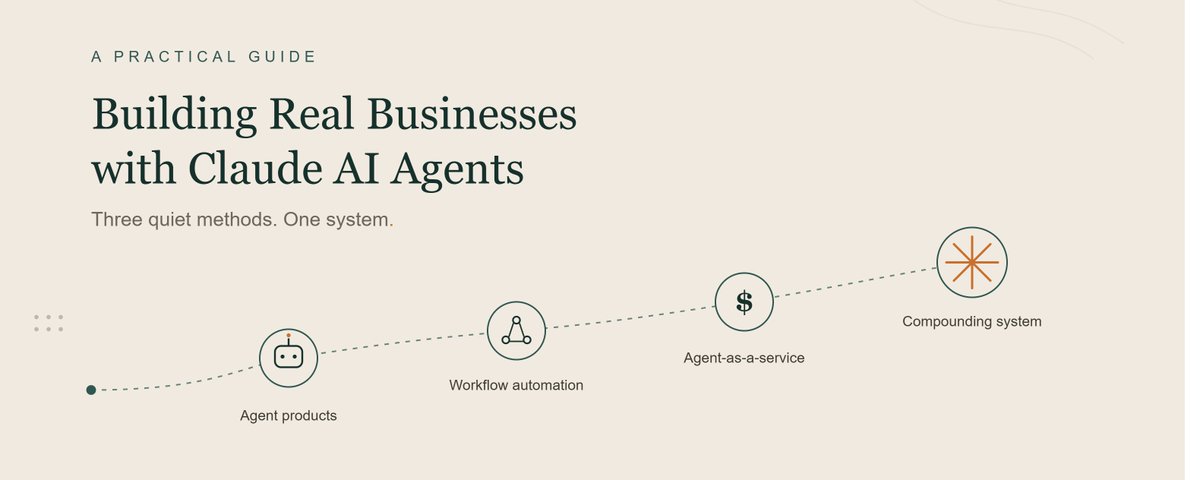
Subtitle: Most people use Claude to write emails faster. A smaller group is using it to run entire client workflows without touching them. This is the difference between a tool and a business.
## Why AI Agents Matter in 2026
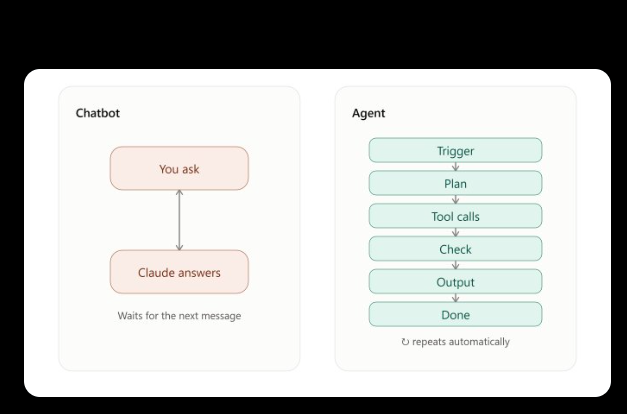
A chatbot answers a question and waits for the next one. An agent is different: it holds a goal, works through a sequence of steps, calls tools when it needs data or has to take an action, checks its own output, and only comes back to a human when something genuinely needs a decision.
That distinction sounds small. It isn't. It's the difference between "Claude helped me draft this" and "Claude ran this end-to-end while I did something else." The second version is what businesses will pay a monthly fee for — because it replaces hours of labor, not minutes of typing.
By 2026, the tooling to build agents — connectors, scheduled tasks, tool use, memory, multi-step orchestration — has moved from "engineering project" to "weekend build." That shift is the opportunity this guide is about. The bottleneck used to be technical skill. Now it's mostly clarity: knowing which workflow to automate, how to package it, and how to sell it.
Key takeaways from this guide:
• AI Agents are not chatbots. They are workflows with judgment built in, and that makes them sellable as outcomes, not access.
• There are three distinct ways to make money here: build agents as a service, sell agent templates as a product, and run an automation agency that combines both. Each has a different ceiling, a different amount of client contact, and a different amount of risk.
• The businesses that last are narrow. "An agent that does everything" sells to no one. "An agent that reconciles Shopify refunds against Stripe payouts every morning" sells itself.
• Pricing should track the value of the outcome the agent produces, not the number of hours you spent building it.
• None of the figures in this guide are guarantees. Where a number appears, it's either a documented pricing benchmark from a public platform or an explicitly labeled illustrative scenario.
## Introduction: You Are Probably Using Claude Wrong
Most people treat Claude like a very fast intern who forgets everything overnight. They open a chat, ask for a draft, copy it out, and close the tab. That's a real use case, and it has real value — but it caps out fast, because the human is still the one doing the orchestration: deciding what to ask, when to ask it, and what to do with the answer.
An agent removes the human from that loop for the parts that don't need judgment, and only surfaces the parts that do. Instead of a person prompting Claude five times a day to check on something, an agent is already checking, on a schedule, using real data, and only pinging a human when a threshold is crossed or a decision is required.
This reframes what you're selling. You are no longer selling "AI-written content" or "a custom document." You're selling a standing capability — something that keeps working after the invoice is paid. That's what turns a one-off gig into a retainer, and a retainer into a business.
Three ways to build a business on top of that idea, covered in order of how fast you can start and how much client interaction each requires:
| Method  | What you sell |  Client contact | Time to first dollar  |   Ceiling|
| --- | --- | --- | --- | --- |
| 1. Agent Services  | A working agent solving one business problem  | High (custom builds)  |  Fast |   Medium — capped by your hours unless you productize|
|  2. Agent Templates |  A packaged, reusable agent config/prompt system |  None (self-serve) |  Medium |  High — scales with distribution, not your time |
|  3. Automation Agency |  Ongoing agent infrastructure + support |  High (retainers) | Slow  |  Highest — recurring revenue, compounding |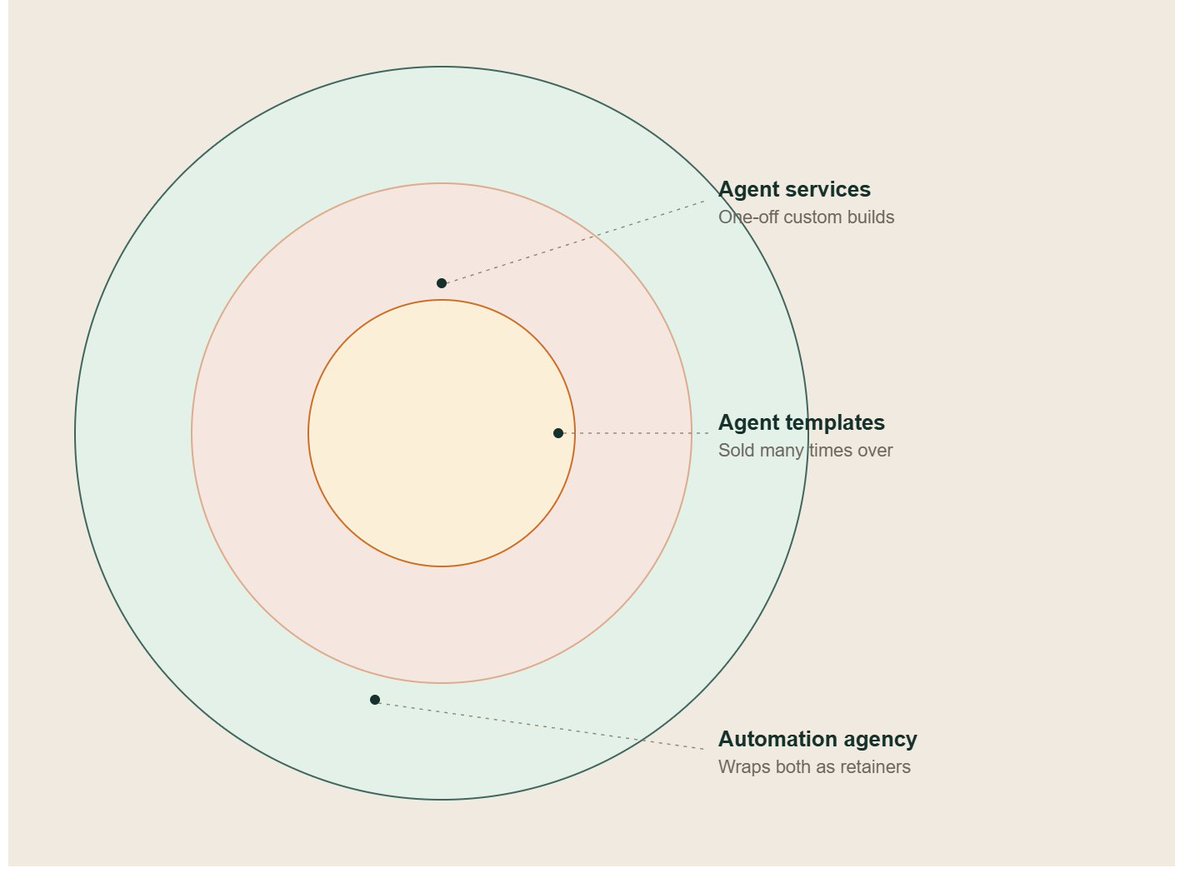
Generated by Thread Navigator
Press ⌘ + S to quick-export