
A free open-source model is running 300 parallel agents across 4,000 coordinated steps from a single prompt, and it scores higher on real research tasks than models you pay 5x more for.

Most people have never opened it.
They open Kimi, type a question, get an answer, close the tab. That's the chatbox. It works. It's also about 10% of what the product does.
>Here's the part most people skip:
The swarm doesn't just run fast. Run it right and it leaves something behind every time - a reusable skill, a sharper spec, a constraint that stops the next run from repeating today's mistake.
The swarm that ran your task yesterday should be smarter than the one running it today.
That's the loop. Kimi does the work and the learning. Opus 4.8 sits at one gate - the verify gate - and its only job is to stop garbage from getting saved as a skill. The engine learns. The closer keeps it honest.
Some people pick one model and marry it. Some chase the top benchmark line. Others wire up LangGraph and spend a weekend debugging a DAG.
The result is usually the same: a workflow that does the exact same thing on run #50 as it did on run #1.
This is not that. This is the complete playbook for a swarm that compounds. 10 steps. Every prompt is copy-paste. Every number is verified.
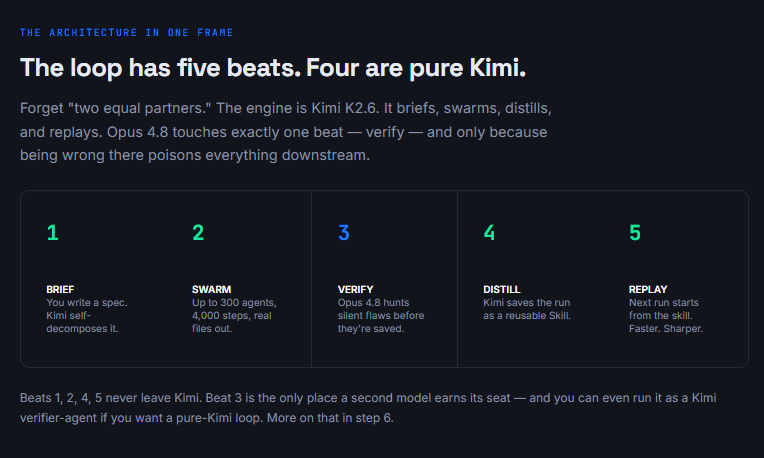
---
Part 1 - Build the loop once. Run it forever.
## 01. Write a spec, not a prompt
When most people hear "300 agents" they fire off a one-liner -"research the fitness app market" - and expect brilliance. That's the fastest way to burn credits and get junk.
A one-line prompt gives the swarm permission to decide everything, and it will decide wrong.
Treat the swarm like a contractor, not a genie. A spec defines what to collect, what counts as valid, which sources are allowed, the exact output format, and what to do on conflict. Here's the part most people skip: Kimi decides the decomposition itself.
You don't build the agents like you would in CrewAI, you don't wire the graph like LangGraph, you don't define structure like AutoGen. You describe the goal - the swarm builds the org chart.
The spec is the single highest-leverage artifact in the whole loop, because in step 4 it becomes the seed of your reusable skill.
Generated by Thread Navigator
Press ⌘ + S to quick-export