Thread Truncated (Cap Enforced)
Only the first 20 tweets are unrolled into slides to ensure reliable PDF exporting and high server performance.
Canvas & Ratio
Choose your destination platform format
Layout Template
Choose a content structure for your slides
Preset Themes
Typography & Sizing
Brand Kit Customization
AGENCYConfigure brand assets for headers & footers
Outro Slide CTA
Customize your closing call-to-action slide
Background Pattern
Build Your Carousel
Drag and drop any post card below onto a slide, or use the quick buttons to insert content/images instantly!

A free open-source model is running <b>300 parallel agents</b> across <b>4,000 coordinated steps</b> from a single prompt, and it scores higher on real research tasks than models you pay 5x more for.

Most people have never opened it.
They open Kimi, type a question, get an answer, close the tab. That's the chatbox. It works. It's also about 10% of what the product does.
> <b>Here's the part most people skip: </b>
The swarm doesn't just run fast. Run it right and it leaves something behind every time - a reusable skill, a sharper spec, a constraint that stops the next run from repeating today's mistake.
The swarm that ran your task yesterday should be smarter than the one running it today.
<a target="_blank" href="https://x.com/i/status/2047190578493096122" color="blue">https://x.com/i/status/2047190578493096122</a>
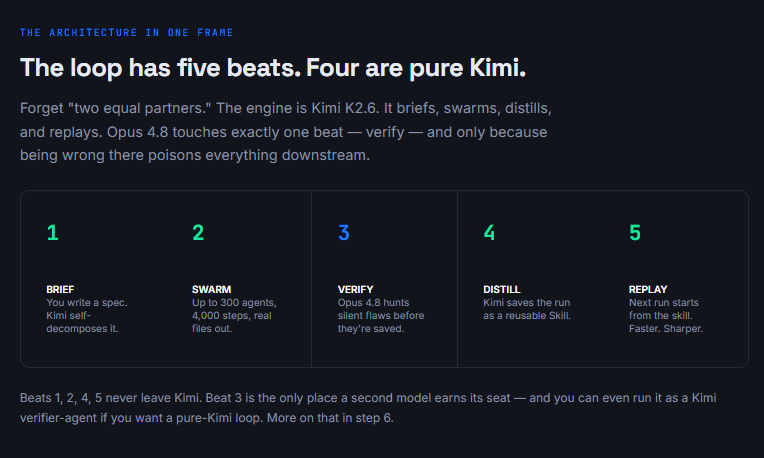
<b><i>That's the loop.</i></b><i></i> Kimi does the work and the learning. Opus 4.8 sits at one gate - the verify gate - and its only job is to stop garbage from getting saved as a skill. <b>The engine learns. The closer keeps it honest.</b>
Some people pick one model and marry it. Some chase the top benchmark line. Others wire up LangGraph and spend a weekend debugging a DAG.
The result is usually the same: a workflow that does the exact same thing on run #50 as it did on run #1.
This is not that. This is the complete playbook for a swarm that compounds. 10 steps. Every prompt is copy-paste. Every number is verified.
---
Part 1 - Build the loop once. Run it forever.
## 01. Write a spec, not a prompt
When most people hear "300 agents" they fire off a one-liner -"research the fitness app market" - and expect brilliance. That's the fastest way to burn credits and get junk.
A one-line prompt gives the swarm permission to decide everything, and it will decide wrong.
Treat the swarm like a contractor, not a genie. A spec defines what to collect, what counts as valid, which sources are allowed, the exact output format, and what to do on conflict. Here's the part most people skip: <b>Kimi decides the decomposition itself.</b>
You don't build the agents like you would in CrewAI, you don't wire the graph like LangGraph, you don't define structure like AutoGen. You describe the goal - the swarm builds the org chart.
The spec is the single highest-leverage artifact in the whole loop, because in step 4 it becomes the seed of your reusable skill.