
Every single result you get from Claude starts with one thing. Your prompt.
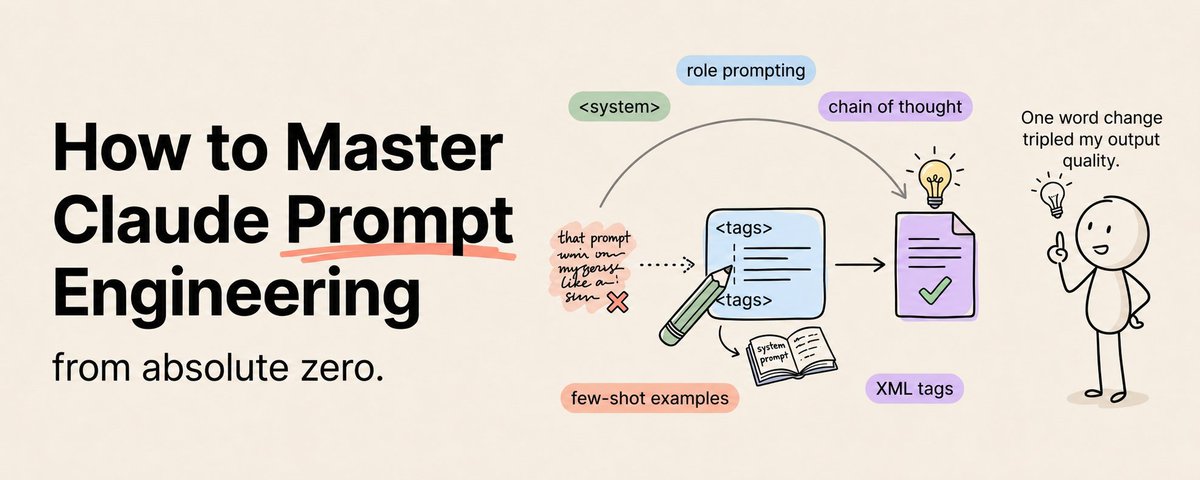
Save this :)
A mediocre prompt produces mediocre output. A precise prompt produces precise output. The model is the same. The subscription is the same. The only variable is how you communicate with it.
And most people are terrible at it.
Not because they are dumb. Because nobody taught them. They type whatever comes to mind, press enter, and hope for the best. When the result is not great, they blame the model instead of the prompt.
Prompt engineering is the single highest-leverage skill in AI right now. It costs nothing to learn. It takes no technical background. And the difference between beginner-level prompting and expert-level prompting is the difference between a tool that "kind of helps" and a tool that transforms how you work.
This is the complete course. Zero to expert. Every technique that matters, explained with examples.
## Level 1: The Foundation (What 90% of People Get Wrong)
The Single Biggest Mistake
Most people write prompts like this:
"Write me a blog post about AI trends."
This is like walking into a restaurant and saying "give me food." You will get something. It might even be edible. But it will not be what you wanted because you did not say what you wanted.
The fix is specificity. Every element you leave unspecified is an element Claude has to guess. And Claude's guesses are not your preferences.
Here is the same request, done right:
"Write a 1,500-word blog post about the three most important AI trends in enterprise software for 2026. My audience is VP-level decision makers at mid-market SaaS companies. Tone should be authoritative but conversational — like a knowledgeable colleague, not a textbook. Include specific company examples and data points for each trend. Open with a hook that challenges a common assumption. Close with three actionable next steps. Do not use phrases like 'in today's rapidly evolving landscape' or 'it's important to note.'"
Same model. Same subscription. Completely different output. The only difference is the prompt.
The Five-Part Framework
Every expert prompt has five components. Miss any one and the output suffers.
1. Role — who is Claude in this interaction? "You are a senior product marketing manager with 10 years of experience in B2B SaaS" gives Claude a perspective to write from. Without a role, Claude defaults to "generic helpful assistant" which is nobody's ideal voice.
2. Context — what does Claude need to know? Your industry. Your audience. Your project. Your goals. The more relevant context Claude has, the more tailored the output.
Generated by Thread Navigator
Press ⌘ + S to quick-export