🚀New paper: Private Delegation of (Non-)Membership Proof Updates in Cryptographic Accumulators
Ever tried to use accumulators in practice? Then you’ve hit the wall: every update breaks everyone’s proofs.
We fix that.
🧵1/n

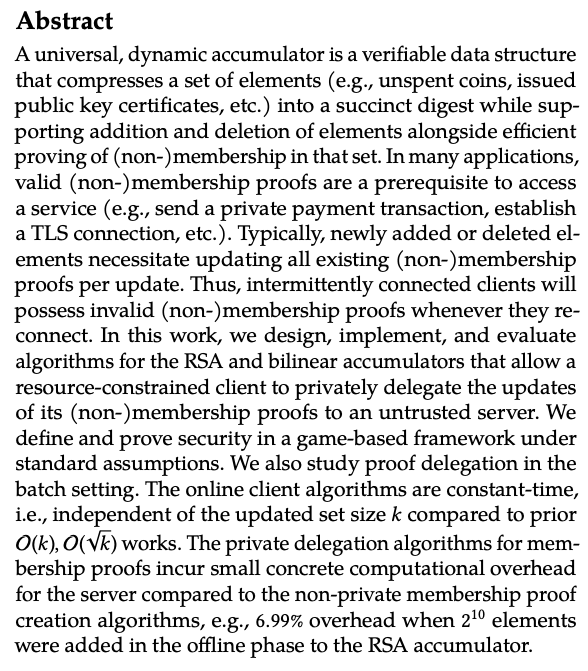

@0xSooki @BotiGlasz 🔥The core problem:
Cryptographic accumulators compress huge sets (e.g., set of unspent coins) into tiny digests.
But… when the set changes:
➡️ ALL membership proofs become outdated
➡️ Clients must recompute them
This kills usability for mobile/offline users.
2/n
Cryptographic accumulators compress huge sets (e.g., set of unspent coins) into tiny digests.
But… when the set changes:
➡️ ALL membership proofs become outdated
➡️ Clients must recompute them
This kills usability for mobile/offline users.
2/n
This isn’t just annoying — it’s fundamental.
Recent lower bounds show:
👉 You can’t avoid frequent proof updates without blowing up the state size.
So the question becomes:
Can we privately outsource (non-)membership proof updates?
3/n
Recent lower bounds show:
👉 You can’t avoid frequent proof updates without blowing up the state size.
So the question becomes:
Can we privately outsource (non-)membership proof updates?
3/n
@0xSooki @BotiGlasz Naively outsourcing fails!❌
If you send your (non-)membership proof to a server:
👉 it can brute-force which element you own.
Privacy = gone.
Even worse in systems like Zcash, anonymous credentials, or key transparency.
4/n
If you send your (non-)membership proof to a server:
👉 it can brute-force which element you own.
Privacy = gone.
Even worse in systems like Zcash, anonymous credentials, or key transparency.
4/n
@0xSooki @BotiGlasz 💡Our idea:
Let clients delegate (non-)membership proof updates to an untrusted server…
BUT:
🔒 without revealing which element they care about
⚡ with constant client work
✅ and publicly verifiable correctness
5/n
Let clients delegate (non-)membership proof updates to an untrusted server…
BUT:
🔒 without revealing which element they care about
⚡ with constant client work
✅ and publicly verifiable correctness
5/n

@0xSooki @BotiGlasz We introduce a new primitive:
👉 Private delegation of accumulator proof updates
Formalized with:
• correctness
• delegation soundness
• (strong + weak) privacy guarantees
6/n
👉 Private delegation of accumulator proof updates
Formalized with:
• correctness
• delegation soundness
• (strong + weak) privacy guarantees
6/n
@0xSooki @BotiGlasz 🧠 Key trick:
Before sending a (non-)membership proof to the server, the client:
👉 blinds it
The server updates the blinded (non-)membership proof
→ learns nothing about the underlying element
7/n
Before sending a (non-)membership proof to the server, the client:
👉 blinds it
The server updates the blinded (non-)membership proof
→ learns nothing about the underlying element
7/n

@0xSooki @BotiGlasz Then:
✔ Server returns updated blinded proof
✔ Anyone can verify the update was correct
✔ Client unblinds → gets valid fresh (non-)membership proof
All without revealing the element x 👀
8/n
✔ Server returns updated blinded proof
✔ Anyone can verify the update was correct
✔ Client unblinds → gets valid fresh (non-)membership proof
All without revealing the element x 👀
8/n
@0xSooki @BotiGlasz ⚡Performance highlight:
Client update cost:
👉 O(1) (constant time!)
Previous work:
👉 O(k) or even O(sqrt(k))
This is a huge win for resource-constrained devices.
9/n
Client update cost:
👉 O(1) (constant time!)
Previous work:
👉 O(k) or even O(sqrt(k))
This is a huge win for resource-constrained devices.
9/n
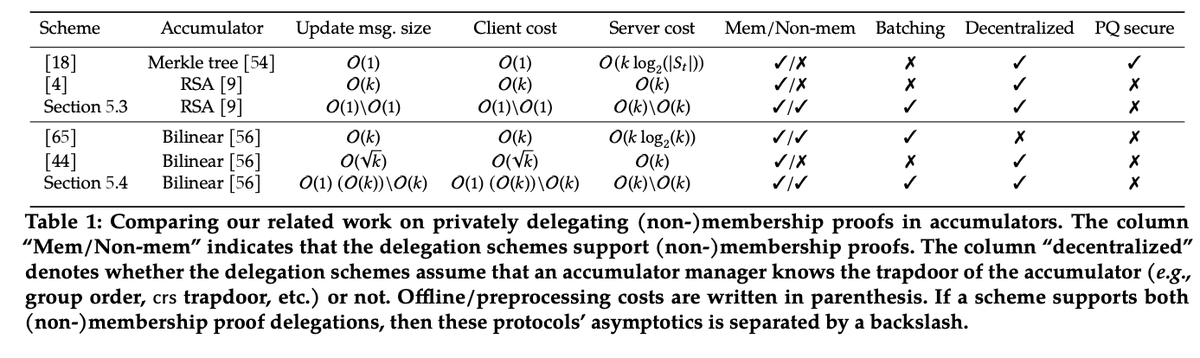
@0xSooki @BotiGlasz 🏗 We build concrete schemes for:
• RSA accumulators
• Bilinear accumulators
Both supporting efficient private delegation for (non-)membership proofs.
10/n
• RSA accumulators
• Bilinear accumulators
Both supporting efficient private delegation for (non-)membership proofs.
10/n
@0xSooki @BotiGlasz For RSA accumulators:
✨ Simple but powerful trick:
Randomize proof → exponentiate → prove consistency with NIZKs
Result:
✔ efficient
✔ practical
✔ ~7% overhead vs non-private baseline
11/n
✨ Simple but powerful trick:
Randomize proof → exponentiate → prove consistency with NIZKs
Result:
✔ efficient
✔ practical
✔ ~7% overhead vs non-private baseline
11/n
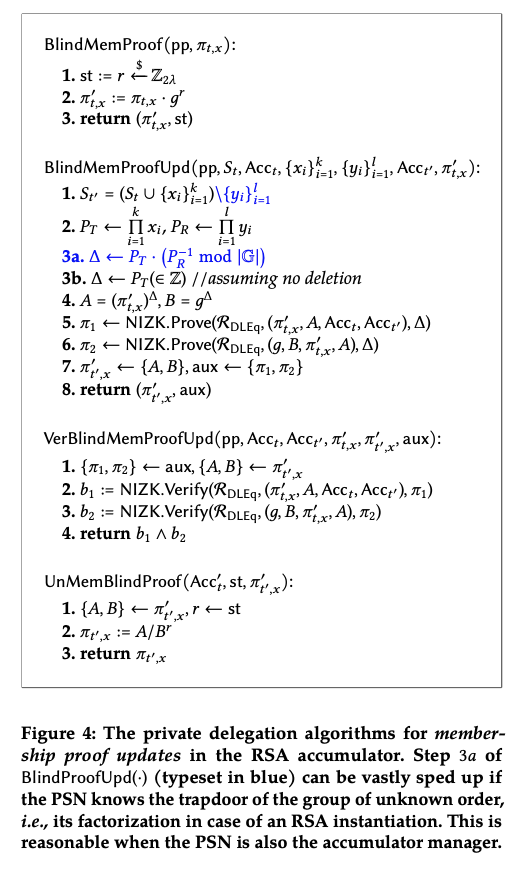
@0xSooki @BotiGlasz We also support:
✔ membership proofs
✔ non-membership proofs
✔ batching of updates
All privately delegated.
12/n
✔ membership proofs
✔ non-membership proofs
✔ batching of updates
All privately delegated.
12/n
@0xSooki @BotiGlasz 🧾 Public verifiability is key:
The server can produce a proof that:
👉 “I updated this correctly”
Anyone can check it.
This enables:
💰 markets for proof-serving nodes.
13/n
The server can produce a proof that:
👉 “I updated this correctly”
Anyone can check it.
This enables:
💰 markets for proof-serving nodes.
13/n
🧠 Why this matters:
Applications include:
• Stateless blockchains
• Anonymous credentials (revocation)
• Registration-based encryption
• Transparency logs
14/n
Applications include:
• Stateless blockchains
• Anonymous credentials (revocation)
• Registration-based encryption
• Transparency logs
14/n
@0xSooki @BotiGlasz Example: stateless blockchains
Without our approach:
👉 you must stay online to keep proofs fresh
With us:
👉 go offline, come back, outsource updates privately
It turns out that running a server for delegating proofs in a stateless blockchain is pretty cheap.
15/n
Without our approach:
👉 you must stay online to keep proofs fresh
With us:
👉 go offline, come back, outsource updates privately
It turns out that running a server for delegating proofs in a stateless blockchain is pretty cheap.
15/n

@0xSooki @BotiGlasz 🧪Bonus:
We built an open-source implementation🔧
👉 First real system for private accumulator proof delegation
3...2...1...Delegate! github.com/GlaszBoti/priv…
16/n
We built an open-source implementation🔧
👉 First real system for private accumulator proof delegation
3...2...1...Delegate! github.com/GlaszBoti/priv…
16/n
@0xSooki @BotiGlasz Open problems, directions
Private delegation for other authenticated data structures: vector commitments, authenticated dictionaries, etc.
Private delegation for PQ-secure accumulators
Multi-server private delegation schemes for better liveness
17/n
Private delegation for other authenticated data structures: vector commitments, authenticated dictionaries, etc.
Private delegation for PQ-secure accumulators
Multi-server private delegation schemes for better liveness
17/n
@0xSooki @BotiGlasz Let us know if you have any comments, feedback, critique, etc.
Tolle, lege: eprint.iacr.org/2026/832.pdf
Q.E.D.
Fin!
18/18
Tolle, lege: eprint.iacr.org/2026/832.pdf
Q.E.D.
Fin!
18/18
Generated by Thread Navigator
Press ⌘ + S to quick-export