Skills make AI consistent.
Spark makes AI competent and a master of specializations, through a mix of recursive self-improvement and collective evolution.
Here's the system that gives agents self-improving mechanisms and collective evolution through real/benchmarked expertise, not just instructions:

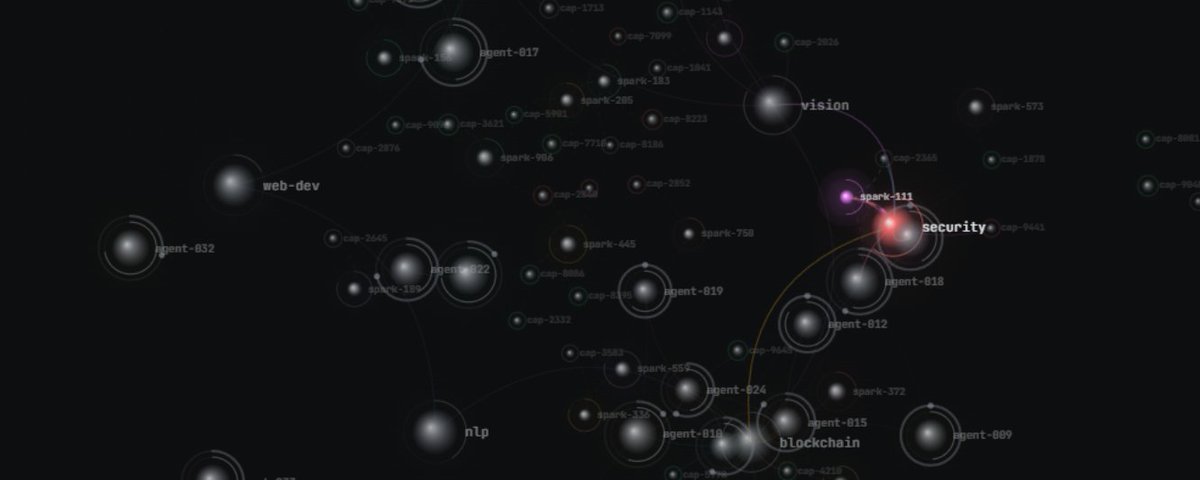
Today's AI gives you a confident speaker. It gives you someone who sounds like they know what they're doing. That may be true or not, and it's hard to tell the difference between the two. AI hallucinates a lot and doesn't always choose the best knowledge or patterns.
They have no mechanism to track what worked, study what failed, or build on accumulated evidence, unless you build specialized tools for this.
They have no mechanism to track what worked, study what failed, or build on accumulated evidence, unless you build specialized tools for this.
That's the gap Spark fills.
Spark is an open-source AI designed to run self-improving flywheels across any category/specialization. This will also come with a collective specialization mastery platform focused on sharing intelligence learned/tested/benchmarked, so agents can grow and evolve together.
It gives AI agents the ability to run structured research, build validated knowledge, share proven insights across a governed network, and improve measurably with every cycle.
It gives AI agents the ability to run structured research, build validated knowledge, share proven insights across a governed network, and improve measurably with every cycle.
This isn't an incremental upgrade to prompting. It's a new category.
And once you see how it works, the current approach of Skills and custom instructions starts to look a bit primitive.
And once you see how it works, the current approach of Skills and custom instructions starts to look a bit primitive.
Let's walk through the full system.
## What people have today (and why it's not enough)
Right now, if you want AI to be good at a specific domain, you have three options.
Option 1: Base LLM training. This is what you get out of the box with ChatGPT, Claude, or any other model. The model was trained on a massive dataset and knows a little about everything.
It's a generalist.
It has no specialized depth in your domain and no way to develop it. Ask it about your specific industry and it'll give you generic advice that sounds smart but misses the nuances that matter.
Option 2: Fine-tuning. You take a base model and retrain it on your specific data. This adds domain knowledge, but it's a one-way door.
The knowledge gets baked into the model weights permanently.
You can't inspect what it learned.
You can't see which specific lessons are driving its outputs.
You can't selectively undo one bad lesson that got mixed into the training data. If something goes wrong, you retrain from scratch.
The entire process is opaque.
Option 3: Skills and custom instructions. You write a set of rules that tell the AI how to behave.
"When evaluating startups, focus on retention metrics." "Always ask about burn rate."
These make the AI more consistent, which is genuinely useful. But they're static. A skill written in January works exactly the same in July, no matter how many times it succeeded or failed in between.
Generated by Thread Navigator
Press ⌘ + S to quick-export