How to build and scale a one-person business with AI:

I'm going to teach you the exact blueprint for running an AI-powered business entirely by yourself - Five lanes of your company producing on autopilot: content, projects, outreach, finance, ads, while you only make the decisions

here's what you're getting:
the two assets
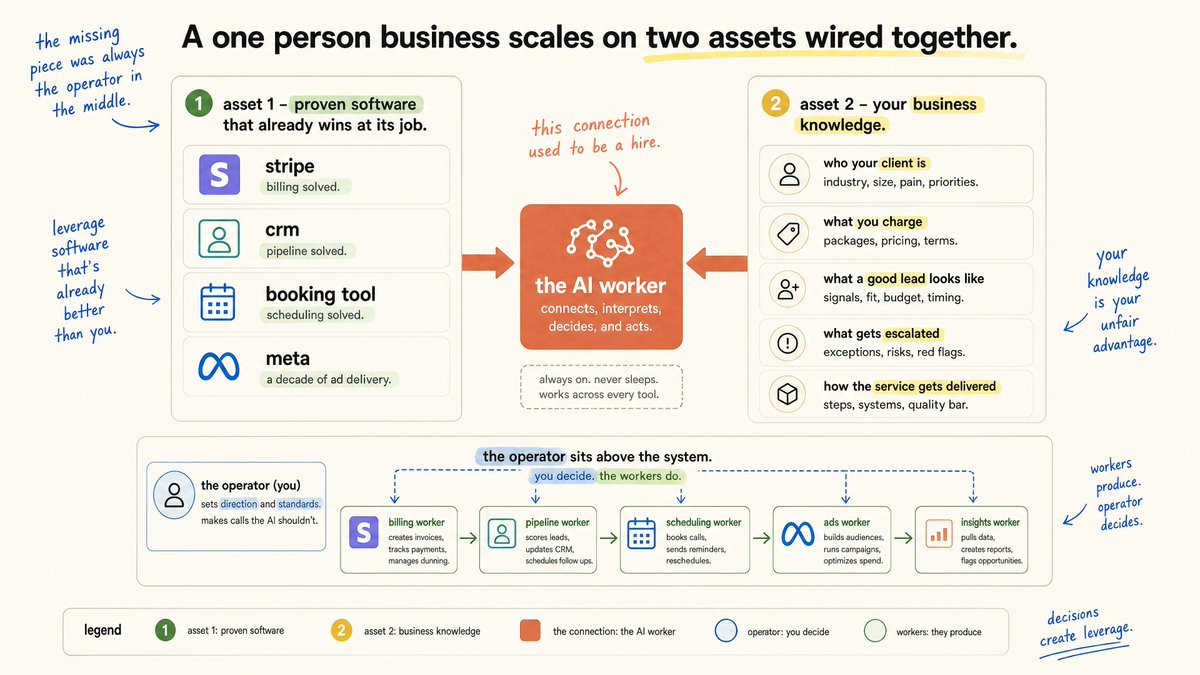
a one person business scales on two assets wired together, and on nothing else
the first asset is software that already wins at its job: Stripe has billing solved, your CRM has pipeline solved, your booking tool has scheduling solved, Meta has a decade of ad delivery baked in
that layer already exists, and the only job left in it is operating
the second asset is your business knowledge: who your client is, what you charge, what a good lead looks like, which requests get escalated, how your service actually gets delivered
the missing piece was always the operator in the middle, the one who knows your business AND runs the software every day, because that person used to be a hire
an AI worker is the connection between proven software and your business knowledge, and that connection used to be a hire
there are two ways to build that connection: out of the box inside the workspace you already use, or by hand, agent by agent
i'll give you the fastest path first... the custom build comes after, for the operators who want to own every part of it
the fastest path: all 5 lanes on Viktor
this thing is genuinely the shortest distance from zero to a working setup
Viktor calls itself an AI employee, and the name is earned in one specific way: it joins Slack or Microsoft Teams as a member of the workspace...
the same office your clients and contractors are already in, so nothing about how you work with people changes
it plugs into the software your business already runs on: thousands of tools through managed connectors, your CRM and ad platform included...
it runs scheduled jobs from a sentence in chat, and it starts free (perfect for setting up our workspace)
the setup, once:
then brief each lane like a colleague... here are the five, copy and fill the [slots]:
lane 1 - content: research what performed on X in the last 14 days around [your niche], real posts with real engagement, note each winner's angle... from that research draft 5 concrete posts and 1 thread on [this week's topic] for a reader skeptical of AI hype... deliver in one organized thread, research first, and flag your strongest draft with a reason
lane 2 - projects: read this channel's context, post a plan for the week: each project, its stage, what ships, the biggest blocker... then every workday at 8:00 post a standup: what moved yesterday, what's due today, what's blocked, under 8 lines... when a status gets posted here, track it without asking
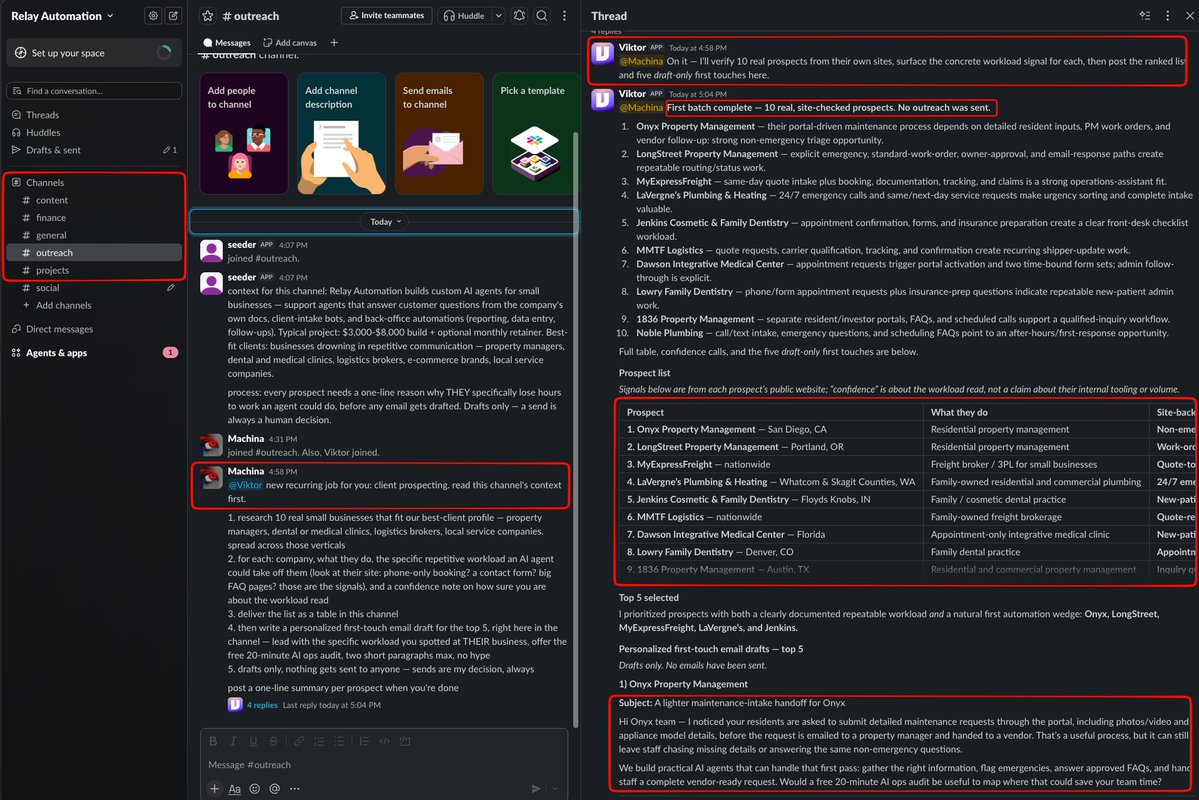
lane 3 - outreach: research 10 real businesses that fit [your client profile]... for each: what they do, the repetitive workload visible on their own website, and a confidence note... draft a first touch for the top 5 that opens with the workload you spotted at THEIR business, two short paragraphs... drafts only, nothing ever sends, sends are my decision
lane 4 - finance: create a draft invoice in [your billing tool] for [client, project milestone, amount], post the link here for review, never finalize... and every friday at 16:00 post a summary: invoices issued, paid, overdue with days outstanding, month to date... under 10 lines
lane 5 - ads: summarize our offer in two lines so i know you understood it... then propose a test media plan: 2 specific audiences, 2 ad angles per audience written for people skeptical of AI, and how you'd split [your daily cap]... after i approve the plan here, build the campaign with everything PAUSED... nothing goes live without my explicit go
the pattern across all five is the same on purpose: context first, named deliverables, a cadence, and a gate on anything that touches money or the outside world
the $100 in free credits at viktor.com covers the whole five-lane build, no card
the custom build: what's under the hood, and when it's worth owning
the custom build buys you total control, your data on your disk, and a system no vendor can change under you... the out-of-the-box build buys you speed, zero maintenance, and an office your clients already understand
plenty of operators land on Viktor precisely because it is plug-and-play and the engineering below is a full project of its own... but the ideas below are worth stealing no matter which side you pick
the mistake that makes handmade setups fragile is one giant assistant with one enormous prompt, expected to do everything
the builds that hold up do the opposite: one agent, one job
a research agent that only researches, a writer that only writes... and a reviewer that is never the author, because an agent grading its own work approves it every time
each specialist is assembled from the same four parts:
keep the identity separate from the memory, always
the identity file is stable so a passing fact can never rewrite who the agent is... the memory is where churn belongs
that separation is the difference between an agent that stays itself over months and one that drifts the first time it saves a bad note

the knowledge base: your business brain
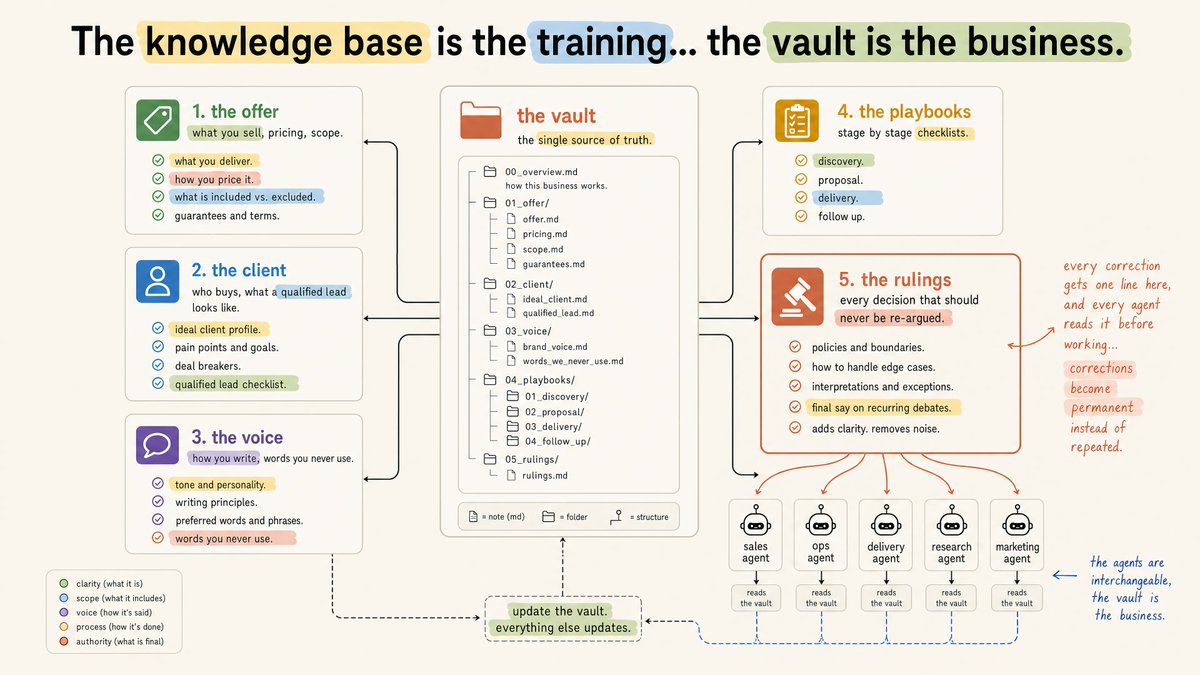
every specialist reads from one shared brain, and the strongest version is embarrassingly simple: a folder of markdown files
an Obsidian vault is the operator favorite here, because it is exactly that... text files on your disk, linked, readable by you and by every agent you run
structure it by what the business knows, one note per fact cluster:
the rulings note is the one nobody builds and everyone needs... every time you correct an agent, the correction gets one line there, and every agent reads it before working
that is how a correction becomes permanent instead of repeated
the knowledge base is the training... the agents are interchangeable, the vault is the business
and this idea transfers straight back to the fastest path: on Viktor, the pinned context message is this vault in miniature, and it deserves the same care
memory: the three levels, and where to stop
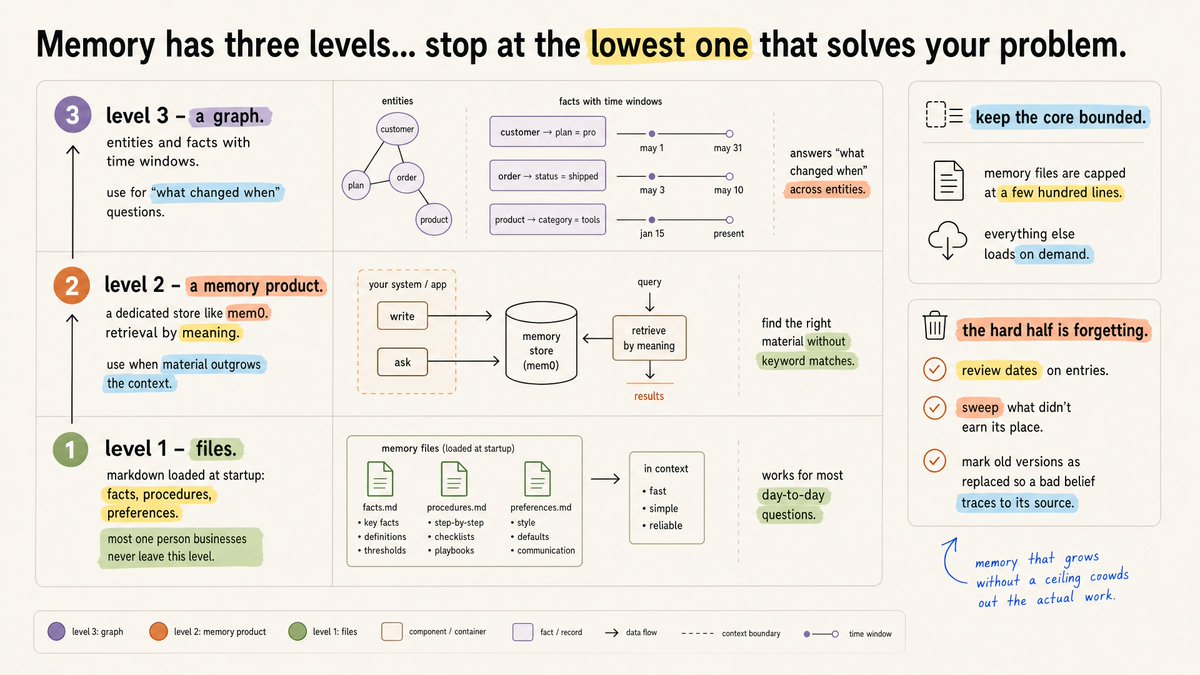
memory is where new builders overspend, so here is the whole field in three levels... you move up only when your problem forces you
most one person businesses never need to leave level 1
keep the always-loaded core small and bounded... the working agents cap their memory files at a few hundred lines and load everything else on demand, because memory that grows without a ceiling slowly crowds out the actual work
and the hard half of memory is forgetting: give entries a review date, sweep what didn't earn its place
when a fact changes, write the new version and keep the old one marked as replaced, so a bad belief can be traced back to its source
one production store logged ten thousand entries in a month and about two hundred were worth keeping... untended memory looks healthy from the outside while it fills with junk
the operating rules: managing a staff that never pushes back
the lanes are the easy half... the skill that decides whether this scales is management, because this is a staff that never pushes back and never flags its own doubt
so the rules below are the counterweight
rule 1 - the brief carries the context: every brief names the deliverable and what done means... a lazy brief produces confident work in the wrong direction, and you will read every word of it
rule 2 - permissions by blast radius: routine internal work runs without asking, and anything that sends or spends waits for your yes... the day the strictness annoys you is the day it saves you
rule 3 - you review, on a schedule: two windows a day to clear the queue of drafts and approvals, because the lanes produce faster than you read
rule 4 - cap the bill before it teaches you: every AI worker meters usage one way or another... so before the first brief, set a hard monthly spend cap, and quote-before-execute goes in every context message

scaling: when to add the next lane
scaling a one person business is one question asked before every addition: did the last lane produce this morning without a prompt from me
the projects lane passes by design... content, the week the drafts stop needing rewrites... outreach, when the confidence column stays honest without you re-checking the sites
then the sequence repeats: write the context, connect the software the lane runs on, brief the work, correct with rules attached, put the sends behind your yes
and your job description changes shape along the way, because the lanes do the producing and you do the deciding
the approval queue becomes the workday: drafts in, decisions out, and every decision writes a line in the rulings note that makes tomorrow's queue shorter
the build sheet
save this block, you will run it once per lane:
skip 4 and you will edit forever, skip 7 and the bill teaches you instead
hiring five people to do all this was only ever the wiring available at the time
and that changed this year
thank you Viktor for sponsoring this piece, get $100 in free credits at viktor.com
start with one lane this week, the one where you lose the most hours, and let it earn the second