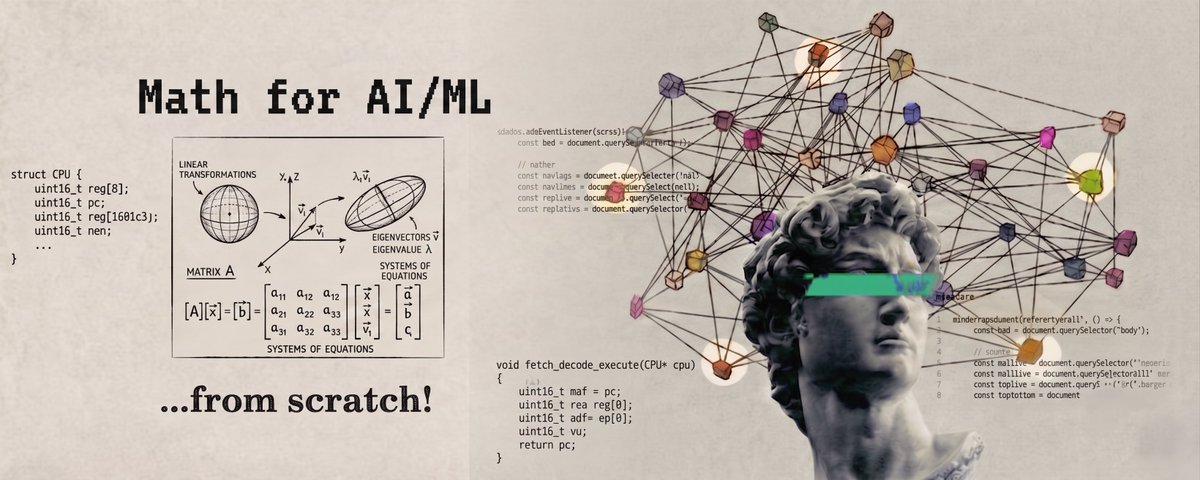
In this article, I’m going to break down the essential math you need for AI and machine learning. I’ll also share the exact roadmap and resources that helped me personally. Let’s get straight to it.
The language of uncertainty, data, and inference
AI/ML systems learn from data that is noisy, incomplete, and uncertain. Probability and statistics provide the formal tools to reason under uncertainty and to extract reliable patterns from samples.
1.1 Populations and Sampling
Population: The full set of possible data points (usually unobservable).Sample: A subset drawn from the population.Understanding sampling bias, representativeness, and variance is crucial for model generalization.1.2 Descriptive Statistics
Mean, Median, Mode: Measures of central tendency.Expected Value: The probabilistic average; foundational for loss functions and risk minimization.1.3 Variance and Covariance
Variance: Measures spread or uncertainty in data.Covariance: Measures how two variables vary together.Leads directly to understanding correlation, multicollinearity, and feature interactions.1.4 Random Variables
Discrete vs. continuous random variables.Probability mass functions (PMFs) and probability density functions (PDFs).1.5 Common Probability Distributions
These define assumptions about how data is generated:
Normal (Gaussian): Noise models, errors, CLT.Binomial: Binary outcomes, classification intuition.Uniform: Non-informative priors and randomness baselines.1.6 Central Limit Theorem (CLT)
Explains why Gaussian assumptions appear everywhere.Justifies many statistical methods even when data is not normally distributed.1.7 Conditional Probability
Probability given partial information.Essential for reasoning, prediction, and causal intuition.1.8 Bayes Theorem
Updates beliefs with evidence.Foundation of Bayesian inference, probabilistic models, and modern uncertainty-aware ML.1.9 Maximum Likelihood Estimation (MLE)
Framework for fitting model parameters to data.Loss functions like MSE and cross-entropy arise naturally from MLE.1.10 Linear and Logistic Regression
Linear regression: Continuous prediction under Gaussian noise.Logistic regression: Probabilistic binary classification.Both are gateways to understanding more complex models.
The structure of data and models
Almost everything in machine learning is a matrix operation. Data, parameters, activations, and gradients are all vectors, matrices, or tensors.
2.1 Scalars, Vectors, Matrices, Tensors
Scalars: Single values.Vectors: Feature representations.Matrices: Datasets, weights, transformations.Tensors: High-dimensional generalizations (deep learning).2.2 Matrix Operations
Addition & Subtraction: Combining signals.Multiplication: Linear transformations and neural layers.Transpose: Shape alignment and symmetry.These operations define forward passes in models.2.3 Determinants and Inverses
Determinant: Volume scaling and singularity.Inverse: Solving linear systems (rarely computed directly in practice, but conceptually important).2.4 Matrix Rank and Linear Independence
Rank determines information content.Explains redundancy, feature collapse, and identifiability.2.5 Eigenvalues and Eigenvectors
Describe invariant directions of transformations.Central to stability, convergence, and dimensionality reduction.2.6 Matrix Decompositions
Used to simplify, analyze, and compress data:
Singular Value Decomposition (SVD): Core tool for numerical stability and low-rank approximation.Principal Component Analysis (PCA): Dimensionality reduction, noise filtering, and feature extraction.
Learning as optimization
Training an AI model is an optimization problem. Calculus explains how models learn, how fast they learn, and whether they converge at all.
3.1 Derivatives and Gradients
Derivative: Rate of change.Gradient: Direction of steepest ascent in high dimensions.Gradients drive learning through gradient descent.3.2 Vector and Matrix Calculus
Modern models are multi-dimensional:
Jacobian: First-order derivatives of vector-valued functions.Hessian: Second-order curvature information.Chain Rule: Backbone of backpropagation.3.3 Fundamentals of Optimization
Understanding loss landscapes is critical:
Local vs. Global Minima: Why training can get “stuck.”Saddle Points: Common in high-dimensional spaces.Convexity: Guarantees optimality and stability (rare but important).
Here’s the roadmap that worked for me.
1. Build Intuition First
Before textbooks, I focused on visual understanding.
3Blue1Brown
Especially:
- Essence of Linear Algebra
- Essence of Calculus2. Structured Courses
Imperial College London – Mathematics for Machine Learning on Coursera
Great for linear algebra and multivariable calculus, taught in a very practical way.3. Statistics & Probability
Khan Academy
Clear explanations and plenty of practice.4. Connecting Math to ML
Excellent for understanding how theory turns into real ML models.
Book: An Introduction to Statistical Learning5. Tying Everything Together
Shows how all the concepts fit together in actual algorithms.
Book: Mathematics for Machine Learning