How to rank #1 on ChatGPT for your competitor's brand name (the alternatives page method)

12 months ago a copycat website launched with a near-identical domain to one of our clients, EssayGrader.
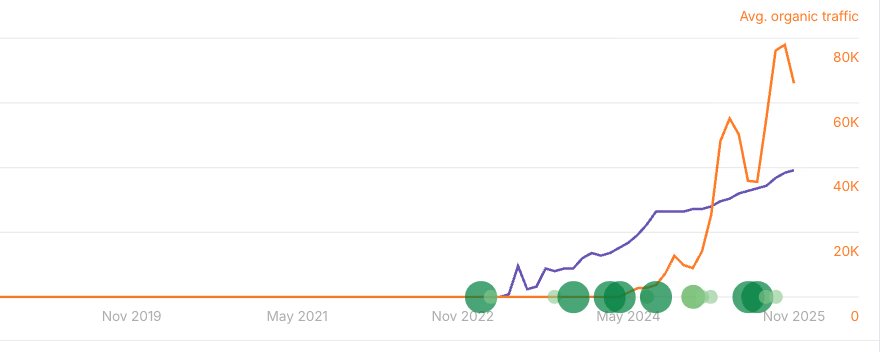
within weeks the copycat was sitting in positions 1-3 for EssayGrader's OWN brand name.
every lead doing due diligence was landing on the wrong site. revenue dropped and their team panicked.
most agencies would have told them to "wait it out and let Google sort it."
we went the other way.
instead of defending their brand, we attacked the copycat's entire keyword footprint with comparison and alternatives pages targeting every category term they ranked for.
12 months later EssayGrader had reclaimed their brand, gone from 3,000 to 77,000 monthly visitors (a 2,467% increase), and one single page ("Magic School AI alternatives") was driving over 5,000 visits a month on its own.

the entire strategy is now one of the most repeatable methods we run for B2B SaaS clients. here's how it works:
The new buyer journey
it doesn't look like 2020 anymore.
then: search Google → open 8 tabs → compare features → demo → buy
now: search the default brand → search "[default brand] alternatives" → pick from the 3 names in the list → demo one → buy
roughly 40% of SaaS buyers now start their research in ChatGPT or Perplexity instead of Google.
and when they do that, the AI engine pulls its answer from whatever comparison pages are already ranking for "[competitor] alternatives" on Google.
own the comparison page = own the AI citation = own the deal.
that's how a single comparison page can outperform 50 blog posts in revenue. it's a double dip on every level.
Why most founders refuse to do this
every category has 3-5 default brands sitting on top of the search volume:
when buyers move from researching to deciding, they stop typing "what is project management software" and start typing things like:
these are the HIGHEST-INTENT queries in the entire category.
someone searching "Asana alternatives" has already decided to switch.
they're not researching anymore… they're picking.
most B2B founders feel weird naming competitors on their own site.
it feels aggressive. so they write 200 blog posts about "what is X" instead and watch their competitors win every decision-stage buyer.
meanwhile ClickUp's homepage literally reads:
"The Asana alternative that gives your team more for less. Join 800,000+ teams using ClickUp."
ClickUp didn't get to a multi-billion-dollar valuation by being shy about naming Asana.
The 3-Step Playbook
Step 1: Find your targets
the goal of this step isn't to write anything yet. it's all about figuring out who your buyers are ALREADY comparing you to.
start with your sales team. list every brand they hear come up in discovery calls:
these are your competitive triggers. the brands your buyers considered before they ever landed on your site.
then pull every keyword they rank for using Ahrefs or Semrush, and filter to bottom-of-funnel queries:
pick your top 5 default brands and start there. don't try to do all 5 at once… work through them in sequence.
Studley AI is a clean example.
when they came to us, they were getting 700 clicks per day, almost all branded "Studley" searches. zero presence on any category keywords.
the default brands in EdTech AI were StudyFetch, StudyAI, and Mindgrasp.
so we mapped every keyword each of them ranked for and built our attack from there.

Step 2: Build the pages
now you write them. one comparison or alternatives page per competitor.
each page should have:
the biggest mistake most founders make?
writing one-sided comparison pages that pretend the competitor has no strengths.
AI engines and real customers both punish dishonest comparisons.
so acknowledge where the competitor genuinely wins on a few specific points… it builds trust and stops your G2 reviews from tanking.
at this stage, also build your own "[category] alternatives" listicle.
your brand at the top, 4 actual competitors listed underneath, all described fairly.
if you don't, G2 or one of those competitors will own that listicle for your category.
Studley used this exact play and within 4 months they were ranking positions 1-5 for "study fetch," "study ai," and "mindgrasp."
outranking the original brands on their OWN brand names.
they grew from $20K to $150K+ MRR in the same window.
Step 3: Rank them
at this point the pages are live, and the job becomes ranking them.
four things you stack:
once the page ranks on Google, ChatGPT and Perplexity start pulling it as a citation source whenever a buyer asks for alternatives to the competitor you've targeted.
you get the double dip:
organic Google traffic AND AI search citations. from the same single page.
a B2B eCommerce software client of ours had been stuck on flat organic traffic for 12 months before they came to us.
we built feature-by-feature comparison pages targeting each of their main competitor's product categories.
inside 12 months:
almost entirely from queries their competitors weren't bothering to address.

another subscription SaaS client (NDA) we work with had fewer than 10 non-branded clicks per day before we ran this for them.
12 months later:

What most people get wrong about SEO
most people still think SEO is about being the loudest and most polished.
it's not.
it's about being PRESENT at the exact moment the buying decision happens.
when you don't build alternatives pages for your category:
that last one is exactly what almost happened to EssayGrader.
every B2B category has roughly a 12-18 month window before this method saturates.
the brands building comparison pages right now will own decision-stage traffic for the next 5 years.
the brands waiting until 2027 will find every category-defining keyword already locked up by someone else.
it's like how early SEO rewarded small affiliate sites before big brands caught on.
or how YouTube creators overtook traditional TV networks because they adapted faster.
or how mobile-first startups beat desktop incumbents when consumer behavior shifted.
the same window is open right now with alternatives pages…
but not forever.
if you want us to build this for your business, book a free discovery call: