Using Claude to go Viral on X… (Mr. Beasts Framework)
Have you seen any of the launches below on your timeline? (you probably have)..

https://x.com/i/status/2060378988606878147
What if I told you they all followed a repeatable viral science that can be 95% automatable with claude.
In this article I will give you the EXACT science of virality, that I’ve used to do 25 of the most viral x launches.
This playbook will teach you how to predictably go viral with 0 luck involved. And it will teach you how to automate 95% using Claude.
I usually get paid $200k to do this from unicorn companies. I’ve taught my framework to billionaire founders, VC’s with bn dollar funds, and publicly traded companies.
I’ve had people launch then go on to raise 100m series C as a direct result of our launch.
I’ve had companies' servers crash because of the demand.
I’ve had sales teams shut off their calendars and have to cancel onboardings.
I don’t say this to brag, I say this to tell you the value of what I will share below can literally change your life, or the trajectory of your company..
(bookmark this, my promise to you is that this will be your most valuable read all day).
Before I begin, Contrary to popular belief: Virality has nothing to do with luck.
It is entirely skill-based. If you don't go viral on a Launch: Your content was not good enough. Period. End of story.
If you disagree with my sentence above, do me a favor and scroll off this article: This article is not for naive people like you.
Mr. Beast agrees. ANYONE who knows content and algo’s will also agree.
How the x Algo works:
X’s incentive is to get you (yes you reading this right now) to spend as long on platform as possible.
In order to do so they want to serve you the BEST content for you that keeps you on platform as long as possible… (this is how they make money, the longer you stay on x the more ads they serve you, the more money they make).
They do this by what is called an algorithm or a system that determines what content to show you.
When you click post on a post X doesn't know whether your piece of content is a phenomenal piece of content that's going to keep people on the platform longer Or a terrible piece of content that's going to get people to scroll off and get off of X.
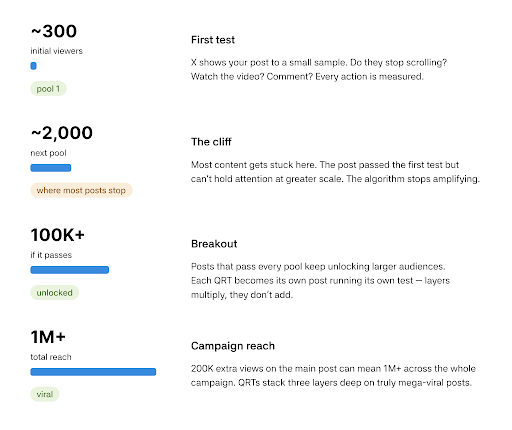
To Determine how good your content is X runs a test. They send your post out to roughly 300 people. This is called a sample test
What these 300 people do is closely watched. Do they stop scrolling? Do they watch the video all the way through? Do they comment?
If your post gets people to do any of these actions enough times you pass the test
Then you get sent to the next pool with around 2,000 people. where this test runs again. This is where a lot of content gets stuck. I personally have posts stuck at 2,000 views. This is because the post was simply not engaging enough.
The algorithm is grading what percentile your content sits in. One standard deviation above average gets you one outcome. Two deviations will get you an even bigger outcome.
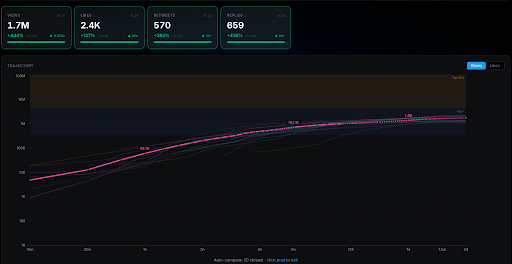
These are the stats for one of our launches:
Hour one closed at 60,000 views.
Hour two, almost 400,000.
Hour four, crossed a million.
There was a 100k to 500k jump in an hour, the post passed every test and kept unlocking a bigger audience. This is because we were passing sample tests and our content was deemed as an outlier.
Understand the difference between Paid attention and Earned Attention
Before we go further, understand this
Paid attention is bought. A TV spot, a YouTube pre roll, a billboard, you pay for the slot, and the audience is captive. They can't skip you, or they have to sit through you to get to whatever they actually came for.
Earned attention is the opposite. Nobody is paying to put you in front of anyone.
On X, someone is scrolling their feed and you have to earn every single second from scratch. They owe you nothing, and they're one thumb flick from gone.
That difference changes everything.
A captive audience can't leave, so you can afford a slow build, you can warm them up, set the scene, get to the point in your own time.
Earned attention gives you no such luxury. You win the first three seconds or you lose them. Simple as that.
One time, a client came to us with a finished launch video from a studio whose work you have definitely seen. Expensive. We told them it wouldn't perform, and they were upset, understandably.
But the video was made for captive attention. It was a beautiful video but It didn't earn the click, and it didn't pay off fast.
Thankfully they trusted us, we rebuilt the launch around earned attention, and the results blew their minds.
Everything below follows from this. You're lucky to get the click, so act like it.
So the rule for everything you put out on launch day:
Lead with the strongest claim, the strongest outcome, or the strongest tension. Every time.
The 4 things every viral launch needs to pass the test
Every launch that breaks out has these four common elements.
Note : It has to have ALL four elements. Skip even one and you reduce your probability of going viral.
Now I'll dive deep into each one of them and show you exactly how founders blow it, and exactly what the winners do instead.
1. A bold claim
Bad founders write: "We're launching the world's smartest AI tutor." Or the world's smartest anything
Here's a reality check : nobody cares.
Good operators write: "AI is killing kids' ability to think. We built the tutor that makes them geniuses." Or, like one of our launches: "We raised $7.5M to kill AI slop."
See the difference?
You want to take a position on something happening to the whole world, and then have the product ride inside it.
"Kill AI slop" is a fight the entire timeline has an opinion on. Opinions are engagement.
Rule: Your claim has to be bigger than your product.
Attach it to a conversation people already care about. If the claim only lands with people already deep in your niche, it's too niche to go viral.
(On open loops, people always ask. We don't really use them. The claim IS the loop. "The world's first AI head of growth that scales brands better than any human" is almost unbelievable on purpose. That's what holds people: they stay to find out how it could possibly be true.)
2. Immediate dopamine
Bad founders will open their launch video with a fancy cinematic intro, a logo animation maybe and a clip of the founder talking for 12 seconds before anything else happens.
Good operators show the wildest, coolest part in the first few seconds without any build up.
Look at your retention curve.
The steepest drop off is ALWAYS in the first seconds, then it flattens, and once someone survives that cliff they tend to stay.
MrBeast opens every single video with the most insane thing in it for exactly this reason.

We learned this the expensive way, with a cinematic open on one of our own launches.
Same mistake every time: a clever artsy hook instead of the payoff.
Rule: If the coolest thing in your video happens at second 38, most people will never see it.
3. No context gaps
One of the biggest launch mistakes is Context Jumps
A context jump is when your copy assumes the viewer can bridge the inference themselves.
Bad founders assume the viewer already knows the category, the pain, the workflow, and the stakes. They live inside their market, so they forget the viewer just arrived.
Good operators spell out the problem in plain English before they ever mention the product. Here's the problem. Here's what it costs. Here's what we do about it.
If they don't already know what those problems are, the jump loses them. Lay the bridge.
Rule: If your mom can't understand the first 10 seconds, the market won't either.
4. The strongest possible outcome
Bad founders sell: "Save five hours a week." Time is almost always the weakest motivator. It books zero demos on its own.
Good operators sell: "Scale from $1M to $10M a month without hiring a growth team." Money is a primary motivator
Rank every outcome your product creates and lead with the top of the list. And this goes past money vs time, the ecom world runs this better than tech does.
Selling hair loss supplements? "Your hair will look better" is weak. The strong version sells the moment the girl who rejected you looks twice.
Crude, sure. It's also the actual motivator, and copy that pretends otherwise loses to copy that doesn't.
Rule: Never sell the feature. Sell the destination.
Why quote tweets turn one post into a distribution network
I'm not exaggerating when I say this : Quote tweets can make or break your launch.
It's sad to see most founders play this completely wrong - they treat them as some sort of social proof. They're not. Each quote tweet is literally GOLD, it's a brand new distribution node.
Zoom out and think about this for a second. When a launch starts working, people quote tweet it. Then people quote tweet the quote tweets. Then those get quote tweeted.
Every single layer is its own post taking its own sample test (remember the 300 → 2,000 → next pool from above?), and the algorithm boosts all of them because the original is performing.
Your launch is not one post. It's a big network of posts compounding on each other.
When we did the launch for Tempo, Jason Wallen quote tweeted the launch with three words: "this is sick."
That QT did 790,000 impressions. I hope you're realising how insanely powerful this is.
Three words. That's what a QT from the right person can do.
https://x.com/i/status/2056839227225084374
For your next launch, keep this in mind :
200,000 extra views on your main post can add up to a MILLION views across the whole campaign.
More eyeballs on the main post means more quote tweets. More quote tweets means more layers. And the layers MULTIPLY each other instead of adding.
Don't just wait and hope that people quote tweet you. Engineer it before you ever hit post. Make it fucking happen :
The best launches are designed so the right people know exactly what they're going to quote before the post even goes live.
What to do BEFORE you launch (this is the source code):
Everything above gets engineered before you launch, from real market research.
This is where most launches die and it's the part nobody wants to do.
The trap is writing for yourself. You assume you know what the audience cares about because you imagine what you'd care about.
https://x.com/i/status/2060378988606878147
If I'd written Brilliant's launch from my own head, it would have flopped. I'm not a parent. I don't live inside the school system.
The line that carried that launch, "right now AI is killing our kids' ability to think when it should be making them geniuses," came from research into what parents and tech people were already angry about.
The client was nervous about that line, by the way. It pushed the envelope. Without it, the launch doesn't go anywhere near as viral.
So do the actual work. Before you write a single line of your launch, find:
Then build the launch around the conversation that already exists. Pre-plan who's going to quote tweet you and exactly what angle they'll take.
Get tactically specific. Give them a named, dated, verifiable fact.
Trust me on this, that riles people up ten times harder than a vague one. And riled up people share.
And here's where Claude does the heavy lifting.
The market research : what people love, what they hate, the language they use, the angriest threads in your niche, claude can pull and synthesize most of it.
The polarizing-but-true claims, the hook variations, the QT angles you hand your seed list: all draftable.
You're not asking it to "write a tweet." You're feeding it the research and having it pressure test 30 versions of a claim so you pick the one that breaks out.
That's the 95%. The 5% is your taste and the final call.
What to do DURING launch:
Once the post is live. DO NOT disappear. That's a mistake, the first hour is where the whole thing is decided.
The first hour after posting is the SACRED HOUR. Stay Active and fuel the launch.
What to do AFTER launch:
Once something starts working, you're not done.
A viral launch is the most valuable creative asset you'll ever make, Don't waste it. Turn the best replies and QTs into follow up posts.
That's the surface area. That's the science.
The actual work is turning all of this into scripts, hooks, claims, QT angles, and launch sequencing and that's the part you can automate with claude.
We built a prompt pack we use internally at Shown Media to pressure test every launch script before it goes out. If you want it, comment "SCRIPT" and I'll send it over. (You'll have to follow me so I can DM you.)