Why Investors Are Forced to Buy Equities: The Macro Constraints...

Capital Flows@Globalflows
21 views
Jul 01, 2025
~4 min read
1
Why Investors Are Forced to Buy Equities: The Macro Constraints That Create Melt-Ups
When liquidity rises and growth improves, capital isn’t free to go anywhere—it’s forced into equities by structural constraints. Melt-ups aren’t a choice. They’re a function of flows.🧵👇
When liquidity rises and growth improves, capital isn’t free to go anywhere—it’s forced into equities by structural constraints. Melt-ups aren’t a choice. They’re a function of flows.🧵👇
2
Macro liquidity is defined by the quantity of money in the system and the level of interest rates. As it interacts with growth and inflation, it determines the return profile for every asset. When liquidity expands, capital is mechanically pushed out the risk curve—because in a world of abundant money, capital is forced to chase the highest return.
3
Macro liquidity is WHY the price to sales ratio is back at 2021 levels and significantly elevated above its historical trend.

4
Valuations aren’t inherently good or bad—they’re simply a reflection of liquidity conditions. When liquidity is abundant, assets reprice higher. What looks like an expensive valuation is often just the market’s way of discounting future cash flows under easier financial conditions. Your view isn’t really about valuation—it’s about liquidity.
5
Imagine liquidity as oil in a pipeline. When central banks inject liquidity (QE, rate cuts, balance sheet expansion), the pipeline floods—money has to flow somewhere.
Just like in commodities, where rising demand and constrained supply push prices up, liquidity expansion creates excess demand for return and a scarcity of safe yield. So capital is forced out the risk curve:
From cash → to Treasuries
Treasuries → to credit
Credit → to equities
Equities → to small caps, EM, crypto, venture
Just like in commodities, where rising demand and constrained supply push prices up, liquidity expansion creates excess demand for return and a scarcity of safe yield. So capital is forced out the risk curve:
From cash → to Treasuries
Treasuries → to credit
Credit → to equities
Equities → to small caps, EM, crypto, venture
6
Each step is not discretionary—it’s a systematic reaction to the need for higher returns in a world of declining opportunity.
Now reverse it.
When liquidity contracts (QT, rate hikes, rising real yields), it’s like draining oil from the pipeline. Capital is pulled back toward safety, not by fear but by math—yields improve, risk premia widen, and investors are rewarded for moving back up the curve.
It’s the same principle as a commodity market:
– When supply (liquidity) surges, capital chases scarce return
– When supply tightens, return becomes concentrated in safer assets
Liquidity is the invisible hand moving capital like a commodity trader moves inventory—it’s not opinion, it’s flow mechanics.
Now reverse it.
When liquidity contracts (QT, rate hikes, rising real yields), it’s like draining oil from the pipeline. Capital is pulled back toward safety, not by fear but by math—yields improve, risk premia widen, and investors are rewarded for moving back up the curve.
It’s the same principle as a commodity market:
– When supply (liquidity) surges, capital chases scarce return
– When supply tightens, return becomes concentrated in safer assets
Liquidity is the invisible hand moving capital like a commodity trader moves inventory—it’s not opinion, it’s flow mechanics.
7
So, WHERE are we right now, and how can we connect this to markets?
First, there is a clear movement of capital OUT the risk curve in markets. The lowest quality companies in indices like the Russell are rallying off their lows with a ton of momentum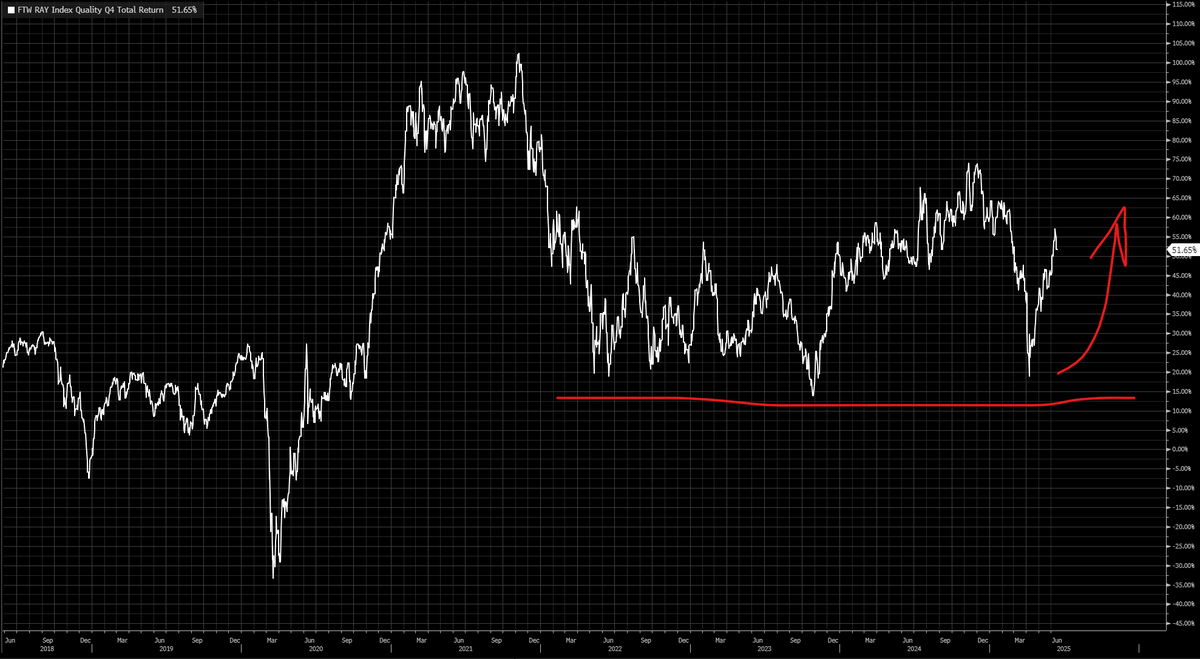
First, there is a clear movement of capital OUT the risk curve in markets. The lowest quality companies in indices like the Russell are rallying off their lows with a ton of momentum
8
Why? because as I laid out in this thread, everyone bet on a recession and realized they were wrong in a major way. Imagine coming into your boss and telling him you sat in cash while the entire market melted up? Youd be fired immediately which is why managers HAVE to put money to work.
x.com/Globalflows/st…
x.com/Globalflows/st…
9
Second, you will notice that signals on the farthest end of the risk curve are beginning to clearly show that capital is plentiful.
x.com/1MarkMoss/stat…
x.com/1MarkMoss/stat…
10
Third, the consumer is taking out debt and spending a ton of money right now. This is not something you see in a recession. When the consumer makes money like this the result is more of their incomes go into 401ks.
x.com/Globalflows/st…
x.com/Globalflows/st…
11
Where do 401ks go? passive vehicles that indiscriminately buy the index
Passive flows continue to take a massive share of asset markets every single month: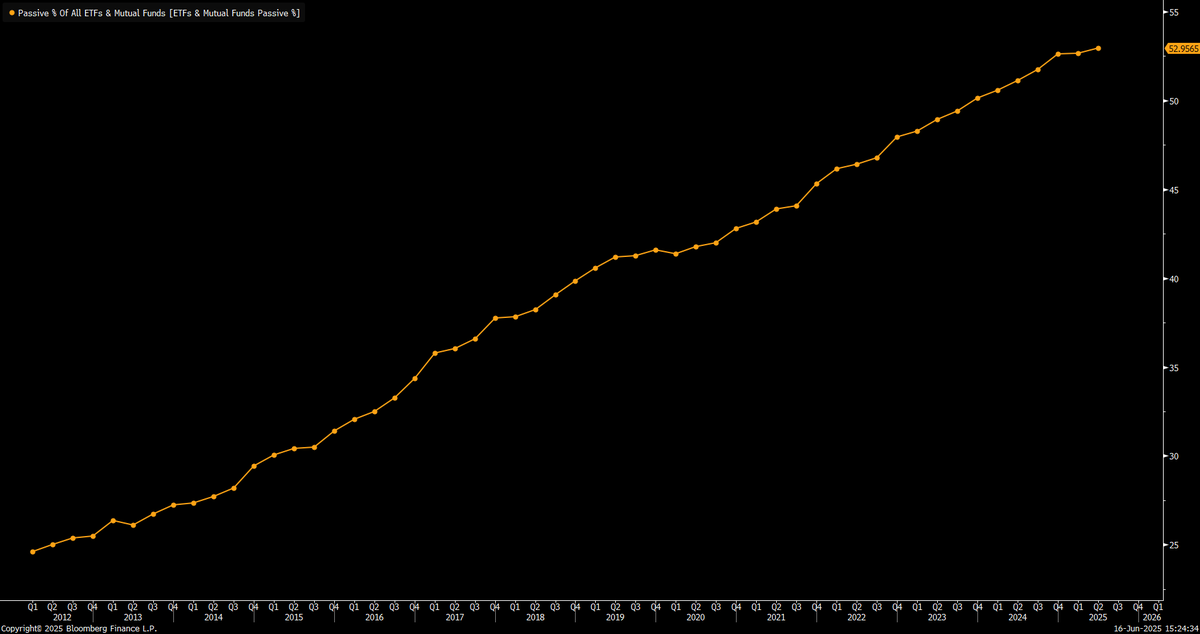
Passive flows continue to take a massive share of asset markets every single month:
12
As the US economy remains strong, the Fed is falling behind which is further amplifying the liquidity impulse. The chart below shows that the Fed's rhetoric (white line) is deviating from long term interest rate. The implication is that when the Fed is more dovish than they should be, liquidity expands because money is cheap relative to where growth and inflation are.
x.com/Globalflows/st…
x.com/Globalflows/st…
13
As @EconstratPB has noted, the deficit is adding fuel to the fire and accelerating this entire process that pushes capital out the risk curve:
x.com/EconstratPB/st…
x.com/EconstratPB/st…
14
And on top of this, you have the @realDonaldTrump family heavily invested in companies that are primed to benefit from a melt up scenario. @LastBearStandng laid this out incredibly well in his recent article:
x.com/LastBearStandn…
x.com/LastBearStandn…
15
And the entire trend of Bitcoin becoming a treasury asset is already attracting people who are taking advantage of people
x.com/WClementeIII/s…
x.com/WClementeIII/s…
16
As I laid out in this video we are seeing asset markets, interest rates, the Fed, and underlying economy all converge to create a massive melt up scenario because liquidity is expanding
x.com/Globalflows/st…
x.com/Globalflows/st…
17
The best way to benefit from this is to own assets on the far end of the risk curve until they begin underperforming lower risk assets.
18
19
20
21
I will be publishing a report further breaking down the opportunities in this regime because they are truly rare. The problem with these regimes is they move so fast to the upside and then they sow the seeds for their own demise. This is why melt ups always end with crashes.
22
For now, we are in the regime where capital is moving out the risk curve and nothing is going to stop it.
x.com/Globalflows/st…
x.com/Globalflows/st…
23
I will be breaking this down further in a report today for everyone: capitalflowsresearch.com
@Globalflows
@Globalflows
24
Here we go